I learnt at the Australian Productivity Commission that the first law of public policy development is plagiarise, plagiarise, plagiarise. Why be original? Copy the successes of others, improve upon them, but do not repeat their failures, just learn from them.
I developed this policy insight from my experience at the Productivity Commission with a smart-arse Commissioner – that was the chairman’s private description of him in a conversation with me, not mine.
This Commissioner with whom I had countless arguments would respond to the many US studies I had marshalled by always asking for Australian evidence – what is the Australian evidence?
He knew that there was no Australian data or studies so he could slow the whole policy process down through this appeal to data chauvinism. The Americans are swimming in data and that is before you get to their cross-sectional data with 50 states.
Ever since then, I regarded data chauvinism – the request for Australian evidence and studies or New Zealand evidence and studies – as a stalling tactic designed either to defend the status quo.
By and large, all the local evidence shows when it augments the US studies is how a local regulation or tax screws things up further. Local evidence rarely served the interests of my opponents who were fighting against deregulation or privatisation.
It is a good public policy – you are much more likely to implement a proposal or act on a particular empirical study – if there are half a dozen to a dozen overseas studies preferably in several different countries showing much the same thing. Beware the man of one study. Milton Friedman (1957) rightly preferred to emphasize the congruence of evidence from a number of different sources and with due attention to the quality of the data:
I have preferred to place major emphasis on the consistency of results from different studies and to cover lightly a wide range of evidence rather than to examine intensively a few limited studies.
The role of empirical evidence is to resolve disagreements – to bring people closer together. One study in one country rarely does that. Many studies in many countries about the same topic of controversy is far more persuasive.
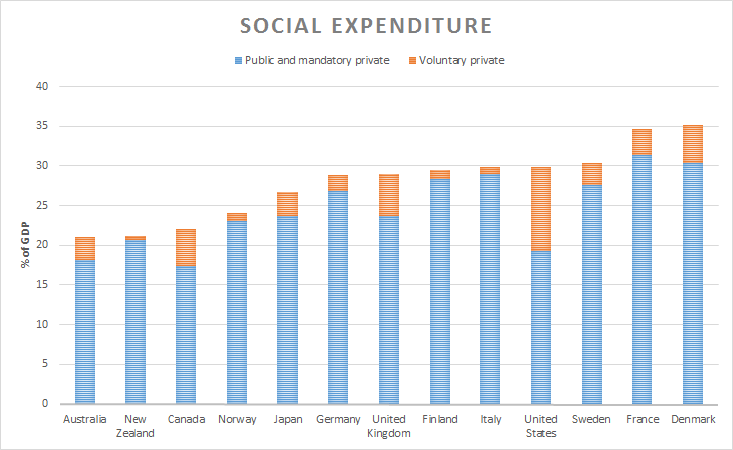
Mandatory and voluntary private social expenditure makes a big difference to the degree of social insurance in some countries but not others. The calculation of these numbers in purchasing power parity would be much more interesting.
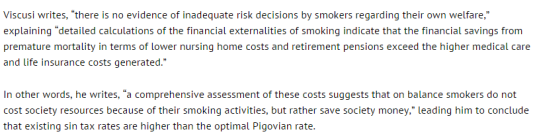
It will be a slow train coming before the Morgan Foundation calls for a cut in the tobacco tax because the optimal Pigovian tax on it is already too high from the perspective of externalities or the burden on the public health budget.
I think smoking is disgusting and unhealthy but that does not give me the right to regulate the disgusting habits of others. Where would I start in regulating risk-taking? I would have to start with swimming, tramping and biking. They are all high-risk activities of the self-righteous? Not everything others do that I do not like causes an externality.
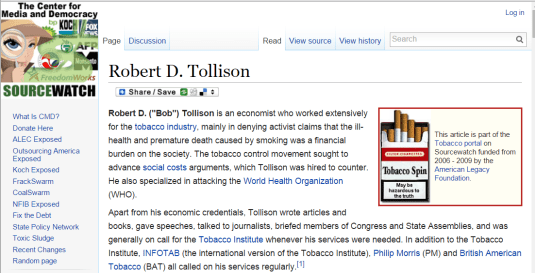
Few economists work on the economics of smoking other from the starting point that it should be reduced. Those that do not share that starting point such as Robert Tollison, Gary Anderson and William Shughart are subject to relentless personal abuse. They are immediately denounced as the paid whores of the tobacco industry.
That was one of the reasons I got interested in the economics of smoking. There must be something in the case made by Robert Tollison and others questioning tobacco taxes if the first line of argument against them is you are saying that because someone paid, you low down dog.
In common with New Zealand, Maine found that a number could not complete work requirements because they could not get time off work from their off the books job.
Lindsay Mitchell found through Official Information Act requests that one in 10 beneficiaries are working full-time and one in 5 have no intention of looking for a job in the next year despite a requirement to actively look for work as a condition of receipt of their benefit.
Despite all the passions about the TPPA, the correct starting post for an economist on regional trade agreements is lukewarm opposition. That is the position of Paul Krugman. Paul Krugman summarised the TPPA well recently from a standpoint of a professional economist:
I’ve described myself as a lukewarm opponent of the Trans-Pacific Partnership; although I don’t share the intense dislike of many progressives, I’ve seen it as an agreement not really so much about trade as about strengthening intellectual property monopolies and corporate clout in dispute settlement — both arguably bad things, not good, even from an efficiency standpoint….
What I know so far: pharma is mad because the extension of property rights in biologics is much shorter than it wanted, tobacco is mad because it has been carved out of the dispute settlement deal, and Republicans in general are mad because the labour protection stuff is stronger than expected. All of these are good things from my point of view. I’ll need to do much more homework once the details are clearer.
Krugman then reminded that a trade agreement is most politically viable when it is most socially harmful. This is the point that the opponents of the TPPA miss. They will not want to discuss how some trade agreements are good deals but others are bad. That would admit that trade agreements can be welfare enhancing, and sometimes they are but sometimes not.
The correct economic name for free trade agreements is preferential trading agreements. These agreements give tariff and other preferences to some countries over others.
Tariffs are lower for the members of the agreement, creating more trade, but there is also trade division.
CER offers a neat example of trade diversion. Instead of buying cars from the cheapest source and collecting tariff revenue, the hopelessly inefficient Australian car industry did not have to pay tariffs so it made New Zealand into a major export market until tariffs were abolished in 1998.
Less tariff revenue because of CER but we still paid way over the odds for Australian instead of Japanese cars. We were worse off. Less tariff revenue but car prices pretty much as high as before.
New Zealand tariffs are minimal these days. The TPPA reduces the key tariffs on our exports at an excruciatingly slow pace.
There is no discussion of trade diversion in the National Interest Analysis before this committee. For that reason alone, the National Interests Analysis is inadequate and should be returned to the Ministry for further work. Right now, it would not pass a first semester test in a basic international economics course because that most basic risk from trade agreements is not discussed.
Most of the TPPA is not about tariffs. Many of these other chapters are suspicious add-ons to trade talks.
Developing countries rightly regard trade and environment clauses in any trade agreement as a new form of colonialism.
Unions, the Labour Party and Greens happily demand these intrusions into the regulatory sovereignty of developing countries to protect special interests against import competition.
The sovereignty objections to trade agreements are no different to those that can be made to climate change treaties and International Labour Organisation conventions. It is all in the details – what do we get in return?
Consistency would help too. Trade agreements should not include labour or environmental standards as they, for example, limit our right to deregulate our labour market. Be careful for what you wish for when you oppose international agreements on sovereignty grounds.
The intellectual property chapters of the TPPA are truly suspicious. With each new day, the case for patents and copyrights is weakening in the economic literature. Some have made powerful arguments to abolish patents and copyrights altogether.
There are modest extensions of the term limits of drug patents and much more mischief on copyright terms. These should be watched carefully in future trade talks and one day will be a deal breaker.
Good arguments can be made against investor state dispute settlement provisions even after the carve-outs. These provisions have no place in trade agreements between democracies.
Foreigners can take their chances in democratic politics like the rest of us. They might occasionally get a short deal because of left-wing or right-wing populism but these gusts of xenophobia are mostly an occasional irritant in the rich fabric of Western democracies.
Developing countries sign-up to investor state dispute settlement to signal they are open for business. Foreign investors do not have to put up with their corrupt courts and bureaucracies and hopelessly venial politicians.
The logic of regional trade negotiations is we cut tariffs we should have cut long ago in return for others cutting their tariffs which they too should have cut long ago.
Much is made of the cost-benefit analysis of the TPPA. All the critics are really saying is cost benefit analysis is really hard and often imprecise.
If the econometric estimates were not in doubt in this or any other public policy field, the academics are simply not trying hard enough to win tenure and promotion. Academics make their careers by being contrarian.
For this lukewarm opponent of regional trade agreements, the TPPA is a so-so deal with small net gains. There is no harm in signing it.
Why Evolution is True is a blog written by Jerry Coyne, centered on evolution and biology but also dealing with diverse topics like politics, culture, and cats.
“We do not believe any group of men adequate enough or wise enough to operate without scrutiny or without criticism. We know that the only way to avoid error is to detect it, that the only way to detect it is to be free to inquire. We know that in secrecy error undetected will flourish and subvert”. - J Robert Oppenheimer.
 Ever since then, I regarded data chauvinism – the request for Australian evidence and studies or New Zealand evidence and studies – as a stalling tactic designed either to defend the status quo.



 Utopia, you are standing in it!
Recent Comments