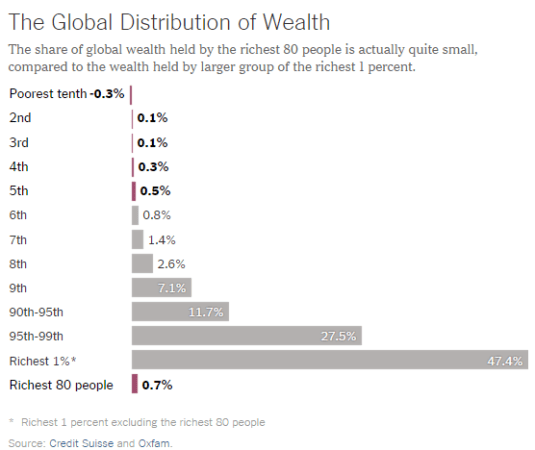
Source: We Can’t Blame a Few Rich People for Global Poverty – The New York Times.
Celebrating humanity's flourishing through the spread of capitalism and the rule of law
19 Jan 2016 1 Comment
in applied welfare economics, development economics, growth miracles, politics - New Zealand, politics - USA, poverty and inequality
Source: We Can’t Blame a Few Rich People for Global Poverty – The New York Times.
18 Jan 2016 Leave a comment
in applied price theory, applied welfare economics, comparative institutional analysis, constitutional political economy, economic history, economics of regulation, politics - New Zealand Tags: Roger Douglas, Ruth Richardson
16 Jan 2016 Leave a comment
in applied welfare economics, energy economics, environmental economics, global warming

SOURCE: Table 10.B.1, IPCC WGII AR5, p. 82 via
14 Jan 2016 Leave a comment
in applied welfare economics, economics of education, politics - New Zealand, politics - USA, poverty and inequality, welfare reform
There is a large literature on what money can buy in terms of improved child outcomes. Central to the left-wing view is the poorer are just like everyone else but they have less money. Susan Mayer, a proud registered Democrat all her life, kick-started the literature challenging this with her book in 1997.
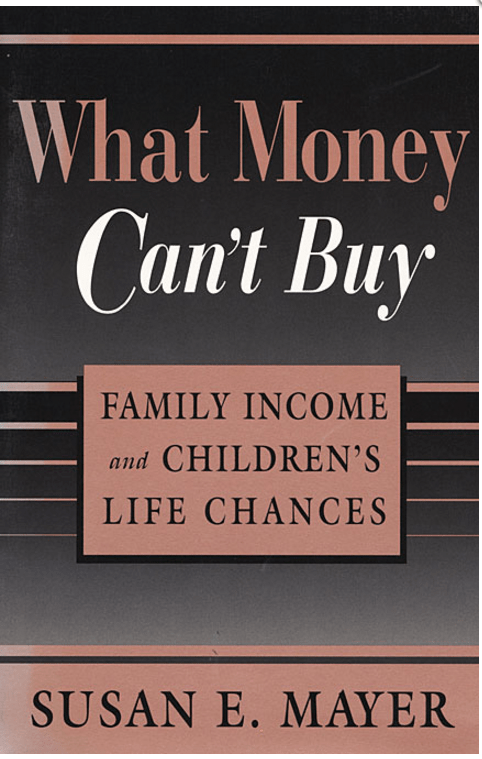
More money does help the children of poor families but the effect is considerably less–and more complicated–than is generally thought because as Mayer says ‘once children’s basic material needs are met, characteristics of their parents become more important to how they turn out than anything additional money can buy.
Doubling the income of poor families would lift most children above the poverty line, it would have virtually no effect on their test scores and only a slight effect on social behaviour. Among her findings, which have largely survive the test of time, are:
Mayer found that as parents have more money to spend, they usually spend the extra money on food, especially food eaten in restaurants; larger homes; and on more automobiles. As a result, children are likely to be better housed and better fed, but not necessarily better educated or better prepared for high-income jobs. Mayer said that her findings do not endorse massive cuts in welfare:
My results do not show that we can cut income support programs with impunity…Indeed, they suggest that income support programs have been relatively successful in maintaining the material living standard of many poor children.
Mayer found that non-monetary factors play a bigger role than previously thought in determining how children overcome disadvantage as she explains. Parent-child interactions appear to be important for children’s success, but the study shows little evidence that a parent’s income has a large influence on parenting practices.
Mayer said that if money alone were responsible for overcoming such problems as unwed pregnancy, low educational achievement and male idleness, states with higher welfare benefits could expect to see reductions in these problems. In reality
once we control all relevant state characteristics, the apparent effect of increasing Aid to Families with Dependent Children benefits is very small.
Social economics has been here before. In the 1960s, the Coleman Report rather than finding that investing in schools improved child outcomes found that most variation between child outcomes depended on family backgrounds. When we talking about schools not matter in too much we are talking about average bad schools and average good school not American inner-city schools into war zones.
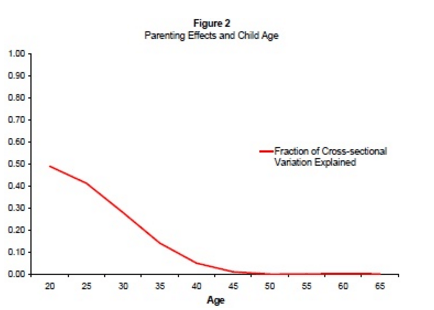
Source: Savings, Genes, and Fade-Out, Bryan Caplan | EconLog | Library of Economics and Liberty.
Behavioural genetics has been a bit of a blow to those that think greater parental investment can raise child outcomes as Bryan Caplan has explained:
Economists like Nobel laureate Gary Becker have been studying the family for decades. Like most modern parents, economists usually take it for granted that “parental investment” has large, lasting effects on adult outcomes.
And yet adoption and twin researchers find surprisingly little evidence for this this assumption(link is external)! With a few notable exceptions, the measured effect of upbringing on adult outcomes is small to zero. Adoptees barely resemble their adopting families, identical twins are much more similar than fraternal twins, and identical twins raised apart are often as similar as identical twins raised together. Almost all traits run in families, but the overarching reason is heredity.
Caplan notes that while it is extremely difficult for parental investments to change the adult outcomes of his children, it is well within his power to give his children a happy childhood.
13 Jan 2016 Leave a comment
in applied welfare economics, economic history, labour economics, labour supply, politics - USA, poverty and inequality, welfare reform Tags: child poverty, family poverty, single mothers, single parents, social insurance, welfare state
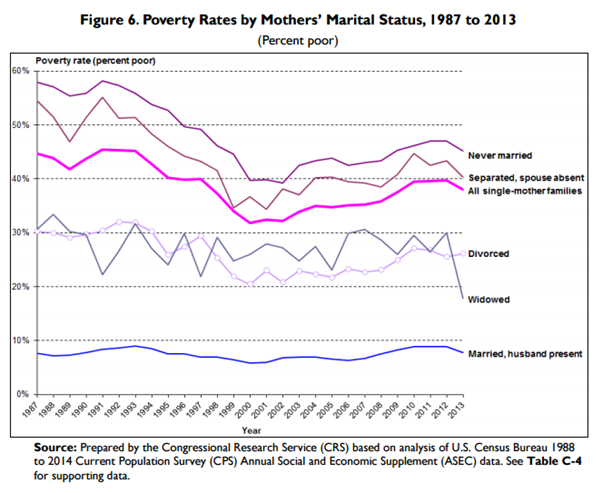
Source: Congressional Research Service.https://www.fas.org/sgp/crs/misc/R41917.pdf
12 Jan 2016 2 Comments
in applied welfare economics, politics - New Zealand, poverty and inequality
12 Jan 2016 Leave a comment
in applied welfare economics, economic history, politics - New Zealand, poverty and inequality
After two lost decades from 1974 where there was real wage stagnation and next to no real GDP growth, following the Mother of All Budgets in 1991 under Ruth Richardson and the passage of the Employment Contracts Act in the same year, real wages growth returned after a hiatus of 20 years. These 20 years of real wage stagnation were the good old days if the Leftover Left is to be believed.

Source: Child Poverty Monitor: 2015 Technical Report, figure 39.
12 Jan 2016 Leave a comment
in applied price theory, applied welfare economics, labour economics, minimum wage Tags: expressive voting, living wage, rational irrationality, Twitter left
11 Jan 2016 Leave a comment
in applied welfare economics, politics - New Zealand, poverty and inequality
Keith Ng stumbled onto an interesting point in a Twitter feud yesterday before he muted me about what is the poverty rate for. Are we interested in the poverty rate before government transfers and other social assistance or after them? Why?
If you are making the case for more assistance to the poor, the correct poverty rate measure is after the existing government assistance. Interestingly, most of those making the case for greater assistance to the poor use the before government transfer measures of poverty rates.
The reason why the correct measure is after government assistance is you are attempting to measure whether the assistance to date has provided people with an adequate standard of living. The before government assistance poverty rate provides no insight into that question.
The recent calculation by the Treasury of inequality based on income and consumption illustrates this. Most people are concerned about what people have to spend rather than how much they earn when thinking about topping them up with government social assistance.
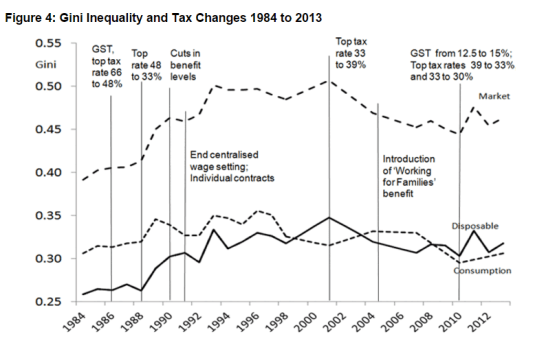
Source: Inequality in New Zealand 1983/84 to 2013/14 (WP 15/06) — The Treasury – New Zealand
As the above chart shows, consumption inequality in New Zealand has not changed much since 1984 while income inequality has. Which is more important how much people have to spend or how much they are? Growing inequality is not a reason for more government assistance to the poor in New Zealand because it simply has not got worse for 30 years.
The reason that the before government assistance poverty rate is used is this rate is a relative measure that does not fall by that much. It therefore helps dramatise the politics of poverty and perhaps strengthen your case in the eyes of low information voters.
The better guide is the poverty rate after government assistance because that tells you how much extra you really need to top up the incomes of the poor to ensure they have an adequate minimum standard of living. The before government assistance poverty rate provides no insight into the success of social insurance and the welfare state regarding the adequacy of income support for the poor.
10 Jan 2016 Leave a comment
in applied welfare economics, economic history, entrepreneurship, financial economics Tags: France, top 1%
Unlike many other countries, French top income earners did not turn into mostly top wage earners over the post-war period.

Source: The World Wealth and Income Database.
....
10 Jan 2016 Leave a comment
in applied welfare economics, economic history, politics - New Zealand, politics - USA, poverty and inequality
The official poverty rate in the USA missed poverty falling to near zero by the eve of the Global Financial Crisis in 2007 as shown in the chart below. That is no small oversight. It calls into question whether the official poverty rate which is based on a percentage of the median income is a useful guide to the magnitude of social problems before us.
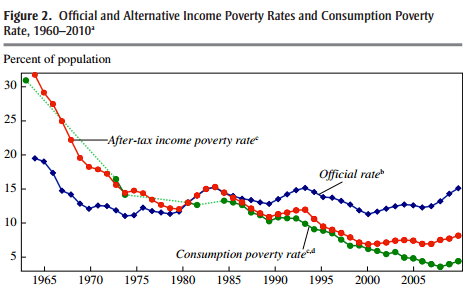
Source: Meyer and Sullivan (2012), p. 153.
Meyer and Sullivan calculated a consumption based measure of poverty and found that the poverty rate fell much faster than previously single digits.
People worry about poor not have enough, not how much income they have before taxes and social insurance. The official poverty rate is before tax and social insurance and therefore before how much the poor actually have to get by with after receiving social assistance of all types and sources.
Interestingly, the divergence between consumption-based poverty and income-based poverty started with the election of Reagan and picked up the US federal welfare reforms in 1996. The number of children in poverty in deep poverty fell immediately after those 1996 US welfare reforms. There is a lesson in that for New Zealand.
It is widely agreed that the official poverty rate is flawed. Measuring poverty as a percentage of median income, usually 60% of the median income, means that poverty may not fall despite incomes doubling every generation and more.
Indeed, increases in the median income can increase poverty without anyone being poorer. This is because the gap between the median income earners and the poor increased such as the New Zealand in 2014 without any of the poor experiencing a fall in income and social support.
The reason why the median is pulling away from the bottom – the reason why income distribution is fanning out – is more people going to university and securing the associated wage premium and the greater rewards for talent in a globalised world.
The forces behind greater educational attainment and the globalisation of markets benefit all and in particular those of bottom of the income distribution through a more prosperous, dynamic, innovative society.
09 Jan 2016 Leave a comment
in applied welfare economics, economic history, human capital, labour economics, poverty and inequality Tags: Canada, superstars, superstore wages, top 0.1%, top incomes
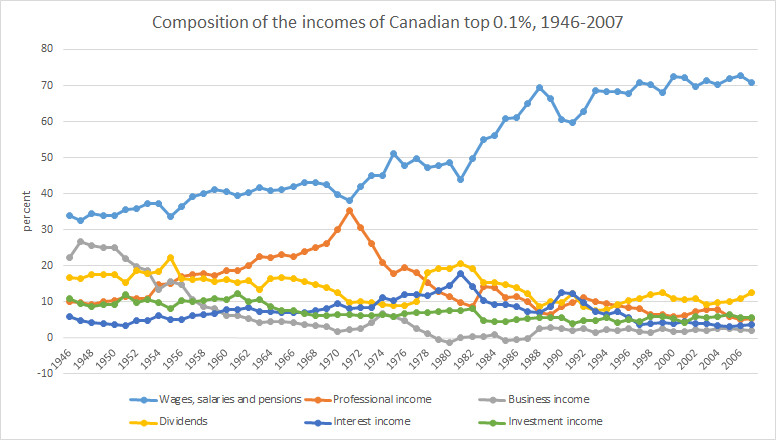
Source: The World Wealth and Income Database.
09 Jan 2016 Leave a comment
in applied welfare economics, economic history, human capital, labour economics, politics - New Zealand, poverty and inequality Tags: Leftover Left, superstar wages, superstars, top incomes
Apart from a bump in the late 80s, the top income earners in New Zealand really are not doing much better than they were in the 1950s or 1920s. The rich are not getting richer in New Zealand. They are just holding their own.
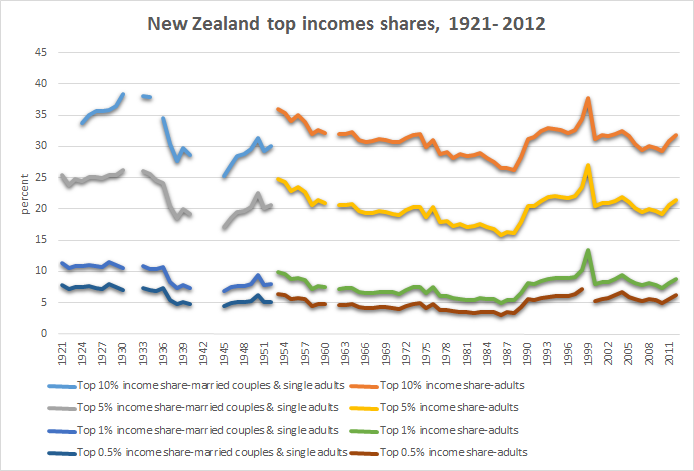
Source: The World Wealth and Income Database.
08 Jan 2016 Leave a comment
in applied welfare economics, economic history, human capital, labour economics, poverty and inequality Tags: Canada, superstar wages, superstars, top 1%, working rich
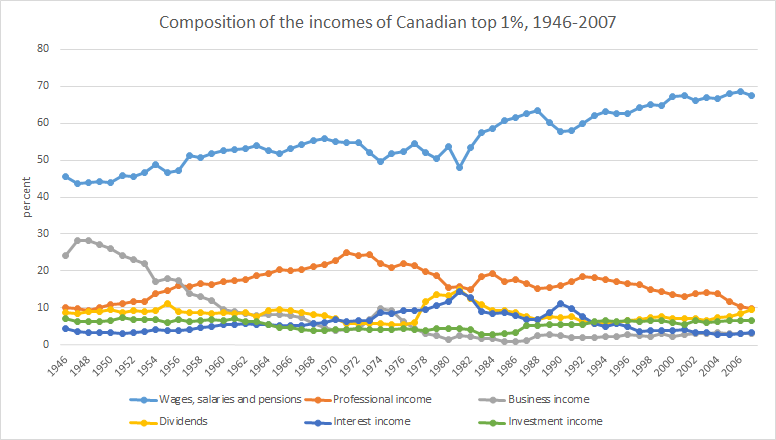
Source: The World Wealth and Income Database.
07 Jan 2016 2 Comments
in Adam Smith, applied welfare economics, politics - New Zealand, poverty and inequality, Rawls and Nozick Tags: child poverty, family poverty, star trek
Jamie Whyte today wrote an excellent op-ed on the meaninglessness of current measures of poverty. His point was that defining poverty as 60% of the median income means the poor will always be with us. This relative definition of poverty misleads us as to the level of hardship and deprivation in society as Jamie Whyte says today:
There is no poverty in New Zealand. Misery, depravity, hopelessness, yes; but no poverty.
The poorest in New Zealand are the unemployed. They receive free medical care, free education for their children and enough cash to pay for basic food, clothing and (subsidised) housing. Most have televisions, refrigerators and ovens. Many even own cars. That isn’t poverty.
I agree that this definition of poverty in relative income terms is misleading and reflects a political agenda. When I was young, the poor were thin, now they are fat.
Poverty rates have not changed despite a greater abundance of food. Indeed, child poverty rates have increased since I was young despite this relative opulence of food.
Over the Christmas break I read Simon Chapple and Jonathan Boston’s Child Poverty in New Zealand. They included a discussion of what was poverty drawing on the relative concept of poverty of Adam Smith. Smith spoke about wrote about the differences in poverty between countries and across time:
A linen shirt … is, strictly speaking, not a necessary of life. The Greeks and Romans lived, I suppose, very comfortably though they had no linen.
But in the present times, through the greater part of Europe, a creditable day-labourer would be ashamed to appear in public without a linen shirt, the want of which would be supposed to denote that disgraceful degree of poverty which, it is presumed, nobody can well fall into without extreme bad conduct.
In any society, a certain level of material well-being is necessary to not be in poverty. Smith also talked about how poverty lines differ between countries starting with the discussion about shoes:
The poorest creditable person of either sex would be ashamed to appear in publick without them. In Scotland, custom has rendered them a necessary of life to the lowest order of men; but not to the same order of women, who may, without any discredit, walk about bare-footed. In France, they are necessaries neither necessaries neither to men nor to women; the lowest rank of both sexes appear there publickly, without any discredit, sometimes in wooden shoes, and sometimes bare-footed.
Under necessaries, I comprehend, not only those things which nature, but those things which the established rules of decency have rendered necessary to the lowest rank of people.
All other things I shall call luxuries; without meaning by this appellation, to throw the smallest degree of reproach upon the temperate use of them. Beer and ale, for example, in Great Britain, and wine, even in the wine countries, I call luxuries. A man of any rank may, without any reproach, abstain totally from tasting such liquors. Nature does not render them necessary for the support of life; and custom nowhere renders it indecent to live without them.
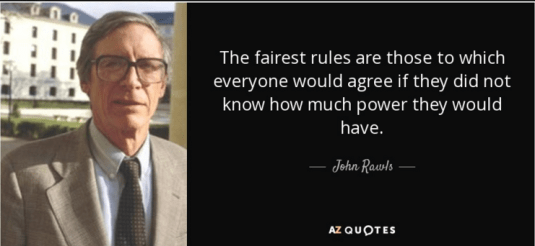
Much of the Wealth of Nations was about the natural progress of opulence under a capitalist system. There is nothing wrong with inequality as John Rawls has explained.

The fact that citizens have different talents can be used to make everyone better off. In a society governed by the difference principle, those better endowed with talents are welcome to use their gifts to make themselves better off, so long as they also contribute to the good of those less well endowed.

With his emphasis on fair distribution of income, Rawls’ initial appeal was to the Left, but left-wing thinkers started to dislike his acceptance of capitalism and tolerance of large discrepancies in income.
Will the poor always be with us? I once had an argument with a colleague at work about whether there was poverty on the Starship Enterprise.
Star Trek was supposed to be a society that had abolished money and a post-scarcity economy because everything was available through a replicator. To quote Captain Picard:
A lot has changed in three hundred years. People are no longer obsessed with the accumulation of ‘things’. We have eliminated hunger, want, the need for possessions.
The economics of the future is somewhat different. You see, money doesn’t exist in the 24th century… The acquisition of wealth is no longer the driving force in our lives. We work to better ourselves and the rest of Humanity.
The Ferengi and their 285 rules of acquisition were a satire on capitalism. The Ferengi was originally meant to replace the Klingons as the Federation’s arch-rival but they were too comical.
Gene Roddenberry’s love story with socialism was a class-ridden society. In Star Trek, higher ranked officers had larger cabins, and most of all they always beamed back from the planet.
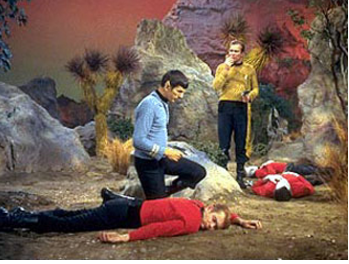
An old mate reminded me years ago that anyone who beamed down with Captain Kirk dressed in those red security officer tops were expendables. They were lucky to last 60 seconds in most episodes I watched.
Death and accommodation were class based on Star Trek but it was a supremely opulent society for everyone. That is the point to remember.
Standards are living are much better today than before for everyone despite inequalities that are quite acceptable under the difference principle of John Rawls.
Current definitions of poverty do not take into account the natural progress of opulence. In the 1970s, US Department of Energy started collecting its Household Energy Consumption Survey. This survey is one of the few accurate measures of growing affluence among the poor in America.
Not only does this survey ask about household appliances, it asked about on income. The survey is conducted every 4 years or so since the 1970s. Because of that, it is able to track the diffusion of appliances to households of varying incomes across America.
Yesterday’s luxuries at today’s necessities in poor households with a rapid diffusion of everything from air-conditioners to digital appliances. Many poor households in the USA have more space than middle-class households in Western Europe. Food is also much cheaper in the USA than in Europe.
https://twitter.com/VisualEcon/status/644080191841640448
This growing affluence of poorer Americans is despite higher measured family poverty in America according to the relative poverty measure based on the median income. That makes no sense.
Celebrating humanity's flourishing through the spread of capitalism and the rule of law
Scholarly commentary on law, economics, and more
Beatrice Cherrier's blog
Celebrating humanity's flourishing through the spread of capitalism and the rule of law
Celebrating humanity's flourishing through the spread of capitalism and the rule of law
Celebrating humanity's flourishing through the spread of capitalism and the rule of law
Why Evolution is True is a blog written by Jerry Coyne, centered on evolution and biology but also dealing with diverse topics like politics, culture, and cats.
Celebrating humanity's flourishing through the spread of capitalism and the rule of law
Celebrating humanity's flourishing through the spread of capitalism and the rule of law
A rural perspective with a blue tint by Ele Ludemann
DPF's Kiwiblog - Fomenting Happy Mischief since 2003
Celebrating humanity's flourishing through the spread of capitalism and the rule of law
The world's most viewed site on global warming and climate change
Tim Harding's writings on rationality, informal logic and skepticism
A window into Doc Freiberger's library
Let's examine hard decisions!
Commentary on monetary policy in the spirit of R. G. Hawtrey
Thoughts on public policy and the media
Celebrating humanity's flourishing through the spread of capitalism and the rule of law
Politics and the economy
A blog (primarily) on Canadian and Commonwealth political history and institutions
Reading between the lines, and underneath the hype.
Economics, and such stuff as dreams are made on
"The British constitution has always been puzzling, and always will be." --Queen Elizabeth II
Celebrating humanity's flourishing through the spread of capitalism and the rule of law
Celebrating humanity's flourishing through the spread of capitalism and the rule of law
WORLD WAR II, MUSIC, HISTORY, HOLOCAUST
Undisciplined scholar, recovering academic
Celebrating humanity's flourishing through the spread of capitalism and the rule of law
Res ipsa loquitur - The thing itself speaks
In Hume’s spirit, I will attempt to serve as an ambassador from my world of economics, and help in “finding topics of conversation fit for the entertainment of rational creatures.”
Researching the House of Commons, 1832-1868
Articles and research from the History of Parliament Trust
Reflections on books and art
Posts on the History of Law, Crime, and Justice
Celebrating humanity's flourishing through the spread of capitalism and the rule of law
Exploring the Monarchs of Europe
Cutting edge science you can dice with
Small Steps Toward A Much Better World
“We do not believe any group of men adequate enough or wise enough to operate without scrutiny or without criticism. We know that the only way to avoid error is to detect it, that the only way to detect it is to be free to inquire. We know that in secrecy error undetected will flourish and subvert”. - J Robert Oppenheimer.
The truth about the great wind power fraud - we're not here to debate the wind industry, we're here to destroy it.
Celebrating humanity's flourishing through the spread of capitalism and the rule of law
Celebrating humanity's flourishing through the spread of capitalism and the rule of law
Economics, public policy, monetary policy, financial regulation, with a New Zealand perspective
Celebrating humanity's flourishing through the spread of capitalism and the rule of law
Restraining Government in America and Around the World
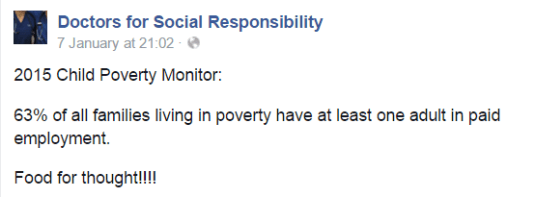

 Utopia, you are standing in it!
Recent Comments