Explaining free trade to @realdonaldtrump @BernieSanders with the same biased, bought and paid for video
08 Feb 2016 Leave a comment
in applied welfare economics, international economics, politics - USA Tags: 2016 presidential election, free trade, left-wing popularism, rational ignorance, rational irrationality, right-wing popularism
@berniesanders How America’s middle class is disappearing
08 Feb 2016 Leave a comment
in applied welfare economics, economic history, labour economics, politics - USA, poverty and inequality Tags: living standards, rational ignorance, rational irrationality, withering away of proletariat

Both the proletariat and the middle class are withering away these days thanks to capitalism and freedom.

#TPPANoWay @oxfamNZ @GreenpeaceUSA The Effects of Globalization
07 Feb 2016 Leave a comment
in applied price theory, applied welfare economics, development economics, economic history, growth disasters, growth miracles, international economics, Marxist economics Tags: customs unions, expressive voting, free trade, Leftover Left, ODA, preferential trading agreements, rational ignorance, rational irrationality, The Great Escape, The Great Fact, TPA, TPPA, Twitter left, Tyler Cowen
@Greens @sarahinthesen8’s solution to boat people drowning
05 Feb 2016 1 Comment
in applied welfare economics, politics - Australia

Source: Another way for refugees | Australian Greens.
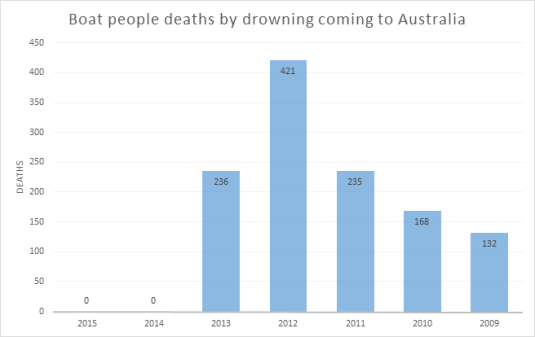
Arriving by boat in Australia does not increase the size of the refugee quota. It just changes who gets to the head of the queue and how many died trying to get to the head of the queue.
Source: Kiwiblog.
There is nothing compassionate about rewarding people for risking their lives. The chances of dying while attempting to come to Australia by boat are about 2%.
The recent experience in Europe confirms that just letting large numbers of refugees come to your country hardens the attitude of the majority of voters in that country to admitting refugees in general, much less more than their current quota.
Tim Hazledine loses the plot when arguing for #TPPANoWay
03 Feb 2016 Leave a comment
in applied welfare economics, economics of regulation, international economic law, international economics, politics - New Zealand
The op-ed by Tim Hazledine today made a poor case against the Trans-Pacific Partnership agreement (TPPA). A much better case could be made but for his still fighting the 1990 election in New Zealand, which was about the future of economic reform.
He starts off strong by saying that the agreement is a mixed bag. I am of the same view. The TPPA is a so-so deal with small net gains.
Economic stuff the PM DIDNT mention #TPPANoWay @ItsOurFutureNZ @etangata @Mihi_Forbes @FoxMarama @grantrobertson1 https://t.co/L9rtd1dXvp—
Moana Maniapoto (@moanatribe) January 26, 2016
The TPPA and other trade agreements have dubious chapters such as the trade and environmental clauses, the intellectual property chapter and investor-state dispute settlement. Good arguments can be mounted against all of them, especially the inclusion of trade and environmental clauses into trade agreements.
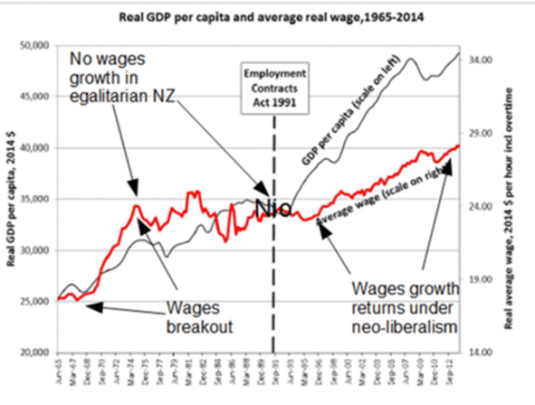
Hazledine makes few of these points of mine, preferring instead to start with a rant against economic reform in New Zealand:
One of the more gormless of the 1980s “Rogernomics” economic policy experiments was to slash tariffs on imports without seeking equivalent concessions from our trading partners.
That didn’t do us much good then, but means now that matching reductions under the TPP is relatively painless for New Zealand, because our tariffs are already so low.
He wants to put tariffs back up again so that the poor pay well over the odds to import goods that are often not made in New Zealand and when they were they were very expensive.
Henry Simons argued that economics and in particular applied price theory is most useful both to the student and the political leader as a prophylactic against popular fallacies. Paul Krugman explained the twisted logic of trade negotiations well in this tradition when he said:
Anyone who has tried to make sense of international trade negotiations eventually realizes that they can only be understood by realizing that they are a game scored according to mercantilist rules, in which an increase in exports – no matter how expensive to produce in terms of other opportunities foregone – is a victory, and an increase in imports – no matter how many resources it releases for other uses – is a defeat.
The implicit mercantilist theory that underlies trade negotiations does not make sense on any level, indeed is inconsistent with simple adding-up constraints; but it nonetheless governs actual policy.
The economist who wants to influence that policy, as opposed to merely jeering at its foolishness, must not forget that the economic theory underlying trade negotiations is nonsense – but he must also be willing to think as the negotiators think, accepting for the sake of argument their view of the world.
The logic of trade negotiations is they are about cutting tariffs we should have cut long ago in return to others cutting their tariffs which they too should have cut long ago if they had any concern for the welfare of their own country rather than special interests.
Tim Hazledine swallows the logic of trade negotiations hook, line and sinker with all the enthusiasm of a non-economist but he is a professional economist. Professional economists laugh at the mercantilist logic of trade negotiations.
Paul Krugman summarised the TPPA well recently from a standpoint of a professional economist, which occasional he still is:
I’ve described myself as a lukewarm opponent of the Trans-Pacific Partnership; although I don’t share the intense dislike of many progressives, I’ve seen it as an agreement not really so much about trade as about strengthening intellectual property monopolies and corporate clout in dispute settlement — both arguably bad things, not good, even from an efficiency standpoint….
What I know so far: pharma is mad because the extension of property rights in biologics is much shorter than it wanted, tobacco is mad because it has been carved out of the dispute settlement deal, and Republicans in general are mad because the labour protection stuff is stronger than expected. All of these are good things from my point of view. I’ll need to do much more homework once the details are clearer.
Krugman then reminded that a trade agreement is most politically viable when it is most socially harmful. This is the point that the opponents of the TPPA miss. They will not want to discuss how some trade agreements are good deals but others are bad. That would admit that trade agreements can be welfare enhancing, and sometimes they are but sometimes not.
Hazledine’s op-ed improves noticeably when he talks about sovereignty but this will backfire on him as I will show shortly:
what perhaps most concerns TPP doubters is possible loss of sovereignty – control by legitimate New Zealand governments over New Zealand policies and institutions: Pharmac, mining, greenhouse gases, fracking, biomedical patents, the Treaty of Waitangi and others have been raised as being at risk. TPP supporters have attempted to soothe such concerns, but I’d say they should come clean. Of course the TPP will weaken New Zealand’s sovereignty. That is what these things are supposed to do!
The fundamental idea or ideology behind the TPP is that national governments cannot be trusted to act independently on many issues, because they will inevitably succumb to local vested interests. Only the cleansing discipline of untrammelled global free-market forces will deliver efficient outcomes.
I fully understand the economic logic of this position, and could easily myself compile a long list of harmful effects of local vested interests, at the top of which would actually be those Canadian etc dairy and other agricultural policies.
But the basic premise is flawed. Most of the sovereignty we are giving up is not ceded to the invisible hand of free, competitive markets. It is not even handed over to larger sovereign states, such as the United States. It is largely to be conceded in the cause of making the world a safer place for huge, stateless multinational corporations to roam. Are we sure this is what we want?
I agree that treaties reduce sovereignty. That is what they are about. I am particularly concerned about treaties that reduce New Zealand’s sovereignty over its greenhouse gas emissions. These sovereignty arguments against trade agreements apply equally to climate treaties.
Likewise, trade agreements should not include trade and environmental standards as they limit the right of New Zealand to deregulate its labour market.
What's in the #TPP? Robust enforceable environmental protections. Get the facts ustr.gov/tpp #LeadOnTrade http://t.co/hzapJwGaCa—
USTR (@USTradeRep) October 05, 2015
What's in the #TPP? Protections for American workers. Get the facts: ustr.gov/tpp #MadeInAmerica http://t.co/VPeV70zaPT—
USTR (@USTradeRep) October 05, 2015
All too often unions point out that this or that International Labor Organisation convention signed decades ago conflicts with labour market deregulation. That undermines the sovereignty of New Zealand regarding the regulation of the economy just as much is the TPPA.
@NZGreens gain the most from an independent costings unit @JulieAnneGenter
01 Feb 2016 1 Comment
in applied welfare economics, constitutional political economy, economics of regulation, income redistribution, politics - New Zealand, public economics
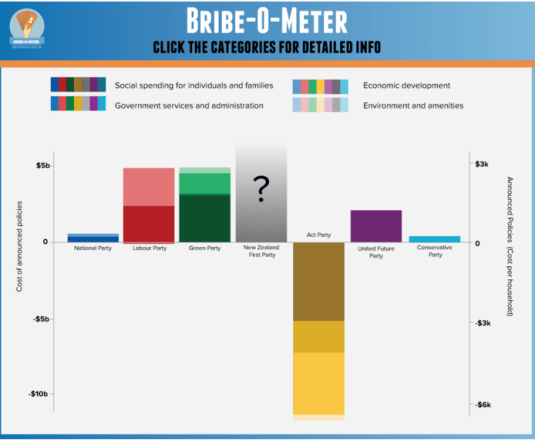
I am sure there will be lots of squabbling over parameters and assumptions of any tax, spending or regulation proposal submitted to the independent costings unit proposed recently by the New Zealand Greens.
The bigger problem is static and dynamic scoring. There is some history of doing this for taxes but little for spending and that is before you consider externalities. Imagine the squabbling over roading proposals and their externalities. The practical hurdles to dynamic scoring are:
- Economists do not know how to accurately measure the growth effects of most policies
- Dynamic scoring relies on less-than-accurate, theory-based macro models
- The macro models undergirding dynamic scoring have numerous controversial and unproven built-in assumptions
- The assumptions embedded in the macro models are not always carefully empirically based
- Macro models exclude theoretically and empirically supported evidence of supply-side effects of public investment
- Macro models exclude evidence-based effects of economic inequality
- Macro models exclude evidence-based effects of numerous policies
- Macro models provide different estimates of growth impacts of policy depending on guesses of how the policy may be finance
Against that is dynamic scoring removes the bias against pro-growth policies in current budgetary scoring:
[A] theoretical advantage of accurate dynamic scoring is that it is not biased against pro-growth policies compared to the current conventional scoring method. By ignoring macroeconomic effects, the conventional method overstates the true budgetary cost of pro-growth policies, such as infrastructure investments, and understates the cost of anti-growth policies.
The bigger problem is something I learnt when costing a tax proposal for an election campaign. There was an error because I did the costing on a spreadsheet while I had a bad head cold.
The advantage of the error was the policy, as a result of this minor error in the tabulations attracted considerable attention from the major parties.
I was advised by a very wise head that this tabulation error in the dynamic scoring was not so bad a problem. This was because the tabulation error gave our side a chance to have a go at them again in the media. The policy announcement stayed in the new cycles for longer than otherwise and attracted attention from the big parties.
If a policy is too good, too perfect, the other parties will kill it with silence. You get only one bite in the news cycle and that is it.
If your policy announcement is killed by silence, at least you are guaranteed a chance to go at it again when the proposed independent costings unit a week or so later in the election campaign. You might disagree of those costings just to attract attention in the next new cycle.
Given the size, ambition and nebulous externality content of Green party proposals, they will benefit considerably from getting another go by questioning the Parliamentary budget office costings. That guarantees at least two new cycles to every one of their budgetary and regulatory announcements. No wonder they have proposed this independent costings unit.
If the New Zealand Greens do not like the costing from their proposed independent costings unit, they can just rage against neoliberalism and the conservative bias of economists. They cannot lose in terms of another bite of the 24-hour news cycle.
As a starter to feigning disagreement with any independent costings of their tax, spending and regulation proposals, Milton Friedman argued that people agree on most social objectives, but they differ often on the predicted outcomes of different policies and institutions. This leads us to Robert and Zeckhauser’s taxonomy of disagreement:
Positive disagreements can be over questions of:
1. Scope: what elements of the world one is trying to understand?
2. Model: what mechanisms explain the behaviour of the world?
3. Estimate: what estimates of the model’s parameters are thought to obtain in particular contexts?
Values disagreements can be over questions of:
1. Standing: who counts?
2. Criteria: what counts?
3. Weights: how much different individuals and criteria count?
Any positive analysis tends to include elements of scope, model, and estimation, though often these elements intertwine; they frequently feature in debates in an implicit or undifferentiated manner. Likewise, normative analysis will also include elements of standing, criteria, and weights, whether or not these distinctions are recognised. There is a rich harvest for nit-picking to keep the story going.
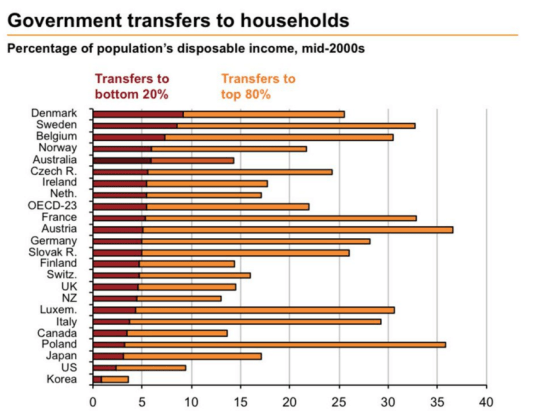
Welfare state targeting across the OECD
01 Feb 2016 Leave a comment
in applied welfare economics, public economics
The importance of correctly measuring income growth over the decades
31 Jan 2016 Leave a comment
in applied welfare economics, economic history Tags: measurement error
Unions are not the cause of our 40 hour workweek
31 Jan 2016 Leave a comment
in applied price theory, applied welfare economics, economic history, labour economics, labour supply, unions Tags: 40 hour week, hours worked, living standards, union power, union wage premium, working hours, working week
The 1st @NYTimeskrugman on #TPPANoWay @Oxfamnz #JaneKelsey
30 Jan 2016 Leave a comment
in applied price theory, applied welfare economics, development economics, economic history, growth disasters, growth miracles, international economics Tags: customs unions, free trade agreements, globalisation, Jane Kelsey, Leftover Left, Oxfam, Paul Krugman, preferential trading agreements, rational irrationality, TPP, Twitter left, Yes Minister
https://twitter.com/TPPMediaMarch/status/692055631579185152
If George Bush had not won the 2000 presidential election, Paul Krugman would have taken over as the best communicator of economics since Milton Friedman. Instead, he became patient number no.1 of George Bush derangement syndrome. Ann Coulter was patient no. 1 of Clintons derangement syndrome.

Source: Enemies of the WTO.
Development & Trade: Empirical Evidence @DavidShearerMP @oxfamnz @TPPANoWay
29 Jan 2016 Leave a comment
in applied price theory, applied welfare economics, development economics, economic history, growth disasters, growth miracles, international economics, politics - New Zealand, politics - USA Tags: free trade, free trade agreements, preferential trading agreements, The Great Enrichment, The Great Fact, TPPA, WTO
@realdonaldtrump is wrong in tariffs
26 Jan 2016 Leave a comment
in applied price theory, applied welfare economics, economic history, international economics, politics - USA Tags: 2016 presidential election, China, tariffs, trade wars
@Oxfam extrapolations and exaggerations
25 Jan 2016 Leave a comment
in applied welfare economics, economic history, entrepreneurship Tags: Oxfam, top 1%
Globalisation is Good – Johan Norberg on Globalisation
23 Jan 2016 Leave a comment
in applied welfare economics, development economics, economic history, growth miracles, international economics, Marxist economics Tags: capitalism and freedom, extreme poverty, global poverty, globalisation, The Great Escape, The Great Fact


Recent Comments