Yes Prime Minister on the fiscal savings from smoking
01 Sep 2015 Leave a comment
in applied welfare economics, economics of regulation, health economics Tags: economics of smoking, nanny state, Yes Minister
Fair Trade: Does It Help Poor Workers?
01 Sep 2015 Leave a comment
in applied price theory, applied welfare economics, development economics, growth disasters, growth miracles, labour economics, poverty and inequality Tags: antimarket bias, expressive voting, fair trade, rational irrationality
How is the top 10% doing?
01 Sep 2015 Leave a comment
in applied welfare economics, human capital, labour economics, poverty and inequality Tags: envy, top 1%
The trouble with boys
31 Aug 2015 1 Comment
in applied welfare economics, labour economics, politics - Australia, politics - New Zealand, politics - USA, welfare reform Tags: economics of the family, lost boys, reversing gender gap, single mothers, single parents
The Trouble w Boys: U Chicago study: boys fr non-intact homes esp likely to struggle in school nber.org/papers/w17541 http://t.co/31xyA4BVQH—
W Bradford Wilcox (@WilcoxNMP) June 18, 2015
The art of economic analysis
29 Aug 2015 Leave a comment
in applied price theory, applied welfare economics, Milton Friedman Tags: antiforeign bias, antimarket bias, economic fallacies, makework bias
US income distribution
29 Aug 2015 Leave a comment
in applied welfare economics, income redistribution, labour economics, politics - USA, poverty and inequality Tags: top 1%
The incomes of the bottom 99%
28 Aug 2015 Leave a comment
in applied welfare economics, politics - USA, poverty and inequality, Public Choice Tags: top 1%
The Bootleggers and Baptists alliance between big tobacco and anti-smoking lobbyists on e-cigarettes
25 Aug 2015 Leave a comment
in applied price theory, applied welfare economics, economics of regulation, health economics, politics - Australia, politics - New Zealand, politics - USA, Public Choice, rentseeking Tags: bootleggers and baptists, economics of smoking, meddlesome preferences, nanny state, pressure groups, special interests
Mises on what history can and cannot teach
22 Aug 2015 Leave a comment
in applied price theory, applied welfare economics, economic history, Ludwig von Mises Tags: methodology of economics, philosophy of economics
Why some billionaires are bad for growth, and others aren’t
22 Aug 2015 Leave a comment
in applied price theory, applied welfare economics, economics of bureaucracy, economics of regulation, financial economics, income redistribution, industrial organisation, politics - Australia, politics - New Zealand, politics - USA, Public Choice, rentseeking, survivor principle Tags: Australia, billionaires, Russia, top 0.1%, top 1%

…Bagchi and Svejnar carefully went through the lists of all the Forbes billionaires, and divided them into those who had acquired their wealth due to political connections, and those who had not. This is kind of a slippery slope — almost all billionaires have probably benefited from government connections at one time or another.
But the researchers used a very conservative standard for classifying people as politically connected, only assigning billionaires to this group when it was clear that their wealth was a product of government connections. Just benefiting from a government that was pro-business, like those in Singapore and Hong Kong, wasn’t enough.
Rather, the researchers were looking for a situation like Indonesia under Suharto, where political connections were usually needed to secure import licenses, or Russia in the mid-1990s, when some state employees made fortunes overnight as the state privatized assets.
…The negative effects of wealth inequality are largely being driven by politically connected wealth inequality. That seems to be the primary channel that drives this relationship…
a 3.72 percent increase in the level of wealth inequality would cost a country about half a percent of real GDP per capita growth. That’s a big impact, given that average GDP growth is in the neighbourhood of two percent per year
How is the environment going under the ravages of 21st century capitalism
22 Aug 2015 Leave a comment
in applied price theory, applied welfare economics, economic history, economics of regulation, energy economics, environmental economics, environmentalism, politics - USA Tags: doomsday prophecies, doomsday prophets, environmental law, environmental protection, environmental regulation, free market environmentalism, green scaremongering, tear pollution, The Great Escape, The Great Fact, water pollution
U.S. population has grown since 1980, yet pollution rates either haven't moved or are falling. buff.ly/1ILu7RM http://t.co/PXriaKlsZO—
HumanProgress.org (@humanprogress) August 14, 2015
Make Progress, Not Work! Bryan Caplan’s best single video
21 Aug 2015 Leave a comment
in applied price theory, applied welfare economics, development economics, economic history, economics of information, economics of media and culture, growth miracles, liberalism, Public Choice Tags: Bryan Caplan, capitalism and freedom, makework bias, The Great Enrichment, The Great Escape, The Great Fact
Why @NZGreens @nzlabour @GreenpeaceNZ hate applied welfare economics
21 Aug 2015 Leave a comment
in applied welfare economics, economics of regulation, energy economics, environmental economics, health economics, international economics, labour economics, law and economics, politics - New Zealand, Public Choice Tags: antiforeign bias, antimarket bias, expressive voting, Greenpeace, Leftover Left, make-work bias, methodology of economics, New Zealand Greens, New Zealand Labour Party, rational ignorance, rational irrationality
Quotation of the Day from French Economist Frederic Bastiat in the 1850s http://t.co/2ECWtb6m9u—
Mark J. Perry (@Mark_J_Perry) August 14, 2015
The great divergence in average and marginal tax rates in New Zealand since 2000
20 Aug 2015 1 Comment
in applied price theory, applied welfare economics, human capital, labour supply, politics - New Zealand, public economics Tags: family tax credits, lost decades, taxation and the labour supply
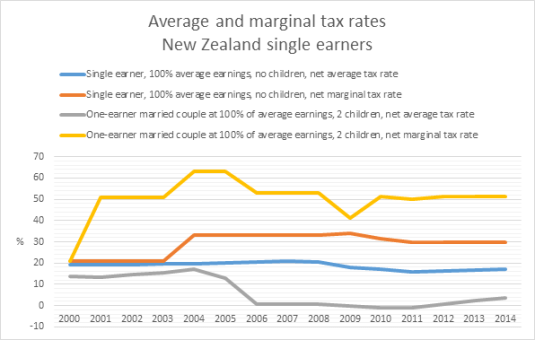
21% would have been a good guess of the average and marginal tax rates of the New Zealand single earner or couple including with children and even a second earner in 2001. New Zealand average and marginal tax rates have been on a wild ride since the year 2000.
Sources: OECD StatExtract and OECD Taxing Wages.
As the above chart shows, while the average tax rate of a single earner with no children is pretty much unchanged at about 20%, he now faces a marginal tax rate of 30% or more rather than 21% in 2001.
For a married couple with one income, as the above chart shows, their average tax rate has been about zero for a good 10 years now but their net marginal tax rate is a good 50% or more because of abatement rates on family tax credits, which is a skewed incentive situation. A large income effect from the family tax credit encourages the consumption of leisure but a high marginal tax rate discourages working more.
Sources: OECD StatExtract and OECD Taxing Wages.
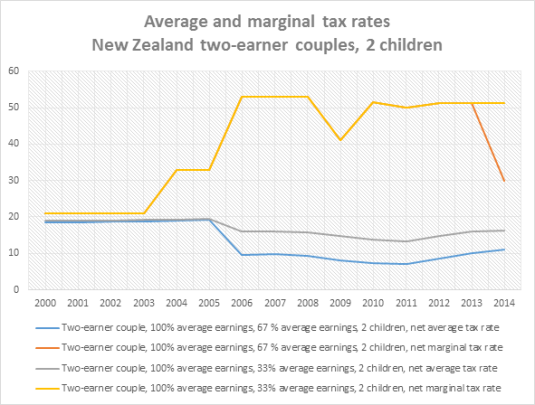
For two earner couples, their average tax rates have fallen because of family tax credits but their marginal tax rates have gone through the roof as the above chart shows. A tax system that discourages quite severely any further work or investment in human capital by average earners may have adverse effects on the long-term trend growth rate of New Zealand.
Where is it easiest to start a business?
20 Aug 2015 Leave a comment
in applied welfare economics, comparative institutional analysis, economics of regulation, industrial organisation, labour economics, occupational choice, occupational regulation Tags: cost of doing business, creative destruction, entrepreneurial alertness, freedom of entry
Where is it easiest to start a business? Explore the fully interactive map. buff.ly/1GPl5DM #progress http://t.co/YlN3vtfKpt—
HumanProgress.org (@humanprogress) June 18, 2015
 Utopia, you are standing in it!
Recent Comments