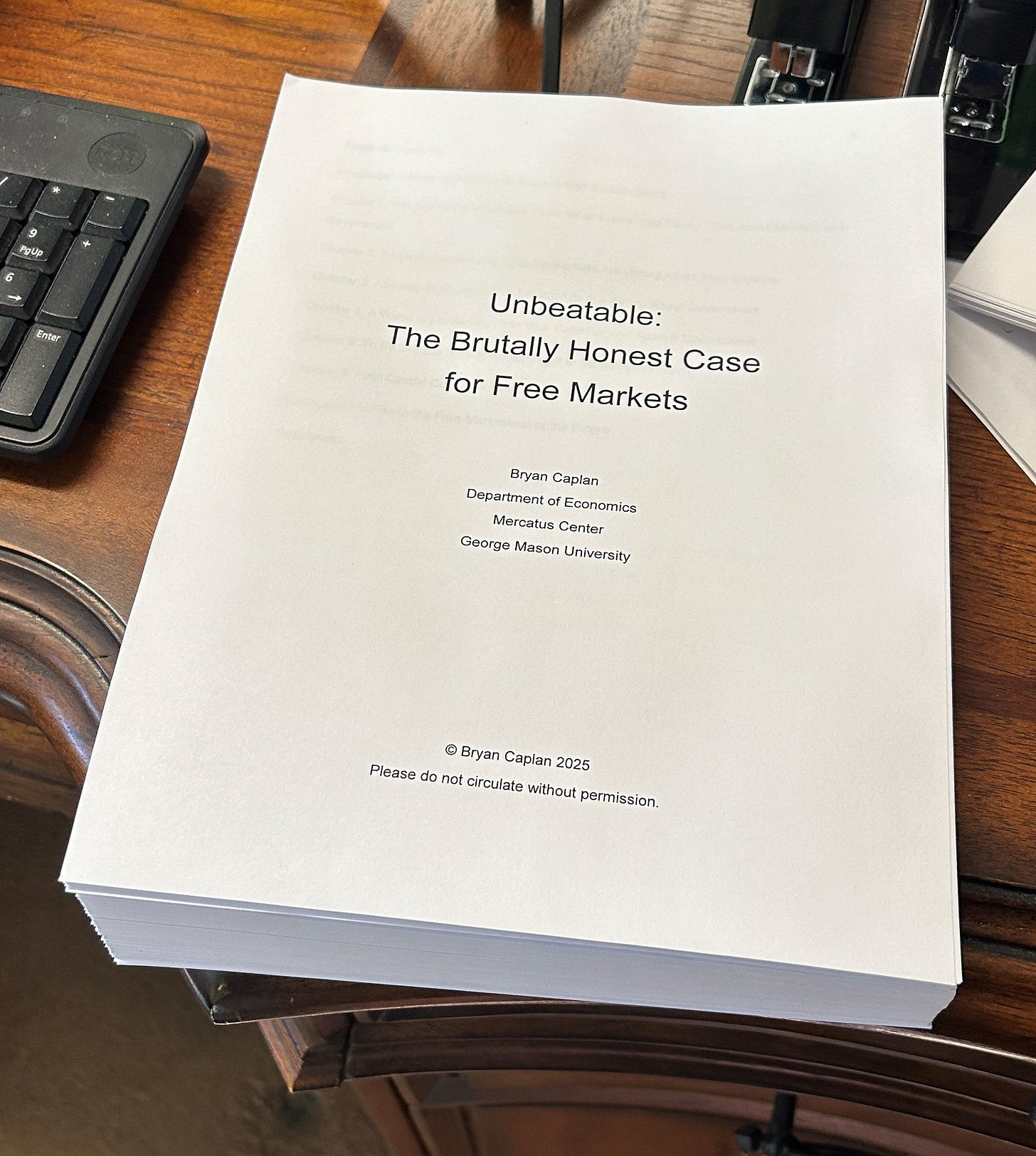
An excerpt from Chapter 3 of *Unbeatable*
Excusing the Government
Celebrating humanity's flourishing through the spread of capitalism and the rule of law
22 May 2025 Leave a comment
in applied price theory, applied welfare economics, comparative institutional analysis, constitutional political economy, economics of bureaucracy, economics of regulation, history of economic thought, income redistribution, international economics, labour economics, law and economics, property rights, Public Choice, public economics, rentseeking, urban economics
An excerpt from Chapter 3 of *Unbeatable*
Excusing the Government
22 May 2025 Leave a comment
in applied price theory, comparative institutional analysis, economics of information, economics of regulation, entrepreneurship, history of economic thought, industrial organisation, labour economics, law and economics, property rights
20 May 2025 Leave a comment
in applied price theory, applied welfare economics, Austrian economics, comparative institutional analysis, development economics, economic history, economics of regulation, entrepreneurship, history of economic thought
TweetThanks for the honor, Kevin! The post Kevin Gentry Talks With Me About Trade and Phil Gramm’s and My New Book appeared first on Cafe Hayek.
Kevin Gentry Talks With Me About Trade and Phil Gramm’s and My New Book
19 May 2025 Leave a comment
in applied price theory, comparative institutional analysis, constitutional political economy, David Friedman, defence economics, economics of crime, economics of regulation, environmental economics, history of economic thought, industrial organisation, law and economics, property rights
10 May 2025 Leave a comment
in applied price theory, applied welfare economics, Austrian economics, comparative institutional analysis, constitutional political economy, economic history, economics of education, economics of regulation, history of economic thought, human capital, labour economics, occupational choice
An excerpt from Chapter 1 of *Unbeatable*
The Mainstream World Is Not Free-Market
10 May 2025 Leave a comment
in applied price theory, comparative institutional analysis, economics of regulation, energy economics, environmental economics, law and economics, politics - New Zealand, property rights
Roger Partridge writes- Resources Minister Shane Jones recently floated a novel idea: Government-backed insurance for oil and gas investors to protect them against future policy reversals. Let that sink in. A New Zealand minister is contemplating taxpayer-funded insurance to compensate companies against… the decisions of future New Zealand Governments.
Policy whiplash risks eroding NZ’s investment stability
01 May 2025 Leave a comment
in applied price theory, comparative institutional analysis, development economics, economic history, entrepreneurship, history of economic thought, industrial organisation Tags: capitalism and freedom
An excerpt from the Introduction of *Unbeatable*
Capitalism, Socialism, and Social Desirability Bias
26 Apr 2025 Leave a comment
in applied price theory, comparative institutional analysis, development economics, economic history, growth disasters, Marxist economics Tags: economics of central planning

Building on my four-part series (here, here, here, and here) explaining the case against socialism and my five-part series (here, here, here, here, and here) on socialism in the modern world, today’s column will look at the economic argument against that statist ideology. Practically speaking, this seems unnecessary. After all, we can simply look at […]
Socialism Is an Economic Cancer
25 Apr 2025 Leave a comment
in applied price theory, applied welfare economics, comparative institutional analysis, economics of bureaucracy, economics of regulation, health economics, politics - USA, Public Choice Tags: economics of pandemics
My latest paper, Pandemic Preparation Without Romance, has just appeared at Public Choice. Abstract: The COVID-19 pandemic, despite its unprecedented scale, mirrored previous disasters in its predictable missteps in preparedness and response. Rather than blaming individual actors or assuming better leadership would have prevented disaster, I examine how standard political incentives—myopic voters, bureaucratic gridlock, and […]
Pandemic Preparation Without Romance
24 Apr 2025 Leave a comment
in applied price theory, Austrian economics, comparative institutional analysis, economics of information, economics of regulation, entrepreneurship, experimental economics, history of economic thought, industrial organisation
Vernon Smith reviews Joe Stiglitz’s book The Road to Freedom: Stiglitz did work in the abstract intellectual theoretical tradition of neoclassical economics showing how the standard results were changed by asymmetric or imperfect information. He is oblivious, however, to the experimental lab and field empirical research showing that agent knowledge of all such information is […]
Smith Reviews Stiglitz
24 Apr 2025 Leave a comment
in applied price theory, applied welfare economics, comparative institutional analysis, development economics, econometerics, history of economic thought, industrial organisation, labour economics, labour supply, politics - USA, unemployment Tags: 2024 presidential election, free trade, tariffs, unintended consequences
This short note shows that accounting for capital adjustment is critical when analyzing the long-run effects of trade wars on real wages and consumption. The reason is that trade wars increase the relative price between investment goods and labor by taxing imported investment goods and their inputs. This price shift depresses capital demand, shrinks the […]
Long-Run Effects of Trade Wars
22 Apr 2025 Leave a comment
in applied price theory, applied welfare economics, comparative institutional analysis, development economics, economic history, history of economic thought, industrial organisation, international economic law, international economics, labour economics, politics - USA, unemployment Tags: 2024 presidential election, free trade, tariffs
This occurred in Knoxville, you can watch it here. Lots of fun, and p.s. I am more of a free trader than he is. We did have some disagreements.
My debate with Dani Rodrik about tariffs and free trade
18 Apr 2025 Leave a comment
in applied price theory, comparative institutional analysis, economic history, history of economic thought, industrial organisation, international economics, politics - USA Tags: 2024 presidential election, free trade, tarrifs
TweetHere’s a letter to The Daily Signal. Editor: Suppose I submitted to you an essay in which Thucydides is described as a first-century Roman senator who wrote a biography of Charlemagne – would you publish it? Of course not. The ignorance of such an essay would be palpable. But I would never write such a…
Victor Davis Hanson Should Stick to the Classics
03 Apr 2025 Leave a comment
in comparative institutional analysis, constitutional political economy, economics of bureaucracy, economics of education, economics of information, economics of media and culture, international economics, law and economics, liberalism, Marxist economics, politics, property rights, Public Choice Tags: Brexit, British politics, political psychology
Political battles historically have been framed as contests between left-wing and right-wing ideologies, with clear distinctions based on policy preferences and socio-economic class interests. However, contemporary political dynamics reveal a new axis of conflict: the division between the educated and the uneducated. This emerging distinction marks a significant departure from traditional political alignments, reshaping electoral […]
Uneducated vs educated
03 Apr 2025 Leave a comment
in comparative institutional analysis, constitutional political economy, economic growth, economic history, law and economics, macroeconomics, politics - New Zealand, Public Choice Tags: constitutional law
In an excellent article in the Herald, Richard Prebble (or “Prebs” as we call him) argues the proposals presented by National-ACT for a…
Prebs is Right – a 4 Year Parliamentary Term is no panacea to NZ’s stagnation. The problem is neither the Nats nor Labour have had a plan since 1993.
Celebrating humanity's flourishing through the spread of capitalism and the rule of law
Scholarly commentary on law, economics, and more
Beatrice Cherrier's blog
Celebrating humanity's flourishing through the spread of capitalism and the rule of law
Celebrating humanity's flourishing through the spread of capitalism and the rule of law
Celebrating humanity's flourishing through the spread of capitalism and the rule of law
Why Evolution is True is a blog written by Jerry Coyne, centered on evolution and biology but also dealing with diverse topics like politics, culture, and cats.
Celebrating humanity's flourishing through the spread of capitalism and the rule of law
Celebrating humanity's flourishing through the spread of capitalism and the rule of law
A rural perspective with a blue tint by Ele Ludemann
DPF's Kiwiblog - Fomenting Happy Mischief since 2003
Celebrating humanity's flourishing through the spread of capitalism and the rule of law
The world's most viewed site on global warming and climate change
Tim Harding's writings on rationality, informal logic and skepticism
A window into Doc Freiberger's library
Let's examine hard decisions!
Commentary on monetary policy in the spirit of R. G. Hawtrey
Thoughts on public policy and the media
Celebrating humanity's flourishing through the spread of capitalism and the rule of law
Politics and the economy
A blog (primarily) on Canadian and Commonwealth political history and institutions
Reading between the lines, and underneath the hype.
Economics, and such stuff as dreams are made on
"The British constitution has always been puzzling, and always will be." --Queen Elizabeth II
Celebrating humanity's flourishing through the spread of capitalism and the rule of law
Celebrating humanity's flourishing through the spread of capitalism and the rule of law
WORLD WAR II, MUSIC, HISTORY, HOLOCAUST
Undisciplined scholar, recovering academic
Celebrating humanity's flourishing through the spread of capitalism and the rule of law
Res ipsa loquitur - The thing itself speaks
Celebrating humanity's flourishing through the spread of capitalism and the rule of law
Researching the House of Commons, 1832-1868
Articles and research from the History of Parliament Trust
Reflections on books and art
Posts on the History of Law, Crime, and Justice
Celebrating humanity's flourishing through the spread of capitalism and the rule of law
Exploring the Monarchs of Europe
Cutting edge science you can dice with
Small Steps Toward A Much Better World
“We do not believe any group of men adequate enough or wise enough to operate without scrutiny or without criticism. We know that the only way to avoid error is to detect it, that the only way to detect it is to be free to inquire. We know that in secrecy error undetected will flourish and subvert”. - J Robert Oppenheimer.
The truth about the great wind power fraud - we're not here to debate the wind industry, we're here to destroy it.
Celebrating humanity's flourishing through the spread of capitalism and the rule of law
Celebrating humanity's flourishing through the spread of capitalism and the rule of law
Economics, public policy, monetary policy, financial regulation, with a New Zealand perspective
Celebrating humanity's flourishing through the spread of capitalism and the rule of law
Restraining Government in America and Around the World
 Utopia, you are standing in it!
Recent Comments