Karl du Fresne writes – Who remembers the Citizens for Rowling campaign? It was a concerted attempt by the Great and the Good to derail National Party leader Robert Muldoon’s election campaign in 1975. The campaign’s backers didn’t like Muldoon’s combative, divisive brand of politics and argued that Labour’s gentlemanly Bill Rowling, who had assumed […]
Echoes of Citizens for Rowling
Echoes of Citizens for Rowling
07 Jul 2025 Leave a comment
in comparative institutional analysis, constitutional political economy, economics of regulation, law and economics, politics - New Zealand, property rights, Public Choice, transport economics, urban economics Tags: constitutional law
“The End Goal of Seizing the Means of Production”: Yup, Mamdani is a Hardcore Marxist
03 Jul 2025 Leave a comment
in applied price theory, comparative institutional analysis, constitutional political economy, economics of bureaucracy, economics of education, economics of regulation, liberalism, Marxist economics, politics - USA, Public Choice

Below is my column on Fox.com on the debate that Democratic New York mayoral candidate Zohran Mamdani is a socialist, a Democratic Socialist, or a communist. What is clear is that Mamdani is a Marxist and that is a serious problem for New York. Here is the column:
“The End Goal of Seizing the Means of Production”: Yup, Mamdani is a Hardcore Marxist
Bad Economic History Fuels Bad Present-Day Economic Policies
28 Jun 2025 1 Comment
in applied price theory, Austrian economics, comparative institutional analysis, development economics, economic history, history of economic thought, income redistribution, industrial organisation, international economics, liberalism, politics - USA, Public Choice
TweetAt CapX, I explain what motivated Phil Gramm and me to write our book, The Triumph of Economic Freedom: Debunking the Seven Great Myths of American Capitalism. A slice: Likewise with America’s own industrial revolution, the ‘Gilded Age’. American schoolchildren are taught that the final third of the 19th century witnessed John D. Rockefeller and…
Bad Economic History Fuels Bad Present-Day Economic Policies
An American Enterprise Institute Discussion of “The Triumph of Economic Freedom”
05 Jun 2025 Leave a comment
in applied price theory, comparative institutional analysis, constitutional political economy, development economics, economic growth, economic history, growth disasters, growth miracles, history of economic thought, macroeconomics Tags: anticapitalist mentality, capitalism and freedom
Tweet The post An American Enterprise Institute Discussion of “The Triumph of Economic Freedom” appeared first on Cafe Hayek.
An American Enterprise Institute Discussion of “The Triumph of Economic Freedom”
Why the U.S. Produces More Unicorns Than China and the EU
01 Jun 2025 1 Comment
in applied price theory, comparative institutional analysis, development economics, economic history, economics of regulation, entrepreneurship, human capital, industrial organisation, labour economics, occupational choice, poverty and inequality, survivor principle Tags: creative destruction
The United States has produced about twice as many unicorns (private startups valued at $1B+) as China and more than four times as many as the European Union. These numbers reflect deep institutional and cultural advantages in the U.S. startup ecosystem. Table: Number of Unicorns Created Since ~1990 Region Cumulative Unicorns United States ~1,950 China…
Why the U.S. Produces More Unicorns Than China and the EU
Irrationality As the Fountainhead of Market Failure
28 May 2025 Leave a comment
in applied price theory, applied welfare economics, comparative institutional analysis, economics of information, history of economic thought
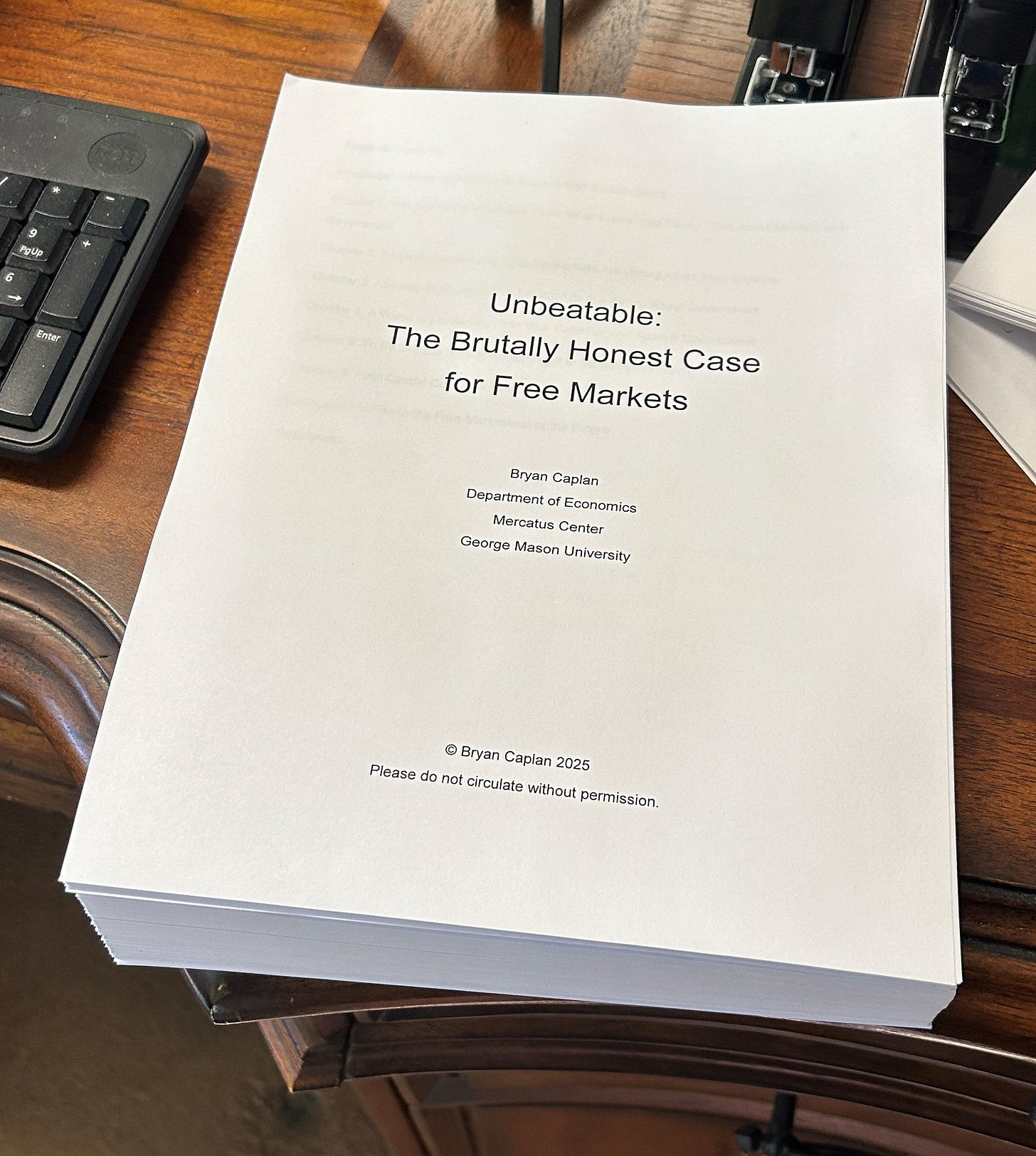
An excerpt from Chapter 4 of *Unbeatable*
Irrationality As the Fountainhead of Market Failure
Excusing the Government
22 May 2025 Leave a comment
in applied price theory, applied welfare economics, comparative institutional analysis, constitutional political economy, economics of bureaucracy, economics of regulation, history of economic thought, income redistribution, international economics, labour economics, law and economics, property rights, Public Choice, public economics, rentseeking, urban economics
An excerpt from Chapter 3 of *Unbeatable*
Excusing the Government
Pro-Market & Pro-Business: Firms Strive to Satisfy the Customer
22 May 2025 Leave a comment
in applied price theory, comparative institutional analysis, economics of information, economics of regulation, entrepreneurship, history of economic thought, industrial organisation, labour economics, law and economics, property rights
Kevin Gentry Talks With Me About Trade and Phil Gramm’s and My New Book
20 May 2025 Leave a comment
in applied price theory, applied welfare economics, Austrian economics, comparative institutional analysis, development economics, economic history, economics of regulation, entrepreneurship, history of economic thought
TweetThanks for the honor, Kevin! The post Kevin Gentry Talks With Me About Trade and Phil Gramm’s and My New Book appeared first on Cafe Hayek.
Kevin Gentry Talks With Me About Trade and Phil Gramm’s and My New Book
David Friedman on markets, governments and whether we need either?
19 May 2025 Leave a comment
in applied price theory, comparative institutional analysis, constitutional political economy, David Friedman, defence economics, economics of crime, economics of regulation, environmental economics, history of economic thought, industrial organisation, law and economics, property rights
The Mainstream World Is Not Free-Market
10 May 2025 Leave a comment
in applied price theory, applied welfare economics, Austrian economics, comparative institutional analysis, constitutional political economy, economic history, economics of education, economics of regulation, history of economic thought, human capital, labour economics, occupational choice
An excerpt from Chapter 1 of *Unbeatable*
The Mainstream World Is Not Free-Market
Policy whiplash risks eroding NZ’s investment stability
10 May 2025 Leave a comment
in applied price theory, comparative institutional analysis, economics of regulation, energy economics, environmental economics, law and economics, politics - New Zealand, property rights
Roger Partridge writes- Resources Minister Shane Jones recently floated a novel idea: Government-backed insurance for oil and gas investors to protect them against future policy reversals. Let that sink in. A New Zealand minister is contemplating taxpayer-funded insurance to compensate companies against… the decisions of future New Zealand Governments.
Policy whiplash risks eroding NZ’s investment stability
Capitalism, Socialism, and Social Desirability Bias
01 May 2025 Leave a comment
in applied price theory, comparative institutional analysis, development economics, economic history, entrepreneurship, history of economic thought, industrial organisation Tags: capitalism and freedom
An excerpt from the Introduction of *Unbeatable*
Capitalism, Socialism, and Social Desirability Bias
Socialism Is an Economic Cancer
26 Apr 2025 Leave a comment
in applied price theory, comparative institutional analysis, development economics, economic history, growth disasters, Marxist economics Tags: economics of central planning

Building on my four-part series (here, here, here, and here) explaining the case against socialism and my five-part series (here, here, here, here, and here) on socialism in the modern world, today’s column will look at the economic argument against that statist ideology. Practically speaking, this seems unnecessary. After all, we can simply look at […]
Socialism Is an Economic Cancer
Pandemic Preparation Without Romance
25 Apr 2025 Leave a comment
in applied price theory, applied welfare economics, comparative institutional analysis, economics of bureaucracy, economics of regulation, health economics, politics - USA, Public Choice Tags: economics of pandemics
My latest paper, Pandemic Preparation Without Romance, has just appeared at Public Choice. Abstract: The COVID-19 pandemic, despite its unprecedented scale, mirrored previous disasters in its predictable missteps in preparedness and response. Rather than blaming individual actors or assuming better leadership would have prevented disaster, I examine how standard political incentives—myopic voters, bureaucratic gridlock, and […]
Pandemic Preparation Without Romance


Recent Comments