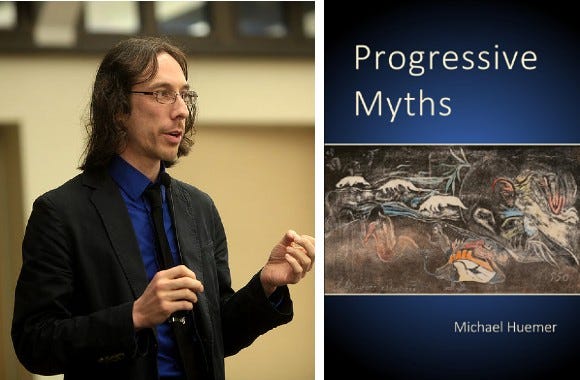
If you are not yet a fan of Michael Huemer, you should be. Hyperbole is the worst thing in the universe, but I still affirm the following: Huemer’s The Problem of Political Authority is the best book on political philosophy. Huemer’s Ethical Intuitionism is the best book on meta-ethics. Huemer’s Knowledge, Reality, and Value is…
Bryan Caplan and Daniel Klein both opine on Milei and populism, Dan being very enthusiastic, while Bryan praising Milei but more reserved in his praise of populism. I too am a big fan of Milei, and I think he is still on a good track. If his reforms do not succeed, likely it will not […]
Roger Partridge writes – Should judges stick to applying the law, or should they reshape it to reflect society’s values? This fundamental tension over judicial power was laid bare at a New Zealand Law Society webinar this month about what it takes to become a High Court judge. Comments from the country’s two senior legal […]
TweetHere’s my just-published remembrance, in Public Choice, of my late teacher, dissertation advisor, co-author, and friend, Bob Ekelund. Three slices: The only textbook assigned for the course was Milton Friedman’s Price Theory. From some younger members of Auburn’s economics faculty, I heard a few cocktail-lubricated complaints that core theory courses in a modern economics Ph.D.…
On my way to India, I connected through Abu Dhabi, capital city of the United Arab Emirates (UAE). During my one-day layover, I toured not only Abu Dhabi, but its more famous sister-city, Dubai. Here are my main thoughts.In Dubai, these are not empty words.Per-capita, UAE is the most amazing country I’ve ever seen. With…
My oral submission to the Regulation Review Committee. Yesterday [Oct 16], Parliament’s Regulation Review Committee heard oral submissions concerning my complaint to the Committee asking that a member of the committee move a resolution asking the House of Representatives to disallow the regulations promulgated by the New Zealand Council of Legal Education. If the regulations…
I’m back from my first trip to India, where I visited Mumbai, Delhi, Agra, and Amritsar. I enjoyed fine company in all four cities. In Mumbai, my new friend Sachin Aggarwal, head of the local EconTalk Club, rolled out the red carpet — and ACX Mumbai joined the festivities. (Thank you, Scott Alexander, for creating…
The Nobel prize goes to Daron Acemoglu, Simon Johnson and James Robinson for their work on institutions, prosperity, and economic growth. Here is a key piece summarizing their work: Institutions as a Fundamental Cause of Long-Run Growth. This paper develops the empirical and theoretical case that differences in economic institutions are the fundamental cause of […]
The Sveriges Riksbank Prize in Economic Sciences in Memory of Alfred Nobel 2024 has been awarded to Daron Acemoglu, Simon Johnson and James Robinson “for studies of how institutions are formed and affect prosperity.” Each year, the Nobel Committee helpfully publishes both a “Popular information” overview of of the award and a “Scientific Background” essay that goes into greater depth.…
During the pandemic, economists often found themselves at odds with politicians, physicians, epidemiologists and others. Some politicians, for example, were worried that the pharma companies might engage in profiteering while economists worried that the pharma companies were not nearly profitable enough. Physicians focused on maximizing the health of patients while economists focused on maximizing the […]
I watched Tuesday night’s debate between David Seymour, Leader of the ACT Party, and Helmut Modlik, an iwi leader, with dismay. On the one hand, David Seymour argued with compelling logic the need to resolve once and for all whether New Zealanders enjoy equal political rights or whether, as Helmut Modlik argued, those with…
Socialism, once hailed as a visionary and revolutionary alternative to capitalism, has deep roots in the progressive movements of the 19th and early 20th centuries. Advocating for state control of the means of production and a more equitable distribution of wealth, socialism aimed to correct the injustices of industrial capitalism. However, as we navigate the […]
New Zealand did once have an upper house known as the Legislative Council. Is there are argument that it should be re-introduced? Philip Crump writes – New Zealand’s parliamentary system has long been admired for its democratic principles and progressive governance although it has increasingly come under strain and criticism over recent years. In […]
As with unionism, overreach will end iwi power push Graham Adams writes – One of former Labour Prime Minister Jacinda Ardern’s most singular achievements during her tenure as premier was to push a majority of voters to the point of revulsion regarding race-based policy. Now the coalition government is orchestrating a swift counter-revolution, with […]
Why Evolution is True is a blog written by Jerry Coyne, centered on evolution and biology but also dealing with diverse topics like politics, culture, and cats.
“We do not believe any group of men adequate enough or wise enough to operate without scrutiny or without criticism. We know that the only way to avoid error is to detect it, that the only way to detect it is to be free to inquire. We know that in secrecy error undetected will flourish and subvert”. - J Robert Oppenheimer.


 Utopia, you are standing in it!
Recent Comments