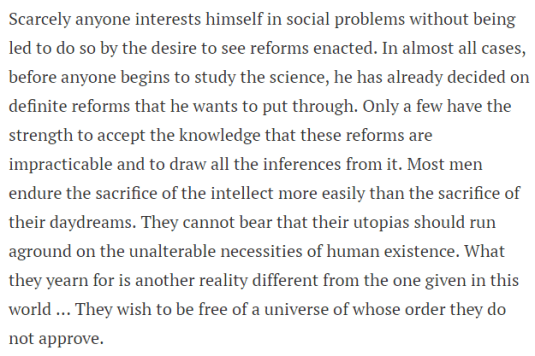
Source: Unicorn Governance | Foundation for Economic Education.
Celebrating humanity's flourishing through the spread of capitalism and the rule of law
20 Jun 2016 Leave a comment
in applied price theory, applied welfare economics, comparative institutional analysis, Ludwig von Mises, Public Choice
20 Jun 2016 Leave a comment
in Adam Smith, applied price theory, applied welfare economics, Austrian economics, comparative institutional analysis, constitutional political economy, development economics, history of economic thought, Public Choice Tags: central planning, The fatal conceit, The pretence to knowledge
19 Jun 2016 Leave a comment
in applied welfare economics, Austrian economics, comparative institutional analysis, macroeconomics, monetary economics Tags: free banking
18 Jun 2016 Leave a comment
in applied price theory, applied welfare economics, comparative institutional analysis, economics of crime, economics of regulation, law and economics, politics - USA Tags: expressive voting, game theory, gun control, offsetting the, unintended consequences
https://twitter.com/Thomas_Conerty/status/649800146528563200
If you want fewer mass shootings, reduce the supply of gun free zones where even the craziest gunmen have been able to find despite being tormented by the voices as John Lott explains
Time after time, we see that these killers tell us they pick soft targets. With just two exceptions, from at least 1950, the mass public shootings have occurred in these gun-free zones. From last summer’s mass public killers in Santa Barbara and Canada, to the Aurora movie theatre shooter, these killers made it abundantly clear in their diaries or on Facebook how they avoided targets where people with guns could stop them.
And even when concealed handgun permit holders don’t deter the killers, the permit holders stop them. Just a couple of weeks ago, a mass public shooting at a liquor store in Conyers, Ga., was stopped by a concealed handgun permit holder.
The USA is in an arms race between criminals and law-abiding citizens. Both have lots of guns so the only people who gain from disarmament to those who obey the law to have fewer guns. They are in a high gun equilibrium where it very difficult to get out of this arms race.
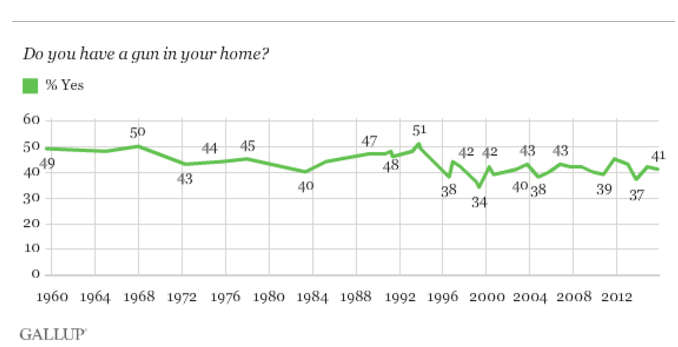
Demands for more gun control and bans on specific weapons postpone the hard work of how to reduce mass shootings in a society with easy gun access. It is expressive politics at its worse.
What does U.S. gun ownership really look like? Load up with #PollPosition’s @Johnnydontlike: bit.ly/1y2EMjX http://t.co/fn5EpM75U7—
(@PJTV) March 25, 2015
An Australian politician today in an unrelated context regarding universal health insurance in Australia called Medicare made this point about politics is hard work, not political theatre
It’s so much easier today to be a cynical poseur than a committed democrat, it’s easier to retreat to observer status than convince your friends of the merits of incremental change.
It required hard slog to ensure those institutions could survive the heat of adversarial politics. Then it took election campaign after election campaign, tough political negotiation, administrative effort, and the making and breaking of careers and governments to finally make Medicare stick,” she said.
The creation of Medicare took more than a hollow-principled stand, it took more than just wishful thinking, it took more than slogans, it took more than protests. It took real, tough politics. It took idealists who were prepared to fight to win government.
Expressive politics is about what voters boo and cheer, not whether policies actually work if adopted. Voters want to feel good about what they voted for and find a sense of identity in who they oppose and what they support. After a mass shooting, voters feel they must do something, cheer for something better and cheering for more gun control is an easy way to feel better.
Gun control is not going to happen in the USA because of the poor incentives for law-abiding individuals to retreat from high levels of legal private gun ownership when criminals will keep their guns. Harry Clarke pointed out that:
The political popularity of guns is strengthened by Prisoner’s Dilemma disincentives for individuals to retreat from high levels of gun ownership.
Accepting a gun buyback would be unattractive to citizens who would recognize high levels of overall gun ownership in the community and, hence, their own personal increased vulnerability if those with criminal intent acted rationally and kept their weapons.
If you want fewer mass shootings, fewer gun free zones is the way to go. That might have other unintended consequences but more mass shootings is not likely to be one of them. Ready access to guns in moments of despair increases suicide rates. Suicides in the Israeli Defence Force fell 40% when young soldiers were not allowed to take their guns home at the week-end. Suicides do not increase during the week so the lack of weekend access to guns got them through dangerous moments of despair where ready access to a firearm would have led to a suicide.

The last thing spree killers want is to be quickly shot down like the dogs they are such as at an American church in 2007. The last wannabe jihadist to try it on in Texas died in a hail of gunfire.
The U.S. Department of Justice’s National Crime Victimization Survey showed the risk of serious injury from a criminal attack is 2.5 times greater for women offering no resistance than for women resisting with a gun. 97% of murders are by men. Any arguments about gun control should be about gun control for men.
The sharemarket perception of gun control is every time there are calls for more gun controls, the share prices of gun manufacturers surge of the back of an anticipated spike in sale. Buying two gun shares on the first trading day after 12 recent mass shootings and selling them 90 days later produces a return of 365% over a nine-year period compared to 66 percent for the S&P 500 Index. A buy-and-hold bet on Smith & Wesson stock starting in January 2007returns 137%.
What gun-control headlines mean for gun-industry bottom lines: reut.rs/20LPJGf via @specialreports https://t.co/R3QiG4MuSM—
Reuters Top News (@Reuters) February 05, 2016
The key to the success of Australian and New Zealand gun laws was low levels of gun crime and minimal use of guns for self-defence. There was no arms race as compared to the USA where criminals and civilians are both armed. It is easy to control an arms race that has not started. The New Zealand, Australian and even the British police rarely have to discharge their weapons.

Martin Luther King was a gun owner for obvious reasons. Tom Palmer was the lead litigant in the recent Supreme Court case on gun control in the USA. He saved himself and a fellow gay man from a severe beating in 1987 by gang of 20 men by pulling a gun on them. Pink pistols has been in the thick of anti-gun control litigation in the USA.
18 Jun 2016 Leave a comment
in applied price theory, comparative institutional analysis, economics of regulation, Public Choice, rentseeking, Ronald Coase
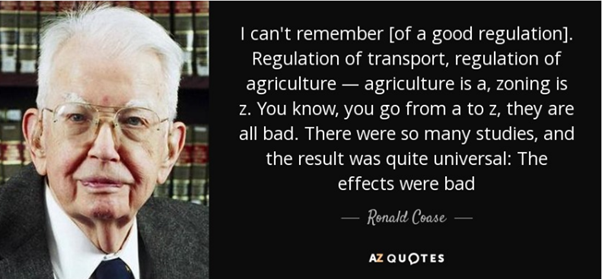
.
18 Jun 2016 Leave a comment
in applied welfare economics, comparative institutional analysis, constitutional political economy, economic history, Public Choice

Source: Quotation of the Day… – Cafe Hayek.
17 Jun 2016 Leave a comment
in applied price theory, comparative institutional analysis, public economics Tags: public goods
13 Jun 2016 Leave a comment
in applied price theory, comparative institutional analysis, economic history, entrepreneurship, industrial organisation Tags: spontaneous order
13 Jun 2016 Leave a comment
in Austrian economics, comparative institutional analysis, constitutional political economy, economics, F.A. Hayek Tags: Robert Bork
11 Jun 2016 Leave a comment
in applied price theory, applied welfare economics, comparative institutional analysis, constitutional political economy, economics, economics of information, income redistribution, Public Choice, public economics, rentseeking Tags: rational ignorance, rational irrationality, voter demographics
09 Jun 2016 Leave a comment
in applied price theory, applied welfare economics, comparative institutional analysis, constitutional political economy, development economics, economic history, history of economic thought, Marxist economics Tags: capitalism and freedom
09 Jun 2016 Leave a comment
in applied price theory, applied welfare economics, comparative institutional analysis, economic history, economics of education, economics of regulation, health economics, income redistribution, industrial organisation, international economics, politics - USA, Public Choice, public economics, rentseeking Tags: 2016 presidential election, antimarket bias, crony capitalism, living wage, pessimism bias, top 1%
08 Jun 2016 Leave a comment
in applied price theory, comparative institutional analysis, health economics, law and economics, politics - USA, property rights Tags: best shot public goods, creative destruction, drug prices, game theory, good shot public goods, military alliances, NATO, patterns and copyrights, Warsaw Pact, weakest link public goods, World War I
Much is made of the fact that drug prices are lower in Canada and Western Europe as compared to the USA. Indeed, day trips are made across the Canadian border to buy cheaper drugs as compared to the local pharmacy pricin in a US city.

Instead of what is always the relevant public policy question. What would happen in the USA if attempts were made to seriously reduce the price of drugs. The answer is obvious, the incentive to create new drugs would be severely diminished. There are no free lunches in public policy.

Bringing in new drug to the market is a seriously expensive business these days. That is before you consider the commercial risk of inventing a drug that isn’t much better than its competitors.
Of course, you can always be leapfrogged by another drug company brining on a better drug not long after you have brought yours to market. None of this is getting any cheaper.

Innovation by specific drug company is a form of public good production known as best shot public goods. Under a best-shot rule, the socially available amount is the maximum of the individual quantities. There is is a single prize of overwhelming social importance, such as a major drug breakthrough, with any individual’s effort having a chance of securing the prize.
A specialty drug for a year costs more, on average, than most household incomes wpo.st/0y_q0 https://t.co/uss6ikgkYk—
carolyn johnson (@Carolynyjohnson) November 20, 2015
The amount to be produced of a best shot public good depends on the best contribution rather than the usual situation of any contribution is interchangeable. Another example is a large number of people shooting at an incoming missile. The best shot counts, all the others don’t matter.
High drug prices in the USA could be the price of the weakest shot or weakest link public good. Weakest shot public good is where the socially available amount is the minimum of the quantities individually provided. One example a weakest link public goods are military alliances where the success of the alliance depends upon everyone contributing
In the weakest shot or weakest link theory of public good production, the free riding countries of Europe will bring the whole show down by not making their contribution to drug research by buying at good prices from the US pharmaceutical companies.
Perhaps a better way to look at drug innovation is a good shot public good. Someone has to make a reasonable contribution; that has to be the USA because it is such a large market. Without access to good prices in the USA, there wouldn’t be enough of an incentive for drug innovation.
Military alliances such as NATO and the Warsaw Pact probably are examples of good shot public goods. They depend on a number of large countries making their contribution but I always leaned towards the crucial best shot contribution of the USA and former USSR .
In the case of the start of World War I, Triple Entente against Germany was a weaker shot public good. Its defensive wall depended on the strength of the weakest country defending i.e. the unfortified Belgian border (in both wars). The Tripartite Alliance was a best shot public good depending on the strength of Germany’s attack for ultimate success or failure.
07 Jun 2016 Leave a comment
in applied price theory, comparative institutional analysis, labour economics, minimum wage, politics - USA, Public Choice Tags: antimarket bias, expressive voting, living wage, rational rationality
Any decent political movement makes an ambit claim in expectation of being beaten back to its real position. That is basic negotiation tactics in politics.
Such is the volatility of expressive politics that the fight for 15 campaign has taken on a life of its own and is actually delivering on a $15 living wage as the minimum wage in the USA in a growing number of states and cities as well is in Democratic party presidential campaign pledges.
If there is any degree of economic sanity and practicality among living wage advocates, they know that such a high living wage increase will cost jobs.
After all, if a large wage increase for low-paid workers cost no jobs, why not increase everyone’s wage by a similar percentage, which is about 100% in the USA?
Celebrating humanity's flourishing through the spread of capitalism and the rule of law
Celebrating humanity's flourishing through the spread of capitalism and the rule of law
Celebrating humanity's flourishing through the spread of capitalism and the rule of law
Celebrating humanity's flourishing through the spread of capitalism and the rule of law
Celebrating humanity's flourishing through the spread of capitalism and the rule of law
Celebrating humanity's flourishing through the spread of capitalism and the rule of law
Celebrating humanity's flourishing through the spread of capitalism and the rule of law
Celebrating humanity's flourishing through the spread of capitalism and the rule of law
A History of the Alt-Right
Econ Prof at George Mason University, Economic Historian, Québécois
Celebrating humanity's flourishing through the spread of capitalism and the rule of law
Scholarly commentary on law, economics, and more
Beatrice Cherrier's blog
Celebrating humanity's flourishing through the spread of capitalism and the rule of law
Celebrating humanity's flourishing through the spread of capitalism and the rule of law
Celebrating humanity's flourishing through the spread of capitalism and the rule of law
Why Evolution is True is a blog written by Jerry Coyne, centered on evolution and biology but also dealing with diverse topics like politics, culture, and cats.
Celebrating humanity's flourishing through the spread of capitalism and the rule of law
A rural perspective with a blue tint by Ele Ludemann
DPF's Kiwiblog - Fomenting Happy Mischief since 2003
Celebrating humanity's flourishing through the spread of capitalism and the rule of law
The world's most viewed site on global warming and climate change
Tim Harding's writings on rationality, informal logic and skepticism
A window into Doc Freiberger's library
Let's examine hard decisions!
Commentary on monetary policy in the spirit of R. G. Hawtrey
Thoughts on public policy and the media
Celebrating humanity's flourishing through the spread of capitalism and the rule of law
Politics and the economy
A blog (primarily) on Canadian and Commonwealth political history and institutions
Reading between the lines, and underneath the hype.
Economics, and such stuff as dreams are made on
"The British constitution has always been puzzling, and always will be." --Queen Elizabeth II
Celebrating humanity's flourishing through the spread of capitalism and the rule of law
Celebrating humanity's flourishing through the spread of capitalism and the rule of law
WORLD WAR II, MUSIC, HISTORY, HOLOCAUST
Undisciplined scholar, recovering academic
Celebrating humanity's flourishing through the spread of capitalism and the rule of law
Res ipsa loquitur - The thing itself speaks
In Hume’s spirit, I will attempt to serve as an ambassador from my world of economics, and help in “finding topics of conversation fit for the entertainment of rational creatures.”
Researching the House of Commons, 1832-1868
Articles and research from the History of Parliament Trust
Reflections on books and art
Posts on the History of Law, Crime, and Justice
Celebrating humanity's flourishing through the spread of capitalism and the rule of law
Exploring the Monarchs of Europe


Recent Comments