Save Our Parks! How to Keep National Parks Open
25 Feb 2016 Leave a comment
in applied price theory, comparative institutional analysis, environmental economics, law and economics, property rights, resource economics Tags: contracting-out, free market environmentalism, national parks, privatisation
@GarethMP proves the case for privatisation when arguing against privatisation
24 Feb 2016 Leave a comment
in applied price theory, comparative institutional analysis, economics of bureaucracy, industrial organisation, politics - New Zealand, Public Choice, public economics Tags: anti-market bias, New Zealand Greens, privatisation, rational irrationality, state owned enterprises

Green MP Gareth Hughes today nailed the case as to why governments should never run businesses. Too many MPs simply do not understand what dividends represent and what the profits from asset sales represent.
Hughes was reported today saying that taxpayers lost nearly $1 billion in dividends since the recent privatisations of power companies. He is the Green party spokesman on state owned enterprises.

Source: Asset sales cost hits $1 billion | Green Party of Aotearoa New Zealand.
Does the Green Party understand that an asset sells for a price equal to its risk-adjusted discounted net present value of the stream of dividends. When you sell a financial asset, you cash out the net present value of the stream of dividends that might have come from those assets.
The Greens, who are prissy about government transparency and dishonesty of their opponents, did not mention the $4.7 billion in revenue from the asset sale. Taxpayers now receiving more in dividends as a part owner of the privatised power companies than they did as a full owner.
Hughes had the cheek to complain about the politicisation of those privatisations such as favourable terms for small share buyers. That inability of governments to even sell an asset competently is a strong reason why governments should never run businesses in the first place.
If an asset cannot be sold in the full light of day – a major issue in an election campaign and a referendum – without the sale price that is politicised, what is the chance of good management of any state-owned enterprise when it is not the central focus of opposition scrutiny?
It is been many years since dividends from the state-owned enterprise portfolio has been a net positive cash flow for the taxpayer, as the chart below shows.
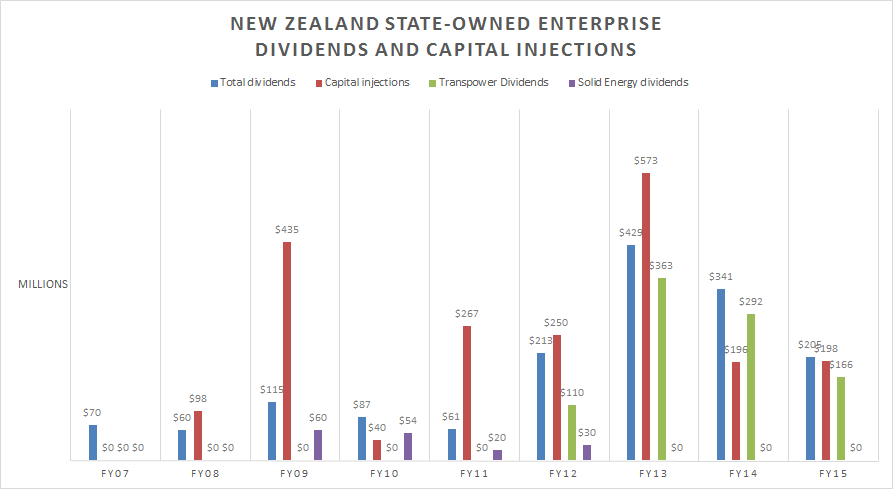
Source: New Zealand Treasury – data released under the Official Information Act.
KiwiRail and Solid Energy gobbled up whatever dividends came out of the power companies. Aside from power companies, state-owned enterprises not really offer much in the way of dividends to the taxpayer as the chart again shows.
Note from @paulkrugman to @BernieSanders @JeremyCorbyn and their supporters
23 Feb 2016 Leave a comment
in applied price theory, comparative institutional analysis, constitutional political economy, economic history, economics of media and culture, economics of regulation, labour economics, macroeconomics, Marxist economics, politics - USA Tags: 2016 presidential election, antiforeign bias, antimarket bias, British politics, Leftover Left, make-work bias, rational ignorance, rational irrationality, renegade Left, Twitter left

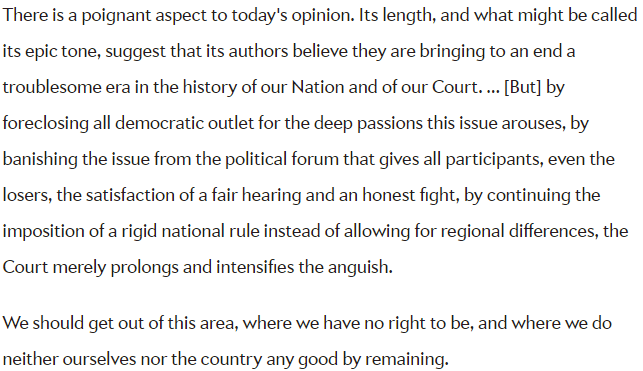
Scalia on who should decide vexing social issues @PeterDunneMP
15 Feb 2016 Leave a comment
in comparative institutional analysis, constitutional political economy, law and economics, politics - New Zealand, politics - USA Tags: abortion rights, marijuana decriminalisation
Ten behavioural biases and effects in regulation
12 Feb 2016 Leave a comment
in applied price theory, behavioural economics, comparative institutional analysis

Source: Stephen Littlechild via Who’s Phooling Whom? – Clive Crook.
Why Robert Hanson leans Libertarian
06 Feb 2016 Leave a comment
in comparative institutional analysis, law and economics, liberalism, libertarianism
Defending the Market Economy – A Lecture by Friedrich A. Hayek
23 Jan 2016 Leave a comment
in applied price theory, Austrian economics, comparative institutional analysis, constitutional political economy, development economics, economic history, F.A. Hayek Tags: capitalism and freedom
Is the #WTO a failure or a success? @russelnorman @AndrewLittleMP #TPPA
18 Jan 2016 Leave a comment
in comparative institutional analysis, international economics
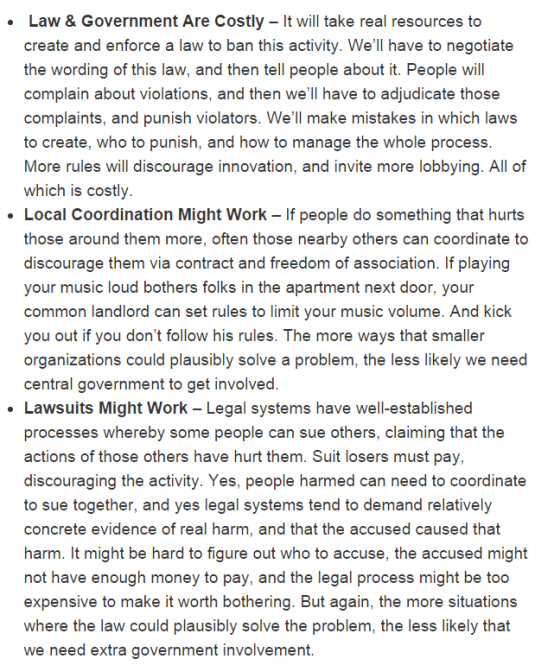
David Friedman explains incentive incompatibility and comparative institutional analysis
18 Jan 2016 Leave a comment
in applied price theory, comparative institutional analysis, constitutional political economy, David Friedman, industrial organisation, law and economics, property rights Tags: incentive incompatibility, public goods

The Miracle of New Zealand
18 Jan 2016 Leave a comment
in applied price theory, applied welfare economics, comparative institutional analysis, constitutional political economy, economic history, economics of regulation, politics - New Zealand Tags: Roger Douglas, Ruth Richardson
Arnold Kling describes “Masonomics”
17 Jan 2016 Leave a comment
in applied price theory, Austrian economics, comparative institutional analysis, constitutional political economy, history of economic thought

Why are Russians more trusting of government than New Zealanders? Maybe they do not trust the interviewer?
12 Jan 2016 Leave a comment
in comparative institutional analysis, politics - New Zealand, Public Choice
Whose voting base has succumbed to unthinking populists?
31 Dec 2015 Leave a comment
in applied price theory, comparative institutional analysis, constitutional political economy, economics of education, economics of information, economics of media and culture, income redistribution, international economics, Marxist economics, politics - New Zealand, Public Choice, rentseeking Tags: 2016 presidential election
Diogenes on what should governments do
26 Dec 2015 Leave a comment
in applied price theory, applied welfare economics, comparative institutional analysis, constitutional political economy, liberalism Tags: ancient Greeks, Diogenes, growth of government, philosophy of economics, size of government, The fatal conceit, The pretence to knowledge


Recent Comments