Jeffrey Miron of Havard University explores three myths about capitalism
26 Apr 2016 Leave a comment
in applied price theory, applied welfare economics, Austrian economics, comparative institutional analysis, constitutional political economy, development economics, economic history, economics Tags: Jeff Miron, The Great Fact
Freedom as a solution to poverty @Oxfam
24 Apr 2016 Leave a comment
in Austrian economics, comparative institutional analysis, constitutional political economy, development economics, economic history, economics of media and culture, growth miracles Tags: Bill Easterly, The Great Escape, The pretence to knowledge
In defence of the economic way of thinking
22 Apr 2016 Leave a comment
in applied price theory, applied welfare economics, Austrian economics, comparative institutional analysis, history of economic thought Tags: conjecture and refutation, economic methodology, philosophy of economics, philosophy of science, philosophy of the social sciences
Thinking about thinking
A study of any problem cannot start by gazing at a mass of unorganised data and material without pre-judgment as to what is and is not important. Every analyst must come equipped with a world-view: an interrelated set of ideas about the causal relationships governing how the world works.
This selection of an analytical framework precedes any attempt to ascertain which facts are relevant to explaining particular events. Facts have to be selected and ordered in accordance with analytical judgments about their importance. This post is about the virtues of the economic point of view in this endeavour.
The facts of the social sciences
The aim of the social sciences is to explain and understand social phenomena. The facts of the world are what the individuals think and believe. Understanding human action in general and particular social phenomena therefore means understanding the opinions and beliefs that guided individual decision-making.
Measurement and theory
Measurement without theory is a futile and self-deceiving exercise. Our observations of the world are always selective and theory-laden (Popper 1963).
The number of factors which predate and lead to any event, past, present, or future, is indefinitely large, and knowledge of all of these factors is impossible, even in principle (Popper 1963).
In the social sciences, there is no laboratory where facts can be isolated and controlled and manipulated one-by-one. The facts of history are complex – the result of many causes including changing human motives and ideas, changes in relative prices and expanding technological possibilities. This rich tapestry of causes can be only isolated by theory, theory that is necessarily developed prior to these historical (including statistical) facts.
Every analyst must come prepared with a theory to tell them ‘what to look for’ (Koopmans 1947). Our experiences and past knowledge selects, shapes, influences, organised, classifies and measures any phenomena we seek to understand (Popper 1963). A theory allows us to think deeply and to figure out how to attain and verify knowledge about the world.
The purpose of theory is to aid in the interpretation of experience and history. A scientific community cannot practice its trade without some set of received beliefs about what the world is like. These beliefs create avenues of inquiry, formulate questions, select methods to examine questions and define areas of relevance (Kuhn 1962).
The questions asked in any research and which data is to be reviewed or reconsidered are not random choices. The variables to be defined, and the specific data to be collated and interrogated are all chosen in light of past research findings. Empirical and theoretical anomalies and prior theoretical beliefs also decide what is relevant or not, where to start and when to stop, and how new findings are to be melded with and even justify overturning existing understandings (Koopmans 1947; Popper 1963; Leamer 1983; Hendry 1980).
Empiricists are able to believe that facts can be understood without any theory only because they failed to recognise a theory is already contained in the very linguistic terms involved in every act of thought. To apply language, with its words and concepts to anything is at the same time to approach it with a theory. The choice is never between theory and no theory. The choice is between articulated and defended theory and unarticulated and non-defended theory.[1]
Thinking about abstractions
The fundamental hypothesis of the scientific method is appearances are deceptive. The way to organise the facts at hand to reveal the more fundamental and often counter-intuitive structures that drive seemly disconnected and diverse phenomena is to break a problem into parts (Friedman 1953; Marshall 1925).
It is fundamental that new knowledge is gleaned by the orderly loss of information. This is done by abstracting from and indexing the great confusion of information in the world around us that must be appreciated and comprehended (Boulding 1970).
A primary function of the human mind is the classification of sensory perceptions of reality; the mind is an apparatus of classification that evolves through experience (Hayek 1952). The human mind abstracts, filters and files as a matter of necessity. Abstractions escape the cognitive overload of the countless many details of daily life to strive to strike at the essence of what might drive different social phenomena (McKenzie and Tullock 1978, 1994).
The power and self-discipline of parsimonious analysis
Some bristle over the small size of the basic analytical tool kit of economists and the leanness of the behavioural assumptions therein (Stigler 1987; McKenzie 2010). This paper is also lean in its analytical structure. It focused on a few costs: the fixed costs of employment and of going to work and team interdependencies.
Simpler explanations and more parsimonious abstractions are better ‘engines for the discovery of concrete truth’ about how people will respond to changes in their economic and social environments.
A limited set of causes or postulates in a theory reduces the chances that one or more of the assumptions on a more extensive list inadvertently explains away in an ad hoc manner every possible anomaly, or allows for a deft reinterpretation and/or adaptation to temporise and escape refutation. An every growing number of auxiliary hypotheses and ah hoc assumptions to co-op inconvenient facts may forever immunise the basic theory under scrutiny against testing and falsification (Olson 1982; Popper 1963).
More parsimonious abstractions are less likely to found theories that seem to have successfully explained a particular social phenomenon spuriously by chance.
Complex human objectives are not assumed in economic analysis because everything could be explained and nothing could be falsified. Every empirical anomaly could be covered in advance by assuming human objectives that are sufficiently complex and large enough in number that are pursued with a high frequency of error and inertia (Friedman 1990; Popper 1963).
Subsequent ad hoc reinterpretations that add new objectives or additional sources of human frailty can finesse major anomalies to make the basic theory compatible with the facts to side-step refutation. Heavily qualified theories and intricate explanations of narrow application rarely come in the open for long enough to be found wanting.
A good theory is a prohibition: the theory forbids certain things to happen. The more that a theory forbids, the better the theory is. Bold, novel and chancy predictions are even better still. These predictions are less likely to explain social and economic behaviour spuriously by chance. If incorrect or incomplete, bold and novel predictions are more likely to be quickly found at odds with experience and the basic theory is either revised or is discarded (Popper 1963).
The nature of economic inquiry
Economic analysis has this strength of bold parsimony. Because economics assumes a few simple objectives and that people tend to choose the best way of achieving their objectives, economics must make risky predictions. Such risk-taking is a methodological strength of a science (Popper 1963).
Evidence falsifying economic predictions is easier to find. This is because economics is a public science with a few well-known behavioural assumptions and it is routine to compare the power of its explanations against data and historical experience. The central assumption of economics is rationality: social behaviour is to be best understood in terms of the purposes the individual intended to achieve.
Economic predictions always must take the risk of being consistent with a few simple and well-known behavioural assumptions which cannot be adjusted ad hoc. The same parsimonious analytical tools are used by a great many people in many countries to validate and improve their applicability and explanatory power. Any ad hoc addition of new assumptions to fill the more glaring gaps in an economic analysis to immunise the basic theory under scrutiny against a looming falsification would immediately become apparent and would invite public discredit.
Falsifying evidence cannot be explained away or be differentiated as a special case. There can be no resort to a protective belt of auxiliary assumptions about a great multiplicity of human objectives and the many decision rules used to pursue them that are often unique to different social settings or countries, and that mistakes and inertia in human choices are frequent. Parsimony is a rebuff both to adhockery and provincialism and to fragile policy advice and evaluations.
Rational choice theory
A most fruitful method for explaining the origins, structure and changes in social phenomena is by describing the causal mechanisms that are based on individual purposeful behaviour motivated by their desires and constrained by their opportunities (Elster 1989, 2007; McKenzie and Tullock 1978, 1994). Economics is a way of understanding behaviour that assumes individuals have objectives and they tend to choose the correct way of achieving them (Friedman 1990).
Only individuals think, feel, choose and act. The elements of social life are individual actions. The explanation of social institutions and social change therefore lies in explaining of how they arose as the often unintended consequences of the actions and interactions of individuals (Elster 1989, 2007).
Complex social and economic phenomena are explained in terms of individual actions of which they are composed (Elster 1989, 2007). There is no analytical approach of comparable generality that has been developed that offers serious competition to rational choice theory in understanding and predicting social and economic behaviour and providing public policy advice and evaluation.[2]
Nothing in economics rests on the premise that people are logically consistent in their processes of thought.[3] Social behaviour can be understood with economic analysis despite Menger’s long ago observation that people are bumbling, erring, ill-informed creatures, plagued with uncertainty, forever hovering between alluring hopes and haunting fears (Jaffe 1976).
People act purposefully to overcome their limitations and improve on their situations. People work harder to do so the larger is the net gain from greater alertness to new opportunities and from learning, correcting errors, adapting, imitating success and developing and maintaining institutions and processes that improve on their lot.[4] For all its biases and blind spots, human rationality is an evolutionary adaptation to the scarcity of resources and the exigencies that have driven natural selection.[5]
The economic way of thinking
Individual behaviour is constrained by income and wealth, the scarcity of resources, limited information, uncertainty, the dispersed and tacit nature of most knowledge, imperfections of memory and calculating capacities, limited amounts of time, surrounding economic, social, legal, regulatory and political institutions, habits, traditions, culture and social norms.[6]
Individual behaviour is also constrained by the available opportunities in the economy and elsewhere; these opportunities are largely determined by the private and collective actions of other individuals and social, economic and political institutions.[7]
The economic analysis aims at indicating what will or will not happen and what will increase or lower the probability of various consequences of different events and market processes. Once the incentives and constraints are established, economic theory, along with other sciences, can be applied to trace out the effects of these actions in producing the complex events and processes of the workplace which are only partially and imperfectly captured in statistical data.
Theory and policy
Policy analysis is not a game of the obvious. The data never speaks for itself. Nor is policy analysis an exercise in chronicling – a listing of events. As Coase observed (1984, p. 230), ‘without a theory they had nothing to pass on except a mass of descriptive material waiting for a theory, or a fire’.
A policy analysis can not start without a theoretical framework to select which institutions and market processes among many are to be used in the subsequent narrative. The analytical assumptions and apparatus to be used to decide what are and what are not pertinent and to what degree should be disclosed for scrutiny.
Positive economics and policy goals
Policy makers look to positive economics in this paper to help in the framing of positive ageing policy options. The economic advice that is offered will be the result from an exercise in positive science concerning facts and making of reliable predictions about the consequences that follow specific changes in circumstances.
Positive economic analysis can investigate whether a policy can bring about its intended results and probe for unintended consequences that even the supporters of the policy might judge to be undesirable. Positive economics is a science of causes. It studies how social phenomena were caused by the interaction between ideas, desires and wants and an environment offering limited resources for the satisfaction of these desires and wants.
For a science to be interpersonally valid, it must not depend on the personal views of any one scholar.[8] The scientific character of any social science requires that it be meticulously impartial as between different judgments of values. Such detachment may be difficult, but it is not impossible.
Economics is a value-free science in the sense that the particular purposes or goals that are being pursued are not essential to the economic analysis of the specific situation that is under discussion and scrutiny. Positive economics makes conditional predictions of an if-then nature.
The positive economic analysis of what is and what might happen are distinct from normative inquiries into what ought to be. To make analytical headway, policy analysis can, however, include interpreting and articulating the incomplete specifications of goals and constraints provided by policy makers (Machlup 1978).
Positive economics can explain: the workings of the economy; that resources are limited; that choices imply opportunities forgone; that human actions have unintended consequences; that in a changing world, decisions must be made based on expectations of future events; and that individuals and firms respond in ways that can offset part of the intended effects of legal and regulatory changes.
Value judgements and public policy
All policy recommendations necessarily involve value judgments. Positive economics is still relevant to normative problems about what ought to be done about an ageing workforce and how any given positive ageing policy goal might be attained. Most policy conclusions rest on predictions about the consequences of one policy over another.
Many policy differences reflect honest disagreements over how to achieve what on closer inspection is the same broad policy goal. People who disagree sharply on moral priorities should be able, in principle, to agree on the consequences of policy options.
Progress in and refinement of economic knowledge may narrow these differences over the particular means of achieving what could be a common policy goal. Interlocutors may instead agree on the predicted consequences of a particular policy option.
One may judge these predicted consequences as desirable on balance and thus favour the policy. For the other, these consequences are judged to be undesirable on balance and oppose the policy.
The power of economic analysis used in this paper lies in predicting the consequences of different events and identifying the relationships between events, processes and social and economic institutions, cultures and social norms. The economic analysis can indicate the direction of an effect, an increase or decrease, and if sequential adjustments are required, it can indicate that a process will take time. The counter-intuitive nature of economic reasoning can identify less obvious, delayed and unintended consequences of human action.
Evidence-based policy
Policy analysis is more expeditious and fruitful if the analyst, audience and critics are familiar with the particulars and the intellectual pedigree of analytical tools used, and it is the results of the application of road-tested tools that is in dispute.
Evidence-based policy is multi-method. A methodenstreit[9] is thereby passed over in favour of comparisons of the relative power of the competing methods to explain social dilemmas and develop policy solutions.
Policy knowledge can then grow through the robust interchange of conflicting ideas. Any preferences for evidence of certain types or for data from particular countries and preferred sources and the use of one analytical method over another must be justified.
Robustness in policy analysis
A leading role of evidence-based policy is to identify and discard as quickly and persuasively as possible proposed solutions that are less effective. The virtues of policy solutions must be transparent and open to falsification. A multitude of auxiliary assumptions to immunise the basic theory against scrutiny loses contact with the progressive, cumulative science-based aspects of evidence-based policy.
From a public policy standpoint, a proposed policy is more likely to be effective if its success does not hinge on the presence of a large number of transitory special conditions. Economic predictions about the likely effects of policy options do not depend on a protective belt of fragile auxiliary assumptions about a multiplicity of human objectives and many decision rules for different settings. This helps design robust public policies whose effects are based on economic predictions that are a body of well-tested generalisations rather than an extensive list of special cases.
The strengths of economic analysis are it is founded on a few well-justified and internally consistent premises such as individuals strive to achieve their goals by using limited resources and incomplete and dispersed knowledge.
Economic predictions have been tested in many institutional settings in many different countries and have survived rigorous, structured public scrutiny on the basis of universal or impersonal criteria of good scientific research.[10]
A systematic approach robust to different data from many countries will help frame policy options on facts, reasoned arguments and anticipated consequences and promote cross-national learning about social and economic change and past policy successes and disappointments. Policy options can be short-listed to those that might be a net social improvement on the status quo.
[1] A theory is a coherent set of propositions about cause and effect relations between events, which when logically used will guide the user to correctly state the consequences of some initial action (Alchian, Allen and Hoel 2005).
[2] See Elster (2007), Stigler (1984, 1987), Hirshleifer (1985), Becker (1993); Demsetz (1996), Ekelund and Tollison (1997) and McKenzie (2010).
[3] See Machlup (1946, 1947), Alchian (1950), Becker (1962), Alchian and Allen (1977), McKenzie and Tullock (1978, 1994), Alchian, Allen and Hoel (2005), McKenzie (2010), Smith (2003, 1998, 1991, 1989), Epstein (2006a, 2006b, 2008), Glaeser (2006), Tarr (1976), and Kirzner (1962, 1987).
[4] See McKenzie and Tullock (1994), Posner (1998), Epstein (2006a, 2006b, 2008), Glaeser (2006) and McKenzie (2010).
[5] See Nozick (1993), McKenzie and Tullock (1994), McKenzie (2010), Smith (2003, 1998) and Alchian, Allen and Hoel (2005).
[6] See Elster (1989, 2007), Becker (1993, 1998), Becker and Murphy (2003) and McKenzie (2010).
[7] See Elster (1989, 2007) Becker (1998) and Becker and Murphy (2003).
[8] Scientific inquiry assumes that: reality is objective and consistent, we have the capacity to perceive reality accurately and honestly, rational explanations exist for the world around us, and all scientists can contribute to science and the search for knowledge regardless of race, nationality, class, culture or gender. A science is any mode of investigation that is systematic and impartial.
[9] The literal translation from German is debate over methods.
[10] Most scientists seek to identify regularities in events. A theory, or science, is useful if it explains a wide range of events in a consistent way. Scientific progress consists of developing ever newer theories which approach closer to the truth. This search is undertaken by thinking carefully about a hypothesis, gathering data to test the hypothesis, modifying the hypothesis in light of tests against relevant data, and repeating these steps as needed (Tullock 1966).
But who would be elected president of New Zealand? @PeterDunneMP
22 Apr 2016 2 Comments
in comparative institutional analysis, constitutional political economy, politics - New Zealand, Public Choice Tags: head of state, New Zealand republic
The principal argument against the republic is it results in a president as the head of state.
In the last Republican debate in Australia in 1999, the Republican movement split between those who wanted an appointed president and an elected president.
An elected president would quickly get ideas above his station because of their popular mandate.
Imagine Gareth Morgan as president. He is a great New Zealander, but heads of state are supposed to be seen and not heard.

It would be a good pub quiz game to list the people would be wholly unsuited as president but would be likely to be elected. Boring people such as those who currently occupy the position such as judges and retired military would not have much of a chance of being elected. A vote for president would be the ultimate protest vote.
The Irish president, for example, is elected but is completely circumscribed in powers. The only power they have to exercise independently is whether to dissolve parliament after a motion of no confidence.
A president elected by the New Zealand House of Representatives would still have some sort of independent mandate and sooner or later would get ideas above their station, which is to be seen but not heard.
Why environmentalists are adverse to real solutions #earthday
22 Apr 2016 Leave a comment
in applied price theory, applied welfare economics, comparative institutional analysis, constitutional political economy, economics of media and culture, economics of regulation, energy economics, entrepreneurship, environmental economics, environmentalism, global warming, politics - USA Tags: anti-market bias, Earth Day, expressive voting, rational ignorance, rational rationality

Source: Quotation of the day for Earth Day on the ‘science of economics versus the religion of environmentalism’ … – AEI | Carpe Diem Blog » AEIdeas from Steven E. Landsburg’s book “The Armchair Economist: Economics and Everyday Life,” in his chapter titled “Why I Am Not an Environmentalist: The Science of Economics versus the Religion of Ecology“.
A challenge for @GarethMorgannz on disagreement in public policy making
21 Apr 2016 Leave a comment
in applied price theory, comparative institutional analysis, constitutional political economy, politics - New Zealand, Public Choice, rentseeking Tags: action bias, conjecture refutation, motivated reasoning, The fatal conceit, The pretense to knowledge


SPECIFIC TYPES OF IRRATIONALITY THAT CAUSE GOVERNMENT FAILURE
21 Apr 2016 Leave a comment
in applied price theory, comparative institutional analysis, constitutional political economy, economics of bureaucracy, economics of information, Public Choice Tags: behavioural public choice, growth of government, rational irrationality, size of government
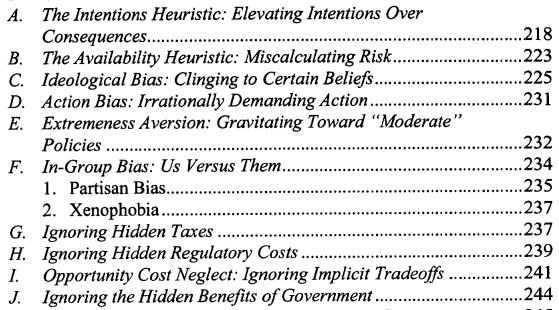
Source: Gary Lucas and Slavisa Tasic‘s "Behavioral Public Choice and the Law" (West Virginia Law Review, 2015) via Bryan Caplan
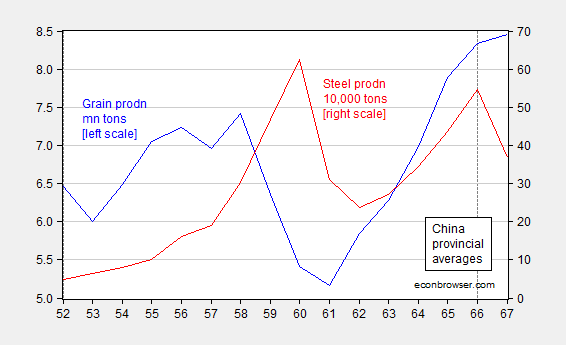
Thinking about The Great Leap Forward | Econbrowser
19 Apr 2016 Leave a comment
in applied price theory, applied welfare economics, comparative institutional analysis, development economics, economic growth, economic history, growth disasters, industrial organisation, law and economics, Marxist economics, Public Choice, rentseeking Tags: China, economics of planning, extreme poverty, famine, Great Leap Forward
Solution aversion and the anti-science Left
11 Mar 2016 1 Comment
in applied price theory, applied welfare economics, comparative institutional analysis, constitutional political economy, economics of regulation, energy economics, environmental economics, global warming, health economics, law and economics, politics - Australia, politics - New Zealand, politics - USA, property rights, Public Choice Tags: antiscience left, climate alarmism, geo-engineering, GMOs, growth of knowledge, gun control, motivated reasoning, nuclear power, political persuasion, solar power, solution aversion, wind power
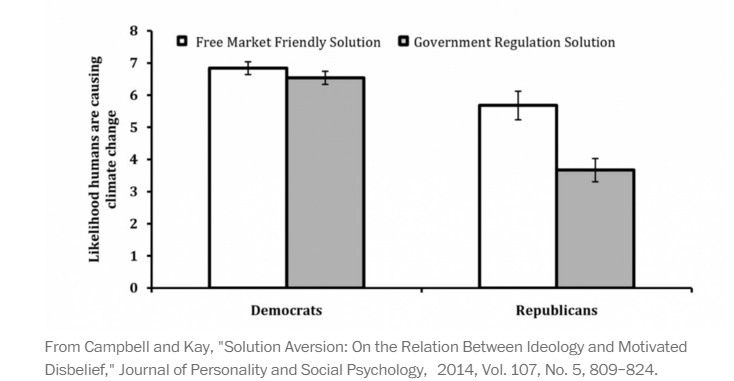
Climate science is the latest manifestation of solution aversion: denying a problem because it has a costly solution. The Right does this on climate science, the Left does it on gun control, GMOs, and plenty more. Cass Sunstein explains:
It is often said that people who don’t want to solve the problem of climate change reject the underlying science, and hence don’t think there’s any problem to solve.
But consider a different possibility: Because they reject the proposed solution, they dismiss the science. If this is right, our whole picture of the politics of climate change is off.
Some psychologists wasted grant money on lab experiments to show that people that think the solution to a problem is costly tend to rubbish every aspect of the argument. Any politician will tell you you do not concede anything. Sunstein again:
Campbell and Kay asked the participants whether they agreed with the IPCC. And in both, about 80 percent of Democrats did agree; the policy solutions made no difference.
Republicans, in contrast, were far more likely to agree with the IPCC when the proposed solution didn’t involve regulatory restrictions…
Here, then, is powerful evidence that many people (of course not all) who purport to be skeptical about climate science are motivated by their hostility to costly regulation.
The Left is equally prone to motivated readings. For example, it was found that those on the left are much more concerned about home invasions when gun control can reduce them rather than increase them.
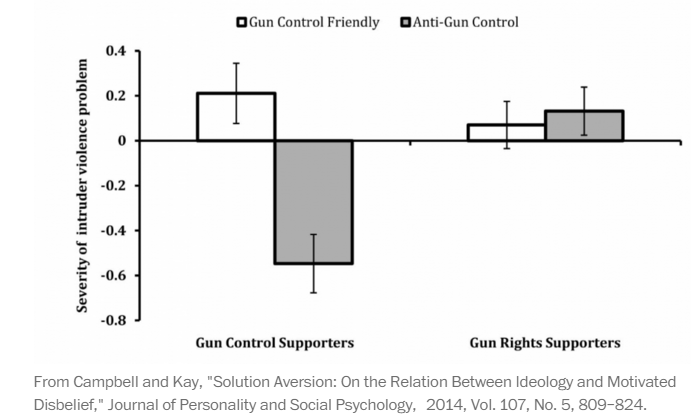
The Left picks and chooses which scientific consensus as it accepts. The overwhelming consensus among researchers is biotech crops are safe for humans and the environment. This is a conclusion that is rejected by the very environmentalist organisations that loudly insist on the policy relevance of the scientific consensus on global warming.
Previously the precautionary principle was used to introduce doubt when there was no doubt. But when climate science turned in their favour, environmentalists wanted public policy to be based on the latest science.
The Right is welcoming of the science of nuclear energy or geo-engineering. The Left rejects it point-blank. Their refusal to consider nuclear energy as a solution to global warming is a classic example of solution aversion. Let he who is without sin cast the first stone.
Monopolies and patents can breed deadweight loss and market inefficiencies
11 Mar 2016 Leave a comment
in applied price theory, applied welfare economics, comparative institutional analysis, law and economics, politics - Australia, politics - New Zealand, politics - USA, property rights Tags: intellectual monopolies, patents and copyright
Negative Externalities and the Coase Theorem
06 Mar 2016 Leave a comment
in applied price theory, applied welfare economics, comparative institutional analysis, history of economic thought, law and economics, property rights Tags: Coase theorem
Why are conspiracy theorists so trusting of citizen initiated binding referendums?
04 Mar 2016 Leave a comment
in comparative institutional analysis, constitutional political economy, politics - New Zealand, Public Choice
After reflecting far more than I should on some conspiracy laden testimony at Parliament yesterday, one of the things I recall was a demand that the approval of the TPPA be put to binding referendum. The conspiracy theorist at hand was deeply concerned about how that treaty was encroaching on New Zealand’s sovereignty.
Why did this conspiracy theorist assume that a binding referendum will go his way and that opposing conspiracy theorists will not put up their own binding referendums in which he will lose?

The major drawback of citizen initiated referendums is any bunch of people can put them up much to the annoyance of those who will be a victim of the law to be passed.

Just as rotation of power is inherent to Parliamentary democracy, the ability of the crazies to the either the left or the right of you to initiate their own binding citizen initiated referendums. The first referendum is likely to be on one of the following:
- decriminalising marijuana,
- banning smoking,
- voluntary euthanasia,
- a living wage,
- life means life in prison,
- same-sex marriages,
- marriage is between a man and a woman,
- entrenching the Treaty of Waitangi,
- abolishing the Maori seats,
- entrenching the Maori seats,
- stop school closures,
- capital punishment; and
- future referendums not be binding.
Binding referenda are unworkable. Parliament can’t amend them later as we learn from the implementation of the law and unintended consequences arise. Every new law is riddled with unintended consequences and blow-backs.
Do you really want to have to have another referendum to undo a binding referendum that turned out to be a bit of a mistake? One of the few redeeming features of the Parliament that is sovereign – a parliament for can make or unmake any law whatsoever – is it can repeal its mistakes quickly.
The first citizens initiated referendum was held on 2 December 1995. The question was
Should the number of professional fire-fighters employed full-time in the New Zealand Fire Service be reduced below the number employed in 1 January 1995?
Turnout was low as the referendum was not held in conjunction with a general election, and the measure was voted down easily, with just over 12% voting “Yes” and almost 88% voting “No”.
The key to constitutional design is not empowering you and yours – it is how to restrain those crazies to the Left or the Right of you, as the case may be, when they get their hands on the levers of power, as they surely will in three, six or nine years’ time.
The one inevitability of democracy is power rotates – unbridled power and binding referenda lose their shine when you must share that power with the opposing side of politics who put up their own referendum question.
Constitutions are brakes, not accelerators. Much of constitutional design is about checks and balances and the division of power to slow the impassioned majority down.
Conspiracy theorists that pretty much sore losers. The last thing they want is a binding referendum on a topic on which they are going to vote no.

The problem of constitutional design was ensuring that government powers would be effectively limited. The constitutions were designed and put in place by the classical liberals to check or constrain the power of the state over individuals.
The motivating force of the classical liberals was never one of making government work better or even of insuring that all interests were more fully represented. Built in conflict and institutional tensions were to act as constraints on the power and the size of government.
Modern democracy is government subject to electoral checks. Citizens do have sufficient knowledge and sophistication to vote out leaders who are performing poorly or contrary to their wishes. Modern democracy is the power to replace governments at periodic elections.
The power of the electorate to turn elected officials out of office at the next election gives elected officials an incentive to adopt policies that do not outrage public opinion and administer the policies with some minimum honesty and competence.
Too many want to remake democracy with the faculty workshop as their model. Such deliberation has demanding requirements for popular participation in the democratic process, including a high level of knowledge and analytical sophistication and an absence, or at least severe curtailment, of self-interested motive. The same goes for citizen initiated binding referendums.
The rotation of power is common in democracies, and the worst rise to the top, so it is wise to design constitutional safeguards to minimise the damage done when those crazies to the right or left of you get their chance in office, as they will.
State power was something that classical liberals feared, and the problem of constitutional design is insuring that such power would be effectively limited. Conspiracy theorists lose all their fear of power by drinking on the heady wine of citizens initiated referendum. Be careful for what you wish for.
Data chauvinism versus the 1st law of public policy development
25 Feb 2016 Leave a comment
in applied welfare economics, comparative institutional analysis, economics of bureaucracy, Public Choice
I learnt at the Australian Productivity Commission that the first law of public policy development is plagiarise, plagiarise, plagiarise. Why be original? Copy the successes of others, improve upon them, but do not repeat their failures, just learn from them.
I developed this policy insight from my experience at the Productivity Commission with a smart-arse Commissioner – that was the chairman’s private description of him in a conversation with me, not mine.
This Commissioner with whom I had countless arguments would respond to the many US studies I had marshalled by always asking for Australian evidence – what is the Australian evidence?
He knew that there was no Australian data or studies so he could slow the whole policy process down through this appeal to data chauvinism. The Americans are swimming in data and that is before you get to their cross-sectional data with 50 states.
 Ever since then, I regarded data chauvinism – the request for Australian evidence and studies or New Zealand evidence and studies – as a stalling tactic designed either to defend the status quo.
By and large, all the local evidence shows when it augments the US studies is how a local regulation or tax screws things up further. Local evidence rarely served the interests of my opponents who were fighting against deregulation or privatisation.

It is a good public policy – you are much more likely to implement a proposal or act on a particular empirical study – if there are half a dozen to a dozen overseas studies preferably in several different countries showing much the same thing. Beware the man of one study. Milton Friedman (1957) rightly preferred to emphasize the congruence of evidence from a number of different sources and with due attention to the quality of the data:
I have preferred to place major emphasis on the consistency of results from different studies and to cover lightly a wide range of evidence rather than to examine intensively a few limited studies.
The role of empirical evidence is to resolve disagreements – to bring people closer together. One study in one country rarely does that. Many studies in many countries about the same topic of controversy is far more persuasive.


Recent Comments