
…
Celebrating humanity's flourishing through the spread of capitalism and the rule of law
08 Jul 2016 Leave a comment
in applied price theory, applied welfare economics, comparative institutional analysis, constitutional political economy, development economics, economics of bureaucracy, entrepreneurship, financial economics, growth disasters, growth miracles, industrial organisation, politics - USA, Public Choice, rentseeking, survivor principle Tags: crony capitalism, superstar wages, superstars, top 1%
…
05 Jul 2016 1 Comment
in constitutional political economy, environmentalism, politics - New Zealand, Public Choice
British political psychology data suggests systematically different personalities for the average green and average labour voter that may transfer to New Zealand. Greens are more than what Paul Keating described them: “a bunch of opportunists and Trots hiding behind a gumtree”.
Labour voters are more agreeable and emotionally stable but far less open to new experiences than the average green voter. Not surprisingly, within the green movement, they tend to prefer consensus in internal decision-making but are rather uncompromising and self-righteous in their policy demands. Labour parties in Australia prefer to avoid coalitions with the Greens now because of bad experiences with their uncompromising nature in previous alliances.
As greens are more likely to get upset and are far less conscientious than others on the political spectrum, maybe they are happy to be a political movement rather than a party of government?
To be a party of government requires compromise, a willingness to appeal to the average voter, and to adopt policies because they are wedge issues rather than because they are principled stands. The Labour Party wants to govern; Greens want to make a point.
Third term governments are an ugly sight because they are unlikely to be a re-elected. Labour governments in the throes of inevitable electoral defeat are very opportunistic about changing policies to have one last roll the dice to cling to office. This is something greens are much less likely to countenance. They prefer defeat over compromise.
03 Jul 2016 Leave a comment
in constitutional political economy, politics - Australia, politics - USA, Public Choice
The fatal error of the Left is to smear populists such as Hansen, Trump and UKIP as extreme right.
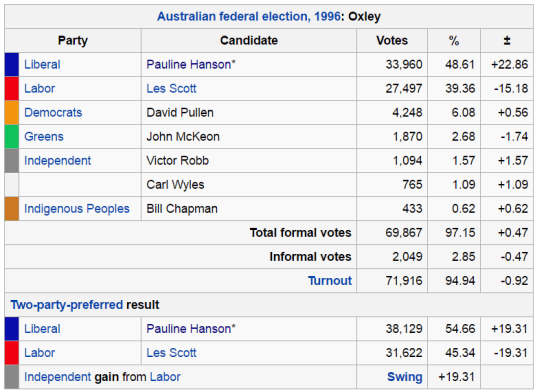
Hanson won the safest Labour seat in Queensland when first elected in 1996. Her 23% swing was mainly made up of Labour voters. Few in the media or commentariat like to remind of that.
Donald Trump defeated opposition on his right from Ted Cruz to win the Republican nomination. If moderate candidate Kasich had dropped out earlier, many of his voters would have gone to Trump, not to Cruz. Trump has appeal to working class Democrat party voters. The only group he seems to win is white men
UKIP is no longer a party out of the Tory shires, when it won 3% of the vote in 2010 in the UK. UKIP is slightly to the left of the LDP and came 2nd in 40 Labour seats in the last UK election. UKIP is a real threat to win seats from Labour or divide the working class work to allow the Tories to come through the centre.
All of these populists combine nationalism, an anti-immigration sentiment, a dislike of globalism and free trade because it involves dealing with foreigners, a preference for lower taxes but no particular opposition to extensive economic and social regulation. In many ways they are Alf Garnett Labour voters.

The work-horses of rational irrationality – antimarket bias, pessimism bias is, anti-foreign bias and make-work bias – are strong among these populist politicians and their voting base.
So few Labour Party MPs, present and upcoming, are working class in origin now that they have simply no experience of the anti-immigration and nationalist settlements of the working class. Until labour parties they work out how to deal with that and meet those concerns, they will keep losing votes to populists.
There is a wonderful quote about how a voter explained he did not vote Labour anymore because he was a white working class Englishman not on the benefit – Labour was no longer interested in him. Identity politics is not just the preserve of the left.
01 Jul 2016 Leave a comment
in constitutional political economy, economics of media and culture, income redistribution, politics - USA, Public Choice, rentseeking Tags: competition for political influence, congressional polarisation, growth of government, interest groups, political polarisation, size of government, soundbites, special interests
My two cents on the sharp rise of partisanship and congressional polarisation is they are driven by the great restraint in the growth of government spending in the 1980s.
From 1950 to 1980 the size of government doubled but then stopped dead in the 1980s. This great restraint on the growth of government happened everywhere. It was not just Thatcher’s Britain or Reagan’s America. It was everywhere, France and Germany, and even Scandinavia.
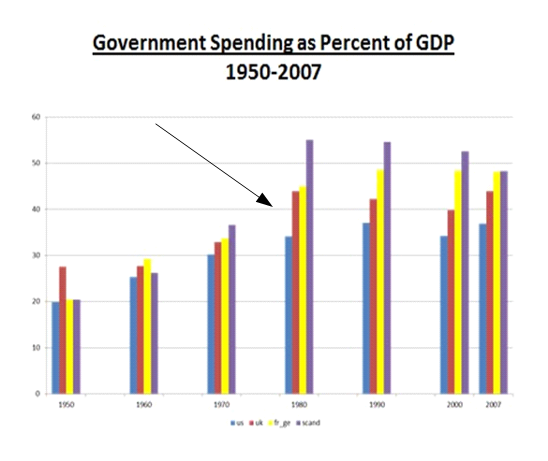
Source: Sam Peltzman, The Socialist Revival? (2012).
Peltzman’s data which I have charted has government spending in the USA, Britain, France and Scandinavia doubling between 1950 and 1980, and then nothing much happened between 1980 and 2007 – the size of government was pretty flat as a share of GDP for 27 years.
Governments everywhere hit a brick wall in terms of their ability to raise further tax revenues. Political parties of the Left and Right recognised this new reality.
Government spending grew in many countries in the m-d-20th century because of demographic shifts, more efficient taxes, more efficient spending, a shift in the political power from those taxed to those subsidised, shifts in political power among taxed groups, and shifts in political power among subsidised groups Importantly for explaining later political polarisation, that growth of government was concentrated in four programs – defence, health, education and income security
The median voter in all countries was alive to the power of incentives and to not killing the goose that laid the golden egg which underwrote the initial growth in the size of government. The rising deadweight losses of taxes, transfers and regulation limit inefficient policies and the sustainability of redistribution.
After 1980, the taxed, regulated and subsidised groups had an increased incentive to converge on new lower cost modes of redistribution to protect what they had. More efficient taxes, more efficient spending, more efficient regulation and a more efficient state sector reduced the burden of taxes on the taxed groups. Reforms ensued after 1980 led by parties on the Left and Right, with some members of existing political groupings benefiting from joining new coalitions.
A lot more is at stake when the main political battleground is dividing a relatively fixed revenue pie post-1980 than a growing pie Between 1950 and 1980. Fiscally conservative voters will elect parties strongly committed to no new taxes. Their opponents will look for equally ideologically committed parties. Peltzman makes the very interesting point that:
There is no new program in the political horizon that seems capable of attaining anything like the size of any of these four. For the time being the future government rest on the extent of existing mega programs.
Health and income security account for 55% of total government spending in the OECD. It is in these two programs where the future of the growth of government lie.
The pressure for that growth in government will come from the elderly. Governments will have to choose between high taxes on the young to fund the current generosity of social insurance, healthcare and old-age pensions or find other options. Peltzman explains this political tension for programs benefiting the elderly in his essay The Socialist Revival:
Deficit financing of future growth in these programs becomes increasingly problematic. So we now have the seeds of political conflict rather than consensus.
These very large programs confer substantial benefits on some. These beneficiaries resist any change in the status quo. But the benefits have to be financed at substantial cost to today’s workers. Many of them will not benefit on balance from these programs over their lifetimes. It is by no means clear whether the number of winners exceeds the number of losers today.
Policies that were once unthinkable now can be discussed and even implemented here and there. These include increased retirement ages, less generous public health care programs, more reliance on private saving for retirement and so forth.
Given that intergenerational and other struggles over who is taxed and who faces benefit cuts, middle-of-the-road politicians lose their appeal to the electorate.
Another reason for greater political polarisation is the rising cost of time. Sound-bites news programs and current affairs are now a couple of seconds long when they used to be 15 seconds long maybe 30 years ago.
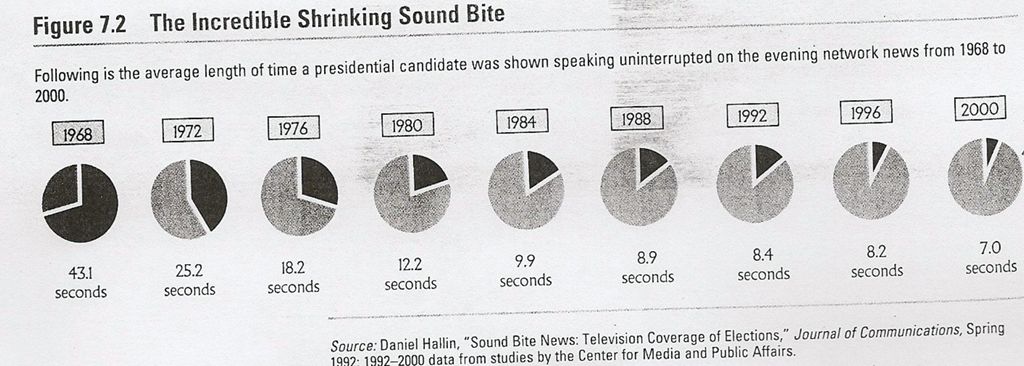
People have less time to pay attention to politics so they want to work out quickly from short sound-bites whether the politicians they are contemplating supporting are made of the right stuff. For voters in a hurry, conviction politicians are more appealing be they of the left or of the right. Voters want someone who will hold fast against new taxes or for new taxes as the case may be. Much is at stake as Sam Peltzman explained in his 2012 essay The Socialist Revival:
The steady growth of the old age population share is on the verge of a substantial acceleration… This means that government health care and public pension spending growth will also have to accelerate merely to keep the promises implicit in present programs.
The political economy will have to choose between higher taxes on the young to keep these promises, an accelerated shrinkage of the rest of the budget or less generous public health and pension programs. It is not clear yet which way the decision will go.
What is clear is that for the first time since the invention of the welfare state the magnitude and generosity of its signature programs is at political risk.
In this stand-off between those who might have to pay more in taxes and those who might receive less in old age pensions, welfare benefits and services including healthcare, neither side wants a politician naturally inclined to blink and compromise. They will elect politicians who hang tough for their side of the argument and their share of the budget.
01 Jul 2016 Leave a comment
in constitutional political economy, Public Choice Tags: British Labour Party, British politics, Leftover Left
Ed Miliband managed to do what 30 years of militant tendency entryism failed to do. He delivered the British Labour Party to the far left.
By allowing anyone to join the Labour Party for £3 to vote for its leader, far left activists were able to join online and vote in a leader and certainly re-elect him in the forthcoming challenge.
Far left control of the National Executive and National Conference means the Left will never have to agree to a less favourable form of electing the leadership. Corbyn plans to remove the parliamentary party from approving developing policy and nominating leadership candidates.
A Labour Party led by Jeremy Corbyn and then John McDonnell and other grumpy old socialists will never win a British general election. They will be massacred in 2020.
John McDonnell is good at saying there is much agreement on domestic policy but some want to go faster. That agreement is to be a more radical government than the Attlee government.
Labour was elected in a landslide in 1945 in the hope of a Better Britain. It was re-elected by 5 seats in 1950 in a time far more forgiving of socialism and the growth of government. Labour lost the 1951 general election and stayed out of office for the next 13 years.
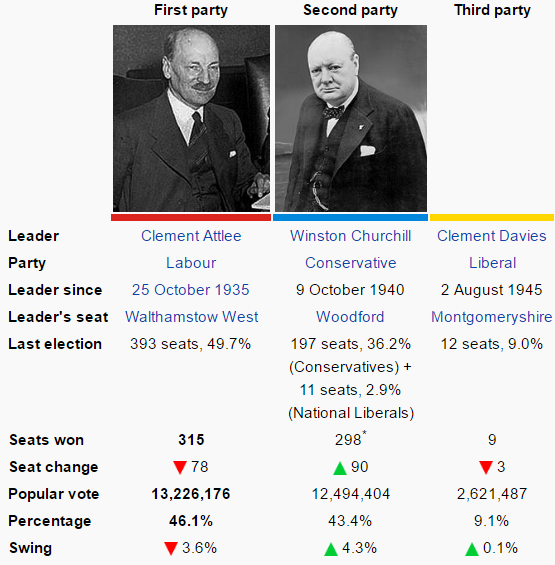
If Labour wants to win a 2020 election in the United Kingdom of England, Wales and Northern Ireland, it must win 6% more of the vote and win England for one of the few times in its history. There will be no Scottish MPs to join in coalition in 2020.
If Labour is ever to be an effective opposition, an opposition that might actually win the next election by winning England outside of London, the party must split, discard the far left and become a social democratic party under a firm control of its MPs.
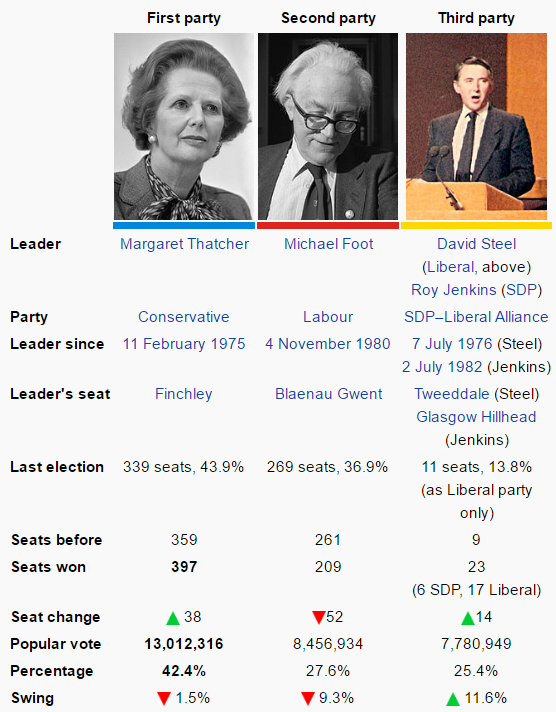
When four leading MPs left in 1981, they were able to cobble together 25% of the popular vote in the 1982 British general election in an alliance with the Liberal Party.
Imagine if 100-150 MPs left to form a new party big enough to be the official opposition now. They would have a real chance of killing off the left-wing rump in 2020 and winning in 2025.
That is better chances that they have now assuming there is no mandatory reselections and mass de-selections of MPs who do not support Corbyn. If Corbyn carries out his plan for mandatory re-selections, they have nothing to lose from forming another party and everything to gain.
30 Jun 2016 Leave a comment
in applied price theory, comparative institutional analysis, constitutional political economy, development economics, economic history, entrepreneurship Tags: capitalism and freedom
28 Jun 2016 Leave a comment
in constitutional political economy, international economic law, international economics, International law, Public Choice Tags: British economy, British politics, Common market, European Union, pessimism bias, single market, Twitter left, voter demographics
There were few difference across the political spectrum as to why voters voted to Remain or Leave. This is according to Lord Ashcroft’s survey on referendum day of over 12,000 voters.

Source: How the United Kingdom voted on Thursday… and why – Lord Ashcroft Polls
Labour and Tory voters voted to leave to regain control over immigration and sovereignty.
Labour and Tory voters who wanted to remain thought the EU and its single market was a good deal not worth putting at risk. It is all about identity politics, not inequality.
Vote Leave voters are a grumpy lot who think things have been getting worse for 30 years:
Leavers see more threats than opportunities to their standard of living from the way the economy and society are changing, by 71% to 29% – more than twice the margin among remainers…
By large majorities, voters who saw multiculturalism, feminism, the Green movement, globalisation and immigration as forces for good voted to remain in the EU; those who saw them as a force for ill voted by even larger majorities to leave.
25 Jun 2016 Leave a comment
in constitutional political economy, international economic law, international economics, International law
24 Jun 2016 Leave a comment
in constitutional political economy, economics, industrial organisation, international economic law, International law, liberalism Tags: Brexit, British economy, British politics, Common market, customs unions
23 Jun 2016 Leave a comment
in constitutional political economy Tags: China, West Wing
20 Jun 2016 Leave a comment
in Adam Smith, applied price theory, applied welfare economics, Austrian economics, comparative institutional analysis, constitutional political economy, development economics, history of economic thought, Public Choice Tags: central planning, The fatal conceit, The pretence to knowledge
Celebrating humanity's flourishing through the spread of capitalism and the rule of law
Scholarly commentary on law, economics, and more
Beatrice Cherrier's blog
Celebrating humanity's flourishing through the spread of capitalism and the rule of law
Celebrating humanity's flourishing through the spread of capitalism and the rule of law
Celebrating humanity's flourishing through the spread of capitalism and the rule of law
Why Evolution is True is a blog written by Jerry Coyne, centered on evolution and biology but also dealing with diverse topics like politics, culture, and cats.
Celebrating humanity's flourishing through the spread of capitalism and the rule of law
Celebrating humanity's flourishing through the spread of capitalism and the rule of law
A rural perspective with a blue tint by Ele Ludemann
DPF's Kiwiblog - Fomenting Happy Mischief since 2003
Celebrating humanity's flourishing through the spread of capitalism and the rule of law
The world's most viewed site on global warming and climate change
Tim Harding's writings on rationality, informal logic and skepticism
A window into Doc Freiberger's library
Let's examine hard decisions!
Commentary on monetary policy in the spirit of R. G. Hawtrey
Thoughts on public policy and the media
Celebrating humanity's flourishing through the spread of capitalism and the rule of law
Politics and the economy
A blog (primarily) on Canadian and Commonwealth political history and institutions
Reading between the lines, and underneath the hype.
Economics, and such stuff as dreams are made on
"The British constitution has always been puzzling, and always will be." --Queen Elizabeth II
Celebrating humanity's flourishing through the spread of capitalism and the rule of law
Celebrating humanity's flourishing through the spread of capitalism and the rule of law
WORLD WAR II, MUSIC, HISTORY, HOLOCAUST
Undisciplined scholar, recovering academic
Celebrating humanity's flourishing through the spread of capitalism and the rule of law
Res ipsa loquitur - The thing itself speaks
Celebrating humanity's flourishing through the spread of capitalism and the rule of law
Researching the House of Commons, 1832-1868
Articles and research from the History of Parliament Trust
Reflections on books and art
Posts on the History of Law, Crime, and Justice
Celebrating humanity's flourishing through the spread of capitalism and the rule of law
Exploring the Monarchs of Europe
Cutting edge science you can dice with
Small Steps Toward A Much Better World
“We do not believe any group of men adequate enough or wise enough to operate without scrutiny or without criticism. We know that the only way to avoid error is to detect it, that the only way to detect it is to be free to inquire. We know that in secrecy error undetected will flourish and subvert”. - J Robert Oppenheimer.
The truth about the great wind power fraud - we're not here to debate the wind industry, we're here to destroy it.
Celebrating humanity's flourishing through the spread of capitalism and the rule of law
Celebrating humanity's flourishing through the spread of capitalism and the rule of law
Economics, public policy, monetary policy, financial regulation, with a New Zealand perspective
Celebrating humanity's flourishing through the spread of capitalism and the rule of law
Restraining Government in America and Around the World


 Utopia, you are standing in it!
Recent Comments