HT: Lise Rose
Celebrating humanity's flourishing through the spread of capitalism and the rule of law
24 Jul 2016 Leave a comment
in constitutional political economy, libertarianism, politics - USA Tags: 2016 presidential election
HT: Lise Rose
22 Jul 2016 Leave a comment
in constitutional political economy, economics Tags: British politics
20 Jul 2016 Leave a comment
in constitutional political economy
Nobody likes fixers or people getting ahead through political connections except when it is they themselves complaining to their local MP about a grievance. Complaining to your local MP is democracy in action.
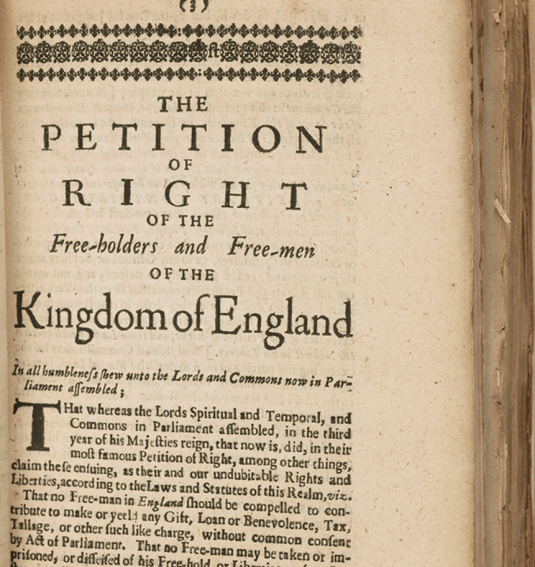
The right to petition for a government for the redress of grievances is the oldest right ever claimed by an Englishman. It appears in every major constitutional document back to Bill of Rights of 1688 and the Magna Carta.
The US 1st Amendment not only is the right of free speech guaranteed, the right to petition for the redress of grievances is set separately guaranteed.
Anyone who has ever complained to an MP expects something to be done. At a minimum, a letter written on a proper reply received.
MPs made and lost their careers when speaking up for constituents. More than a few MPs have come across on immigration correspondence. That perception is they are asking favours even when all they were doing was pointing out that this person has a good-looking resume, people of note voucher of them and we will then be a decision soon and if so by date.
MPs have mounted great crusades on the behalf of an aggrieved constituent or worthy cause. In the criminal justice area, these can range from a wrongful conviction to the abolition of capital punishment was restoration too.
When you go to an MP and complain about crime, poor local schools or inadequate health services, you expect something to improve as a result. Not all the time. But at least some of the time.
When I worked in the Australian Prime Minister’s department, special care was taken to identify any letter from the Prime Minister’s own electorate so that he would reply personally.
Either Prime Minister Hawke or his long time private secretary Jean Sinclair would reply to letters from children. Some of these letters from children asked surprisingly penetrating questions.
MPs routinely lobby for services for various constituents and other organisations they favour. An MP, particularly independent and minor party MPs routinely trade their votes or support in the governing party caucus for all sorts favours.
But we still hate people getting favours through connections despite that is democracy in action as long as money does not change hands into the back pocket of the MP. Vote buying is democracy in action.
16 Jul 2016 Leave a comment
in constitutional political economy, politics - USA, Public Choice
16 Jul 2016 Leave a comment
in applied price theory, comparative institutional analysis, constitutional political economy, defence economics, economics of bureaucracy, Gordon Tullock, Public Choice, rentseeking Tags: economics of revolutions, fall of communism, military coups, people power, Romania
The obituaries today for Victor Stanculescu, the Romanian army chief at the time of the 1989 revolution, vindicated Gordon Tullock’s view that popular revolutions are in fact military coups.
Tullock argues that any dictator can survive popular revolts as long as he has
Ordinary citizens obey dictators because if they don’t, they are highly unlikely to make any difference in any revolt and could get killed during the uprising even if it succeeds. Worse awaits them if the revolt fails.
Most dictators do not anoint a formal successor while they are in office. Tullock argued that as soon as a likely successor emerges, loyal retainers start to form alliances with that person and may see private advantage in bringing his anointed day forward.
More than a few autocrats were murdered in their sleep. To his very last day, Stalin locked his bedroom door because he did not trust the bodyguards who had been with him since the 1920s.
The role of street protests in the Arab Spring was to throw in the possibility of mutinies and desertions in the army and police. Previous alliances are thrown into doubt especially as the autocrat is old and sick, but had for many years grooming his 39 year-old son to inherit power.
Turning back to the Romanian revolution, Victor Stanculescu was the recently appointed army chief and initially stuck by the regime. He ordered the troops to open fire on protesters and at least 1000 died from in the shootings in the street.
In common with the Arab Spring, a large street protest did led him to reconsider his position:
Sniffing Mr. Ceausescu’s defeat, General Stanculescu quickly returned to Bucharest, where he faked a broken leg to avoid further counterrevolutionary deployment. Promoted to defense minister after the incumbent minister killed himself, he helped Mr. Ceausescu and his wife, Elena, flee by helicopter from the roof of party headquarters.
But fearing that the copter had been spotted by radar and would be shot down, the pilot hastily landed. Mr. Ceausescu hijacked a passing car, but he and his wife were soon surrounded and arrested.
After the couple were captured, General Stanculescu organized their trial by a military court and recruited the firing squad (before the verdict, by some accounts) that executed them on Christmas Day. He then joined the new government.
But for this late switch by the army chief, the popular revolt would never have succeeded. The army was needed to put down the still loyal security police. The army chief’s top priority was to execute Ceausescu as quickly as possible so that he was not a rallying point for a counter coup.
Ceausescu found out that his game was up when who he thought was his still loyal army chief arrived at his hideout with military judges to try and execute him.
About 10 years later, the Romanian government turned against the man who made the revolution and put him in prison for the many deaths in the street when he was on the side of the regime putting down the revolt.
Not so good an idea. A little bit of forgiveness carries a lot of weight encouraging late switching within the ruling elite and army that makes the difference to bringing down the old regime.
15 Jul 2016 Leave a comment
in constitutional political economy, development economics, growth disasters, law and economics, property rights, Public Choice
13 Jul 2016 Leave a comment
in constitutional political economy, economic history, Public Choice
Lord Mandelson, another founder of New Labour, told The Independent:
Labour went through a near-death experience in the 1980s. We turned ourselves round but the effect of Margaret Thatcher was to remind the Labour Party that it had to listen to the public and not just its activist base in order to be re-elected. In particular, we had to speak to the aspirational working class to whom Lady Thatcher appealed and who we had to win back.

12 Jul 2016 1 Comment
in constitutional political economy, politics - USA, Public Choice
The book Dark Money by jane Mayer on the influence of the Koch brothers and the reviews of the same were written stone cold sober. Two libertarian billionaires are a cabal that secretly rule the USA with hard right libertarian policies. The sense of alienation and powerless libertarians feel from the current political system is deeply mistaken if Mayer is to be believed. Libertarians secretly rule despite their minuscule numbers!
 I only met a libertarian in person recently. Most people have never heard of libertarians or think they believe in sexual license. A number of libertarians do not know what a libertarian is because a good minority of them oppose marijuana decriminalisation.
There are no elected libertarian officeholders in the USA. The Australian libertarian senator was elected by the donkey vote in New South Wales. Voters confused his party name, the Liberal Democrats, with that of the Liberal party. Perhaps 20% of Liberal party voters do not know the correct name of the Liberal party.
Former New Mexico Republican governor and now libertarian presidential candidate Gary Johnson is attracting attention simply because Clinton and Trump are such appalling candidates. Previous libertarian presidential candidates have not got more than about half a percent of the vote in presidential campaigns.

There are libertarian minded senators such as Rand Paul and his father who was in the House of Representatives but they are but a handful. The Koch Brothers money had no success in pushing their names forward to true power in presidential primaries.
The Republican presidential primary candidate favoured by the Koch brothers, Governor Walker, dropped out before the Iowa caucuses despite having more money than the rest of the field.
Dark Money and its book reviews would have us believe that despite abysmal election results, libertarians still rule the roost. An example is the book review at the Guardian:
A veteran investigative reporter and a staff writer for the New Yorker, Mayer has combined her own research with the work of scores of other investigators, to describe how the Kochs and fellow billionaires like Richard Scaife have spent hundreds of millions to “move their political ideas from the fringe to the center of American political life”…
In the 2016 elections, the goal of the Koch network of contributors is to spend $889m, more than twice what they spent in 2012. Four years ago, because Obama had the most sophisticated vote-pulling operation in the history of American politics, and a rather lackluster opponent, a Democratic president was able to withstand such a gigantic financial onslaught. This time around, it’s not clear that any Democrat will be so fortunate.
Jane Mayer summarises her view relatively succinctly this way when discussing a study by Harvard academics of dark money
In essence, the Harvard study concludes, the Kochs and their allied donors have far financial influence over American politics that extends far beyond the Presidential race. They have acted as an ideological magnet, pulling the Republican Party far to the right on economic issues, in alignment with their own and other donors’ financial interests. On issue after issue, Republican candidates have sworn fealty to the Kochs’ ultra-free-market positions. The study calculates that Republican members of the House and Senate largely voted as Americans for Prosperity told them to eighty-eight per cent of the time last year, up from seventy-three per cent of the time in 2007. More eye-catching, the positions that A.F.P. took, and that the elected representatives adopted, put them far to the right of the general voting population, including many Republicans voters.
The review of Mayer’s book in the New York Review of Books accepts her hypothesis uncritically
Jane Mayer’s remarkable new book makes it abundantly clear that the Kochs, and the closely connected group of billionaires they’ve helped assemble, have spent thousands of times that much over the past few decades, and that in the process they’ve distorted American politics in devastating ways, impairing the chances that we’ll effectively respond to climate change, reducing voting rights in many states, paralyzing Congress, and radically ratcheting up inequality.
The book review in The Nation is even more breathless about the reach of the Koch brothers cabal
I’m ashamed to admit that I had little understanding of the scope of the activities that Charles and David Koch have undertaken to mainstream their radical libertarian ideology until I read Jane Mayer’s pathbreaking account in The New Yorker in 2010. (I fought a losing battle on the jury of the National Magazine Awards that year to award it the prize in the reporting category.) Back then, the fantastic reach of the Kochs’ personal investments and subterranean funding network was difficult to track. It has since grown to a size almost impossible to imagine, with a sphere of influence that touches nearly every aspect of American public life. That’s the message of Dark Money, the authoritative book on the Kochs that Mayer has spent the past five years reporting.
Jonah Goldberg’s review of Dark Money is a bit of a fresh air after all these dark conspiracy theories
“What people need to understand is the Kochs have been playing a very long game,” she told NPR’s Steve Inskeep. “And it’s not just about elections. It started four decades ago with a plan to change how America thinks and votes. So while some elections they win and some elections they lose, what they’re aiming at is changing the conversation in the country.” …the Kochs are secretive, sinister denizens of the stygian underworld of “dark money” and the “radical right.” Except for the fact that the Kochs have been out in the open for nearly a half-century. David Koch ran for vice president on the Libertarian ticket in 1980, which you might argue is a brilliant way to hide in plain sight, given how little attention the Libertarian Party gets.
To its credit, the book review in Dissent magazine is the only one on the left that actually enquires into the mechanisms of and divisions within political pressure groups and political parties:
By focusing on elite idea production and election messaging, Mayer overlooks divisions within the right and offers no insights that could help us understand the unruly Trump surge. Dark Money portrays an unstoppable, unified far-right juggernaut led by plutocrats. It correctly alerts us to many aspects of their secretive, unaccountable machinations. But the full story of what is happening on the right is more complex and volatile.
It took a proper Marxist to remember that conspiracy theories do not succeed on their own. They require grunt work on the ground and there are feuding factions galore not even aware of the Koch brothers, much less their influence and money:
From the top, Fox News and other right-wing media outlets hyped the “Tea Party” label as a way for conservative voters to express anger at newly installed President Obama and Democratic congressional majorities; and many professional advocacy organizations jumped on the bandwagon, offering buses to carry people to rallies where their own operatives gave speeches. But these top-down maneuvers were not the driving force of the movement. Ordinary conservative citizens and community activists, almost all white and mostly older, provided angry passion and volunteered their energies to make the early Tea Party more than just occasional televised rallies. Grassroots Tea Partiers accomplished an utterly remarkable feat: starting in 2009, they organized at least 900 local groups,
Mayer forgot that the Tea Party was not libertarian and was very much a grassroots movement as the Dissent Magazine reviewer points out:
We learned that grassroots Tea Partiers were far from disciplined libertarian followers of ultra-free-market advocacy groups. Local Tea Party groups met in churches, libraries, and restaurants, and collected small contributions or sold books, pins, bumper stickers and other Tea Party paraphernalia on commission to cover their modest costs. They did not get by on checks from the Koch brothers or any other wealthy advocacy organizations. Furthermore, the views of both grassroots Tea Party activists and of many other Republican-leaning voters who have sympathized with this label do not align with free-market dogmas.
The Tea Party was socially conservative but only fiscally conservative when it came to other groups than them receiving money from the government as the Dissent review reminds us
… ordinary Tea Party activists and sympathizers are worried about sociocultural changes in the United States, angry and fearful about immigration, freaked out by the presence in the White House of a black liberal with a Muslim middle name, and fiercely opposed to what they view as out of control “welfare spending” on the poor, minorities, and young people. Many Tea Partiers benefit from Social Security, Medicare, and military veterans’ programs, and do not want them to be cut or privatized. About half of Tea Party activists or sympathizers are also Christian conservatives intensely concerned with banning abortion and repealing gay marriage.
In what continues to be a devastating review of the Mayer book, Dissent reminds us that
Today’s Republican Party is being revamped and torn asunder from contradictory directions. Almost all GOP candidates and legislators, even most presidential aspirants, espouse free-market, anti-government ideas like those pushed by the Koch network. But these honchos are not necessarily carrying voters with them. Many centrist voters do not want to cut education or gut the Environmental Protection Agency, while many right-wing voters care most about stopping immigration, outlawing abortions, and cutting back on what they view as government largesse for the poor. The core Koch agenda of bashing unions, slashing taxes for the rich, blocking environmental protection measures, and dismantling Social Security is not the top priority for many conservative voters.
The Dissent magazine review still believes that the Koch brothers have the Republican Party in their grasp, but was sensible enough to remind that the Republican Party is divided and voters still think for themselves. That was a crucial concession. As the Wall Street Journal review said
It can be argued that the cynicism behind the politics-for-sale claim, even when displayed by a talented writer like Ms. Mayer, reflects a distrust of the American democratic system—as if “the people” are commodities to be purchased and not autonomous beings who can think for themselves. The cynicism also denigrates the work of activists and scholars who join up with Cato, the Manhattan Institute, Heritage, Brookings, Hoover, the Sierra Club, the World Wildlife Foundation, Common Cause—or whatever organization one might choose—because they believe in what those bodies stand for, not because they are the mindless slaves of some rich donor.
10 Jul 2016 Leave a comment
in constitutional political economy, politics - Australia, politics - New Zealand, Public Choice
To be a party of government requires compromise, a willingness to appeal to the average voter, and to adopt policies because they are wedge issues rather than because they are principled stands.

Labour (at least their social democratic wings) want to win and govern by adopting policies that work; Greens want to send a message.
08 Jul 2016 Leave a comment
in applied price theory, applied welfare economics, comparative institutional analysis, constitutional political economy, development economics, economics of bureaucracy, entrepreneurship, financial economics, growth disasters, growth miracles, industrial organisation, politics - USA, Public Choice, rentseeking, survivor principle Tags: crony capitalism, superstar wages, superstars, top 1%

…
05 Jul 2016 1 Comment
in constitutional political economy, environmentalism, politics - New Zealand, Public Choice
British political psychology data suggests systematically different personalities for the average green and average labour voter that may transfer to New Zealand. Greens are more than what Paul Keating described them: “a bunch of opportunists and Trots hiding behind a gumtree”.
Labour voters are more agreeable and emotionally stable but far less open to new experiences than the average green voter. Not surprisingly, within the green movement, they tend to prefer consensus in internal decision-making but are rather uncompromising and self-righteous in their policy demands. Labour parties in Australia prefer to avoid coalitions with the Greens now because of bad experiences with their uncompromising nature in previous alliances.
As greens are more likely to get upset and are far less conscientious than others on the political spectrum, maybe they are happy to be a political movement rather than a party of government?
To be a party of government requires compromise, a willingness to appeal to the average voter, and to adopt policies because they are wedge issues rather than because they are principled stands. The Labour Party wants to govern; Greens want to make a point.
Third term governments are an ugly sight because they are unlikely to be a re-elected. Labour governments in the throes of inevitable electoral defeat are very opportunistic about changing policies to have one last roll the dice to cling to office. This is something greens are much less likely to countenance. They prefer defeat over compromise.
03 Jul 2016 Leave a comment
in constitutional political economy, politics - Australia, politics - USA, Public Choice
The fatal error of the Left is to smear populists such as Hansen, Trump and UKIP as extreme right.
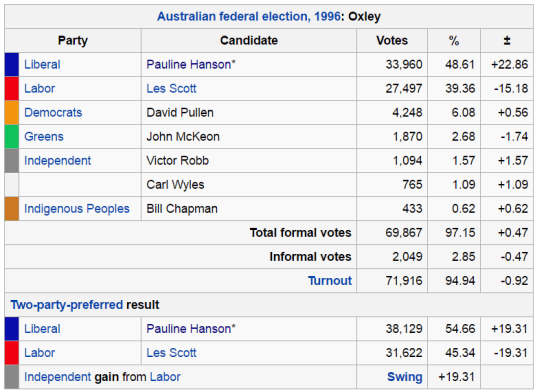
Hanson won the safest Labour seat in Queensland when first elected in 1996. Her 23% swing was mainly made up of Labour voters. Few in the media or commentariat like to remind of that.
Donald Trump defeated opposition on his right from Ted Cruz to win the Republican nomination. If moderate candidate Kasich had dropped out earlier, many of his voters would have gone to Trump, not to Cruz. Trump has appeal to working class Democrat party voters. The only group he seems to win is white men
UKIP is no longer a party out of the Tory shires, when it won 3% of the vote in 2010 in the UK. UKIP is slightly to the left of the LDP and came 2nd in 40 Labour seats in the last UK election. UKIP is a real threat to win seats from Labour or divide the working class work to allow the Tories to come through the centre.
All of these populists combine nationalism, an anti-immigration sentiment, a dislike of globalism and free trade because it involves dealing with foreigners, a preference for lower taxes but no particular opposition to extensive economic and social regulation. In many ways they are Alf Garnett Labour voters.

The work-horses of rational irrationality – antimarket bias, pessimism bias is, anti-foreign bias and make-work bias – are strong among these populist politicians and their voting base.
So few Labour Party MPs, present and upcoming, are working class in origin now that they have simply no experience of the anti-immigration and nationalist settlements of the working class. Until labour parties they work out how to deal with that and meet those concerns, they will keep losing votes to populists.
There is a wonderful quote about how a voter explained he did not vote Labour anymore because he was a white working class Englishman not on the benefit – Labour was no longer interested in him. Identity politics is not just the preserve of the left.
01 Jul 2016 Leave a comment
in constitutional political economy, economics of media and culture, income redistribution, politics - USA, Public Choice, rentseeking Tags: competition for political influence, congressional polarisation, growth of government, interest groups, political polarisation, size of government, soundbites, special interests
My two cents on the sharp rise of partisanship and congressional polarisation is they are driven by the great restraint in the growth of government spending in the 1980s.
From 1950 to 1980 the size of government doubled but then stopped dead in the 1980s. This great restraint on the growth of government happened everywhere. It was not just Thatcher’s Britain or Reagan’s America. It was everywhere, France and Germany, and even Scandinavia.
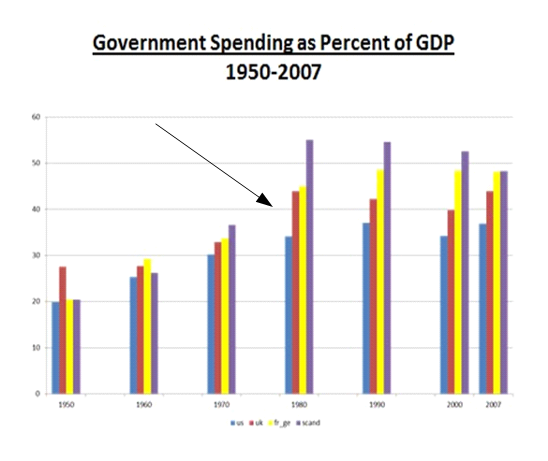
Source: Sam Peltzman, The Socialist Revival? (2012).
Peltzman’s data which I have charted has government spending in the USA, Britain, France and Scandinavia doubling between 1950 and 1980, and then nothing much happened between 1980 and 2007 – the size of government was pretty flat as a share of GDP for 27 years.
Governments everywhere hit a brick wall in terms of their ability to raise further tax revenues. Political parties of the Left and Right recognised this new reality.
Government spending grew in many countries in the m-d-20th century because of demographic shifts, more efficient taxes, more efficient spending, a shift in the political power from those taxed to those subsidised, shifts in political power among taxed groups, and shifts in political power among subsidised groups Importantly for explaining later political polarisation, that growth of government was concentrated in four programs – defence, health, education and income security
The median voter in all countries was alive to the power of incentives and to not killing the goose that laid the golden egg which underwrote the initial growth in the size of government. The rising deadweight losses of taxes, transfers and regulation limit inefficient policies and the sustainability of redistribution.
After 1980, the taxed, regulated and subsidised groups had an increased incentive to converge on new lower cost modes of redistribution to protect what they had. More efficient taxes, more efficient spending, more efficient regulation and a more efficient state sector reduced the burden of taxes on the taxed groups. Reforms ensued after 1980 led by parties on the Left and Right, with some members of existing political groupings benefiting from joining new coalitions.
A lot more is at stake when the main political battleground is dividing a relatively fixed revenue pie post-1980 than a growing pie Between 1950 and 1980. Fiscally conservative voters will elect parties strongly committed to no new taxes. Their opponents will look for equally ideologically committed parties. Peltzman makes the very interesting point that:
There is no new program in the political horizon that seems capable of attaining anything like the size of any of these four. For the time being the future government rest on the extent of existing mega programs.
Health and income security account for 55% of total government spending in the OECD. It is in these two programs where the future of the growth of government lie.
The pressure for that growth in government will come from the elderly. Governments will have to choose between high taxes on the young to fund the current generosity of social insurance, healthcare and old-age pensions or find other options. Peltzman explains this political tension for programs benefiting the elderly in his essay The Socialist Revival:
Deficit financing of future growth in these programs becomes increasingly problematic. So we now have the seeds of political conflict rather than consensus.
These very large programs confer substantial benefits on some. These beneficiaries resist any change in the status quo. But the benefits have to be financed at substantial cost to today’s workers. Many of them will not benefit on balance from these programs over their lifetimes. It is by no means clear whether the number of winners exceeds the number of losers today.
Policies that were once unthinkable now can be discussed and even implemented here and there. These include increased retirement ages, less generous public health care programs, more reliance on private saving for retirement and so forth.
Given that intergenerational and other struggles over who is taxed and who faces benefit cuts, middle-of-the-road politicians lose their appeal to the electorate.
Another reason for greater political polarisation is the rising cost of time. Sound-bites news programs and current affairs are now a couple of seconds long when they used to be 15 seconds long maybe 30 years ago.
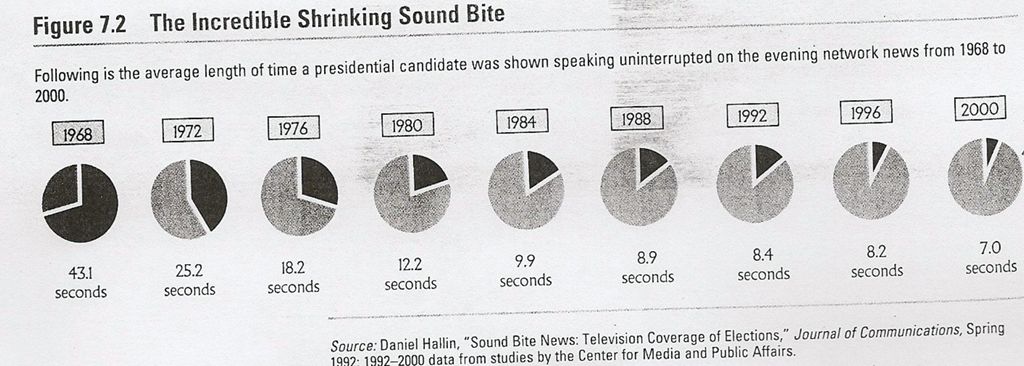
People have less time to pay attention to politics so they want to work out quickly from short sound-bites whether the politicians they are contemplating supporting are made of the right stuff. For voters in a hurry, conviction politicians are more appealing be they of the left or of the right. Voters want someone who will hold fast against new taxes or for new taxes as the case may be. Much is at stake as Sam Peltzman explained in his 2012 essay The Socialist Revival:
The steady growth of the old age population share is on the verge of a substantial acceleration… This means that government health care and public pension spending growth will also have to accelerate merely to keep the promises implicit in present programs.
The political economy will have to choose between higher taxes on the young to keep these promises, an accelerated shrinkage of the rest of the budget or less generous public health and pension programs. It is not clear yet which way the decision will go.
What is clear is that for the first time since the invention of the welfare state the magnitude and generosity of its signature programs is at political risk.
In this stand-off between those who might have to pay more in taxes and those who might receive less in old age pensions, welfare benefits and services including healthcare, neither side wants a politician naturally inclined to blink and compromise. They will elect politicians who hang tough for their side of the argument and their share of the budget.
01 Jul 2016 Leave a comment
in constitutional political economy, Public Choice Tags: British Labour Party, British politics, Leftover Left
Ed Miliband managed to do what 30 years of militant tendency entryism failed to do. He delivered the British Labour Party to the far left.
By allowing anyone to join the Labour Party for £3 to vote for its leader, far left activists were able to join online and vote in a leader and certainly re-elect him in the forthcoming challenge.
Far left control of the National Executive and National Conference means the Left will never have to agree to a less favourable form of electing the leadership. Corbyn plans to remove the parliamentary party from approving developing policy and nominating leadership candidates.
A Labour Party led by Jeremy Corbyn and then John McDonnell and other grumpy old socialists will never win a British general election. They will be massacred in 2020.
John McDonnell is good at saying there is much agreement on domestic policy but some want to go faster. That agreement is to be a more radical government than the Attlee government.
Labour was elected in a landslide in 1945 in the hope of a Better Britain. It was re-elected by 5 seats in 1950 in a time far more forgiving of socialism and the growth of government. Labour lost the 1951 general election and stayed out of office for the next 13 years.
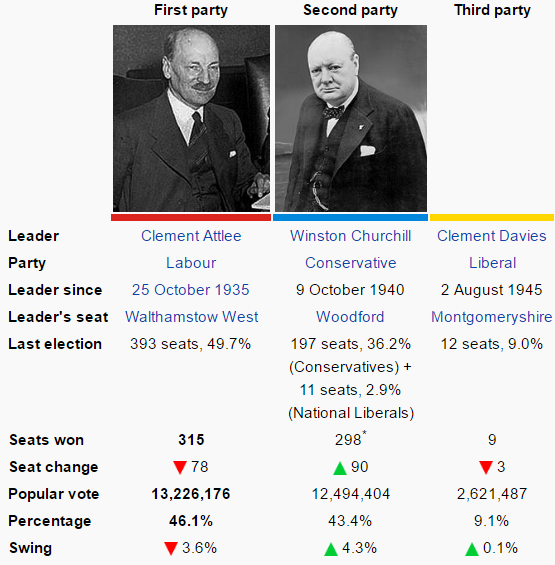
If Labour wants to win a 2020 election in the United Kingdom of England, Wales and Northern Ireland, it must win 6% more of the vote and win England for one of the few times in its history. There will be no Scottish MPs to join in coalition in 2020.
If Labour is ever to be an effective opposition, an opposition that might actually win the next election by winning England outside of London, the party must split, discard the far left and become a social democratic party under a firm control of its MPs.
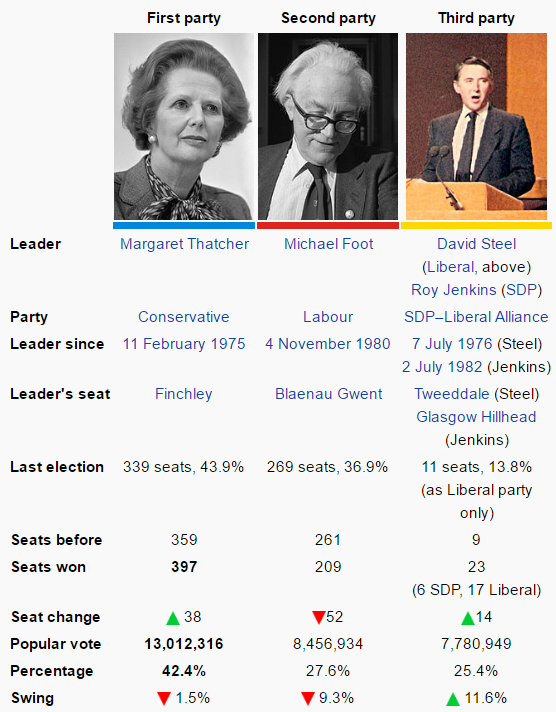
When four leading MPs left in 1981, they were able to cobble together 25% of the popular vote in the 1982 British general election in an alliance with the Liberal Party.
Imagine if 100-150 MPs left to form a new party big enough to be the official opposition now. They would have a real chance of killing off the left-wing rump in 2020 and winning in 2025.
That is better chances that they have now assuming there is no mandatory reselections and mass de-selections of MPs who do not support Corbyn. If Corbyn carries out his plan for mandatory re-selections, they have nothing to lose from forming another party and everything to gain.
Celebrating humanity's flourishing through the spread of capitalism and the rule of law
Celebrating humanity's flourishing through the spread of capitalism and the rule of law
Celebrating humanity's flourishing through the spread of capitalism and the rule of law
Celebrating humanity's flourishing through the spread of capitalism and the rule of law
Celebrating humanity's flourishing through the spread of capitalism and the rule of law
Celebrating humanity's flourishing through the spread of capitalism and the rule of law
Celebrating humanity's flourishing through the spread of capitalism and the rule of law
A History of the Alt-Right
Econ Prof at George Mason University, Economic Historian, Québécois
Celebrating humanity's flourishing through the spread of capitalism and the rule of law
Scholarly commentary on law, economics, and more
Beatrice Cherrier's blog
Celebrating humanity's flourishing through the spread of capitalism and the rule of law
Celebrating humanity's flourishing through the spread of capitalism and the rule of law
Celebrating humanity's flourishing through the spread of capitalism and the rule of law
Why Evolution is True is a blog written by Jerry Coyne, centered on evolution and biology but also dealing with diverse topics like politics, culture, and cats.
Celebrating humanity's flourishing through the spread of capitalism and the rule of law
A rural perspective with a blue tint by Ele Ludemann
DPF's Kiwiblog - Fomenting Happy Mischief since 2003
Celebrating humanity's flourishing through the spread of capitalism and the rule of law
The world's most viewed site on global warming and climate change
Tim Harding's writings on rationality, informal logic and skepticism
A window into Doc Freiberger's library
Let's examine hard decisions!
Commentary on monetary policy in the spirit of R. G. Hawtrey
Thoughts on public policy and the media
Celebrating humanity's flourishing through the spread of capitalism and the rule of law
Politics and the economy
A blog (primarily) on Canadian and Commonwealth political history and institutions
Reading between the lines, and underneath the hype.
Economics, and such stuff as dreams are made on
"The British constitution has always been puzzling, and always will be." --Queen Elizabeth II
Celebrating humanity's flourishing through the spread of capitalism and the rule of law
Celebrating humanity's flourishing through the spread of capitalism and the rule of law
WORLD WAR II, MUSIC, HISTORY, HOLOCAUST
Undisciplined scholar, recovering academic
Celebrating humanity's flourishing through the spread of capitalism and the rule of law
Res ipsa loquitur - The thing itself speaks
In Hume’s spirit, I will attempt to serve as an ambassador from my world of economics, and help in “finding topics of conversation fit for the entertainment of rational creatures.”
Researching the House of Commons, 1832-1868
Articles and research from the History of Parliament Trust
Reflections on books and art
Posts on the History of Law, Crime, and Justice
Celebrating humanity's flourishing through the spread of capitalism and the rule of law
Exploring the Monarchs of Europe
Cutting edge science you can dice with




Recent Comments