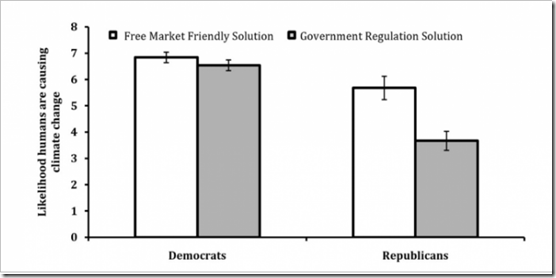
Source: Denying Problems When We Don’t Like the Solutions | Duke Today
I am not sure that the Australian Greens earn brownie points for referring to the scientific consensus on global warming as follows
Current global climate change is primarily caused by human activities contributing to increased concentrations of greenhouse gases in the atmosphere, and is already contributing to disruption of human societies through sea level rise, extreme weather events, desertification, harm to health, wellbeing and other effects. This is the overwhelming consensus of the international scientific community.
The Greens then give their opponents a free kick regarding their views on coal:and their commitment to science-based risk policy:
No new coal-fired power stations or coal mines, and no expansions to any existing power stations or mines, plus the development of programs to assist coal-dependent communities to make the transition to other more sustainable sources of economic prosperity.
There is no attempt to refer to science to justify this blanket prohibition against a specific energy source.
The views of the Australian Greens is no more science based on atomic energy:
- The world should be free of nuclear weapons and the nuclear fuel chain.
- There is a strong link between the mining and export of uranium and nuclear weapons proliferation.
- The use of nuclear weapons, nuclear accidents or attacks on reactors pose unacceptable risk of catastrophic consequences.
- Future generations must not be burdened with dangerous levels of radioactive waste.
- Nuclear power is not a safe, clean, timely, economic or practical solution to reducing global greenhouse gas emissions.
If there is any basis in science with this blanket opposition, I am sure the Australian Greens might have mentioned it.
Do the Australian Greens refer to the scientific consensus on GMOs in their policy platform as a helpful reminder or is there just have an ever rising demand for more evidence
- Genetically modified organisms (GMOs), their products, and the chemicals used to manage them may pose significant risks to natural and agricultural ecosystems.
- GMOs have not been proven safe to human health.
- Scientific evidence produced independently from the developers and proponents of the GMO must be undertaken and form the basis for assessing and licensing of GMOs. GMO assessments must be broad, independent and scientifically robust.
- The precautionary principle must be applied to the production and use of GMOs.
Unlike the New Zealand Greens, at least they do not simply reject the possibility of GMOs, the Australian Greens prefer the tactic of never being satisfied by the evidence.
The only thing I can find on the position of the Greens on fluoridation and vaccines is from a Victorian upper house MP who is half sensible on these issues. On fluoridation she says on behalf of the Greens
The Greens policy is quite clear on this. We do not have a policy for or against fluoride. Our policy supports the right of communities to determine the introduction of fluoride into local water supplies.
Not expressing the opinion on the wisdom of not putting fluoride in local water supply hardly shows a strong commitment to science-based public health policy.
On vaccines, this Victorian upper house green MP is not too bad at all:
I want to begin by stating that the Greens join health and scientific experts in absolutely supporting vaccination as a safe, proven and critical preventative health measure. The elimination of horrific diseases such as polio in Australia is testament to the incredible effectiveness and importance of vaccines…
There is also a group of people who might be called ‘hesitators’. They are not strongly opposed to vaccination, but they have heard that there might be some risks and they are thus unsure about them. These people do not perceive a strong risk of their child contracting any of the horrible diseases that immunisation prevents, so they think that on balance it might be reasonable not to vaccinate or to delay vaccination until their child is older or they simply have not yet made a decision either way. Hesitating parents may not realise that in some areas the local vaccination rate is getting well below safe levels and thus the risk of an outbreak is increasing.
This is far better than her New Zealand counterparts who do not seem to have an opinion on this vital public health issue. Indeed, the New South Wales Greens moved in the state parliament to tighten up a bill on exemptions from vaccinations.
Changes to the NSW Public Health Act in 2013 prohibited unvaccinated children from attending childcare unless their parents held “a personal, philosophical, religious or medical belief involving a conviction that vaccination under the National Immunisation Program should not take place” and they had discussed the matter with their GP”. The NSW Greens moved an amendment to remove personal, philosophical and religious beliefs as a grounds for exemption. This is one of the few times I can say something nice about a green MP.
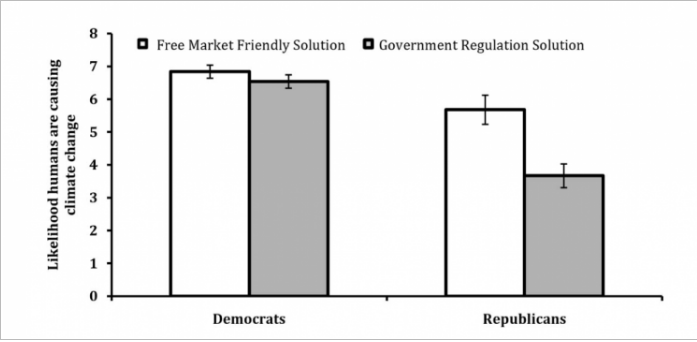
Many on the right have their doubts about climate change science, much of which is actually delivered driven by solution aversion.They do not like the costs of the solution so they attack the rationale for it for tactical reasons. Cass Sunstein explains:
It is often said that people who don’t want to solve the problem of climate change reject the underlying science, and hence don’t think there’s any problem to solve. But consider a different possibility: Because they reject the proposed solution, they dismiss the science. If this is right, our whole picture of the politics of climate change is off.
The Left picks and chooses which scientific consensus as it accepts. The overwhelming consensus among researchers is biotech crops are safe for humans and the environment. This is a conclusion that is rejected by the very environmentalist organisations that loudly insist on the policy relevance of the scientific consensus on global warming.
What is worse is this rejection of science is not based on solution aversion; that the costs are high. It is a plain rejection of science on principle by the green left rather than for tactical reasons such as by the right on global warming.
What is more worrying is all the science that is rejected by the left will make us more prosperous. Only when the solutions make is poorer does the green left support them such as with global warming and carbon taxes.
In many ways what divides the left and right onn science is a question of values: the value placed on progress, on the Great Enrichment, on the Great Fact and on the Great Escape.
The Greens are no more than a reincarnation of the 19th century British Tory Radicals with their aristocratic sensibilities that combined strong support for centralised power with a paternalistic concern for the plight of the poor:
- 19th century Tory radicals opposed the middle classes and the aesthetic ugliness they associated with an industrial economy; and
- Like the 19th century Tory Radicals, today’s green gentry see the untamed middle classes as the true enemy.
Many Greens think they are expressing an entirely new and progressive philosophy as they mouthed the same prejudices as Trollope’s 19th century Tory squires; attacking any further expansion of industry and commerce as impossibly vulgar, because it was
ecologically unfair to their pheasants and wild ducks.
Neither the failure of the environmental apocalypse to arrive nor the steady improvement in environmental conditions because of capitalism has dampened the ardour of those well-off enough to be eager to make hair-shirts for others to wear.
True to its 1960s origins, environmentalism is a mix of bureaucrats and hippies: a global, little-brother government that keeps the lower classes in line and a back-to-the-earth localism imposed on others but presenting no real threat to the inner city green elites’ comfortable middle class lives.





Recent Comments