Brexit: the Movie
15 May 2016 Leave a comment
in applied price theory, applied welfare economics, comparative institutional analysis, constitutional political economy, economic history, economics of regulation, industrial organisation, international economics Tags: Brexit, Common market
What If There Were No Prices? Railroad Thought Experiment
15 May 2016 Leave a comment
in applied price theory, applied welfare economics, Austrian economics, comparative institutional analysis, constitutional political economy, entrepreneurship Tags: market process
The Difference between the United Kingdom, Great Britain and England Explained
12 May 2016 Leave a comment
in constitutional political economy, economics
Trekonomics: The Final Frontier (w/ Manu Saadia)
09 May 2016 Leave a comment
in applied price theory, applied welfare economics, Austrian economics, comparative institutional analysis, constitutional political economy, development economics, economics of regulation, environmental economics, history of economic thought, industrial organisation, international economics, law and economics, property rights Tags: star trek
The Coase Theorem
08 May 2016 Leave a comment
in applied price theory, applied welfare economics, Austrian economics, comparative institutional analysis, constitutional political economy, economics of regulation, environmental economics, history of economic thought, industrial organisation, law and economics, property rights, Ronald Coase Tags: Coase theorem
Be careful for what you wish for when using irrationality as a rationale for the scope of government
07 May 2016 Leave a comment
in applied price theory, comparative institutional analysis, constitutional political economy, economics of information, Public Choice Tags: behavioural public choice, growth of government, rational irrationality, size of government

Source: Gary Lucas and Slavisa Tasic‘s "Behavioral Public Choice and the Law" (West Virginia Law Review, 2015) via Bryan Caplan
Psychological Bias as a Driver of Financial Regulation
06 May 2016 Leave a comment
in comparative institutional analysis, constitutional political economy, economics of bureaucracy, economics of regulation, financial economics, Public Choice Tags: behavioural public choice, rational irrationality
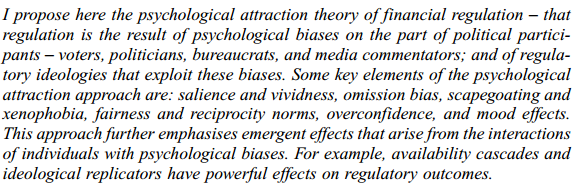
“Psychological Bias as a Driver of Financial Regulation,” David Hirshleifer, European Financial Management, 14(5), November, (2008):856-874.
Deirdre McCloskey and George Will discuss bourgeois inquality
05 May 2016 Leave a comment
in comparative institutional analysis, constitutional political economy, development economics, economic history Tags: Deirdre McCloskey
How Do You Deal With Painful Truths? Left vs. Right
02 May 2016 Leave a comment
in applied price theory, applied welfare economics, comparative institutional analysis, constitutional political economy, economics of media and culture Tags: expressive voting, rational irrationality
The renewable energy curse – does corruption turn clean energy into dirty? @GarethMP
30 Apr 2016 Leave a comment
in comparative institutional analysis, constitutional political economy, energy economics, environmental economics, global warming, Public Choice, rentseeking Tags: European Union, expressive voting, green rent seeking, Italy, renewable energy, solar power, wind power
Massimo Tavoni and Caterina Gennaioli published a nice paper showing that corruption and violence was higher in the high wind provinces of Italy after the installation of wind generators. They built on earlier work about countries with abundant renewable resources and weak institutions. The main question in their paper
… is whether an increase in the expected returns of investments in wind energy, following the introduction of the new policy regime based on a green certificate system, has driven economic agents, namely bureaucrats and entrepreneurs, to engage more in rent seeking activities.
As they studied Italy, there is no surprise about the answer which was yes. High winds ensure high returns of the wind farm investment, but whether this translates into more bribery depends on institutional quality. There was more corruption, and so especially in high-wind provinces of Italy.
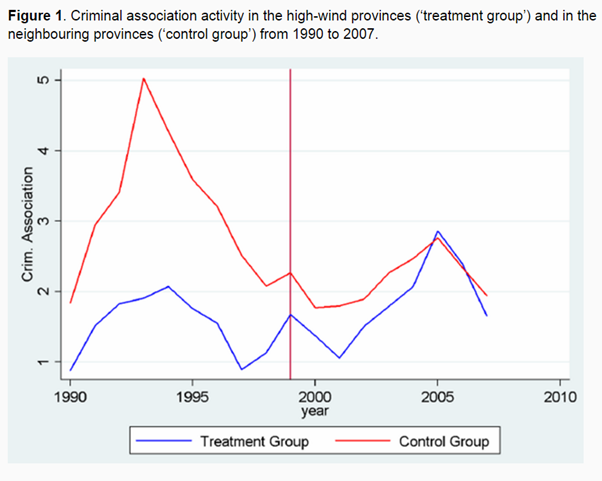
Source: Green policy and corruption | VOX, CEPR’s Policy Portal.
The construction of an average wind park is associated with an increase of criminal association activity of 6%. Italy will have more corruption than elsewhere in the old European Union.
The wider problem is renewable energy is a celebrity technology. In the context of expressive politics, so many cheer for solar and wind power that standards drop in terms of who qualifies for subsidies and who should lose support when their investments do not turn out as promised.
https://twitter.com/CountCarbon/status/715136022414299138
Wind power is not new, it is intermittent, is unsuitable for modern work, and is land constrained but it is still subsidised. Green rent seeking is a real risk even in countries with the best political institutions.
Why Private Investment Works & Govt. Investment Doesn’t
27 Apr 2016 1 Comment
in applied price theory, comparative institutional analysis, constitutional political economy, economic history, economics of media and culture, economics of regulation, industrial organisation, survivor principle Tags: industry policy, picking winners, The fatal conceit, The pretence to knowledge
Jeffrey Miron of Havard University explores three myths about capitalism
26 Apr 2016 Leave a comment
in applied price theory, applied welfare economics, Austrian economics, comparative institutional analysis, constitutional political economy, development economics, economic history, economics Tags: Jeff Miron, The Great Fact
 Utopia, you are standing in it!
Recent Comments