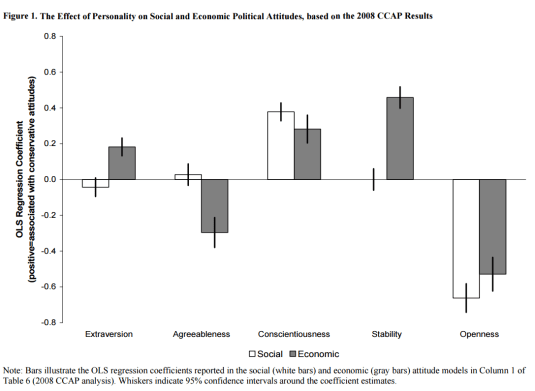
Conscientiousness is associated with conservatism and Openness is associated with liberalism. Emotional Stability is associated with conservative economic attitudes and Agreeableness is associated with liberal economic attitudes.
Celebrating humanity's flourishing through the spread of capitalism and the rule of law
04 Mar 2016 Leave a comment
in constitutional political economy, Public Choice
Conscientiousness is associated with conservatism and Openness is associated with liberalism. Emotional Stability is associated with conservative economic attitudes and Agreeableness is associated with liberal economic attitudes.
29 Feb 2016 Leave a comment
in constitutional political economy, development economics, growth disasters, Public Choice, rentseeking Tags: failed states
23 Feb 2016 Leave a comment
in applied price theory, comparative institutional analysis, constitutional political economy, economic history, economics of media and culture, economics of regulation, labour economics, macroeconomics, Marxist economics, politics - USA Tags: 2016 presidential election, antiforeign bias, antimarket bias, British politics, Leftover Left, make-work bias, rational ignorance, rational irrationality, renegade Left, Twitter left

15 Feb 2016 Leave a comment
in comparative institutional analysis, constitutional political economy, law and economics, politics - New Zealand, politics - USA Tags: abortion rights, marijuana decriminalisation
15 Feb 2016 Leave a comment
in constitutional political economy Tags: economics of borders, India
12 Feb 2016 Leave a comment
in constitutional political economy, law and economics, liberalism
11 Feb 2016 Leave a comment
in constitutional political economy, politics - USA, Public Choice
https://twitter.com/bargemUK/status/687610265400152065

Source: Gerrymandering Is Even More Infuriating When You Can Actually See It | WIRED.
08 Feb 2016 Leave a comment
in constitutional political economy, politics - Australia, politics - New Zealand, politics - USA, Public Choice Tags: 2016 presidential election, median voter theorem
07 Feb 2016 Leave a comment
in constitutional political economy, discrimination, economic history, law and economics, politics - Australia, politics - New Zealand, property rights, Public Choice Tags: Aboriginal land rights, Maori economic development, native title, racial discrimination
From 1965 onwards, 1/3rd of terrestrial Australia – 2.5 million sq kms of land – was returned to indigenous owners, with half of that since the Native Title decision in 1993. Tasmania pioneered aboriginal land rights with the Cape Barron Island Act 1912.

Source: Jon Altman, The political ecology and political economy of the Indigenous land titling ‘revolution’ in Australia, March 2014 Māori Law Review.
New Zealand extinguished native title twice in its history with the 2nd of these takings of Māori land by the last Labour government with the foreshore and seabed legislation. In her op-ed today, has Jacinda Ardern forgotten why the Māori party came into being?
Unlike New Zealand, Australia welcomed migrants from a wide range of ethnicities after the Second World War. It abolished the White Australia policy in the 1960s along with any discrimination in its Constitution against aboriginals.
Australia takes 8 times as many refugees as New Zealand on a per capita basis.
Sweden – the OECD's highest per capita recipient of asylum seekers bit.ly/1vfFEUh http://t.co/y6DmdJjAsE—
Guardian Data (@GuardianData) December 02, 2014
This redress of indigenous grievances was done out of the generosity of the Australian heart. Aboriginals are a tiny minority in Australia with little independent political pull.
04 Feb 2016 Leave a comment
in constitutional political economy, economics of regulation, international economic law, international economics, International law, labour economics, law and economics, politics - New Zealand, unions Tags: employment law, employment protection, employment regulation, ILO, labour market regulation, social clauses, TPPA
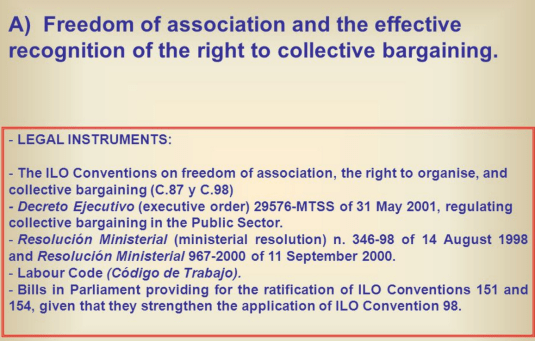
New Zealand has signed and ratified dozens of International Labour Organisation Conventions dating back to 1921. They all fetter the sovereignty of New Zealand. As a member of the ILO, New Zealand is required to report on its application of ILO Conventions.
That limitation on the sovereignty of New Zealand is no more and no less than in an international trade agreement. New Zealand can renounce an international trade agreement and has renounced nine International Labour Organisation conventions.
Jane Kelsey makes the following points about the legal implications of the Trans-Pacific Partnership agreement:
The 30 chapter Trans-Pacific Partnership Agreement (TPPA) constrains domestic law and policy at central government level, and in places by local government and SOEs, in diverse areas beyond traditional aspects of international trade.
…The TPP provides cumulative opportunities for foreign states and corporations to influence domestic decisions which may be burdensome and intrusive.
The exact same objections apply to the ILO conventions. The union movement does not hesitate to argue that the democratic process in New Zealand should be overridden because the proposal at hand purportedly conflicts with an ILO convention.
For example, when the government was choosing to deregulate collective bargaining, the sovereignty of Parliament was questioned because of an ILO convention. Helen Kelly, CTU President said:
in Parliament on 4 June, the Minister was asked if he agreed with advice from officials that the ability for employers to opt out of multi-employer bargaining may breach our obligations under ILO Convention 98 on the right to organise and collective bargaining.
…There is no point attending such an important UN ILO conference at the time your Government is being advised it is breaching its undertakings to that very organisation…
The CTU President also referred to the regulatory impact statement prepared for that collective bargaining legislation:
The paper also points out that these changes open NZ up to international examination by the International Labour Organisation (ILO) for non-compliance with Convention 98 – on the Right to Organise and Collectively Bargain, which New Zealand has signed up to.
Helen Kelly says “at least four of the proposals are deemed to be inconsistent with our international obligations, and two of them are classified as uncertain. Why the Government wants law changes that damage our international obligations is unclear.”
Council of Trade Unions submissions to minimum wage reviews have at least a dozen references to ILO conventions and the requirement to honour their provisions.
Posner and Goldsmith rightly argue that international law is a product of states pursuing their interests on the international stage. It does not induce states to comply contrary to their interests. The possibilities for what it can achieve are limited.
Government sign-up to various international agreements depending on their political priorities. You cannot complain that governments that you did not vote do what government you voted for also did, which was sign up to international agreements that suited their political agendas. The solution is to work harder to win the next general election.
As for opposing trade agreements on sovereignty grounds, it is rank hypocrisy for the union movement to do so given the number of times it cites international labour agreements when it suits them and seeks their inclusion in trade agreements to raise labour costs in developing countries.
02 Feb 2016 Leave a comment
in constitutional political economy, politics - USA
02 Feb 2016 Leave a comment
in constitutional political economy, politics - USA
02 Feb 2016 Leave a comment
in constitutional political economy, economics of information, Public Choice
The rise of Jeremy Corbyn has reminded me of how lazy political activists happen to be. For all their lifelong agitating, they think that as soon as they get a degree of prominent, their work is done. Suddenly, everyone who has disagreed with accidentally prominent activists for all that life will flock to their side and they will win the next election.

The thing about being a political fringe dwelling is you are a political fringe dweller. Only a tiny percentage of the population support you. To get anything above that requires hard work and a considerable amount of compromise to expand your base.
Those that already agree with you already agree with you. If you want more to agree with you, you have to start agreeing with those that disagree with you rather than they agree with you. It is a slow laborious process of compromise.
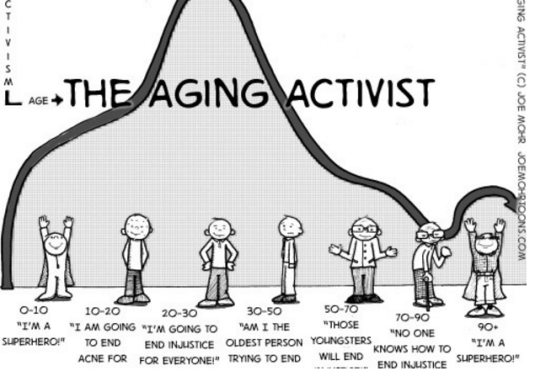
Occasionally, parties rush to prominence. Left-wing and right-wing populists are examples of these as are the anti-immigration parties. Their support is soft and can quickly disappear. Trump, Corbyn and Sanders should remember this.
Most of all, political activists who slip into prominence forget that voters tend to vote retrospectively: on past performance and out of anger than voting for a particular agenda of the alternative parties.
Because of this political ignorance and apathy, Richard Posner championed Schumpeter’s view of democracy. Schumpeter disputed the widely held view that democracy was a process by which the electorate identified the common good, and that politicians carried this out:
Schumpeter’s theory of democratic participation is that voters have the ability to replace political leaders through periodic elections. Citizens do have sufficient knowledge and sophistication to vote out leaders who are performing poorly or contrary to their wishes.
The power of the electorate to turn elected officials out of office at the next election gives elected officials an incentive to adopt policies that do not outrage public opinion and administer the policies with some minimum honesty and competence.
That lack of competence and judgement are what will bring Trump, Corbyn and Sanders down. They are just not up to the job. There are better left-wing and right-wing populists and firebrands about.
The outcome of Schumpeterian democracy in the 20th century, where governments are voted out rather than voted in, is most of modern public spending is income transfers that grew to the levels they are because of support from the average voter.
Political parties on the Left and Right that delivered efficient increments and stream-linings in the size and shape of government were elected, and then thrown out from time to time, in turn, because they became tired and flabby or just plain out of touch.
There is considerable excitement about how popular and elite preferences seem to have equal chances are being implemented.
If Americans at different income levels agree on a policy, they are equally likely to get what they want. But what about the other half of the time? What happens when preferences across income levels diverge?
When preferences diverge, the views of the affluent make a big difference, while support among the middle class and the poor has almost no relationship to policy outcomes. Policies favored by 20 percent of affluent Americans, for example, have about a one-in-five chance of being adopted, while policies favored by 80 percent of affluent Americans are adopted about half the time. In contrast, the support or opposition of the poor or the middle class has no impact on a policy’s prospects of being adopted.
These patterns play out across numerous policy issues. American trade policy, for example, has become far less protectionist since the 1970s, in line with the positions of the affluent but in opposition to those of the poor. Similarly, income taxes have become less progressive over the past decades and corporate regulations have been loosened in a wide range of industries.
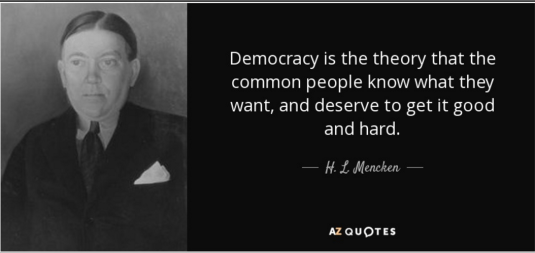
This is a dewy eyed view of democracy that would make HL Mencken proud. The notion of a democracy is governed by the rule of law, checks and balances and the protection of minority rights is lost in these dewy eyed conception is a democracy. As Matthew Yglesias said:
…the idea that the point of democracy is to implement legislative outcomes that are supported by broad-based surveys seems almost like a straw man dreamed up by an eighteenth-century monarchist.
Gilens concedes that other values—the protection of minority rights, for example—may also be important, but this misses the forest for the trees. The purpose of a political system is to resolve political questions in a satisfactory way….
The watchword of democracy should not be responsiveness but rather accountability.
In a well-functioning system, voters should elect a team of politicians and then fire them if their performance is seen as unsatisfactory. Seen in this light, the problem with American democracy today is that the intersection of counter-majoritarian legislative procedures and increased partisan polarization has blurred the lines of responsibility.
My confidence in the median voter theorem returned when Bryan Caplan and Sam Peltzman pointed out that it is difficult to point to a major government program in the 20th century that does not have majority support.
Director’s law is the bulk of public programmes are designed primarily to benefit the middle classes but are financed by taxes paid primarily by the upper and lower classes. Based on the size of its population and its aggregate wealth, the middle class will always be the dominant interest group in a modern democracy.
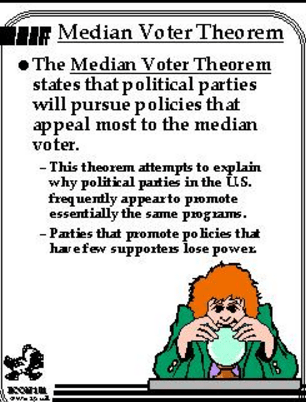
Within this framework of accountability and voting on the basis of performance rather than promise, there is considerable rotation of power. The fact that this particular activist or populists stumbled onto the treasury benches does not mean much. They usually got there because the previous administration was no longer seen as competent. Nothing more than that.
02 Feb 2016 Leave a comment
in constitutional political economy, development economics, economics of regulation, growth miracles, international economics, politics - New Zealand, Public Choice, rentseeking
The key reason why China joined the World Trade Organisation and other trade agreements is to bring some semblance of law to an authoritarian country. 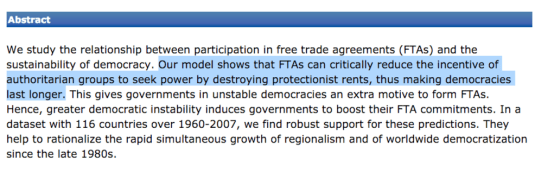
Source: AEAweb: AEJ: Macro (6,2) p. 29 – Free Trade Agreements and the Consolidation of Democracy via Max Roser.
Both the elites and ordinary people are prospering tremendously from the rise of capitalism in China, Vietnam and other places. A move away from this liberalisation to a more authoritarian setting would cost too many people too much money.
In the course of these economic liberalisations, China and Vietnam, for example, changed from totalitarian dictatorships to tin-pot dictatorships. As long as you keep out of politics in these countries, there is a fair degree of freedom and much more freedom compared to the days of communism.
Percentage employed in agriculture in the world's major economies over the last 50 years. https://t.co/UbaDnaE8Lr—
Robert Wilson (@CountCarbon) January 08, 2016
01 Feb 2016 1 Comment
in applied welfare economics, constitutional political economy, economics of regulation, income redistribution, politics - New Zealand, public economics
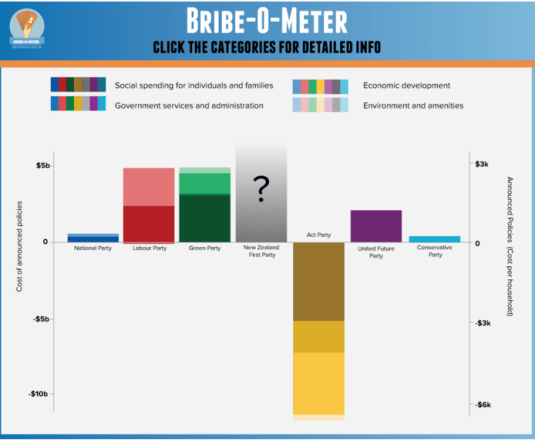
I am sure there will be lots of squabbling over parameters and assumptions of any tax, spending or regulation proposal submitted to the independent costings unit proposed recently by the New Zealand Greens.
The bigger problem is static and dynamic scoring. There is some history of doing this for taxes but little for spending and that is before you consider externalities. Imagine the squabbling over roading proposals and their externalities. The practical hurdles to dynamic scoring are:
Against that is dynamic scoring removes the bias against pro-growth policies in current budgetary scoring:
[A] theoretical advantage of accurate dynamic scoring is that it is not biased against pro-growth policies compared to the current conventional scoring method. By ignoring macroeconomic effects, the conventional method overstates the true budgetary cost of pro-growth policies, such as infrastructure investments, and understates the cost of anti-growth policies.
The bigger problem is something I learnt when costing a tax proposal for an election campaign. There was an error because I did the costing on a spreadsheet while I had a bad head cold.
The advantage of the error was the policy, as a result of this minor error in the tabulations attracted considerable attention from the major parties.
I was advised by a very wise head that this tabulation error in the dynamic scoring was not so bad a problem. This was because the tabulation error gave our side a chance to have a go at them again in the media. The policy announcement stayed in the new cycles for longer than otherwise and attracted attention from the big parties.
If a policy is too good, too perfect, the other parties will kill it with silence. You get only one bite in the news cycle and that is it.
If your policy announcement is killed by silence, at least you are guaranteed a chance to go at it again when the proposed independent costings unit a week or so later in the election campaign. You might disagree of those costings just to attract attention in the next new cycle.
Given the size, ambition and nebulous externality content of Green party proposals, they will benefit considerably from getting another go by questioning the Parliamentary budget office costings. That guarantees at least two new cycles to every one of their budgetary and regulatory announcements. No wonder they have proposed this independent costings unit.
If the New Zealand Greens do not like the costing from their proposed independent costings unit, they can just rage against neoliberalism and the conservative bias of economists. They cannot lose in terms of another bite of the 24-hour news cycle.
As a starter to feigning disagreement with any independent costings of their tax, spending and regulation proposals, Milton Friedman argued that people agree on most social objectives, but they differ often on the predicted outcomes of different policies and institutions. This leads us to Robert and Zeckhauser’s taxonomy of disagreement:
Positive disagreements can be over questions of:
1. Scope: what elements of the world one is trying to understand?
2. Model: what mechanisms explain the behaviour of the world?
3. Estimate: what estimates of the model’s parameters are thought to obtain in particular contexts?
Values disagreements can be over questions of:
1. Standing: who counts?
2. Criteria: what counts?
3. Weights: how much different individuals and criteria count?
Any positive analysis tends to include elements of scope, model, and estimation, though often these elements intertwine; they frequently feature in debates in an implicit or undifferentiated manner. Likewise, normative analysis will also include elements of standing, criteria, and weights, whether or not these distinctions are recognised. There is a rich harvest for nit-picking to keep the story going.
Celebrating humanity's flourishing through the spread of capitalism and the rule of law
Scholarly commentary on law, economics, and more
Beatrice Cherrier's blog
Celebrating humanity's flourishing through the spread of capitalism and the rule of law
Celebrating humanity's flourishing through the spread of capitalism and the rule of law
Celebrating humanity's flourishing through the spread of capitalism and the rule of law
Why Evolution is True is a blog written by Jerry Coyne, centered on evolution and biology but also dealing with diverse topics like politics, culture, and cats.
Celebrating humanity's flourishing through the spread of capitalism and the rule of law
Celebrating humanity's flourishing through the spread of capitalism and the rule of law
A rural perspective with a blue tint by Ele Ludemann
DPF's Kiwiblog - Fomenting Happy Mischief since 2003
Celebrating humanity's flourishing through the spread of capitalism and the rule of law
The world's most viewed site on global warming and climate change
Tim Harding's writings on rationality, informal logic and skepticism
A window into Doc Freiberger's library
Let's examine hard decisions!
Commentary on monetary policy in the spirit of R. G. Hawtrey
Thoughts on public policy and the media
Celebrating humanity's flourishing through the spread of capitalism and the rule of law
Politics and the economy
A blog (primarily) on Canadian and Commonwealth political history and institutions
Reading between the lines, and underneath the hype.
Economics, and such stuff as dreams are made on
"The British constitution has always been puzzling, and always will be." --Queen Elizabeth II
Celebrating humanity's flourishing through the spread of capitalism and the rule of law
Celebrating humanity's flourishing through the spread of capitalism and the rule of law
WORLD WAR II, MUSIC, HISTORY, HOLOCAUST
Undisciplined scholar, recovering academic
Celebrating humanity's flourishing through the spread of capitalism and the rule of law
Res ipsa loquitur - The thing itself speaks
In Hume’s spirit, I will attempt to serve as an ambassador from my world of economics, and help in “finding topics of conversation fit for the entertainment of rational creatures.”
Researching the House of Commons, 1832-1868
Articles and research from the History of Parliament Trust
Reflections on books and art
Posts on the History of Law, Crime, and Justice
Celebrating humanity's flourishing through the spread of capitalism and the rule of law
Exploring the Monarchs of Europe
Cutting edge science you can dice with
Small Steps Toward A Much Better World
“We do not believe any group of men adequate enough or wise enough to operate without scrutiny or without criticism. We know that the only way to avoid error is to detect it, that the only way to detect it is to be free to inquire. We know that in secrecy error undetected will flourish and subvert”. - J Robert Oppenheimer.
The truth about the great wind power fraud - we're not here to debate the wind industry, we're here to destroy it.
Celebrating humanity's flourishing through the spread of capitalism and the rule of law
Celebrating humanity's flourishing through the spread of capitalism and the rule of law
Economics, public policy, monetary policy, financial regulation, with a New Zealand perspective
Celebrating humanity's flourishing through the spread of capitalism and the rule of law
Restraining Government in America and Around the World



 Utopia, you are standing in it!
Recent Comments