The Coase Theorem
08 May 2016 Leave a comment
in applied price theory, applied welfare economics, Austrian economics, comparative institutional analysis, constitutional political economy, economics of regulation, environmental economics, history of economic thought, industrial organisation, law and economics, property rights, Ronald Coase Tags: Coase theorem
Be careful for what you wish for when using irrationality as a rationale for the scope of government
07 May 2016 Leave a comment
in applied price theory, comparative institutional analysis, constitutional political economy, economics of information, Public Choice Tags: behavioural public choice, growth of government, rational irrationality, size of government

Source: Gary Lucas and Slavisa Tasic‘s "Behavioral Public Choice and the Law" (West Virginia Law Review, 2015) via Bryan Caplan
Psychological Bias as a Driver of Financial Regulation
06 May 2016 Leave a comment
in comparative institutional analysis, constitutional political economy, economics of bureaucracy, economics of regulation, financial economics, Public Choice Tags: behavioural public choice, rational irrationality
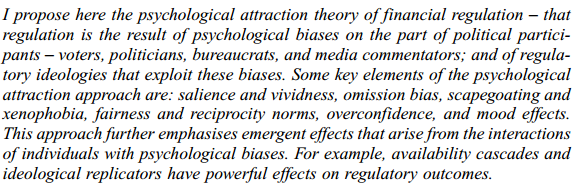
“Psychological Bias as a Driver of Financial Regulation,” David Hirshleifer, European Financial Management, 14(5), November, (2008):856-874.
Deirdre McCloskey and George Will discuss bourgeois inquality
05 May 2016 Leave a comment
in comparative institutional analysis, constitutional political economy, development economics, economic history Tags: Deirdre McCloskey
How Do You Deal With Painful Truths? Left vs. Right
02 May 2016 Leave a comment
in applied price theory, applied welfare economics, comparative institutional analysis, constitutional political economy, economics of media and culture Tags: expressive voting, rational irrationality
The renewable energy curse – does corruption turn clean energy into dirty? @GarethMP
30 Apr 2016 Leave a comment
in comparative institutional analysis, constitutional political economy, energy economics, environmental economics, global warming, Public Choice, rentseeking Tags: European Union, expressive voting, green rent seeking, Italy, renewable energy, solar power, wind power
Massimo Tavoni and Caterina Gennaioli published a nice paper showing that corruption and violence was higher in the high wind provinces of Italy after the installation of wind generators. They built on earlier work about countries with abundant renewable resources and weak institutions. The main question in their paper
… is whether an increase in the expected returns of investments in wind energy, following the introduction of the new policy regime based on a green certificate system, has driven economic agents, namely bureaucrats and entrepreneurs, to engage more in rent seeking activities.
As they studied Italy, there is no surprise about the answer which was yes. High winds ensure high returns of the wind farm investment, but whether this translates into more bribery depends on institutional quality. There was more corruption, and so especially in high-wind provinces of Italy.
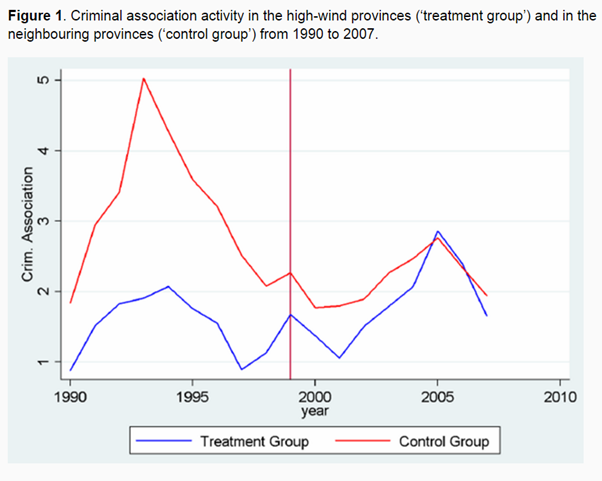
Source: Green policy and corruption | VOX, CEPR’s Policy Portal.
The construction of an average wind park is associated with an increase of criminal association activity of 6%. Italy will have more corruption than elsewhere in the old European Union.
The wider problem is renewable energy is a celebrity technology. In the context of expressive politics, so many cheer for solar and wind power that standards drop in terms of who qualifies for subsidies and who should lose support when their investments do not turn out as promised.
https://twitter.com/CountCarbon/status/715136022414299138
Wind power is not new, it is intermittent, is unsuitable for modern work, and is land constrained but it is still subsidised. Green rent seeking is a real risk even in countries with the best political institutions.
Why Private Investment Works & Govt. Investment Doesn’t
27 Apr 2016 1 Comment
in applied price theory, comparative institutional analysis, constitutional political economy, economic history, economics of media and culture, economics of regulation, industrial organisation, survivor principle Tags: industry policy, picking winners, The fatal conceit, The pretence to knowledge
Jeffrey Miron of Havard University explores three myths about capitalism
26 Apr 2016 Leave a comment
in applied price theory, applied welfare economics, Austrian economics, comparative institutional analysis, constitutional political economy, development economics, economic history, economics Tags: Jeff Miron, The Great Fact
The Philippines’ Geographic Challenge
26 Apr 2016 Leave a comment
in constitutional political economy, development economics, Public Choice Tags: The Philippines
Freedom as a solution to poverty @Oxfam
24 Apr 2016 Leave a comment
in Austrian economics, comparative institutional analysis, constitutional political economy, development economics, economic history, economics of media and culture, growth miracles Tags: Bill Easterly, The Great Escape, The pretence to knowledge
Why Is Marijuana Legal in Some States and Not Others?
24 Apr 2016 Leave a comment
in constitutional political economy, economics of crime, economics of regulation, health economics, law and economics Tags: federalism, war on drugs
Poverty in #India under the Permit Raj and then the dead hand of #neoliberalism
24 Apr 2016 Leave a comment
in applied welfare economics, constitutional political economy, development economics, growth disasters, growth miracles, Marxist economics Tags: antiforeign bias, antimarket buyers, economics of socialism, India, permit raj, rational irrationality
But who would be elected president of New Zealand? @PeterDunneMP
22 Apr 2016 2 Comments
in comparative institutional analysis, constitutional political economy, politics - New Zealand, Public Choice Tags: head of state, New Zealand republic
The principal argument against the republic is it results in a president as the head of state.
In the last Republican debate in Australia in 1999, the Republican movement split between those who wanted an appointed president and an elected president.
An elected president would quickly get ideas above his station because of their popular mandate.
Imagine Gareth Morgan as president. He is a great New Zealander, but heads of state are supposed to be seen and not heard.

It would be a good pub quiz game to list the people would be wholly unsuited as president but would be likely to be elected. Boring people such as those who currently occupy the position such as judges and retired military would not have much of a chance of being elected. A vote for president would be the ultimate protest vote.
The Irish president, for example, is elected but is completely circumscribed in powers. The only power they have to exercise independently is whether to dissolve parliament after a motion of no confidence.
A president elected by the New Zealand House of Representatives would still have some sort of independent mandate and sooner or later would get ideas above their station, which is to be seen but not heard.
Why environmentalists are adverse to real solutions #earthday
22 Apr 2016 Leave a comment
in applied price theory, applied welfare economics, comparative institutional analysis, constitutional political economy, economics of media and culture, economics of regulation, energy economics, entrepreneurship, environmental economics, environmentalism, global warming, politics - USA Tags: anti-market bias, Earth Day, expressive voting, rational ignorance, rational rationality

Source: Quotation of the day for Earth Day on the ‘science of economics versus the religion of environmentalism’ … – AEI | Carpe Diem Blog » AEIdeas from Steven E. Landsburg’s book “The Armchair Economist: Economics and Everyday Life,” in his chapter titled “Why I Am Not an Environmentalist: The Science of Economics versus the Religion of Ecology“.


Recent Comments