Should we redistribute money from rich to poor? What voters of each party said. blogs.lse.ac.uk/generalelectio… http://t.co/aqc8yO3OYE—
Martin Hickman (@martin_hickman) April 26, 2015
UKIP are a bunch of fellow travellers
27 Apr 2015 Leave a comment
in applied welfare economics, constitutional political economy, income redistribution, Public Choice, rentseeking Tags: British election, expressive voting, rational ignorance, rational irrationality, UK politics, UKIP
Murphy’s Law of Economic Policy
26 Apr 2015 Leave a comment
in applied price theory, applied welfare economics, comparative institutional analysis, constitutional political economy, economic history, economics of bureaucracy, Public Choice, rentseeking Tags: Alan Blinder, evidence-based policy, expressive politics, free trade, protectionism, rational ignorance, rational irrationality, rent seeking
Greg Mankiw on one of the few things economists agree on: free trade. That's the problem. nyti.ms/1GrLisQ http://t.co/WrLuP3oBSW—
The Upshot (@UpshotNYT) April 25, 2015
The role of the courts in end of life choices for the terminally ill
26 Apr 2015 Leave a comment
in comparative institutional analysis, constitutional political economy, law and economics, politics - New Zealand, Public Choice Tags: assisted dying, assisted suicide, euthanasia, Justice Scalia
Lindsay Mitchell has a nice summary of the latest developments on an application to the High Court of New Zealand by a terminally ill patient for a declaration that her assisted suicide would not be unlawful and subject to the criminal law. This application currently before the court is specific to that individual and is crafted to claim that it will set no general precedent.
I’m with Justice Scalia when he argues that fundamental issues such as these should be decided by parliaments. As he says regarding general social change:
The virtue of a democratic system [with a constitutionally guaranteed right to free speech] is that it readily enables the people, over time, to be persuaded that what they took for granted is not so and to change their laws accordingly.
The amount of social change in the mid to late 20th century has been stunning. Yes, assisted dying years a passionate issue and some people are impatient, but again I believe Justice Scalia is right when he said:
We might have let the People decide. But that the majority will not do. Some will rejoice in today’s decision, and some will despair at it; that is the nature of a controversy that matters so much to so many. But the Court has cheated both sides, robbing the winners of an honest victory, and the losers of the peace that comes from a fair defeat. We owed both of them better. I dissent.
That importance of a fair defeat at the ballot box and in Parliament is important both to when and if a bill on end of life choice is passed, and to how quickly support opposition to that bill will be mobilised before such a bill even is put into the Parliamentary ballot of private member’s bills.
Nothing stirs up the impassioned (and most other people as well) more than depriving them of their right to support or oppose what is important to them through political campaigns and at an election. The losing side, we all end up on the losing side at one time or another, are much more likely to accept an outcome if they had their say and simply lost the vote at the election or in Parliament.

A decision by the High Court authorising assisted dying in some way does not offer the peace of a fair defeat where the votes are added up where your vote counted as much as mine and one side or the other lost as must always be in a democracy. That’s how majority rule works.
The last bill before the New Zealand Parliament to allow a death with dignity through an assisted suicide for the terminally ill was in 2003 and it failed by three votes: 60 votes to 57 votes.
It is not the role of the courts to hurry up the marshalling of those extra few votes to change the law to judicial action and dispensation. Again, when Scalia dissented on a parental rights case:
I have no reason to believe that federal judges will be better at this than state legislatures; and state legislatures have the great advantages of doing harm in a more circumscribed area, of being able to correct their mistakes in a flash, and of being removable by the people
As Justice Scalia explains, the purpose of the law is to slow the impassioned majority down, not speeding it up:
Judges are sometimes called upon to be courageous, because they must sometimes stand up to what is generally supreme in a democracy: the popular will.
Their most significant roles, in our system, are to protect the individual criminal defendant against the occasional excesses of that popular will, and to preserve the checks and balances within our constitutional system that are precisely designed to inhibit swift and complete accomplishment of that popular will.
Those are tasks which, properly performed, may earn widespread respect and admiration in the long run, but — almost by definition — never in the particular case.
The intervention in a court to grant that right before Parliament is willing to act will only mobilise opposition to any future private member’s bill because they have been denied the right to oppose it through normal democratic means. What are those normal democratic means? Scalia explains when discussing the right to an abortion:
The States may, if they wish, permit abortion on demand, but the Constitution does not require them to do so. The permissibility of abortion, and the limitations upon it, are to be resolved like most important questions in our democracy: by citizens trying to persuade one another and then voting.
Assisted suicide has had popular support for many decades in New Zealand. The reason political parties do not act is those who are against assisted suicide are passionately against it and will change their vote because of such a bill. Those who are for assisted suicide are unlikely to change their vote if a bill is not passed by Parliament.
 For these reasons regarding strong passionate minority opposition and weak majority support, the Labour Party’s new leader pressured a member of his caucus to withdraw a private member’s bill on end of life choice.
Similarly, the Green Party showed equal political cowardice in this matter. They don’t regard a death with dignity to be a priority for them, despite their alleged social liberalism and a willingness to champion the right to abortion in the most recent general election in 2014, which is a socially contentious issue.

The reason is a private member’s bill on abortion in New Zealand won’t get anywhere because the current compromise works – a point to which I shall return. A private member’s bill on end of life choice sponsored by a Green MP would attract too much political flak for the Green Party to handle.
The law has long acted to prevent, by force if necessary, suicide – including suicide by refusing to take appropriate measures necessary to preserve one’s life after the point at which life become unbearable. Justice Scalia argued that:
I believe in liberal democracy, which is a democracy that worries about the tyranny of the majority, but it is the majority itself that must draw the lines.
Whether the patient’s wishes to be honoured in this area is left to elected representatives to legislate. Justice Scalia asks
Are there, then, no reasonable and humane limits that ought not to be exceeded in requiring an individual to preserve his own life? There obviously are, but they are not set forth in the Due Process Clause.
What assures us that those limits will not be exceeded is the same constitutional guarantee that is the source of most of our protection – what protects us, for example, from being assessed a tax of 100% of our income above the subsistence level, from being forbidden to drive cars, or from being required to send our children to school for 10 hours a day, none of which horribles is categorically prohibited by the Constitution.
Our salvation is the Equal Protection Clause, which requires the democratic majority to accept for themselves and their loved ones what they impose on you and me.
The biggest threat to an End of Life Choice bill passing the New Zealand Parliament is judicial intervention in this charged social issue that will only mobilises the opponents of the very right the applicants to the court seek. Scalia again this time on the risks of the courts moving in advance of the popular will, and thereby poisoning the democratic process:
Leaving this matter to the political process is not only legally correct, it is pragmatically so. That alone… can produce compromises satisfying a sufficient mass of the electorate that this deeply felt issue will cease distorting the remainder of our democratic process.
As an example of the importance of democratic compromises in securing the votes in Parliament, there is a voluntary euthanasia bill currently before the Scottish Parliament. It has been stuck in committee for two years because it not only promises end of life choice, it also grants a right of euthanasia to those with progressive degenerative diseases.
By overreaching to progressive degenerative diseases, this Bill in the Scottish Parliament is bogged down because euthanasia as distinct from a death with dignity is a step too far from many members of Parliament willing to support end of life choice for the terminally ill such as provided for in the House of Lords Private Member’s Bill on end of life choice.

Any private member’s bill that does pass the New Zealand Parliament on end of life choice will be riddled with compromises and will have a genuine concern to prevent abuse and guard against questionable decisions made when judgements of the terminally ill is clouded in some way. No court in a single judgement can provide all those details and compromises.

The law attracts more than its share of reformers wanting to use the courts and judge-made law for political purposes. If you want to reform the world, do what we ordinary people have to do: change your vote, write to an MP, protest, donate to or even join a political party, or run for parliament.
The great strength of democracy is a small group of concerned and thoughtful citizens can band together and change things by mounting single issue campaigns or joining a political party and running for office and winning elections or influencing who wins.
Indeed, it is that very strength of democracy – small groups of concerned citizens banding together – is what is holding up legislating on an end of life choice. It is not that minorities are powerless and individuals are voiceless. Exactly the opposite.
Many people have passionate opinions for and against an End of Life Choice Bill. These opinions are taken into account by members of Parliament in fine detail depending on how voters will vote at the next election.
What can be undemocratic about members of Parliament paying attention to how a wide range of ordinary members of the community might vote if they disappoint them.
The key safeguard of minorities against the majority is their ability to block vote. Yes, those in the majority will be annoyed at the power of the minority to slow down the passage of a End of Life Choices Bill.
Yet on some other matter passionate to them those currently in the majority will one day or another end up in a minority. The rotation of power is common in democracies, and the worst rise to the top.
It is wise to design constitutional safeguards to minimise the damage done when those crazies to the right or left of you get their chance in office, as they will sooner or later rather than focus on the powers you and those that currently agree with you should have in your few days in which you fleetingly have a majority.
Too many policies and ideas of the one political party or another assume that they are the face of the future, rather than just another political party that will hold power as often as not and always for an uncertain time.
New Zealand Parliamentary elections are always close because of proportional representation. This makes reality of ending up in the minority again very quickly in a few years very real.
Yesterday’s majority of the vote sooner or later and often sooner than they expect will break off into different minorities on the next big issue of the day.
These newly formed minorities will use that same ability to band together as a minority to block vote to protect what they think is important and advance agendas they think are to be wider benefit despite the opinion of the current majority to the contrary. All reforms start as a minority viewpoint.
You can’t complain about democracy not working because it’s working precisely as it should: parliamentarians paying attention to a great number of people from all walks of life vote in light of how they as members of Parliament voted on specific issues that are important to them.
Maybe the European Union membership isn’t that bad after all, especially if you’re a former Eastern Bloc country
24 Apr 2015 Leave a comment
in applied price theory, applied welfare economics, comparative institutional analysis, constitutional political economy, development economics, growth disasters, growth miracles Tags: European Union, transitional economies
Putin is actually the best of a bad lot
16 Apr 2015 Leave a comment
in constitutional political economy, development economics, growth disasters, growth miracles, Public Choice Tags: Putin, Russia
60 years ago North Korea was richer than the South
15 Apr 2015 1 Comment
in comparative institutional analysis, constitutional political economy, development economics, economic history, growth disasters, growth miracles Tags: capitalism and freedom, China, North Korea, South Korea


Where does democracy figure in the cycle of development thinking?
13 Apr 2015 Leave a comment
in comparative institutional analysis, constitutional political economy, development economics, growth disasters, growth miracles Tags: capitalism and freedom, democracy and freedom, IMF, ODA, rule of law, UN, World Bank
just brilliant: hype cycle for development ideas by @dalgoso http://t.co/UQX3tRHOBJ—
Laurence Chandy (@laurencechandy) January 03, 2014
The power of ordinary citizens to effect change when there is federalism and upper houses
11 Apr 2015 Leave a comment
in constitutional political economy, election campaigns, politics - Australia, politics - New Zealand, Public Choice
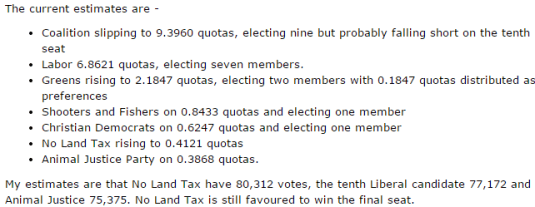
The latest counting in the New South Wales Legislative Council election shows the ease in which ordinary citizens can form a political party and be elected to Parliament when there is federalism and an upper house elected by proportional representation.
Five of the six Australian states have an upper house. In four of those states, the electoral system is proportional representation, with results in the election of many small parties.
In Tasmania, my home state, the Legislative Council as single member constituencies with two or three vacancies filled every year but is full of independents elected the six-year terms. The political parties having no chance of getting candidates elected in front of them. The Tasmanian voters simply don’t vote for party candidates in the Legislative Council elections. Out of 15 members, there is one Liberal Party member, and two members from the Labour Party
In the current New South Wales Legislative Council election, the favourite to win the last seat, and with it the balance of power in the upper house is a previously unheard of No Land Tax party. The Shooters and Fishers party is electing another member this year in New South Wales. The Christian Democrats also have two members.
In Victoria, the Australian Sex Party finally got a candidate elected to the upper house late last year through the courtesy of proportional representation.
Other small parties in the Victorian Legislative Council are the Shooters and Fishers Party with two members, the Democratic Labour Party with one member and a party of never heard of, Vote 1 Local Jobs, with the last seat. These small parties share the balance of power.
The South Australian Legislative Council includes two members from the No Pokies Party, two members from the Family First Party, and one from the Death with Dignity party. Again, this motley crew shares the balance of power.
Western Australian Legislative Council has a government majority, but there is one member from the Shooters and Fishers Party.
The crossbench in the Australian Senate is made up of eight independents and small parties. Several Australian senators on the crossbenchers are completely mad and ignorant; in one certain case, as thick as two short planks. This doesn’t harm, in the case of Jackie Lambie, her chances of being re-elected to the Senate for Tasmania for another six-year term in 2019. A number of Tasmanian voters, including members of my family, value her honesty, though they do admit she is not very bright and is rather rough around the edges.
The strength of democracy lies in the ability of small groups of concerned and thoughtful citizens to band together and change things by running for office and winning elections. That is how new Australian parties such as the ALP, the country party, DLP, Australian democrats and Greens changed Australia. One Nation even had its 15 minutes of fame. Most of these parties started in someone’s living room, full of concerned citizens aggrieved with the status quo.
In Australian elections in recent years, about a quarter of the electorate do not give their vote in upper house selections to the major parties: the Labour Party, the Liberal Party and the Australian Greens. That is fertile ground for small parties to flourish.
So fertile ground is the Australian Senate that the big parties want to change the election system to make it harder for the small parties to swap preferences to get elected through proportional representation and make it much harder to register a political party in the first place.
As would be expected, the far left parties get nowhere in the upper houses of the Australian State parliaments, despite the benefits of proportional representation and preferential voting. These upper houses are filled with small parties from both the left and the right, populist parties all, but the battle cry of socialism just doesn’t resonate with the Australian electorate.
Same thing happened in New Zealand in its recent parliamentary elections. New Zealand has no upper house, but does have proportional representation for the House of Representatives.
A pre-existing hard left party well-funded by a millionaire with an agenda to avoid extradition to the USA got 1.2% of the party vote, but it lost its electorate seat and so is out of Parliament since late last year’s general election.
Greenpeace’s Indian bank accounts frozen
10 Apr 2015 Leave a comment
in constitutional political economy
Those poor possums at Greenpeace have had their Indian bank accounts frozen by the Indian government. In common with many countries, including New Zealand and the USA, India regulates the domestic political activities of foreigners. It is alleged Greenpeace failed to disclose the source of its funding.
Really don’t know what to make of this. Seeking moral advice and guidance, I turned to the Green Party of New Zealand. They are very much against foreign donations to domestic politics, believing elections are for citizens, not foreigners. The screen snapshot below is of the Green’s policy in campaign finance.

I’m yet to see a press release from Greens welcoming this assertion of Indian political sovereignty. Don’t hold your breath.
Capitalism and freedom is noticeably missing from this survey of UN effectiveness
09 Apr 2015 Leave a comment
in comparative institutional analysis, constitutional political economy, development economics, growth disasters, growth miracles, Public Choice, rentseeking Tags: capitalism and freedom, overseas development assistance, UN
perceptions of the UN's impact from the development community http://t.co/k8XYisxGaK—
Laurence Chandy (@laurencechandy) October 07, 2014
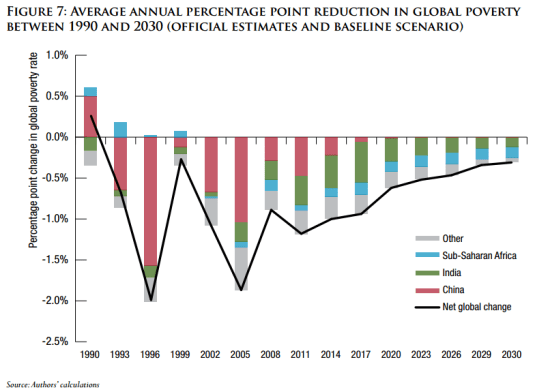
Who has been and will be carrying the baton to abolish global poverty by 2030?
09 Apr 2015 Leave a comment
in constitutional political economy, development economics, growth disasters, growth miracles
Via The Final Countdown: Prospects for Ending Extreme Poverty by 2030 (Report) | Brookings Institution.
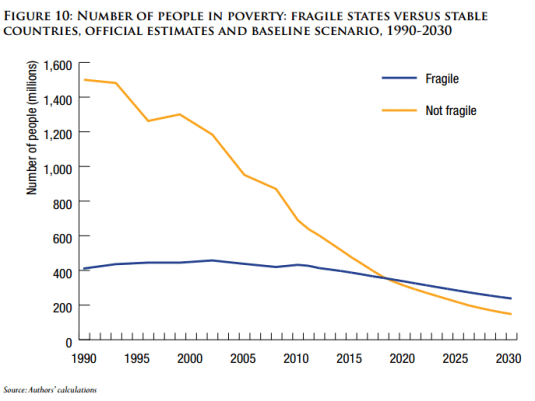
The role of governance in holding back the abolition of extreme poverty by 2030
08 Apr 2015 Leave a comment
in constitutional political economy, development economics, growth disasters, growth miracles
Via The Final Countdown: Prospects for Ending Extreme Poverty by 2030 (Report) | Brookings Institution.

19 incumbent African leaders have been defeated at the polls
06 Apr 2015 Leave a comment
in constitutional political economy, development economics, growth disasters, growth miracles, Public Choice Tags: Africa, capitalism and freedom, free elections, second turnover
After Nigeria, 19 incumbent African leaders have been defeated at the polls. Ever. (ht @calestous) http://t.co/nRdeFYS122—
ian bremmer (@ianbremmer) April 02, 2015
 Utopia, you are standing in it!
Recent Comments