
How on earth did this guy get to become French Minister of Finance? Shades of Roger Douglas?
28 Oct 2014 Leave a comment


Piketty on inequality: views of the IGM economic experts
16 Oct 2014 Leave a comment
in applied price theory, applied welfare economics, comparative institutional analysis, constitutional political economy, discrimination, economic growth, entrepreneurship, gender, human capital, income redistribution, industrial organisation, labour economics, Marxist economics, Rawls and Nozick Tags: Daron Acemoglu, James Robinson, Piketty, poverty and inequality, The Great Enrichment
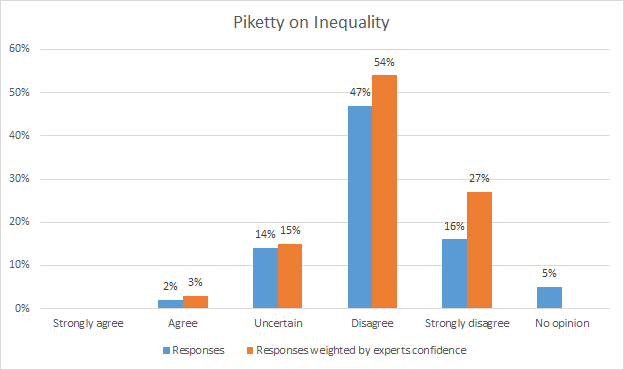
Question: The most powerful force pushing towards greater wealth inequality in the US since the 1970s is the gap between the after-tax return on capital and the economic growth rate?
Daron Acemoglu and James Robinson have a simple explanation for why Piketty is wrong:
But like Marx, Piketty goes wrong for a very simple reason. The quest for general laws of capitalism or any economic system is misguided because it is a-institutional.
It ignores that it is the institutions and the political equilibrium of a society that determine how technology evolves, how markets function, and how the gains from various different economic arrangements are distributed.
Despite his erudition, ambition, and creativity, Marx was ultimately led astray because of his disregard of institutions and politics. The same is true of Piketty.
Legal Systems Very Different from Ours – David Friedman’s forthcoming book
14 Oct 2014 Leave a comment
in comparative institutional analysis, constitutional political economy, David Friedman, law and economics Tags: comparative economic analysis, comparative law, David Friedman, law and economics, Legal systems very different to ours
The central idea of David Friedman’s forthcoming book on legal systems of different societies is they face similar problems and solve them, or fail to, in an interesting variety of ways.
Looking at a range of such societies and trying to make sense of their legal systems provides a window into both problems and solutions, useful for the general project of understanding law—in particular but not exclusively from an economic point of view—and for the narrower project of improving it.
Unlike the usual course in comparative law, he did not look at systems close to ours such as modern Civil Law or Japanese law. Instead, Friedman examined systems from the distant past (Athens, Imperial China), from radically different societies (saga period Iceland, Sharia), or contemporary systems independent of government law (gypsy law, Amish).
System Chapters
Icelandic Law
18th c. English Criminal Law
Gypsy Law
Chinese Law
Athenian Law: The Work of a Mad Economist
Jewish Law
Islamic Law [Recently Updated]
Plains Indian Law
Puzzles of Irish Law
Amish Law
Somali Law [Recently Updated]
Commanche, Kiowa and Cheyenne: The Plains Indians
Thread Chapters
Enforcement Mechanisms: Civil, Criminal, And Lots More
The Incentive to Enforce: What and How Much
Embedded and Polylegal Systems
God as Legislator
Making Law
Guarding the Guardians
His Class web page is based on Student Papers from the SCU Seminar





Recent Comments