What’s going on in the EU with the electing of so many anti-EU candidates?

UK's anti-EU party big winner in local elections- UPDATED

The best achievements of European institutions have all stemmed from removing restrictions—to trade, travel, residency and financial transactions.

But for at least 30 years, the EU has mainly been in the business of imposing restrictions on everything from the judicial sentences that national courts can impose to the shape of the vegetables that Europeans get to eat.

Stealth Europe transmogrified into Busybody Europe.

Wall Street Journal via Managerial Econ: What’s going on in the EU?

David Friedman – Market Failure: An Argument Both For and Against Government

Sam Peltzman and the great restraint in the growth of government, 1980-2007

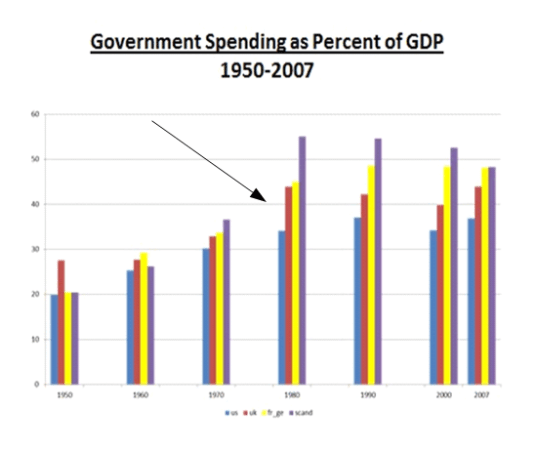
From 1950 to 1980 the size of government doubled in the developed world and then stopped dead in 1980. This great restraint on the growth of government happened everywhere. It was not just Thatcher’s Britain or Reagan’s America. It was everywhere, in France and Germany, and even in Scandinavia.

Peltzman’s data below has government spending double between 1950 and 1980, and then nothing much happened in between 1980 and 2007 – the size of government is pretty flat as a share of GDP for 27 years.

Source: Sam Peltzman, The Socialist Revival? (2012).

There is a noticeable reduction in the size of government spending in Scandinavia. Reagan and Thatcher had nothing on those Social Democrats in Scandinavia when it comes to cutting the size of government.

Governments everywhere hit a brick wall in terms of their ability to raise further tax revenues. Political parties of the Left and Right recognised this new reality.

Government spending grew in many countries in the 20th century because of demographic shifts, more efficient taxes, more efficient spending, a shift in the political power from those taxed to those subsidised, shifts in political power among taxed groups, and shifts in political power among subsidised groups.

The median voter in all countries was alive to the power of incentives and to not killing the goose that laid the golden egg.

After 1980, the taxed, regulated and subsidised groups had an increased incentive to converge on new lower cost modes of redistribution.

More efficient taxes, more efficient spending, more efficient regulation and a more efficient state sector reduced the burden of taxes on the taxed groups.

Most subsidised groups benefited as well because their needs were met in ways that provoked less political opposition.

Gary Becker made this warning about the political repercussions of tax reform and economic reform in general for the size of government:

…the greater efficiency of a VAT and its ease of collection is a two-edged sword.

On the one hand, it would raise a given amount of tax revenue efficiently and cheaply.

Since economists usually evaluate different types of taxes by their efficiency and ease of collecting a given amount of tax revenue, economists typically like value added taxes.

The error in this method of evaluating taxes is that it does not consider the political economy determinants of the level of taxes.

From this political economy perspective, the value added tax does not look so attractive, at least to those of us who worry that governments would spend and tax at higher levels than is economically and socially desirable.


Reforms ensued after 1980 led by parties on the Left and Right, with some members of existing political groupings benefiting from joining new political coalitions.

The deadweight losses of taxes, transfers and regulation limit inefficient policies and the sustainability of redistribution.

Peltzman likes to note that at the start of the 20th century, the United States government was about 8% of GDP. The two largest programs were education and highways. The post office was as big as the military.

Government is about five times that now with defence, health, education and income security accounting for 70% of this total. Peltzman makes the very interesting point that:

There is no new program in the political horizon that seems capable of attaining anything like the size of any of these four.

For the time being the future government rest on the extent of existing mega programs.

Health and income security account for 55% of total government spending in the OECD. It is in these two programs where the future of the growth of government lie.

The pressure for that growth in government will come from the elderly. Governments will have to choose between high taxes on the young to fund these programs for the elderly or find other options.

Gordon Tullock on the motives for income distribution

David Friedman – Legal Systems Very Different From Ours

Video

Ronald Coase on applied welfare economics versus comparative institutional analysis

All solutions have costs, and there is no reason to suppose that governmental regulation is called for simply because the problem is not well handled by the market or the firm.

Satisfactory views on policy can only come from a patient study of how, in practice, the market, firms and governments handle the problem of harmful effects….

It is my belief that economists, and policy-makers generally, have tended to over-estimate the advantages which come from governmental regulation.

But this belief, even if justified, does not do more than suggest that government regulation should be curtailed. It does not tell us where the boundary line should be drawn.

This, it seems to me, has to come from a detailed investigation of the actual results of handling the problem in different ways.

Why do we have governments?

Ancient philosophers in general thought that it was to establish virtue or do good. Most modern public choice scholars are more modest in their evaluation of government.

We simply want government to provide those goods and services that people in fact want and that, for a variety of reasons, are hard to provide through the market.

Most people, for example, would like to have the poor taken care of by taxes on those better off. It is true they would have no objection if the poor were taken care of by voluntary contributions, but our experience seems to indicate that voluntary contributions don’t produce adequate funds for this purpose. Hence the use of the government to provide that particular service is generally approved. Of course, that does not prove that in general people are in favour of the exact quantity transferred or the methods used by the government.

There is a large literature on why certain types of things, sometimes called public goods, are provided by the market in a very inefficient way and will be provided in a better (although far from optimal) way by the government.

…We will just accept as a fact that there are a number of things which are better dealt with by the government. We will also accept as a fact that there are other things which are better dealt with by the market.

…In general, we want the government to give the citizens what they themselves want. That, indeed, is the point of democracy.

The smaller the government, the smaller the number of its voters. The smaller the number of voters, the more power each individual voter has. That’s one side of the argument.

On the other side, we have the fact that many government services are hard or impossible for small governmental units to provide.

These two arguments have to be set off against each other and since different government activities will turn out to have a different balance, having different governmental sizes is sensible.

… The existence of many small government units dealing with certain special problems has another advantage. Not only are these small governments more under the control of their voters in the sense that each individual voter’s preferences count for more than in the large government, their existence means that citizens may move from one to the other if they are dissatisfied.

Gordon Tullock

The New Federalist (1995)

New Zealand is not a federal state. I like federalism because a divided government is a weak government.

In praise of traffic cops

Due to budget cuts, 35% of Oregon State Highway Police were laid off. These mass layoffs dramatically reduced citations and resulted in a 10-20% increase in injuries and fatalities.

The strongest effects were under fair weather conditions outside of city-limits where state police employment levels were most relevant.

These results in DeAngelo and Hansen’s “Life and Death in the Fast Lane: Police Enforcement and Traffic FatalitiesAmerican Economic Journal: Economic Policy 2014 suggest that a highway fatality can be prevented with $309,000 of additional expenditures on traffic police.

A standard measure of the “value of a statistical life” is it is worth taking regulatory or law enforcement actions that reduce the risks of death when the costs of these actions are less than about $9 million per life saved.

Road safety is an area where James Buchanan’s punishment dilemma is strong:

For some laws or behavioural rules, the individual’s self-interest may override adherence [to the law], at least in certain circumstances.

Traffic violations offer a good example here.

Recognizing that he may himself violate traffic regulations on occasion, the individual may be reluctant to accept institutions that impose severe penalties, despite his preferences that all “others” than himself should be led to obey the general rules by sufficiently severe sanctions.

Just as the individual prefers that all others abide voluntarily by law while he remains free to violate it, so, too, he prefers that differentially severe punishment for law violation be meted out to others than himself.

Voters are less than keen to support strong penalties and convict when sitting on juries because of the fear that there but for the grace of god go I: that they would be in the dock at the receiving end of the heavy punishments.

If we commit to punish offenders and those who might commit offenses are deterred by this commitment to punish them, there would be fewer offenses. This also means doing the unpleasant things of meeting out these punishment when there are offenses by the undeterred:

  • It is painful to subject others to punishment (“son, this is going to hurt me as much as it hurts you”); and
  • It is even more painful to vote for penalties that may be imposed on yourself in person.

The initially low penalties for causing death by dangerous driving is an example of the punishment dilemma. These penalties only slowly increased over several decades as societal attitudes hardened.

Why Does 1% of History Have 99% of the Wealth? | Learn Liberty – YouTube

Throughout the history of the world, the average person on earth has been extremely poor: subsisting on the modern equivalent of $3 per day.


This was true until 1800, at which point average wages—and standards of living—began to rise dramatically.

Prof. Deirdre McCloskey explains how this tremendous increase in wealth came about.

In the past 30 years alone, the number of people in the world living on less than $3 per day has been halved.

The cause of the economic growth we have witnessed in the past 200 years may surprise you.

It’s not exploitation, or investment. Innovation—new ideas, new inventions, materials, machinery, organizational structures—has fueled this economic boom.

Prof. McCloskey explains how changes in Holland and England in the 1600s and 1700s opened the door for innovation to take off—starting the growth that continues to benefit us today.

via Why Does 1% of History Have 99% of the Wealth? | Learn Liberty – YouTube.

You’re an ideologue; no, you’re the ideologue!

I find that people who call out other people and opposing analysis as ideological are themselves ideologues. They cannot see political differences as other than ideological cat fights.

This is rather than an honest difference of opinion over the effectiveness of different options to achieve a common end as Milton Friedman explained:

I venture the judgment, however, that currently in the Western world, and especially in the United States, differences about economic policy among disinterested citizens derive predominantly from different predictions about the economic consequences of taking action – differences that in principle can be eliminated by the progress of positive economics – rather than from fundamental differences in basic values, differences about which men can ultimately only fight.

Hayek attributed to his opponents nothing more than intellectual error. Hayek (1948) believed that:

we must recognize that it may be genuine error which leads the well-meaning and intelligent people who occupy those key positions in our society to spread views which to us appear a threat to our civilization. Nothing could be more important than to try to understand the sources of this error in order that we should be able to counter it.

Hayek (1968) continues:

The worst mistake a fighter for our ideals can make is to ascribe to our opponents dishonest or immoral aims. I know it is sometimes difficult not to be irritated into a feeling that most of them are a bunch of irresponsible demagogues who ought to know better…

we ought to realize that their conceptions derive from serious thinkers whose ultimate ideals are not so very different from our own and with whom we differ not so much on ultimate values, but on the effective means of achieving them.

William Baumol and Alan Blinder described the role of economics in policy debates as follows:

While economic science can contribute the best theoretical and factual knowledge there is on a particular issue, the final decision on policy questions often rests either on information that is not currently available or on tastes and ethical opinions about which people differ (the things we call ‘value judgments’), or on both.

Lester Thurow said that differences in the valuation of outcomes is at the basis of most disagreements:

Liberal and conservative economists most frequently disagree on who ought to be hurt and who ought to be helped. Their technical disagreements on who will be hurt and who will be helped are much less frequent.

Karl Popper argued that who made an argument is of little value. He said that the growth of knowledge depended not on the ethics of the individual scientists but on the critical spirit to scientific community as a whole. The critical scrutiny of others polices the truth:

The genuine rationalist does not think that he or anyone else is in possession of the truth; nor does he think that mere criticism as such helps us achieve new ideas.

But he does think that, in the sphere of ideas, only critical discussion can help us sort the wheat from the chaff.

He is well aware that acceptance or rejection of an idea is never a purely rational matter; but he thinks that only critical discussion can give us the maturity to see an idea from more and more sides and to make a correct judgement of it.

Peter Drucker championed a business rule of never making a decision until there is disagreement; only then do you know what you are planning to do:

Unless one has considered alternatives, one has a closed mind.

This above all, explains why effective decision-makers deliberately disregard the second major command of the textbooks on decision-making and create dissension and disagreement, rather than consensus.

Decisions of the kind the executive has to make are not made well by acclamation.

They are made well only if based on the clash of conflicting views, the dialogue between different points of view, the choice between different judgments.

The first rule in decision-making is that one does not make a decision unless there is disagreement

Alfred P. Sloan said at a meeting of one of his top management committees:

“Gentlemen, I take it we are all in complete agreement on the decision here.”  Everyone around the table nodded assent.

“Then,”continued Sloan, “I propose we postpone further discussion of this matter until our next meeting to give ourselves time to develop disagreement and perhaps gain some understanding of what the decision is all about”.

What Have We Learned from the Collapse of Communism? by Peter Boettke

the collapse of Communism has taught political economists several things:

first, that economic policy is always nested within a set of institutions—that there are economic/financial, political/legal, and social/cultural issues, which all must be taken into account;

second, that leadership matters throughout the transition process;

and third, that historical contingency can either work in your favour or cut against the successful transition.

And I would add a fourth one: that political power corrupts even the most informed and idealistic of individuals, such that you cannot count on ideological alignment to win the day. You have instead a small window of opportunity in which ideological alignment can be utilized to establish institutions that make it difficult for even bad men to do much harm.

In other words, the goal of our political/legal institutions should not be to ensure that the best and the brightest can govern, but instead that if the worst get in power, they can do little damage. This is the idea of a “robust political economy”.

Hayek’s spotty record as a prophet in the Road to Serfdom – part 2: what about the post-colonial Third World?

Gordon Tullock used Sweden to argue that  the problem with The Road to Serfdom was:

“that it offered predictions which turned out to be false. The steady advance of government in places such as Sweden did not lead to any loss of non-economic freedoms.”

But was socialism good for democratic consolidations in the post-colonial third world? Was that not a better hunting ground for Hayek’s fears?

clip_image001

The people and parties, very often with a socialist hew, who won the election after the colonial government left town are not always all that keen to give up the reins of power.

Remember Huntington’s Two Turnover Test: when a nation moves from an emergent to a stable democracy, it must undergo two democratic and peaceful turnovers of ruling parties.

After an emerging democracy’s first turnover, the new administration often reverts to authoritarian rule. Russia under Yeltsin and Putin are examples.

Would Singapore be an example of central planning and state ownership leading to serfdom and a one-party state?

The state controls and owns firms that comprise at least 60% of the GDP through government entities. The vast majority (more than 80%) of Singaporeans live in public housing;

Although initially styling itself an anti-Communist and Social Democratic, the People Action Party (PAP) was expelled from the Socialist International in 1976 because it suppressed dissent and jailed opposition leaders. Hayek would be vindicated?!

The Index of Economic Freedom says that Singapore is a nominally democratic state ruled by the PAP since the country became independent in 1965, and that certain rights, such as freedom of assembly and freedom of speech, remain restricted

The Freedom House 2010 country report notes that Singapore is not an electoral democracy despite elections free of irregularities and mentions that all domestic newspapers, radio stations, and television channels are owned by government-linked companies, which limits free speech. The PAP has used the Government’s extensive powers to place formidable obstacles in the path of political opponents.

Daron Acemoglu has written on the role of institutions on post-colonial development in his why nations fail research agenda.

  • In Africa, Central America, the Caribbean and South Asia, European powers set up extractive states. These institutions did not introduce much protection for private property nor did they provide checks and balances against government expropriation. The explicit goal of the Europeans, in one form or another, was the extraction of resources from these colonies.
  • This colonization strategy contrasts with the institutions that the Europeans set up in colonies in which they settled in large numbers, e.g., the United States, Canada, Australia and New Zealand. In these colonies, life was modelled after that in the home country; the emphasis was on the enforcement of property rights for a broad cross-section of society, especially smallholders, merchants and entrepreneurs.

The same British colonists established different institutions in very different parts of the world:

  • If Europeans settled in a colony, institutions were developed for their own future benefits.
  • If Europeans did not settle in a colony, they set up a highly centralized state apparatus and other similar institutions to oppress the native population and to facilitate the extraction of resources in the short run

Acemoglu has written on Singapore as a stable non-democracy that can persist without significant repression.

Singapore was able through industrialization in the post-colonial period to ease social tensions and thus eliminate the need for democratic consolidation and also the need for repression. China’s ruling elite has the same current goal.

Why has Singapore not democratized? Acemoglu suggests is it is because Singapore is a very equal society. There is no traditional wealthy landed elite and the economy relies on external capital and businesses.

Most people appear to be relatively happy with the status-quo, at least not so unhappy that they want to engage in serious, and potentially costly, collective action to induce a major change in political institutions.

All and all, political economy has come on in leaps and bounds since 1944. Hayek should be judged against the other predictions of his times. Few socialist countries in the post-colonial Third World stayed democratic for long.

Hayek’s spotty record as a prophet in The Road to Serfdom – Part 1

Gordon Tullock used Sweden to support his argument that the basic problem with The Road to Serfdom was:

“that it offered predictions which turned out to be false. The steady advance of government in places such as Sweden did not lead to any loss of non-economic freedoms.”

Hayek discusses the Road to Serfdom

When looking back longingly at the mixed economies of 1950s and 1960s, people often forget who won elections much of the time back then.

The period that managed to combine a large degree of state ownership and control of the UK economy with a free and diverse media and political pluralism was often under Tory rule (1951 to 1964) with the Labor governments (1964-1970) often with a margin of a few seats.

Then there was the Menzies era in Australia with Liberal party rule from 1949 to 1972; and then 1975 to 1983. Much the same in New Zealand. The Left rarely held power in the mid-20th century.

The Christian democrats usually ran both Italy and Germany in coalitions, as I recall, up until the late 1960 or the early 1970s. Gaullist France? The LDP in Japan?

That is where Hayek got it wrong. The left-wing parties were not the face of the future.

Power rotated in Schumpeterian sense. Governments were voted out when they disappointed voters with the replacement not necessarily having very different policies.

The right-wing parties won many western European elections by that well-proven old trick of being slightly to the right of the left-wing parties. Hayek failed to predict this.

Hayek was himself a major critic of detailed predictions:

“We can build up beautiful theories which would explain everything, if we could fit into the blanks of the formulae the specific information; but we never have all the specific information.

Therefore, all we can explain is what I like to call “pattern prediction.”

You can predict what sort of pattern will form itself, but the specific manifestation of it depends on the number of specific data, which you can never completely ascertain. Therefore, in that intermediate field — intermediate between the fields where you can ascertain all the data and the fields where you can substitute probabilities for the data–you are very limited in your predictive capacities.”

“Our capacity of prediction in a scientific sense is very seriously limited. We must put up with this.

We can only understand the principle on which things operate, but these explanations of the principle, as I sometimes call them, do not enable us to make specific predictions on what will happen tomorrow.”

Hayek’s warnings in The Road to Serfdom was against a background where democracy was still young and insecure in Europe and peacetime democratic governments were, up until then, not much bigger than a post office and a military. The big governments of his day were not democratic.

As Popper and Kuhn understood it, bold, risky hypotheses are at the heart of great advances in the sciences and scholarship generally.

The public choice theory of LBJ

I am about 3000 pages into Robert Caro’s biography of Lyndon Johnson. Caro, now in his 70s, has spent thirty-eight years writing the biography of one man. Volume 4 published in 2012 finished in early 1964. The best biography about; Caro has you looking over the shoulder of LBJ and into his mind and into the minds of everyone around him.

LBJ was an astute man who could look deep into other men’s hearts to see exactly where he could find a weakness or a common ground to exploit to change their minds.

Johnson was famous for persuading the strongest of men to do something they absolutely did not want to do. It became known as the Johnson treatment.

The Southern Democrats thought JFK was a cream puff when it came to passing civil rights bills. They had no difficulty killing his bills in committee.

The Southern Democrats were full of despair the moment LBJ became president.

They knew that Johnson would find a way to pass a major civil rights bill through congress and despite any senate filibusters. Such was Johnson’s reputation as a legislator and a tactician when he was senate majority leader in the 1950s.

LBJ was behind the first civil rights bill of the 20th century. This was the 1957 civil rights bill.

LBJ’s astute understanding of public choice processes was central to how he crafted the 1957 bill.

Johnson could see that the Southern Democrats would not live with racial integration at the social level.

But he knew from his dealings with the Southern Democrats that in their hearts that they could not ultimately deny that people have a right to vote.

LBJ knew that if Black Americans in the Southern States could secure the right to vote, all the other rights they sought would soon follow and would be protected by law. He was right.

The 1957 and, particular, the 1964 civil rights laws overthrew racial segregation because more Black Americans could vote in the Southern States in state and local elections. Politicians soon courted those votes and there was a political realignment and a social revolution. The lawlessness that back-up most of segregation quickly came to an end  because its victims could now vote. Richard Epstein explains:

With Jim Crow in the South this set of insidious practices was not accomplished by explicit laws mandating racial segregation.

Rather, those  inflexible social and economic patterns were supported by four interlocking strategies.

First, illicit control of the electoral franchise, which in turn translated into control of the police and the courts.

Second, corrupt use over the infrastructure translated into an ability to deny water and electrical hook-ups to firms that did not toe the segregationist line.

Third, private violence to which southern police forces turned a blind eye when they did not actively support it.

Fourth, social ostracism to those who spoke up against the system. Sensible people either left, stayed away or remained silent.

… At its best, and in its original form, the Civil Rights Act of 1964 sought to break the control of the local segregationist forces over their political institutions. First on the list was Title I, which attacked exclusion from voting.

Is the Blogosphere an Infotopia or an Echo Chamber – the Daily Me?

Cass Sunstein made some astute observations in Republic.com 2.0 about how the blogosphere forms into information cocoons and echo chambers. People can avoid the news and opinions they don’t want to hear.

This is not all that surprising. Many do not read the newspaper, or read those newspapers that fuel their initial beliefs. London is famous for its partisan newspapers each pandering to their own slice of the political spectrum.

The standard J.S. Mill view of deliberation is that group discussion is likely to lead to better outcomes, if only because competing views are stated and exchanged.

Sunstein has argued that there are limitless news and information options and, more significantly, there are limitless options for avoiding what you do not want to hear:

  • Those in search of affirmation will find it in abundance on the Internet in those newspapers, blogs, podcasts and other media that reinforce their views.
  • People can filter out opposing or alternative viewpoints to create a "Daily Me."
  • The sense of personal empowerment that consumers gain from filtering out news to create their Daily Me creates an echo chamber effect and accelerates political polarisation.

A common risk of debate is group polarisation. Members of the deliberating group move toward a more extreme position relative to their initial tendencies!

How many blogs are populated by those that denounce those who disagree? This is the role of the mind guard in group-think.

Debate is over-rated as compared to brute experience. Milton Friedman said this in his Nobel price lecture:

Government policy about inflation and unemployment has been at the centre of political controversy. Ideological war has raged over these matters.

Yet the drastic  change that has occurred in economic theory has not been a result of ideological warfare.

It has not resulted from divergent political beliefs or aims.

It has responded almost  entirely to the force of events: brute experience proved far more potent than the  strongest of political or ideological preferences

The market process succeeds because it relies on a bare minimum of knowledge and hardly any deliberation but a lot of learning from experience.

A purpose of voting through secret ballots is both to bring the debate to a close and to clip the wings of those that shout the loudest and longest.

Sunstein in Infotopia wrote about how people use the Internet to spend too much time talking to those that agree with them and not enough time looking to be challenged:

In an age of information overload, it is easy to fall back on our own prejudices and insulate ourselves with comforting opinions that reaffirm our core beliefs. Crowds quickly become mobs.

The justification for the Iraq war, the collapse of Enron, the explosion of the space shuttle Columbia–all of these resulted from decisions made by leaders and groups trapped in "information cocoons," shielded from information at odds with their preconceptions. How can leaders and ordinary people challenge insular decision making and gain access to the sum of human knowledge?

Conspiracy theories had enough momentum of their own before the information cocoons and echo chambers of the blogosphere gained ground.

Must everything be the result of a grand plan? As Karl Popper explains:

…a theory which is widely held but which assumes what I consider the very opposite of the true aim of the social sciences; I call it the "conspiracy theory of society."

It is the view that an explanation of a social phenomenon consists in the discovery of the men or groups who are interested in the occurrence of this phenomenon (sometimes it is a hidden interest which has first to be revealed), and who have planned and conspired to bring it about.

This view of the aims of the social sciences arises, of course, from the mistaken theory that, whatever happens in society – especially happenings such as war, unemployment, poverty, shortages, which people as a rule dislike – is the result of direct design by some powerful individuals and groups.

Cass Sunstein in another book defines a conspiracy theory as:

An effort to explain some event or practice by reference to the machinations of powerful people, who have also managed to conceal their role.

He goes on to argue that millions hold conspiracy theories – that powerful people work together to withhold the truth about some important practice or terrible event.

Conspiracy theories attribute extraordinary powers to political leaders and bureaucracies to plan, to control others, and to maintain secrets. Conspiracy theories overestimate the competence and discretion of these political leaders and bureaucracies, who are assumed to be able to make and carry out sophisticated secret plans, despite ample evidence that most government actions do not remain secret for long.

Conspiracy theories also assume that these nefarious secret plans are easily detected by members of the public without the need for special access to the key information or any investigative resources.

Sunstein also argued that a distinctive feature of conspiracy theories is their self-sealing quality. Conspiracy theorists are not persuaded by an attempt to dispel their theories and look at these attempts as further proof of the conspiracy.

Karl Popper argued that conspiracy theories overlook the pervasive unintended consequences of political and social action; they assume that all consequences must have been intended by someone.

Most people lack direct or personal information about the explanations for terrible events, and they are often tempted to attribute such events to some nefarious actor as a way of coping with an uncertain world. More than a few blogs help them round-up the usual suspects.

Previous Older Entries Next Newer Entries

David Andolfatto

Celebrating humanity's flourishing through the spread of capitalism and the rule of law

Monetary Non-Neutrality

Celebrating humanity's flourishing through the spread of capitalism and the rule of law

Reason Magazine

Celebrating humanity's flourishing through the spread of capitalism and the rule of law

Coyote Blog

Celebrating humanity's flourishing through the spread of capitalism and the rule of law

Thoughts from the North

Celebrating humanity's flourishing through the spread of capitalism and the rule of law

Fardels Bear

A History of the Alt-Right

Vincent Geloso

Econ Prof at George Mason University, Economic Historian, Québécois

Bassett, Brash & Hide

Celebrating humanity's flourishing through the spread of capitalism and the rule of law

Truth on the Market

Scholarly commentary on law, economics, and more

The Undercover Historian

Beatrice Cherrier's blog

Matua Kahurangi

Celebrating humanity's flourishing through the spread of capitalism and the rule of law

Temple of Sociology

Celebrating humanity's flourishing through the spread of capitalism and the rule of law

Velvet Glove, Iron Fist

Celebrating humanity's flourishing through the spread of capitalism and the rule of law

Why Evolution Is True

Why Evolution is True is a blog written by Jerry Coyne, centered on evolution and biology but also dealing with diverse topics like politics, culture, and cats.

NoTricksZone

Celebrating humanity's flourishing through the spread of capitalism and the rule of law

Homepaddock

A rural perspective with a blue tint by Ele Ludemann

Kiwiblog

DPF's Kiwiblog - Fomenting Happy Mischief since 2003

The Dangerous Economist

Celebrating humanity's flourishing through the spread of capitalism and the rule of law

Watts Up With That?

The world's most viewed site on global warming and climate change

The Logical Place

Tim Harding's writings on rationality, informal logic and skepticism

Doc's Books

A window into Doc Freiberger's library

The Risk-Monger

Let's examine hard decisions!

Uneasy Money

Commentary on monetary policy in the spirit of R. G. Hawtrey

Barrie Saunders

Thoughts on public policy and the media

Liberty Scott

Celebrating humanity's flourishing through the spread of capitalism and the rule of law

Point of Order

Politics and the economy

James Bowden's Blog

A blog (primarily) on Canadian and Commonwealth political history and institutions

Science Matters

Reading between the lines, and underneath the hype.

Peter Winsley

Economics, and such stuff as dreams are made on

A Venerable Puzzle

"The British constitution has always been puzzling, and always will be." --Queen Elizabeth II

The Antiplanner

Celebrating humanity's flourishing through the spread of capitalism and the rule of law

Bet On It

Celebrating humanity's flourishing through the spread of capitalism and the rule of law

History of Sorts

WORLD WAR II, MUSIC, HISTORY, HOLOCAUST

Roger Pielke Jr.

Undisciplined scholar, recovering academic

Offsetting Behaviour

Celebrating humanity's flourishing through the spread of capitalism and the rule of law

JONATHAN TURLEY

Res ipsa loquitur - The thing itself speaks

Conversable Economist

In Hume’s spirit, I will attempt to serve as an ambassador from my world of economics, and help in “finding topics of conversation fit for the entertainment of rational creatures.”

The Victorian Commons

Researching the House of Commons, 1832-1868

The History of Parliament

Articles and research from the History of Parliament Trust

Books & Boots

Reflections on books and art

Legal History Miscellany

Posts on the History of Law, Crime, and Justice

Sex, Drugs and Economics

Celebrating humanity's flourishing through the spread of capitalism and the rule of law

European Royal History

Exploring the Monarchs of Europe

Tallbloke's Talkshop

Cutting edge science you can dice with

Marginal REVOLUTION

Small Steps Toward A Much Better World

NOT A LOT OF PEOPLE KNOW THAT

“We do not believe any group of men adequate enough or wise enough to operate without scrutiny or without criticism. We know that the only way to avoid error is to detect it, that the only way to detect it is to be free to inquire. We know that in secrecy error undetected will flourish and subvert”. - J Robert Oppenheimer.