Since 2000 there have been 62 coup attempts and 23 successful coups.

Source: Map of coups since 2000 – including 2016 Turkey Coup attempt.
Celebrating humanity's flourishing through the spread of capitalism and the rule of law
17 Jul 2016 Leave a comment
in defence economics, development economics, Public Choice
Since 2000 there have been 62 coup attempts and 23 successful coups.
Source: Map of coups since 2000 – including 2016 Turkey Coup attempt.
16 Jul 2016 Leave a comment
in applied price theory, comparative institutional analysis, constitutional political economy, defence economics, economics of bureaucracy, Gordon Tullock, Public Choice, rentseeking Tags: economics of revolutions, fall of communism, military coups, people power, Romania
The obituaries today for Victor Stanculescu, the Romanian army chief at the time of the 1989 revolution, vindicated Gordon Tullock’s view that popular revolutions are in fact military coups.
Tullock argues that any dictator can survive popular revolts as long as he has
Ordinary citizens obey dictators because if they don’t, they are highly unlikely to make any difference in any revolt and could get killed during the uprising even if it succeeds. Worse awaits them if the revolt fails.
Most dictators do not anoint a formal successor while they are in office. Tullock argued that as soon as a likely successor emerges, loyal retainers start to form alliances with that person and may see private advantage in bringing his anointed day forward.
More than a few autocrats were murdered in their sleep. To his very last day, Stalin locked his bedroom door because he did not trust the bodyguards who had been with him since the 1920s.
The role of street protests in the Arab Spring was to throw in the possibility of mutinies and desertions in the army and police. Previous alliances are thrown into doubt especially as the autocrat is old and sick, but had for many years grooming his 39 year-old son to inherit power.
Turning back to the Romanian revolution, Victor Stanculescu was the recently appointed army chief and initially stuck by the regime. He ordered the troops to open fire on protesters and at least 1000 died from in the shootings in the street.
In common with the Arab Spring, a large street protest did led him to reconsider his position:
Sniffing Mr. Ceausescu’s defeat, General Stanculescu quickly returned to Bucharest, where he faked a broken leg to avoid further counterrevolutionary deployment. Promoted to defense minister after the incumbent minister killed himself, he helped Mr. Ceausescu and his wife, Elena, flee by helicopter from the roof of party headquarters.
But fearing that the copter had been spotted by radar and would be shot down, the pilot hastily landed. Mr. Ceausescu hijacked a passing car, but he and his wife were soon surrounded and arrested.
After the couple were captured, General Stanculescu organized their trial by a military court and recruited the firing squad (before the verdict, by some accounts) that executed them on Christmas Day. He then joined the new government.
But for this late switch by the army chief, the popular revolt would never have succeeded. The army was needed to put down the still loyal security police. The army chief’s top priority was to execute Ceausescu as quickly as possible so that he was not a rallying point for a counter coup.
Ceausescu found out that his game was up when who he thought was his still loyal army chief arrived at his hideout with military judges to try and execute him.
About 10 years later, the Romanian government turned against the man who made the revolution and put him in prison for the many deaths in the street when he was on the side of the regime putting down the revolt.
Not so good an idea. A little bit of forgiveness carries a lot of weight encouraging late switching within the ruling elite and army that makes the difference to bringing down the old regime.
15 Jul 2016 Leave a comment
in defence economics, economics, economics of crime, economics of religion, law and economics Tags: economics of oppositional identities, war against terror
10 Jul 2016 Leave a comment
in defence economics, war and peace Tags: anti-war movements, British politics, game theory, Iraq, Iraq war, Middle-East politics, mutually assured destruction, nuclear deterrence, peace movements, Syrian Civil War
This idea of suing ministers for abuse of public office has appeal given the gap between many left-wing policies and sound economics.
https://twitter.com/_PaulMonaghan/status/751525929613156352
Anti-war MPs such as Jeremy Corbyn should be sued for abuse of public office and crimes against peace for not making the knockdown argument against the 2nd war against Iraq.
Instead, Corbyn said he did not like war without explaining how this was different from appeasement and surrender. The easiest way to stop a war is to surrender. The easiest way to start a war is to look weak to an aggressor.
That knockdown argument against the 2nd Iraq war argument was right under the noses of the peace movement. It was yes, Iraq has weapons of mass destruction.

Source: The Secret Casualties of Iraq’s Abandoned Chemical Weapons – The New York Times
It is madness to invade a country that has weapons of mass destruction because they might use them especially if the objective is regime change. Iraq may not have had nuclear weapons, but the potential for Iraq to have biological and chemical weapons secreted away was real.
No one is mad enough to invade North Korea. They will use chemical and biological weapons on Seoul and Tokyo. Syria has chemical and biological weapons to make sure no one invades it.

From what I read, in the current Civil War, Syria uses chemical and biological weapons when it is on the retreat but does not use them to advance and claim new territory.
The reason why the renegade left could not possibly make this obvious argument against the war in Iraq, which was it could be a massive disaster if these chemical and biological weapons were used in desperation, was these peace activists would have to admit nuclear deterrence works. To stop a war by having to admit that weapons of mass destruction deter war was too much for the peace movement to swallow.
An admission that nuclear deterrence works would invalidate the entire political activism of the peace movements in the Cold War. The practical effect of those peace movements was, of course, to undermine the one factor preventing a nuclear war, which was nuclear deterrence.

Since 1945, at least seven or eight wars have occurred where one side had nuclear weapons. In 1973, Israel had nuclear weapons it could have used.

The reason for the non-use of nuclear weapons in those seven or eight wars including the 1973 Yom Kippur War was none were wars of annihilation. Nuclear weapons were more likely to be used if the suspected intention is to invade or occupy a country.
The Yom Kippur war was launched with a plan by President Sadat to reclaim the Sinai then after a few days agreed to an internationally brokered ceasefire. He was intending on reclaiming lost territory, not invading Israel proper continue and risk nuclear retaliation.
Saddam destroyed his nuclear, biological, and weapons but not his weapons development capability soon after he lost the first Iraq war. Saddam played a double strategy: make sure he was not caught with contraband but play a fine game of bluff making everybody think Iraq still has them so he remains a regional strongman.
Saddam could have produced biological and chemical weapons within weeks if he chose to do so but was probably 5 years away from a nuclear weapon. Chilcot’s recent report concluded:
The ingrained belief that Saddam Hussein’s regime retained chemical and biological warfare capabilities, was determined to preserve and if possible enhance its capabilities, including at some point in the future a nuclear capability, and was pursuing an active policy of deception and concealment, had underpinned UK policy towards Iraq since the Gulf Conflict ended in 1991.
The 2nd Iraq war started because Saddam fooled his enemies into thinking he had chemical, biological and nuclear weapons. He certainly had the Japan option. This is having in place the capability to produce weapons of mass destruction such as chemical and biological weapons quickly if he wanted.
07 Jul 2016 1 Comment
in defence economics, laws of war, war and peace Tags: Armenian genocide, crimes against humanity, Ottoman Empire, Turkey, war crimes, World War I
05 Jul 2016 Leave a comment
05 Jul 2016 2 Comments
in defence economics, economic history Tags: Europe, World War I
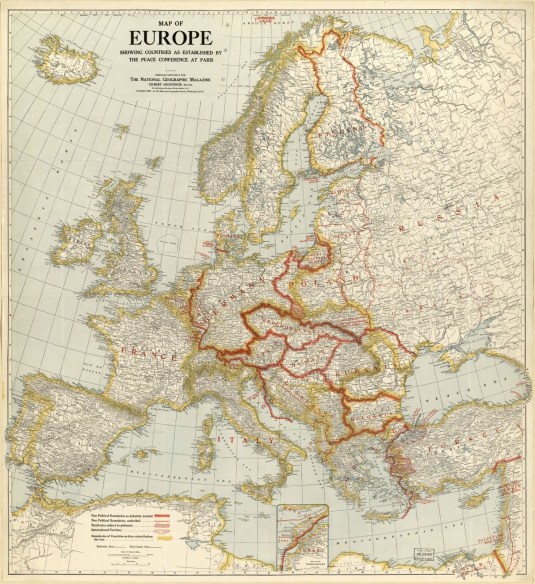
Source: Map of Europe showing countries as established by the peace conference at Paris – Vivid Maps
04 Jul 2016 Leave a comment
in defence economics, labour economics, occupational choice
ISIS foreign fighters are not driven by economic deprivation or inequality. In What Explains the Flow of Foreign Fighters to ISIS? (NBER Working Paper No. 22190),Efraim Benmelech
and Esteban F. Klor found that many foreign fighters come from countries with high levels of economic development, low income inequality, and highly developed political institutions.
Foreign ISIS recruits come largely from prosperous, ethnically and linguistically homogeneous countries. As Alan Krueger explains in a discussion of terrorism is an occupational choice:
One of the conclusions from the work of Laurence Iannaccone—whose paper, “The Market for Martyrs,” is supported by my own research—is that it is very difficult to effect change on the supply side.
People who are willing to sacrifice themselves for a cause have diverse motivations. Some are motivated by nationalism, some by religious fanaticism, some by historical grievances, and so on. If we address one motivation and thus reduce one source on the supply side, there remain other motivations that will incite other people to terror.
Malcontents join the jihadists today for the same reasons they joined the Red Brigade, the Japanese Red Army Faction and Baader-Meinhof gang in the 1970s and 1980s. Plenty of young people were attracted to communism in previous generations as a way of sticking it to the man.
Now as then economic conditions were good as were political freedoms. Italy, Japan and Germany were all at the peak of recoveries from war. Japanese incomes are doubled in the previous decade. Germany and Italy were rich countries. As Alan Krueger explains:
Despite these pronouncements, however, the available evidence is nearly unanimous in rejecting either material deprivation or inadequate education as important causes of support for terrorism or participation in terrorist activities. Such explanations have been embraced almost entirely on faith, not scientific evidence.
Each generation has its defining oppositional identity. Radical Islam is the oppositional identity of choice for today’s angry young men and women. Mind you, they have to buy Islam for dummies to understand what they’re signing up for.
In previous generations, it was communism, weird Christian sects, eco-terrorism, animal liberationist terrorism and a variety of domestic terrorists of the left and right with conspiratorial motivations. Look at the level of diversity of the angry young men and women on the domestic terrorists list of the FBI.
One jihadists when interviewed said that 30 years ago he would probably have become a Communist as his vehicle for venting his frustrations.
28 Jun 2016 Leave a comment
in defence economics, libertarianism, Marxist economics, war and peace

Source: Michael Walzer (2002), Dissent Magazine, Can There Be a Decent Left?
26 Jun 2016 Leave a comment
in defence economics, economics of crime, economics of religion
The Sunday Star Times today took an unfortunate big brother angle to a one-page feature story who second half was about cooperation between New Zealand Muslims and the police and security services. Like any law-abiding people, they report potential criminal behaviour and mentally disturbed people.

Source: Marked by their religion – is the threat of homegrown terrorism real? | Stuff.co.nz.
The fact that these wannabe jihadists go blabbing about their plans at the local mosque despite knowing that their leadership and members are open about reporting suspicious behaviour to the police shows how stupid these people are.
That does not mean that these wannabe jihadists are not dangerous, but they are still stupid. Being completely useless appears to not disqualify them from joining either Al Qaeda or ISIS.
There are ratbags attracted to many large groups, be they secular or religious. Plenty of parties on the left and the right have at their wings a few wild men and one or two potentially violent people who are often off their medication. There are rat-bags everywhere.
23 Jun 2016 Leave a comment
in defence economics, economics, politics - USA, war and peace Tags: foreign policy, Iraq, ISIS, New Zealand Greens, Syrian Civil War, war on terror
The Greens this week has decided to offer every support short of real help to those being massacred and brutalised by ISIS
“The NZDF deployment to Iraq does not make us safer, but puts New Zealand troops at risk and makes New Zealanders unnecessary targets of ISIL.
“We condemn the horrific violence of ISIL. New Zealand should be using its leverage as a member of the UN Security Council to curb ISIL’s access to funding and arms, not keeping our troops in danger for another year and a half,” said Mr Shaw.
This is straight out of the Yes Prime Minister episode on how the Foreign & Commonwealth Office explains how it helps foreign nations in trouble from invasion and tyranny. A 4 stage plan on how to do nothing.
In his recent speech before the House of Commons on further assistance to those fighting ISIS since Syria, Labour Party foreign office spokesman Hilary Benn described this as walking to the other side of the road.
23 Jun 2016 Leave a comment
in defence economics, economics of religion, liberalism
23 Jun 2016 Leave a comment
in defence economics, liberalism, libertarianism Tags: Age of Enlightenment, free speech, Middle-East politics, political correctness, religious tolerance, war against terror
22 Jun 2016 Leave a comment
in defence economics, war and peace Tags: just wars, Middle-East politics
Celebrating humanity's flourishing through the spread of capitalism and the rule of law
Celebrating humanity's flourishing through the spread of capitalism and the rule of law
Celebrating humanity's flourishing through the spread of capitalism and the rule of law
Celebrating humanity's flourishing through the spread of capitalism and the rule of law
Celebrating humanity's flourishing through the spread of capitalism and the rule of law
Celebrating humanity's flourishing through the spread of capitalism and the rule of law
Celebrating humanity's flourishing through the spread of capitalism and the rule of law
Celebrating humanity's flourishing through the spread of capitalism and the rule of law
Celebrating humanity's flourishing through the spread of capitalism and the rule of law
Celebrating humanity's flourishing through the spread of capitalism and the rule of law
Celebrating humanity's flourishing through the spread of capitalism and the rule of law
Celebrating humanity's flourishing through the spread of capitalism and the rule of law
A History of the Alt-Right
Econ Prof at George Mason University, Economic Historian, Québécois
Celebrating humanity's flourishing through the spread of capitalism and the rule of law
Scholarly commentary on law, economics, and more
Beatrice Cherrier's blog
Celebrating humanity's flourishing through the spread of capitalism and the rule of law
Celebrating humanity's flourishing through the spread of capitalism and the rule of law
Celebrating humanity's flourishing through the spread of capitalism and the rule of law
Why Evolution is True is a blog written by Jerry Coyne, centered on evolution and biology but also dealing with diverse topics like politics, culture, and cats.
Celebrating humanity's flourishing through the spread of capitalism and the rule of law
A rural perspective with a blue tint by Ele Ludemann
DPF's Kiwiblog - Fomenting Happy Mischief since 2003
Celebrating humanity's flourishing through the spread of capitalism and the rule of law
The world's most viewed site on global warming and climate change
Tim Harding's writings on rationality, informal logic and skepticism
A window into Doc Freiberger's library
Let's examine hard decisions!
Commentary on monetary policy in the spirit of R. G. Hawtrey
Thoughts on public policy and the media
Celebrating humanity's flourishing through the spread of capitalism and the rule of law
Politics and the economy
A blog (primarily) on Canadian and Commonwealth political history and institutions
Reading between the lines, and underneath the hype.
Economics, and such stuff as dreams are made on
"The British constitution has always been puzzling, and always will be." --Queen Elizabeth II
Celebrating humanity's flourishing through the spread of capitalism and the rule of law
Celebrating humanity's flourishing through the spread of capitalism and the rule of law
WORLD WAR II, MUSIC, HISTORY, HOLOCAUST
Undisciplined scholar, recovering academic
Celebrating humanity's flourishing through the spread of capitalism and the rule of law
Res ipsa loquitur - The thing itself speaks
In Hume’s spirit, I will attempt to serve as an ambassador from my world of economics, and help in “finding topics of conversation fit for the entertainment of rational creatures.”
Researching the House of Commons, 1832-1868
Reflections on books and art


Recent Comments