One of my personal hobby horses: Young people were typically as or *much more* supportive of Vietnam than older folk pic.twitter.com/oF7bHkcvGS
— Osita Nwanevu (@OsitaNwanevu) December 11, 2015
Young people supported the Vietnam War as much as older folk
16 Dec 2015 Leave a comment
in defence economics, politics - USA, war and peace Tags: Vietnam war, votor demographics
Who controls what in Libya at the moment
13 Dec 2015 Leave a comment
in defence economics, development economics, energy economics, growth disasters Tags: Libya, Middle-East politics, Oil prices
SIS’s external attacks and ambitions
10 Dec 2015 Leave a comment
in defence economics Tags: ISIS, war on terror
Support for ISIS in the Muslim world
08 Dec 2015 Leave a comment
12 ways ISIS gets funding
03 Dec 2015 Leave a comment
in defence economics, war and peace Tags: ISIS
What would be the opening offer of @jeremycorbyn at Syrian Civil War peace talks?
03 Dec 2015 Leave a comment
in defence economics, International law, war and peace Tags: British politics, Middle-East politics, Syrian Civil War
https://www.youtube.com/watch?v=h7M9NuiQXgs&feature=youtu.be
The best part of Hilary Benn’s speech when he explain the benefits of airstrikes. Benn pointed out that 14 months ago, ISIS was at the gates of Baghdad but airstrikes beat them back. Benn then referred to the Kurds where they were in retreat until there were airstrikes. They now have a border with ISIS they can defend.

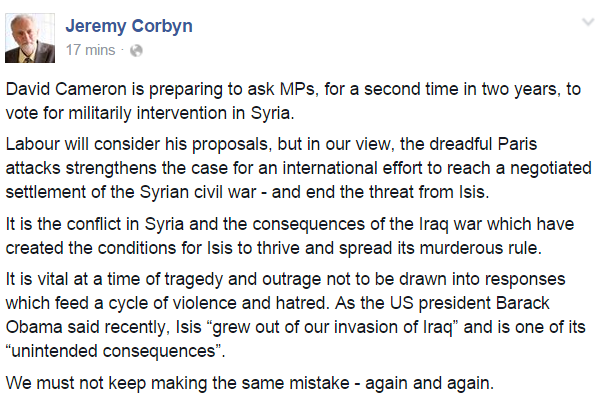
Exactly what would Jeremy Corbyn put on that negotiating table for a comprehensive peace settlement to the Syrian Civil War that:
- would end the military threat from ISIS in Syria, and
- allow the Kurdish succession opposed by all others plus Turkey, Iraq and Russia?
Without the resumption of military strikes as negotiating coin if such peace talks break down, why would anyone fighting on the ground in Syria care about what proposals the Western powers might put up?
The possibility of a temporary cessation in current and intensifying Western military airstrikes is one of the few reasons for the parties to sit down at a negotiating table with the Western powers and Russia if only to string out that cessation of those airstrikes while they regroup and re-equip. The parties to the Syrian Civil War only respect force, not moral authority.

The ability to negotiate a credible peaceful settlement between…
View original post 307 more words
RAF sent Tornados and Typhoons into action from Akrotiri base in Cyprus within an hour of the vote result
03 Dec 2015 Leave a comment

FREE SHILAN OZCELIK NOW!
01 Dec 2015 Leave a comment
in defence economics, war and peace
You can sign a petition calling for Silhan Özçelik’s release here, and a petition calling for the decriminalisation of the PKK here
But Özçelik’s conviction should also raise a more fundamental concern: that the contradictions and complications that we are so used to associating with the Middle East lie at the heart of British and western policy as well. If the British state persecutes, rather than supports, the few secular and progressive organisations in the region who are fighting Isis, whose interests is it really serving? And if we don’t trust those interests, how much trust can we really place in it to act on our behalf in Syria?
Source: Meet the remarkable British woman imprisoned for fighting against Isis.

Syria Control Map
28 Nov 2015 Leave a comment
in defence economics, war and peace Tags: Syria civil war
Some think World War 3 will be started by a WW 2 designed bomber – a B-29 knockoff
27 Nov 2015 Leave a comment
Where are British taxes spent?
26 Nov 2015 1 Comment
in budget deficits, defence economics, economics of education, fiscal policy, health economics, labour supply Tags: ageing society, British economy, British politics, demographic crisis
What would be the opening offer of @jeremycorbyn at Syrian Civil War peace talks?
24 Nov 2015 1 Comment
in defence economics, war and peace Tags: British politics, game theory, Iraqi civil war, ISIS, Kurds, Middle-East politics, peace talks, Syrian Civil War, Turkey
Exactly what would Jeremy Corbyn put on that negotiating table for a comprehensive peace settlement to the Syrian Civil War that:
- would end the military threat from ISIS in Syria, and
- allow the Kurdish succession opposed by all others plus Turkey, Iraq and Russia?
Without the resumption of military strikes as negotiating coin if such peace talks break down, why would anyone fighting on the ground in Syria care about what proposals the Western powers might put up?
The possibility of a temporary cessation in current and intensifying Western military airstrikes is one of the few reasons for the parties to sit down at a negotiating table with the Western powers and Russia if only to string out that cessation of those airstrikes while they regroup and re-equip. The parties to the Syrian Civil War only respect force, not moral authority.

The ability to negotiate a credible peaceful settlement between sovereign states depends on:
- the divisibility of the outcome of the dispute,
- the effectiveness of the fortifications and counterattacks with which an attacker would expect to have to contend, and
- on the permanence of the outcome of a potential war.
Central to any peace talks is that any peace agreement is credible – it will hold and not will not be quickly broken:
A state would think that another state’s promise not to start a war is credible only if the other state would be better off by keeping its promise not to start a war than by breaking its promise.
Peace talks occur only when there something to bargain about. As James Fearon explained,there must be
a set of negotiated settlements that both sides prefer to fighting.
When a war is over territory rather than annihilation of the other side, the challenge is to divide the disputed territory in a way that both are happy to keep the peace settlement rather than come back and fight in a few years.
Civil wars such as those in Syria and Iraq today are grubby affairs in terms of peace talks because of the greater inability to divide what is contested.
Who Does What to Whom in #Syria https://t.co/xO8PJHZwgW—
ian bremmer (@ianbremmer) November 04, 2015
Ending civil wars is even more difficult to make binding commitments because new groups such as ISIS can spring up to replace the signatories to the old peace treaty or introduce new agendas:
…if the constituent groups of a polity are deeply divided and, hence, are unwilling to accept meaningful limitations on the prerogatives of winners of constitutional contests, then civil war can be unavoidable.
@jeremycorbyn wants to abolish the army @johnmcdonnellMP disarm the police
24 Nov 2015 Leave a comment
in defence economics, economics of crime
That these claims about abolishing the military and disarming the police are far from absolute lies shows how far British Labour is out there. Corbyn did say what he said in an interview in 2013.
"SCLV is important for ensuring a clear program of socialist demands on
a Labour government." @johnmcdonnellMP http://t.co/mumQeyndyP—
Socialist Campaign (@SCLV_UK) April 02, 2015
The Shadow Chancellor did sign that letter despite his best protestations that that he never seen it, much less was photographed holding it up to the camera smiling for later tweeting.
It is clear that these men spent their lives shooting from the hip because they never expected to hold public office and have responsibility for safeguarding others. They expected to live their life in political obscurity despite their dreams to the contrary. Now that they do have responsibility, they are just out of their depth. Corbyn and McDonnell spend a considerable part of their time lying about their previous record.


Recent Comments