Where does ISIS get its money? pic.twitter.com/3fsr6x0oBb
— Paul Kirby (@paul1kirby) December 7, 2015
Support for ISIS in the Muslim world
08 Dec 2015 Leave a comment
12 ways ISIS gets funding
03 Dec 2015 Leave a comment
in defence economics, war and peace Tags: ISIS
What would be the opening offer of @jeremycorbyn at Syrian Civil War peace talks?
03 Dec 2015 Leave a comment
in defence economics, International law, war and peace Tags: British politics, Middle-East politics, Syrian Civil War
https://www.youtube.com/watch?v=h7M9NuiQXgs&feature=youtu.be
The best part of Hilary Benn’s speech when he explain the benefits of airstrikes. Benn pointed out that 14 months ago, ISIS was at the gates of Baghdad but airstrikes beat them back. Benn then referred to the Kurds where they were in retreat until there were airstrikes. They now have a border with ISIS they can defend.

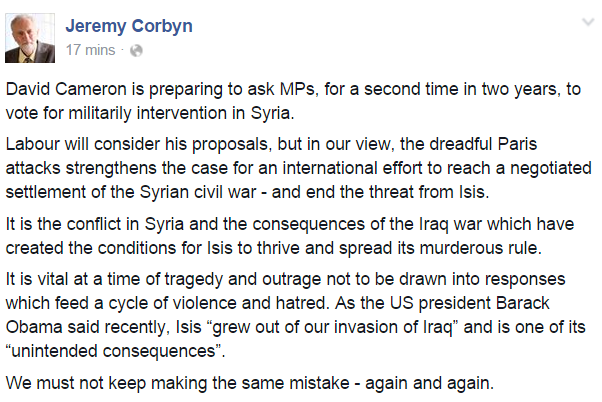
Exactly what would Jeremy Corbyn put on that negotiating table for a comprehensive peace settlement to the Syrian Civil War that:
- would end the military threat from ISIS in Syria, and
- allow the Kurdish succession opposed by all others plus Turkey, Iraq and Russia?
Without the resumption of military strikes as negotiating coin if such peace talks break down, why would anyone fighting on the ground in Syria care about what proposals the Western powers might put up?
The possibility of a temporary cessation in current and intensifying Western military airstrikes is one of the few reasons for the parties to sit down at a negotiating table with the Western powers and Russia if only to string out that cessation of those airstrikes while they regroup and re-equip. The parties to the Syrian Civil War only respect force, not moral authority.

The ability to negotiate a credible peaceful settlement between…
View original post 307 more words
RAF sent Tornados and Typhoons into action from Akrotiri base in Cyprus within an hour of the vote result
03 Dec 2015 Leave a comment

FREE SHILAN OZCELIK NOW!
01 Dec 2015 Leave a comment
in defence economics, war and peace
You can sign a petition calling for Silhan Özçelik’s release here, and a petition calling for the decriminalisation of the PKK here
But Özçelik’s conviction should also raise a more fundamental concern: that the contradictions and complications that we are so used to associating with the Middle East lie at the heart of British and western policy as well. If the British state persecutes, rather than supports, the few secular and progressive organisations in the region who are fighting Isis, whose interests is it really serving? And if we don’t trust those interests, how much trust can we really place in it to act on our behalf in Syria?
Source: Meet the remarkable British woman imprisoned for fighting against Isis.

Syria Control Map
28 Nov 2015 Leave a comment
in defence economics, war and peace Tags: Syria civil war
Some think World War 3 will be started by a WW 2 designed bomber – a B-29 knockoff
27 Nov 2015 Leave a comment
Where are British taxes spent?
26 Nov 2015 1 Comment
in budget deficits, defence economics, economics of education, fiscal policy, health economics, labour supply Tags: ageing society, British economy, British politics, demographic crisis
What would be the opening offer of @jeremycorbyn at Syrian Civil War peace talks?
24 Nov 2015 1 Comment
in defence economics, war and peace Tags: British politics, game theory, Iraqi civil war, ISIS, Kurds, Middle-East politics, peace talks, Syrian Civil War, Turkey
Exactly what would Jeremy Corbyn put on that negotiating table for a comprehensive peace settlement to the Syrian Civil War that:
- would end the military threat from ISIS in Syria, and
- allow the Kurdish succession opposed by all others plus Turkey, Iraq and Russia?
Without the resumption of military strikes as negotiating coin if such peace talks break down, why would anyone fighting on the ground in Syria care about what proposals the Western powers might put up?
The possibility of a temporary cessation in current and intensifying Western military airstrikes is one of the few reasons for the parties to sit down at a negotiating table with the Western powers and Russia if only to string out that cessation of those airstrikes while they regroup and re-equip. The parties to the Syrian Civil War only respect force, not moral authority.

The ability to negotiate a credible peaceful settlement between sovereign states depends on:
- the divisibility of the outcome of the dispute,
- the effectiveness of the fortifications and counterattacks with which an attacker would expect to have to contend, and
- on the permanence of the outcome of a potential war.
Central to any peace talks is that any peace agreement is credible – it will hold and not will not be quickly broken:
A state would think that another state’s promise not to start a war is credible only if the other state would be better off by keeping its promise not to start a war than by breaking its promise.
Peace talks occur only when there something to bargain about. As James Fearon explained,there must be
a set of negotiated settlements that both sides prefer to fighting.
When a war is over territory rather than annihilation of the other side, the challenge is to divide the disputed territory in a way that both are happy to keep the peace settlement rather than come back and fight in a few years.
Civil wars such as those in Syria and Iraq today are grubby affairs in terms of peace talks because of the greater inability to divide what is contested.
Who Does What to Whom in #Syria https://t.co/xO8PJHZwgW—
ian bremmer (@ianbremmer) November 04, 2015
Ending civil wars is even more difficult to make binding commitments because new groups such as ISIS can spring up to replace the signatories to the old peace treaty or introduce new agendas:
…if the constituent groups of a polity are deeply divided and, hence, are unwilling to accept meaningful limitations on the prerogatives of winners of constitutional contests, then civil war can be unavoidable.
@jeremycorbyn wants to abolish the army @johnmcdonnellMP disarm the police
24 Nov 2015 Leave a comment
in defence economics, economics of crime
That these claims about abolishing the military and disarming the police are far from absolute lies shows how far British Labour is out there. Corbyn did say what he said in an interview in 2013.
"SCLV is important for ensuring a clear program of socialist demands on
a Labour government." @johnmcdonnellMP http://t.co/mumQeyndyP—
Socialist Campaign (@SCLV_UK) April 02, 2015
The Shadow Chancellor did sign that letter despite his best protestations that that he never seen it, much less was photographed holding it up to the camera smiling for later tweeting.
It is clear that these men spent their lives shooting from the hip because they never expected to hold public office and have responsibility for safeguarding others. They expected to live their life in political obscurity despite their dreams to the contrary. Now that they do have responsibility, they are just out of their depth. Corbyn and McDonnell spend a considerable part of their time lying about their previous record.
Do peace talks have a role in wars of annihilation @jeremycorbyn
17 Nov 2015 1 Comment
in defence economics, war and peace Tags: British politics, game theory, ISIS, Middle-East politics, Twitter left, World War I
Peace activists are utterly clueless about what is discussed at peace talks. The ability to negotiate a credible peaceful settlement between sovereign states depends on:
- the divisibility of the outcome of the dispute,
- the effectiveness of the fortifications and counterattacks with which an attacker would expect to have to contend, and
- on the permanence of the outcome of a potential war.
Central to any peace talks is that any peace agreement is credible – it will hold and not will not be quickly broken:
A state would think that another state’s promise not to start a war is credible only if the other state would be better off by keeping its promise not to start a war than by breaking its promise.
Peace talks occur only when there something to bargain about. As James Fearon explained, there must be
a set of negotiated settlements that both sides prefer to fighting
That need for a bargaining range is the fundamental flaw of peace activists. When they call for peace talks, peace activists never explain what will be discussed in a world where everybody is not like them terms of good intentions. What are the possible negotiated settlements that each both side will prefer to continue fighting? Diplomacy is about one side having some control over something the other side wants and this other side have something you want to exchange. In a war, the attacker thinks he can get what it wants to fighting for it.
There were plenty of peace feelers during World War I. World War I came to an end when Germany preferred surrender and disarmament over conquest. Its armies were in full retreat and disarray – revolution was a threat at home
Previous World War I peace feelers failed because each side thought it could gain more by fighting. German peace feelers when they are advancing were premised on keeping what they are taken. When the Germans were retreating, the Germans wanted to go back to the pre-war borders and keep their capability for relaunching the war once they have recouped. The Allies had nothing to gain from allowing Germans simply to withdraw from the fighting intact and regroup, attack again and perhaps win.
When a war is over territory rather than annihilation of the other side, the challenge is to divide the disputed territory in a way that both are happy to keep the peace settlement rather than come back and fight in a few years. Grossman explains:
If the winner of a war would gain control of the entire territory, and if the whole of a contested territory is sufficiently more valuable than the sum of its parts, then, despite the costs and risks of war, promises not to start a war could be not credible, and a peaceful settlement, or at least a peaceful settlement with unfortified borders, would not be possible.
That point about the need for fortified or unfortified borders after a peaceful settlement over contested territory is the ultimate failure of peace activists.
If peace activists truly want peace, rather than victory for the other side, they must prepare for war including fortified borders so that the other side doesn’t dare cross them and start a war. A peace settlement depends upon the ability to divide the contested territory is with or without fortified borders to make a settlement credible:
…despite the costs and risks of war, if a dispute is existential, or, more generally, if the whole of a contested territory is sufficiently more valuable than the sum of its parts, then a peaceful settlement is not possible. A peaceful settlement of a territorial dispute, and especially a settlement that includes an agreement not to fortify the resulting border, also can be impossible if a state thinks, even if over optimistically, that by starting a war it would be able at a small cost to settle the dispute completely in its favour permanently.
Wars of annihilation have a long history. The first two Punic wars were settled by Rome and Carthage. The third was not because the objective of Rome was to destroy Carthage which it did. Rome is decided it simply did not want to have any further wars with Carthage. The only way to ensure that was to destroy that city – level it to the ground. The Arab Israel conflict is another example:
Over the years the Arabs have rejected every proposal for a peaceful settlement that would divide Palestine into a Jewish state and an Arab state, because for the Arabs allowing a Jewish state would be a defeat, not a compromise. The Israelis, however, demand a Jewish state, and they refuse to turn all of Palestine into a single multinational state in which Jews would not make up a large majority of the population. If the dispute between Arabs and Israelis were about the control of tracts of land or sources of water, then a peaceful settlement might have been possible long ago. But, the dispute is about the existence of a Jewish state, and the outcome is indivisible. Is there or is there not to be a Jewish state in Palestine? The answer is either yes or no.
The key guardian of peace and enforcer of peace settlements is the ability of the other side to mount an effective counter-attack if attacked again. If you want peace, you must prepare for war. The loudest champions of a large military budget should be peace activists. Peace activists know, they should know, that a country with a strong military is less likely to be attacked.
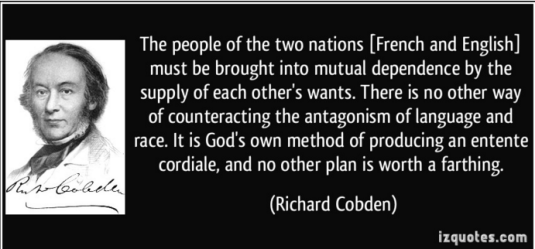
If a country is a democracy, it is less likely to start wars and especially with other democracies. If peace activists want more democracies in the world, they should preach capitalism and free trade because countries that are capitalistic become democracies.
Peace activists think that they can make peace just by talking with people. Peace is made by trading with hostile countries to make them depend on you for their prosperity as well as yours. By growing rich through free trade, training partners have less reasons to go to war or otherwise have poor relations with each other or each other’s friends. Trade increases the opportunity cost of starting a war.
Robert Aumann argued well that the way to peace is like bargaining in a medieval bazaar. Never look too keen, and bargain long and hard. Aumann argues that:
If you are ready for war, you will not need to fight. If you cry ‘peace, peace,’ you will end up fighting… What brings war is that you signal weakness and concessions.
Countries are more likely to cooperate if they have frequent interactions and have a long time horizon. The chances of cooperation increase when it is backed by the threat of punishment.
The ability to threaten to hurt is conducive to peace. Disarmament, Aumann argues, “would do exactly the opposite” and increase the chances of war. He gave the example of the Cold War as an example of how their stockpiles of nuclear weapons and fleets of bombers prevented a hot war from starting:
In the long years of the cold war between the US and the Soviet Union, what prevented “hot” war was that bombers carrying nuclear weapons were in the air 24 hours a day, 365 days a year? Disarming would have led to war.
Aumann has quoted the passage from the biblical Book of Isaiah:
Isaiah is saying that the nations can beat their swords into ploughshares when there is a central government – a Lord, recognized by all. In the absence of that, one can perhaps have peace – no nation lifting up its sword against another. But the swords must continue to be there – they cannot be beaten into ploughshares – and the nations must continue to learn war, in order not to fight!
Civil wars such as those in Syria and Iraq today are grubby affairs in terms of peace talks because of the greater inability to divide what is contested.
Who Does What to Whom in #Syria https://t.co/xO8PJHZwgW—
ian bremmer (@ianbremmer) November 04, 2015
Ending civil wars is even more difficult to make binding commitments because new groups such as ISIS can spring up to replace the signatories to the old peace treaty or introduce new agendas:
…if the constituent groups of a polity are deeply divided and, hence, are unwilling to accept meaningful limitations on the prerogatives of winners of constitutional contests, then civil war can be unavoidable.
Detailed map of Syria and Iraq showing which forces hold what territory. bit.ly/1VlPsH2 http://t.co/up3YGV5SGB—
Kenneth Roth (@KenRoth) August 29, 2015
ISIS is responsible for biggest number of co-ordinated terror attacks, 2000-14
17 Nov 2015 1 Comment
in defence economics, war and peace
@jeremycorbyn wants to use the #Kurds as a bargaining chip with Assad
17 Nov 2015 Leave a comment
in defence economics, war and peace
Jeremy Corbyn wants to use about the only good guys in the Syrian civil war as a bargaining chip with President Assad.
Corbyn said overnight that he doesn’t want to sit around the negotiating table with ISIS but he wants a political settlement that defeats ISIS and bring an end to the civil war in Syria
by the unity of the people of Syria. That is a good step forward.
Corbyn is a man who claims to have studied Middle East politics all his life:
Jeremy is someone who genuinely understands international political situations, especially those of the Middle East. Not just in a superficial way, but in terms of the history of countries like Syria, Iran and Iraq. He has studies them all of his political life.
Corbyn doesn’t seem to have noticed that the Syrian Kurds do not want to be Syrians – they want their own country.
The Iraqi Kurds don’t want to be Iraqis – they want their own country too. The Kurds already have a fair degree of autonomy in northern Iraq and northern Syria respectively. Much of it achieved in the field of battle.
Any call for a political settlement with Syria that involves a united Syria betrays the aspirations of the Kurdish people for national liberation. Turkey is also waiting on the wings, sternly opposed to any Kurdish autonomy and willing to intervene in the Syrian Civil War with its army and air force to those ends.
With Jeremy Corbyn & the comrades @ Portcullis House, Westminster. http://t.co/A6Vgmaglsa—
Gerry Adams (@GerryAdamsSF) July 21, 2015
Jeremy Corbyn is a seething hypocrite because he was a fanatical supporter of the Irish Republicans despite the fact that they are a tiny violent minority of Irish Catholics.
Corbyn wants peace talks. Political settlements are challenging in wars of annihilation and wars of succession. The American Civil War had to be resolved in the field of battle because the North would not accept succession. The Arab-Israeli conflict is a war of annihilation. Israel expects there always to be two states. Hamas and the other terrorists want to destroy the state of Israel. There is no middle ground.
ISIS is leading a war of annihilation. The Kurds are leading a war of succession. There is little room for compromise.
It’s harder to get out of even the most ordinary of wars than get into them. The problem with peace settlements is credible assurances that the peace is lasting rather than is a chance for the other side to rebuild and come back to attack from a stronger position.
A warring state would think that another state’s promise not to start another war is credible only if the other state would be better off by keeping such promises not to start another war than by breaking its promise once it has rearmed.

For example, in World War I, making sure that Germany and its allies did not restart the war a few years later, fed and rested, is why the peace treaty in 1919 totally disarmed Germany and split-up the other Axis powers.
One side will think that the other’s promise not to re-start a war is credible only if the other state would be better off by keeping its promise not to re-start a war than by breaking its promise.
France fortified its border with Germany in the 1920s because of a lack of trust that the peace would endure. Germany was disarmed after 1918 so that the day which it would be a threat again was well into the future.
Neither side of World War I were interested in peace feelers when they thought they could either prevail in the field of battle or would be in a stronger negotiating position by fighting on for a while.
The same goes for the Syrian and Iraqi civil wars and that is before the fact that the terrorists are highly decentralised. There is no one central party able to make and keep a peace settlement by dealing with renegade elements within their own ranks.
Margaret Thatcher on peacemakers
16 Nov 2015 Leave a comment
in defence economics, war and peace Tags: game theory, Margaret Thatcher


Recent Comments