Can the American fighters fly slow enough to intercept the Russian bombers
08 Jul 2015 1 Comment
in defence economics, politics - USA, war and peace Tags: obsolete military technology, Russia
Droll critique of ISIS training video
06 Jul 2015 Leave a comment
in defence economics, economics of media and culture Tags: ISIS, Middle-East politics, war against terror
War is declining
05 Jul 2015 Leave a comment
in defence economics, war and peace Tags: civil wars, interstate wars
Worldwide battle deaths decline. Technology, trade & institutions matter. vox.com/2014/9/23/6829… #22maps #22maps http://t.co/WfbzdQFCjR—
Mark Steckbeck (@msteck1) June 13, 2015
America’s wars
05 Jul 2015 Leave a comment
in defence economics, politics - USA, war and peace Tags: American Civil War, Korean war, Revolutionary War, Vietnam war, War of 1812, World War I, World War II
Undeclared war:
bloom.bg/17bV5nM http://t.co/xx51J6R0sA—
Bloomberg VisualData (@BBGVisualData) May 31, 2015
War Plan Red: The 1930 US War Department plan to invade Canada
03 Jul 2015 Leave a comment
in defence economics, economic history, politics - USA, war and peace Tags: Canada
War Plan Red: The 1930 US War Department plan to invade Canada – bit.ly/1srJcxW via @ezraklein http://t.co/ai3A96nY34—
Brilliant Maps (@BrilliantMaps) December 14, 2014
The Empire of Japan in 1939
03 Jul 2015 Leave a comment
in defence economics, economic history, war and peace Tags: China, colonisation, imperialism, Japan, World War II
The Empire of Japan in 1939, read how it got there brilliantmaps.com/russo-japanese… http://t.co/wop0insgnD—
Brilliant Maps (@BrilliantMaps) January 21, 2015
A partial map of geopolitical anomalies
16 Jun 2015 Leave a comment
in defence economics, economic history, war and peace Tags: defacto states, enclaves, exclaves, geography, maps, political geography

Google maps of India differ in India and China
07 Jun 2015 Leave a comment
in defence economics, economics of media and culture, war and peace Tags: border disputes, China, Google, India, maps
The occupation, partition and annexation of Germany, 1947
06 Jun 2015 Leave a comment
in defence economics, war and peace Tags: Germany, World War II
Occupation zones in Germany, 1947. The territories east of the Oder-Neisse line, ceded to Poland & the Soviet Union http://t.co/iY3aHRaCga—
History Facts 247 (@historyfacts247) June 05, 2015
The war situation in Iraq and Syria
10 May 2015 Leave a comment
ISW Iraq SITREP. Baiji-Repeat of Tikrit w/ roles of Iranian militias vs. Coalition airstrikes?
iswiraq.blogspot.com/2015/05/iraq-s… http://t.co/QLwhV0lkhS—
ISW (@TheStudyofWar) May 09, 2015
ISW Syria SITREP is out. Did Hezbollah decide to not engage JN or is "Qalamoun battle coming"? bit.ly/1JOMZ4R http://t.co/eb3zIQuhwU—
ISW (@TheStudyofWar) May 05, 2015
HT: Lorenzo M Warby
Hypocritical Greens betray NZ sovereignty to US court decision but oppose investor state dispute settlement on sovereignty grounds
10 May 2015 Leave a comment
in defence economics, economics of crime, international economic law, international economics, International law, law and economics, politics - New Zealand, politics - USA Tags: foreign policy, free trade agreements, green hypocrisy, green party, investor state disputes settlement, national security, preferential trading agreements, war against terror
The Greens are happy to betray New Zealand’s sovereignty to a US court where New Zealand’s side of the story was not heard, New Zealand was not a litigant, New Zealand was not named in the proceedings and New Zealand had not agreed to waive its sovereign immunity under US law.
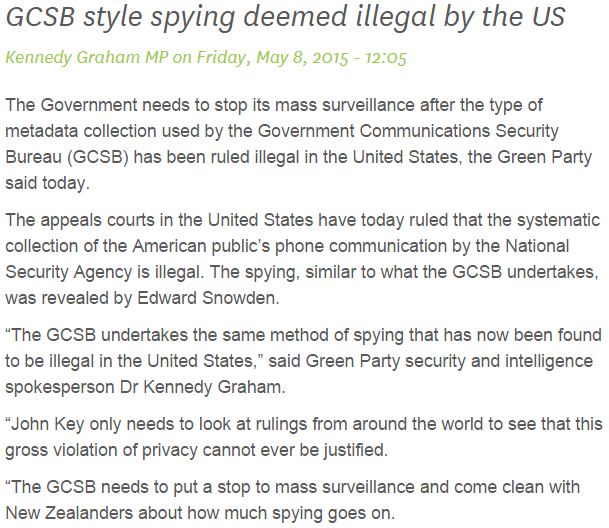
The Greens on the other hand are hysterical about the prospect of New Zealand voluntarily submitting to investor state disputes settlement through an international treaty. International treaties normally are about trading in sovereignty: you give up some form of sovereignty return for something you value more.
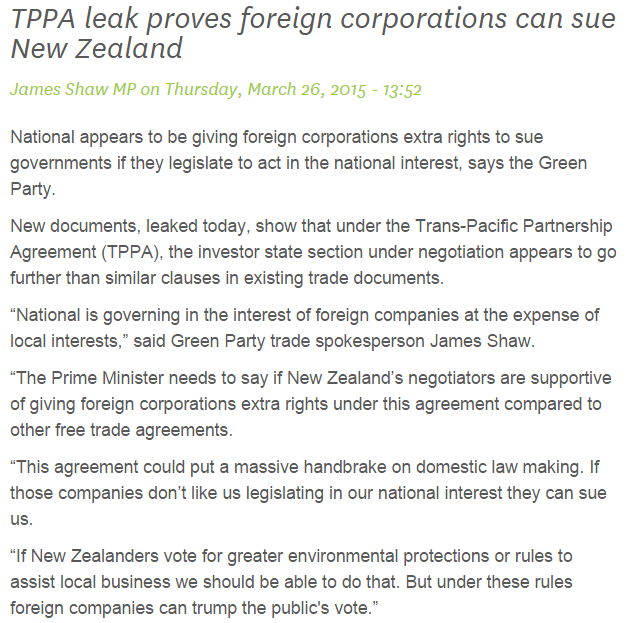
It is thoroughly hypocritical of the Greens to argue the New Zealand should bow down to a foreign court when that court rules in a way that it favours its ideological agenda but refuse to support the principle of international arbitration in circumstances where that may advance New Zealand’s national interests.
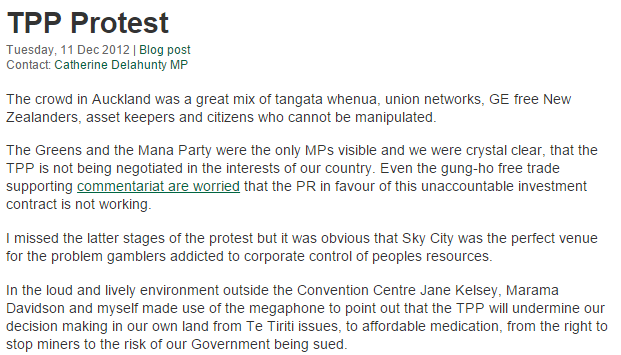
At a minimum, New Zealand itself chose to give up its sovereignty if it agrees to investor state dispute settlement in a trade agreement. The decision was not imposed by a foreign court where it was not heard nor was a party.


Of particular concern to the Greens is international arbitration could "trump the public’s vote vote". New Zealand has repeatedly elected parties that support the alliance with America, and support a robust security and intelligence policy, including electronic surveillance as part of the war on terror.
The last week of the 2014 general election campaign was dominated by the Government Security Communications Bureau and its cooperation with the National Security Agency and the extent to which New Zealand security services engaged in electronic surveillance in New Zealand and abroad.
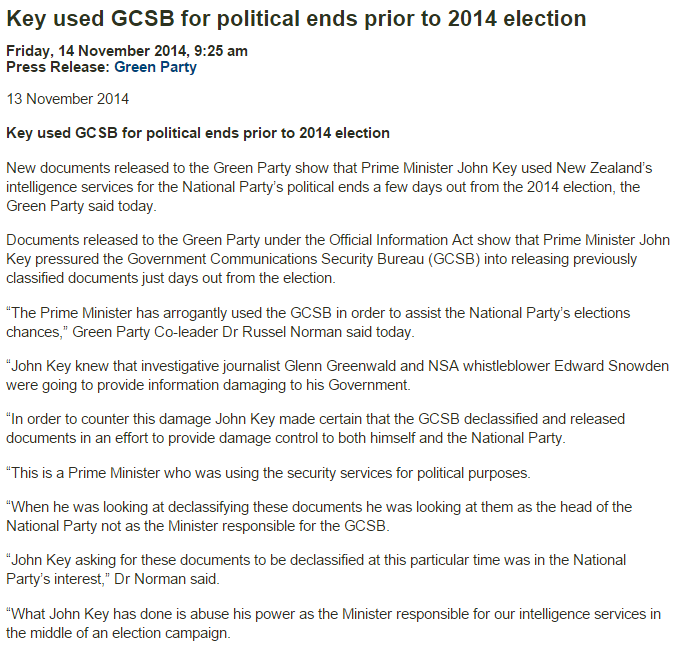
The Greens want to subvert that democratic decision that has been repeated over many New Zealand elections about national security and foreign relations to defer to an American court when New Zealand didn’t even appear as a party.

The US Court of appeal was deciding an issue of statutory interpretation of the Patriot Act. There was no constitutional issues at hand.
The Patriot Act expires in a month unless it is extended. Congress has ample opportunity to amend the renewed law to overturn the appeal court’s decision for the future operation of its security and intelligence laws.
The Greens want a Court of Appeal interpretation of the American Patriot Act to extend to New Zealand without a vote of the New Zealand people or the parliament having any say on whether to give up New Zealand’s sovereignty or waive sovereign immunity in American courts.
.
Commonwealth War Dead: First World War Visualised — Information is Beautiful Awards
25 Apr 2015 Leave a comment
in defence economics Tags: Anzac Day, World War I

Moondoggle: The Forgotten Opposition to the Apollo Program – The Atlantic
05 Mar 2015 Leave a comment
in applied welfare economics, defence economics, economic history, politics - USA Tags: industry policy, picking winners, R&D, smart industry policy, space programme

…many people believe that Project Apollo was popular, probably because it garnered significant media attention, but the polls do not support a contention that Americans embraced the lunar landing mission.
Consistently throughout the 1960s a majority of Americans did not believe Apollo was worth the cost, with the one exception to this a poll taken at the time of the Apollo 11 lunar landing in July 1969.
And consistently throughout the decade 45-60 percent of Americans believed that the government was spending too much onspace, indicative of a lack of commitment to the spaceflight agenda. These data do not support a contention that most people approved of Apollo and thought it important to explore space.
HT: Moondoggle: The Forgotten Opposition to the Apollo Program – The Atlantic.


Recent Comments