
https://www.facebook.com/share/crgx3xUytceWBFc9/?mibextid=xfxF2i
Celebrating humanity's flourishing through the spread of capitalism and the rule of law
26 May 2024 Leave a comment
in development economics, economic history, growth disasters, growth miracles, income redistribution, law and economics, Public Choice, rentseeking, transport economics Tags: China
21 May 2024 Leave a comment
in development economics, economic growth, economic history, growth disasters, growth miracles, health economics, liberalism, macroeconomics Tags: The Great Enrichment
See The Case for Hope by Nicholas Kristof of The NY Times. Excerpts:”whenever I hear that America has never been such a mess or so divided, I think not just of the Civil War but of my own childhood: the assassinations of the 1960s; the riots; the murders of civil rights workers; the curses directed at…
There is still reason to hope despite the fact that more than three-quarters of Americans say the United States is headed in the wrong direction
09 May 2024 Leave a comment
in applied price theory, comparative institutional analysis, constitutional political economy, development economics, economic history, growth disasters, growth miracles, history of economic thought, income redistribution, industrial organisation, law and economics, property rights, Public Choice, public economics, rentseeking

Mancur Olson’s The Rise and Decline of Nations is one of my favorite books and a classic of public choice. Olson may well have won the Nobel prize had he not died young. He summarized his book in nine implications of which I will present four: 2. Stable societies with unchanged boundaries tend to accumulate […]
The Rise and Decline and Rise Again of Mancur Olson
28 Apr 2024 Leave a comment
in budget deficits, business cycles, comparative institutional analysis, development economics, economic growth, economic history, economics of bureaucracy, economics of regulation, fiscal policy, growth disasters, income redistribution, labour economics, liberalism, libertarianism, macroeconomics, Marxist economics, monetary economics, Public Choice, rentseeking, unemployment Tags: Argentina
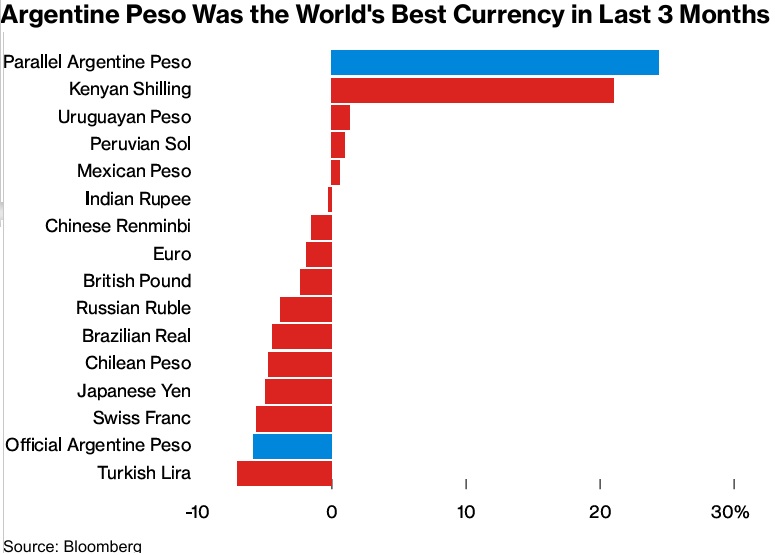
The most important election of 2023 took place in Argentina, where that nation’s voters elected the libertarian candidate, Javier Milei, as their new president. I discussed the outlook for Milei’s agenda on a recent appearance of the Schilling Show. Here’s a brief excerpt. As you can see, I’m worried that Milei faces enormous obstacles. Argentina […]
More Good Results from Argentina
26 Apr 2024 Leave a comment
in applied price theory, comparative institutional analysis, constitutional political economy, development economics, economic history, economics of bureaucracy, entrepreneurship, growth disasters, history of economic thought, income redistribution, industrial organisation, law and economics, liberalism, Marxist economics, property rights, Public Choice Tags: economics of socialism

“to employ a hundred people is… exploitation, but to command the same number [is] honorable.” That’s an actual book by the way, explaining that although communism has failed in the past across different nations, races and cultures, it might work in the future where machines can create anything we want. Think Star Trek’s replicator technology. […]
Why Socialism Won’t Die
23 Apr 2024 Leave a comment
in applied price theory, applied welfare economics, comparative institutional analysis, constitutional political economy, development economics, economic growth, economic history, energy economics, environmental economics, global warming, growth disasters, growth miracles, health economics, history of economic thought, income redistribution, labour economics, law and economics, liberalism, macroeconomics, Marxist economics, politics - Australia, politics - New Zealand, politics - USA, poverty and inequality, property rights, Public Choice, public economics, rentseeking Tags: anticapitalist mentality, capitalism and freedom
05 Apr 2024 Leave a comment
in applied price theory, comparative institutional analysis, constitutional political economy, development economics, economic history, economics of bureaucracy, economics of crime, growth disasters, history of economic thought, human capital, income redistribution, industrial organisation, labour economics, labour supply, law and economics, liberalism, Marxist economics, politics - USA, poverty and inequality, Public Choice, public economics, rentseeking Tags: Cuba
Martin Gurri has a very good, deep-dive on the current situation in Cuba. The wreckage of the Cuban economy really can’t be exaggerated. The perpetual blackouts are an apt symbol of a country that is headed for the dark ages. For the first time since the revolution, Cuba is begging the United Nations for food aid. Nearly […]
Cuba Libre
26 Mar 2024 Leave a comment
in comparative institutional analysis, development economics, growth disasters Tags: Haiti
I am setting aside most of the cultural and “macro” issues, and just considering policy, in my latest Bloomberg column. Excerpt: Consider agriculture. If you fly over Hispaniola, you can see a notable difference between the Haitian and Dominican sides of the border. The Dominican side has plenty of trees, whereas the Haitian side is denuded. Much […]
Haiti vs. the Dominican Republic
24 Mar 2024 Leave a comment
in applied price theory, budget deficits, business cycles, development economics, economic growth, financial economics, fiscal policy, growth disasters, income redistribution, international economics, macroeconomics, monetary economics, Public Choice, public economics Tags: Argentina
Here is a good Substack essay by Nicolas Cachanosky, excerpt: Inflation expectations depend on what is expected to happen to the budget in the months to come. It is natural, then, to ask whether the observed surpluses are sustainable in the months ahead. Answering this question requires looking at two things. First, how was the fiscal […]
How credible is the Milei plan?
19 Mar 2024 Leave a comment
in development economics, energy economics, environmental economics, global warming, growth disasters, growth miracles

By Paul Homewood India’s thermal power production continues to forge ahead, growing by 9% last year, from 1190 to 1294 TWh. Meanwhile there has been barely any increase at all in their much vaunted renewables. Wind and solar only increased by 16 TWh in the 10 months to October (latest data), and still […]
India Power Sector In 2023
12 Mar 2024 Leave a comment
in applied price theory, applied welfare economics, comparative institutional analysis, development economics, econometerics, economic history, economics of bureaucracy, economics of education, economics of information, economics of regulation, experimental economics, growth disasters, growth miracles, history of economic thought, human capital, labour economics, labour supply, law and economics, managerial economics, market efficiency, Marxist economics, occupational choice, organisational economics, property rights, Public Choice, public economics Tags: The fatal conceit

Randomized Controlled Trials: Could you be any more scientific? The book I’m now writing, Unbeatable: The Brutally Honest Case for Free Markets, insists that the randomistas of the economics profession actually have a thinly-veiled political agenda. Namely: To get economists to humbly serve the demagogues that rule the world instead of bluntly challenging their unabated…
The RCT Agenda
27 Feb 2024 Leave a comment
in defence economics, development economics, economics of crime, economics of religion, growth disasters, law and economics Tags: Iran
I’ve chatted with a lot of Iranians online in the past few years (they’re in Iran). Some of their takes (always subject to the “plural of anecdote is not “data”)… 1. Islam is seen by younger people as the doctrine of a failed government staffed by a bunch of crooks. 2. And it’s a foreign, […]
Claims about Iran (from the comments)
10 Feb 2024 Leave a comment
in development economics, economic history, economics of crime, growth disasters, law and economics
But Bukele copycats and those who believe his model can be replicated far and wide overlook a key point: The conditions that allowed him to wipe out El Salvador’s gangs are unlikely to jointly appear elsewhere in Latin America. El Salvador’s gangs were unique, and far from the most formidable criminal organizations in the entire […]
Is El Salvador special?
22 Jan 2024 Leave a comment
in applied price theory, budget deficits, comparative institutional analysis, development economics, economic growth, economic history, economics of bureaucracy, economics of regulation, fiscal policy, growth disasters, income redistribution, labour economics, liberalism, libertarianism, macroeconomics, Marxist economics, monetary economics, Public Choice, public economics, rentseeking Tags: Argentina
I give him a 30-40% chance, which is perhaps generous because I am rooting for him. Bryan Caplan, who is more optimistic, offers some analysis and estimates that Milei needs to close a fiscal gap of about five percent of gdp. I have two major worries. First, if Milei approaches fiscal success, the opposing parties […]
Will Milei succeed in Argentina?
22 Jan 2024 Leave a comment
in development economics, economic history, entrepreneurship, financial economics, growth disasters, growth miracles Tags: India

📸 Look at this post on Facebook
https://www.facebook.com/share/utqMWmwSv6CsNYNR/?mibextid=RXn8sy
Celebrating humanity's flourishing through the spread of capitalism and the rule of law
Celebrating humanity's flourishing through the spread of capitalism and the rule of law
Celebrating humanity's flourishing through the spread of capitalism and the rule of law
Celebrating humanity's flourishing through the spread of capitalism and the rule of law
Celebrating humanity's flourishing through the spread of capitalism and the rule of law
Celebrating humanity's flourishing through the spread of capitalism and the rule of law
Celebrating humanity's flourishing through the spread of capitalism and the rule of law
Celebrating humanity's flourishing through the spread of capitalism and the rule of law
Celebrating humanity's flourishing through the spread of capitalism and the rule of law
A History of the Alt-Right
Econ Prof at George Mason University, Economic Historian, Québécois
Celebrating humanity's flourishing through the spread of capitalism and the rule of law
Scholarly commentary on law, economics, and more
Beatrice Cherrier's blog
Celebrating humanity's flourishing through the spread of capitalism and the rule of law
Celebrating humanity's flourishing through the spread of capitalism and the rule of law
Celebrating humanity's flourishing through the spread of capitalism and the rule of law
Why Evolution is True is a blog written by Jerry Coyne, centered on evolution and biology but also dealing with diverse topics like politics, culture, and cats.
Celebrating humanity's flourishing through the spread of capitalism and the rule of law
A rural perspective with a blue tint by Ele Ludemann
DPF's Kiwiblog - Fomenting Happy Mischief since 2003
Celebrating humanity's flourishing through the spread of capitalism and the rule of law
The world's most viewed site on global warming and climate change
Tim Harding's writings on rationality, informal logic and skepticism
A window into Doc Freiberger's library
Let's examine hard decisions!
Commentary on monetary policy in the spirit of R. G. Hawtrey
Thoughts on public policy and the media
Celebrating humanity's flourishing through the spread of capitalism and the rule of law
Politics and the economy
A blog (primarily) on Canadian and Commonwealth political history and institutions
Reading between the lines, and underneath the hype.
Economics, and such stuff as dreams are made on
"The British constitution has always been puzzling, and always will be." --Queen Elizabeth II
Celebrating humanity's flourishing through the spread of capitalism and the rule of law
Celebrating humanity's flourishing through the spread of capitalism and the rule of law
WORLD WAR II, MUSIC, HISTORY, HOLOCAUST
Undisciplined scholar, recovering academic
Celebrating humanity's flourishing through the spread of capitalism and the rule of law
Res ipsa loquitur - The thing itself speaks
In Hume’s spirit, I will attempt to serve as an ambassador from my world of economics, and help in “finding topics of conversation fit for the entertainment of rational creatures.”
Researching the House of Commons, 1832-1868
Reflections on books and art
Posts on the History of Law, Crime, and Justice
Celebrating humanity's flourishing through the spread of capitalism and the rule of law
Exploring the Monarchs of Europe


Recent Comments