Some good news for development economists econ.st/1A7xuSu http://t.co/UcDhD1SCXz—
The Economist (@TheEconomist) May 18, 2015
The Great Fact, past and future, in one chart
18 May 2015 Leave a comment
in development economics, growth miracles Tags: capitalism and freedom, The Great Escape, The Great Fact
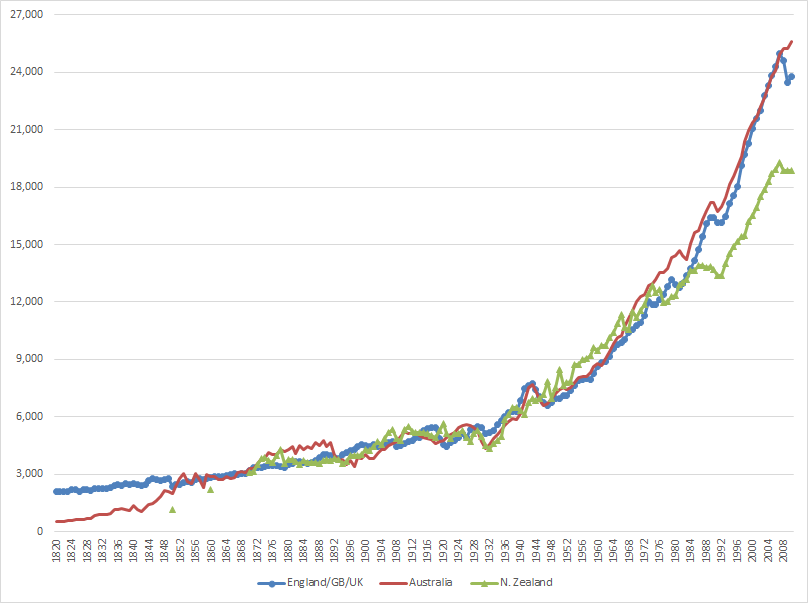
When did Down Under overtake the Mother Country? Real GDP Britain, Australia and New Zealand 1820–2010
17 May 2015 Leave a comment
in development economics, economic growth, economic history, growth disasters, growth miracles, macroeconomics Tags: Australia, British economy, convergence, lost decades, Maddison database, New Zealand
Pretty quickly according to figure 1. Britain, Australia and New Zealand quickly had similar standards of living in the middle of the 19th century until about 1880. Australia was richer for about 20 years until the great Federation drought took the wind out of its sails.
Figure 1: British, Australian and New Zealand GDP per capita (1990 Int. GK$PPP), 1820 – 2010
Source: The Maddison-Project, http://www.ggdc.net/maddison/maddison-project/home.htm 2013 version.
New Zealand then broke away at the end of the Second World War from both Australia and UK. In the mid-1960s circumstances changed with Australia drifting ahead of the UK and New Zealand drifting away to a lower standard of living.
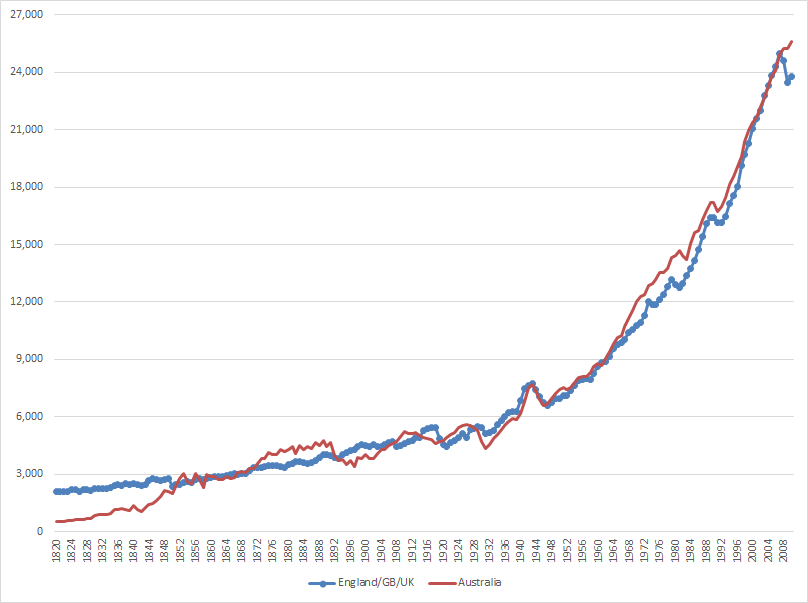
Figure 2: British and Australian GDP per capita (1990 Int. GK$PPP), 1820 – 2010
Source: The Maddison-Project, http://www.ggdc.net/maddison/maddison-project/home.htm 2013 version.
Figure 2 shows that from about 1960 until 1990 Australia was richer than the UK. After that, the growth dividend of Thatchernomics allowed the British to catch up again to the Australians.
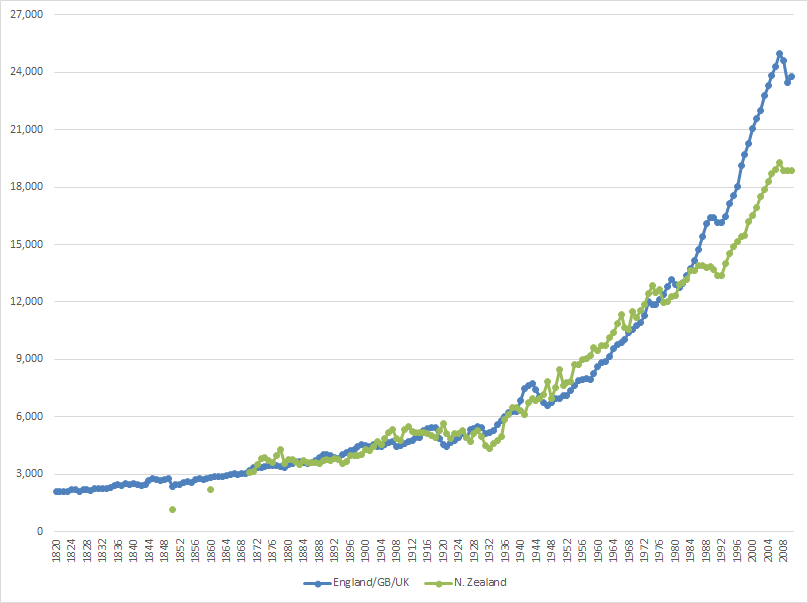
Figure 3: British and New Zealand GDP per capita (1990 Int. GK$PPP), 1820 – 2010
Source: The Maddison-Project, http://www.ggdc.net/maddison/maddison-project/home.htm 2013 version.
Figure 3 shows that New Zealand was richer than the UK in the mid-20th century. The lost decades in New Zealand from 1974 to 1992 let the sick man of Europe overtake New Zealand before Thatchernomics caused a growth spurt in the UK to take the British well ahead.
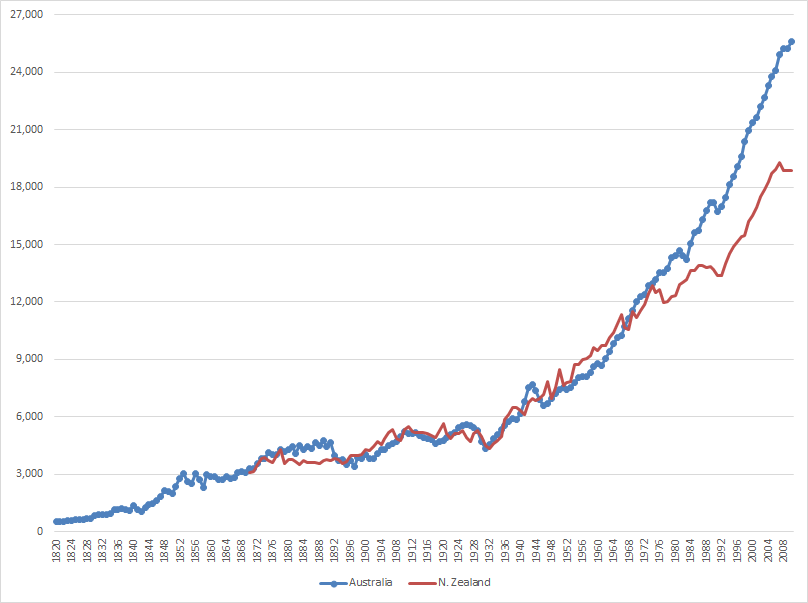
Figure 4: Australian and New Zealand GDP per capita (1990 Int. GK$PPP), 1820 – 2010
Source: The Maddison-Project, http://www.ggdc.net/maddison/maddison-project/home.htm 2013 version.
Figure 4 shows that New Zealand was richer than Australian in the first part of the post-war period. The divergence started with the onset of the lost decades in New Zealand in the early 1970s.
The International diffusion of the Internet
17 May 2015 Leave a comment
in development economics, economic history, entrepreneurship, growth disasters, growth miracles, industrial organisation, survivor principle Tags: China, creative destruction, international technology diffusion, technology diffusion
Leading causes of death in Africa
17 May 2015 Leave a comment
in development economics, growth disasters, growth miracles, health economics Tags: The Great Escape
Urban planners are confident souls
15 May 2015 Leave a comment
in development economics, economics of regulation, environmental economics, growth miracles, politics - Australia, politics - New Zealand, politics - USA, urban economics Tags: green rent seeking, housing affordability The fatal conceit, land use regulation, offsetting behaviour, RMA, The pretence to knowledge, unintended consequences, urban planning, zoning

The Great Escape – child mortality since 1950
14 May 2015 Leave a comment
in development economics, growth disasters, growth miracles, health economics Tags: child mortality, infant mortality, The Great Escape
Child mortality rate down across the globe via @UNICEF
statista.com/chart/3410/glo… http://t.co/SAYPhFMIC0—
Statista (@StatistaCharts) April 17, 2015
The fiscal consequences of oil at $50 a barrel
12 May 2015 Leave a comment
in development economics, energy economics, growth disasters, growth miracles Tags: Oil prices
#Dailychart: Oil at $50 econ.st/14nUWvA http://t.co/eg1PpoipWZ—
The Economist (@ECONdailycharts) January 07, 2015
The crazy mixed up priorities of climate alarmists-in-chief
12 May 2015 Leave a comment
in development economics, environmental economics, environmentalism, global warming, growth disasters, growth miracles, health economics Tags: climate alarmism, doomsday prophets, The Great Enrichment, The Great Escape, The Great Fact, Twitter left
Leaving the Left Exposed. James Hansen: dld.bz/dBnyq http://t.co/ZQsKSJxlr1—
The Left, Exposed (@leftexposed) April 23, 2015

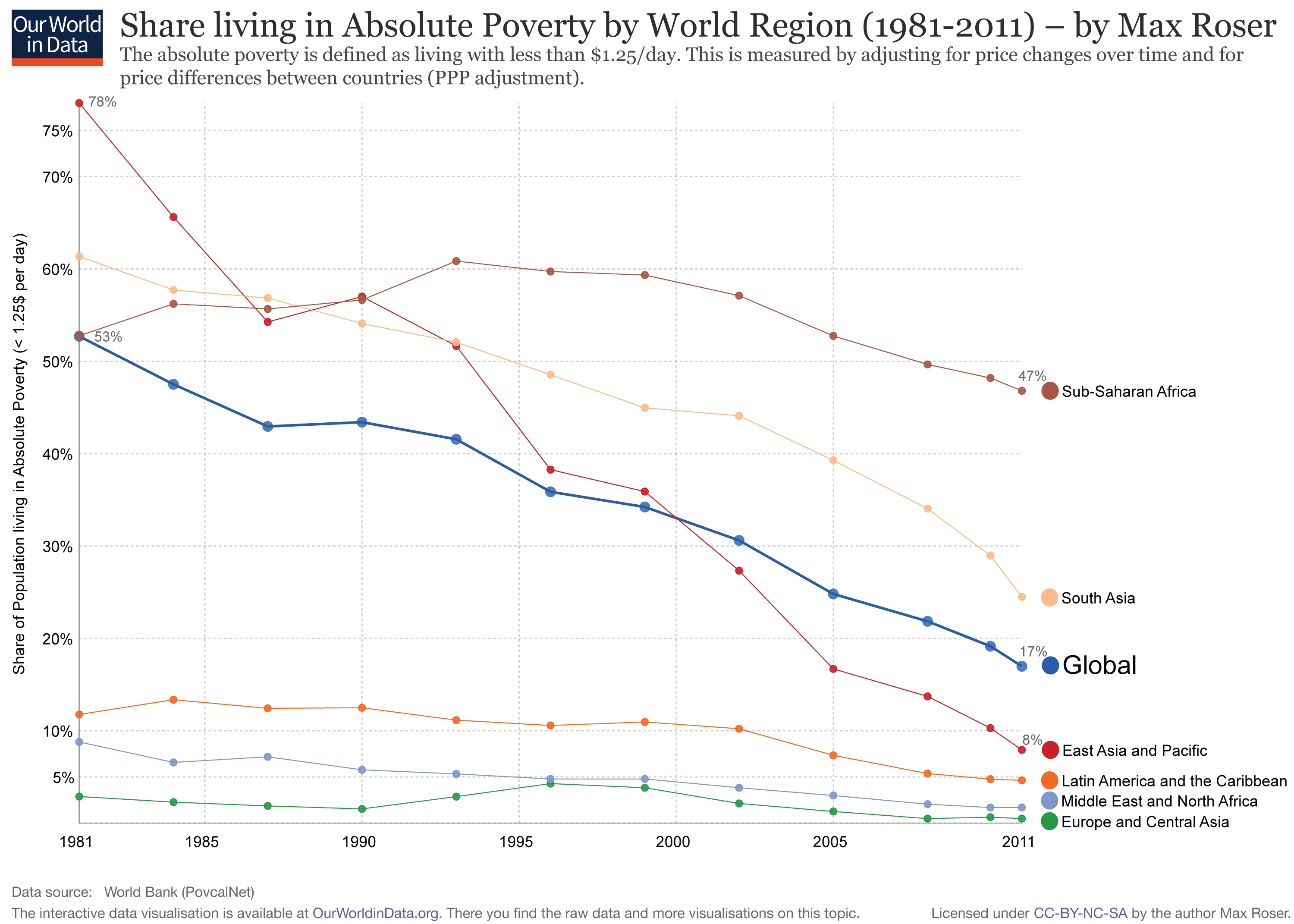


The Great Escape – Child mortality is falling in Africa
12 May 2015 Leave a comment
Child mortality is decreasing throughout Africa.
From my project: bit.ly/1IfQSjg http://t.co/jqA30V6GWq—
Max Roser (@MaxCRoser) April 26, 2015
The robots are coming, the robots are coming – been there, done that in Japan
12 May 2015 1 Comment
in applied price theory, development economics, economic history, entrepreneurship, growth miracles, industrial organisation, labour economics, labour supply, survivor principle, unemployment Tags: creative destruction, entrepreneurial alertness, innovation, Japan, technological unemployment
When I was a kid, I used to like reading the Encyclopaedia Britannica. I read them from cover to cover.
One of the things I recalled from the Encyclopaedia Britannica was that in 1961 nearly half of the Japanese workforce worked in the agricultural sector.
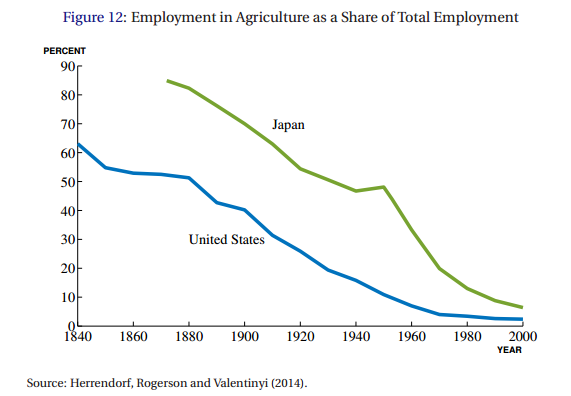
I notice that anomaly when I was reading the Encyclopaedia Britannica entry on Japan in the 1970s. Japan had undergoing an economic transformation since my Encyclopaedia Britannica’s were written in 1961. It was very much out of date.
Australian manufacturing was being outcompeted in every direction from automobiles to clothing and footwear by the Japanese manufacturing sector back when I was a teenager.
The Japanese economic miracle absorbed the Japanese agricultural labour force without anybody having time to shout "the robots are coming, the robots are coming".

There is a lesson in there somewhere for the current breathless journalism, with far too many academic fellow travellers about "the robots are coming, the robots are coming".
When I was a student at graduate school in Japan, I visited a Japanese factory in 1996 that was completely automated bar one function. Only once did a human hand actually touch the electrical goods they were making. Naturally, at the Q&A session at the end of our visit, I asked when was his job going to be automated.

The killer air pollution that the Greens never mention
12 May 2015 Leave a comment
4.3 million die every year. Indoor air pollution is the least reported problem of the world. bit.ly/1BfMiZg http://t.co/CDhafWSbj8—
Max Roser (@MaxCRoser) May 07, 2015
Maybe joining Euroland isn’t that bad after all
08 May 2015 Leave a comment
in business cycles, currency unions, development economics, Euro crisis, global financial crisis (GFC), growth miracles, international economics, macroeconomics, monetary economics Tags: Eastern Europe, Euroland, European Union, Eurosclerosis, transitional economies
#Dailychart: How "New Europe" has fared on its tenth birthday econ.st/1fwOg33 http://t.co/AvkCqHmzAf—
The Economist (@ECONdailycharts) May 01, 2014
When will capitalism abolish poverty?
06 May 2015 Leave a comment
in development economics, economic history, growth disasters, growth miracles Tags: capitalism and freedom, The Great Escape, The Great Fact
Global poverty is rapidly falling, says @BrookingsInst: buff.ly/1PM4Mdr #progress http://t.co/nGzbnxSHnp—
HumanProgress.org (@humanprogress) April 29, 2015
When will Paul Ehrlich’s food riots be starting?
05 May 2015 Leave a comment
in development economics, energy economics, environmental economics, growth disasters, growth miracles, population economics, resource economics Tags: agricultural economics, doomsday prophets, ecological economics, Paul Ehrlich, population bomb, The Great Escape, The Great Fact
"Although the size and wealth of the human population has shot up…"—Jesse H. Ausubel. buff.ly/1Gz5vb8 http://t.co/ZvnnhV9aXH—
HumanProgress.org (@humanprogress) April 30, 2015
Despite a recent uptick, food prices have been declining for over a century, says @chellivia: j.mp/1Evos3r http://t.co/perdLhFods—
Cato Institute (@CatoInstitute) April 24, 2015
Even taking population growth into account, food production per person is actually increasing: j.mp/1Qo0fPt http://t.co/VH0NieLMOX—
Cato Institute (@CatoInstitute) April 23, 2015
Climate experts @PaulREhrlich says we all died during the 1980s http://t.co/C7k1Qc4B4O—
Steve Goddard (@SteveSGoddard) May 14, 2015
The Great Fact in East Asia
05 May 2015 Leave a comment
in development economics, economic history, growth disasters, growth miracles Tags: The Great Escape, The Great Fact
https://twitter.com/humanprogress/status/594875847552675841/photo/1
As China grew freer economically, its poverty rate fell. buff.ly/1DiVIow http://t.co/8upmR6NUvV—
HumanProgress.org (@humanprogress) April 26, 2015
 Utopia, you are standing in it!
Recent Comments