
Infrastructure investment and economic development strategies in Shanghai and Rio de Janeiro
28 Aug 2014 Leave a comment
What is the precariat?
24 Aug 2014 Leave a comment
in applied price theory, applied welfare economics, comparative institutional analysis, constitutional political economy, development economics, entrepreneurship, growth disasters, growth miracles, income redistribution, rentseeking, technological progress, Uncategorized Tags: Leftover Left, precariat, The Great Act, The Great Enrichment, The withering away the proletariat
With the withering away of the proletariat because of the great enrichment, the Left over Left coined the word precariat.

The precariat is a social class formed by people suffering from precarity: a condition of existence without predictability or security, affecting material or psychological welfare as well as being a member of a proletariat class of industrial workers who lack their own means of production and hence sell their labour to live. Specifically, it is applied to the condition of lack of job security, in other words intermittent employment or underemployment and the resultant precarious existence. The term is a portmanteau obtained by merging precarious with proletariat.
Very similar to the Karl Marx’s Lumpenproletariat: the layer of the working class that is unlikely ever to achieve class consciousness and is therefore lost to socially useful production, of no use to the revolutionary struggle, and perhaps even an impediment to the realization of a classless society.
One of the drawbacks of the precariat is they are inconveniently happier than Left over Left are willing to give them credit. For example, a lot of women in part-time jobs are happier than those in full-time jobs because of the greater worklife balance. Casual and seasonal jobs pay more too.
0
Deirdre McCloskey – Equality vs. Lifting Up the Poor
21 Aug 2014 Leave a comment
in applied welfare economics, constitutional political economy, development economics, growth disasters, growth miracles, liberalism Tags: Deirdre McCloskey, poverty versus inequality, The Age of Enlightenment, The Great Enrichment, The Great Escape, The Great Fact

HT: deirdremccloskey via cafehayek
Deirdre McCloskey: inequality is an ugly word – it frightens
20 Aug 2014 Leave a comment
in applied welfare economics, development economics, growth disasters, growth miracles, history of economic thought, income redistribution, liberalism Tags: Deirdre McCloskey, poverty versus inequality, The Great Escape The Age of Enlightenment, The Great Fact

HT: deirdremccloskey via cafehayek

The Great Fact
06 Jul 2014 Leave a comment
in development economics, growth miracles Tags: The Great Escape, The Great Fact
The graph shows the total global proportion of people in extreme poverty from 1820-2005, defined as having less than $1 per day (inflation adjusted across the time period).
HT: Cool It
The Great Enrichment foretold
01 Jul 2014 Leave a comment
in growth miracles, liberalism Tags: The Great Enrichment, The Great Fact, Thomas Babington Macaulay, Whig theory of history

Thomas Babington Macaulay’s books on British history are hailed as literary masterpieces.
His writing are famous for their emphasis on a progressive model of British history, according to which the country threw off superstition, autocracy and confusion to create a balanced constitution and a forward-looking culture combined with freedom of belief and expression.
This model of human progress has been called the Whig interpretation of history where civilisation marches onwards and upwards towards the light. I do know how he explained the fall of the Roman Empire and the Dark Ages.
The Great Fact in the Age of Milton Friedman
27 Jun 2014 Leave a comment
in development economics, growth miracles Tags: The Age of Milton Friedman, The Great Escape, The Great Fact
HT: The Gapminder
What was the greatest invention of the industrial revolution?
26 Jun 2014 Leave a comment
This video by Hans Rosling is one of the best about the Great Escape and the Great Fact; and what we just so take from granted, even myself because of the overweening conceit of youth, from our childhoods and the lives of our parents.
The Great Escape: the astonishing fall in child mortality rates
25 Jun 2014 Leave a comment
in development economics, growth miracles Tags: child mortality, The Great Escape, The Great Fact

HT: The Gapminder
On independence, Jamaica was rated a better prospect for economic development than Singapore!
24 Jun 2014 Leave a comment
in development economics, growth disasters, growth miracles Tags: East Asian Tigers, Jamaica, Singapore

Upon Singapore’s independence in 1965—three years after Jamaica’s own establishment as a nation—the two nations were about equal in wealth: the gross domestic product (in 2006 U.S. dollars) was $2,850 per person in Jamaica, slightly higher than Singapore’s $2,650.
Both nations had a centrally located port, a tradition of British colonial rule, and governments with a strong capitalist orientation. (Jamaica, in addition, had plentiful natural resources and a robust tourist industry.)
But four decades later, their standing was dramatically different: Singapore had climbed to a per capita GDP of $31,400 (2006 data, in current dollars), while Jamaica’s figure was only $4,800.
Both countries were ruled by political parties that were members of Socialist International.
Both countries had a Prime Minister who held office for a long time in the period after independence. Both countries had a father and son follow each other in short order as Prime Minister.
Bill Easterly at the Asian Development Bank
20 Jun 2014 Leave a comment
in Bill Easterly, development economics, growth miracles Tags: Bill Easterly, East Asian Tigers

— United Nations Conference on Trade and Development, a body that has long distinguished itself by promoting all the bad ideas that stifle both trade and development.
— But any Asian leader who hasn’t already figured out that trade should be mainstream after Asia’s world-historical trade explosion is past the point of rescue anyway.
— Successful trade booms (and the accompanying infrastructure demand) come about through letting free market entrepreneurs run wild to find things foreigners want rather than consulting ADB bureaucrats on designing a “national development strategy.”
— All of which goes to show that the ADB’s fundamental problem is that it needs advice from successful Asian countries more than they need advice from it.
The World Bank wrote South Korea off in the 1960s
20 Jun 2014 3 Comments
in development economics, growth miracles Tags: East Asian Tigers, South Korea
The World Bank (2002) mentions South Korea and Botswana as long term success stories. The first World Bank mission to Korea in the early 1960s described Korea’s development program as ludicrously optimistic:
There can be no doubt that this development program GDP growth of 7.1 per cent exceeds the potential of the Korean economy. . .
It is inconceivable that exports will rise as much as projected.
Korean economic growth turned out to be 7.3 per cent in the forecasted period. In 1960, South Korea was one of the poorest countries in the world, with an income per head on a par with the poorest parts of Africa.
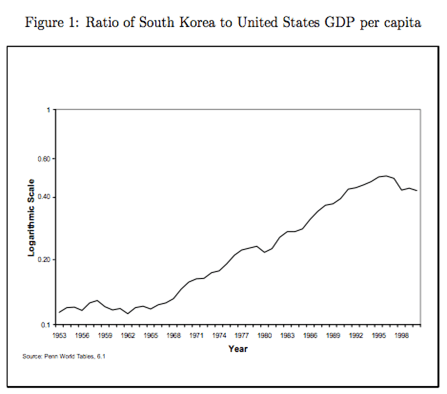
Unfortunately, a study for the World Bank’s Operations Evaluation Department found that Korea’s growth accelerated only after the decline in US aid, and did so by following policies contrary to the advice of US aid officials; hence, the consensus of most studies of Korea is that aid contributed little to Korea’s take-off (Fox 2000).
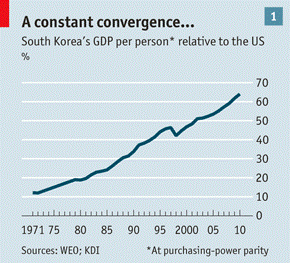
Chenery and Strout forecast in the early 1960s that growth in India and Pakistan over 1962-76 would exceed that of Korea. Rosenstein-Rodan at the same time predicted that Sri Lanka would have a higher per capita income than Taiwan or Korea by 1976. Hong Kong and Singapore, according to the same predictions, were to be left in the dust by Argentina and Colombia.
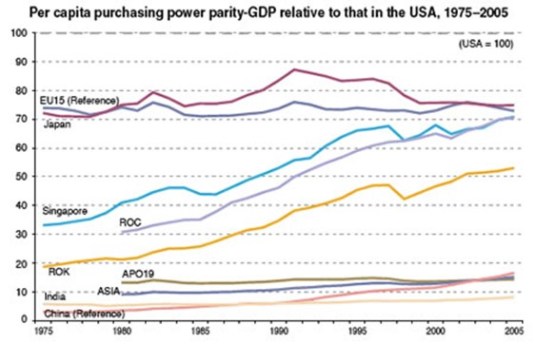
A key feature of this development miracle was an enormous increase in Korea’s international trade. In the early 1960s, Korea eliminated tariffs on imported production inputs and capital goods as long as these imports were used to produce goods for export. Beginning in the 1970s, Korea engaged in a broader, gradual reduction of tariff from about 40 per cent to 13 per cent.
Gordon Tullock is an interesting writer on South Korea saying that:
• Syngman Rhee was a socialist who knew nothing of capitalism.
• To make his country look capitalist to please the Americans, Rhee gave previously Japanese owned industries to his friends as monopolies.
• When General Park overthrew Syngman Rhee, he knew no economics, but he knew the bureaucracy was filled with Rhee’s cronies so he fired them all.
Tullock considers that South Korea became an open economy as a by-product of this political purge.
Double standards watch: was Milton Friedman a double secret communist agent?
20 Jun 2014 Leave a comment
in development economics, growth miracles, Milton Friedman Tags: Chile, China, double standards, Milton Friedman, tinpot dictatorships, totalitarian dictatorships


In March 1975, Friedman had a 45-minute meeting with Pinochet while he was on a private visit to Chile. Friedman later wrote a letter to that tin-pot military dictator proposing some economic remedies. That advice was the same advice he gave to countries all around the world such as to the government of India in 1955 .
Friedman advocated quick and severe cuts in government spending and inflation, deregulation, a floating exchange rate and more open international trade policy and to
provide for the relief of any cases of real hardship and severe distress among the poorest classes.
Milton Friedman first visited China in 1980. According to Ronald Coase’s book on Chinese economic reform, as part of that visit, Friedman gave a week long seminar to Chinese government officials. Friedman met with the leadership of this totalitarian dictatorship. Friedman returned again as a guest of the Chinese government in 1988 and 1993:
Milton Friedman and his wife Rose visited China in 1980 and 1988 to learn about the economic reform that was taking place there and to share their economic knowledge and insights with the Chinese people.
Friedman gave lectures in numerous cities and held discussions with government officials, managers, bankers, students, professors and even with ordinary people in their homes and on the streets.
In their second visit they met with Zhao Ziyang… General Secretary of the Chinese Communist Party, to discuss China’s economic reform.

In his meetings with the Chinese leaders when he first visited China in 1980, Friedman strongly emphasised
the importance of unfettered markets, pointing to China’s neighbour, Hong Kong, as a model to be followed by mainland China.
Steven Cheung wrote about those visits and the extremely sophisticated discussions Friedman had with top Chinese officials and their economic advisers in 1988 with Cheung as his translator. The only two points they disagreed on was the control that the Communist Party had over the society and when to loosen exchange-rate controls. Cheung said that Zhao’s rationale for delay deserved a good grade in any graduate exam. Following Friedman’s meetings with Zhao, he said the general secretary
was the best economist I have ever met from a socialist country
Subsequent to his 1988 meeting with Zhao Ziyang, Milton Friedman wrote him a letter that gave much the same advice that he gave to Pinochet. Friedman also advised the Chinese against following the market socialism model of Yugoslavia because although it would work for a while before further economic growth required privatisation.
Why is it wrong to have one 45 minute meeting with the tin-pot dictator and yet give seminars and detailed policy advice to a totalitarian dictatorship. Friedman would spend the rest of his life being defamed as an accomplice to evil for meeting Pinochet for 45 minutes. Friedman later noted that he gave communist dictatorships the same advice he gave Pinochet:
It’s curious. I gave exactly the same lectures in China that I gave in Chile. I have had many demonstrations against me for what I said in Chile.
Nobody has made any objections to what I said in China. How come?
If the same standard of evidence is applied to all people who visit dictatorships, Friedman must be a Communist agent or at least a collaborator and responsible for all the horrors that took place in China before and after he visited: the Great Leap Forward and the cultural revolution would be examples. Friedman also visited Yugoslavia: market socialism is his fault as well.
P.T. Bauer on development aid as a precondition to development in the Third World
14 Jun 2014 Leave a comment
in development economics, growth miracles, P.T. Bauer Tags: development aid, P.T. Bauer, The Great Enrichment, The Great Fact
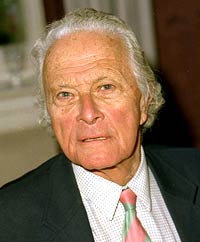
Foreign aid is clearly not a necessary condition of economic development. This fact is obvious from the history of the developed countries, all of which began poor and have invariably progressed without government-to-government aid.
It is clear also from the history of many underdeveloped countries — Hong Kong, Japan, Malaya — which have advanced in recent decades without foreign aid.


Recent Comments