What African Presidents Make (Officially) http://t.co/X3F0j5DYHG—
ian bremmer (@ianbremmer) July 23, 2015
The official salaries of African presidents
22 Oct 2015 Leave a comment
in development economics, economics of crime, growth disasters, growth miracles, law and economics Tags: Africa, bribery and corruption
Are @vngalasso @OxfamAmerica @dpaulobrien Great Escape deniers? @WhitefordPeter
21 Oct 2015 Leave a comment
in development economics, economic history, growth miracles Tags: Leftover Left, life expectancy, The Great Escape, The Great Fact, Twitter left
https://twitter.com/MaxCRoser/status/656144668468641793
In 1800 there was no country with a life expectancy over 40.
bit.ly/1C8oCsK http://t.co/Ow7gE4F1qL—
Max Roser (@MaxCRoser) October 19, 2015
From my project: bit.ly/1IfQSjg
Huge progress in education in #Africa between 1950 and 2010! https://t.co/oipFNpPTqy—
Max Roser (@MaxCRoser) October 20, 2015
When more infants survive the birth rate goes down.
From: ourworldindata.org/data/populatio… https://t.co/zIZ1jNc1w5—
Max Roser (@MaxCRoser) October 20, 2015
A Graph for Pope Francis: If You Want to Help the Poor, You Should Embrace Capitalism. Exhibit A: See Chart http://t.co/yG1ixKZxrJ—
Mark J. Perry (@Mark_J_Perry) September 21, 2015
Technology diffusion to underdeveloped countries is quickening
20 Oct 2015 Leave a comment
in development economics, growth disasters, growth miracles Tags: creative destruction, international technology diffusion, technology diffusion
pace of diffusion of digital technologies in the developing world far exceeds growth in access to basic services http://t.co/Kig46T713M—
Laurence Chandy (@laurencechandy) May 20, 2015
Chinese & Indian female life expectancies as a sign of broad-based economic growth
20 Oct 2015 Leave a comment
in development economics, economic history, growth miracles, health economics
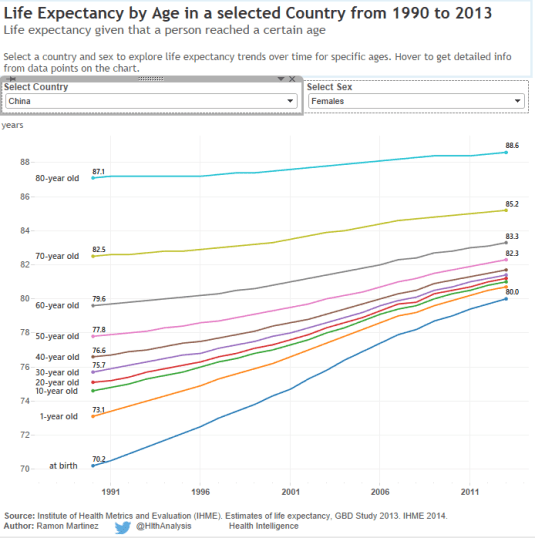
In the last 20 years in India, life expectancy at birth increased by 10 years. The same in China. There were increases in Chinese and Indian life expectancies across all age bands.
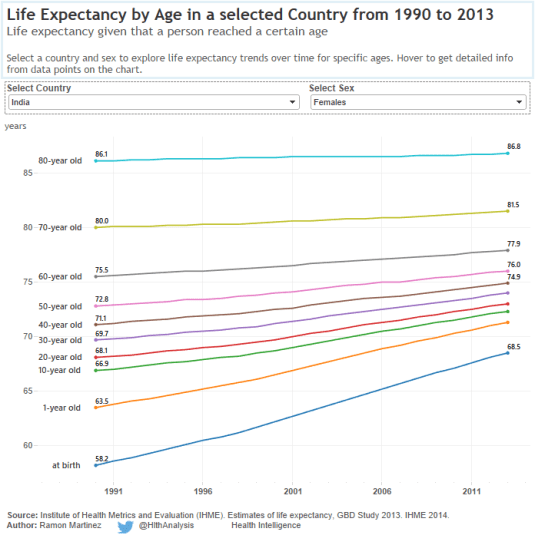
The difference between the two countries is the low base in India which was 58 years versus 70 years in China for life expectancy at birth. Obviously, recovering from the Permit Raj has been a bit of a struggle for socialist India. Either way, such a rapid increase in life expectancy in India and China suggests broad-based economic growth in the last 20 years.
If you look at China and India over the longer term and compare it with capitalism, again the socialist solution comes up short. The initial improvements in life expectancies in India and China in the mid-20th century were simply curing of endemic diseases and childhood illnesses. Hong Kong and Macau were miles ahead of China until China took the capitalist road.
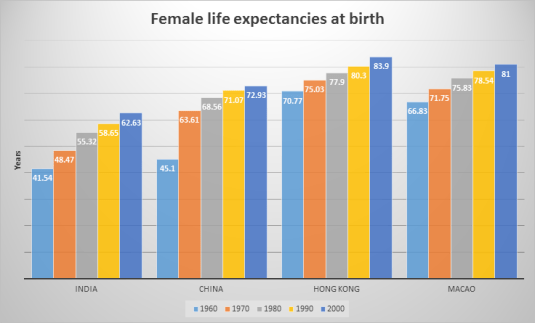
Source: Cleo Infra.
In the 10 years from 2000, China close that gap in female life expectancies of birth through the blessings of capitalism but not as much freedom as we might have hoped. That said, if you stay out of politics in China, you can run a business, raise a family and travel and study abroad. China is now a tin-pot dictatorship rather than a totalitarian dictatorship. That’s a major improvement.
The differences in Hong Kong and Macau life expectancies is also a good measure of the advantages of being colonised by the British rather than the Portuguese.
Height differences between South Koreans and North Korean female escapees
20 Oct 2015 Leave a comment
in development economics, growth disasters, growth miracles, Marxist economics
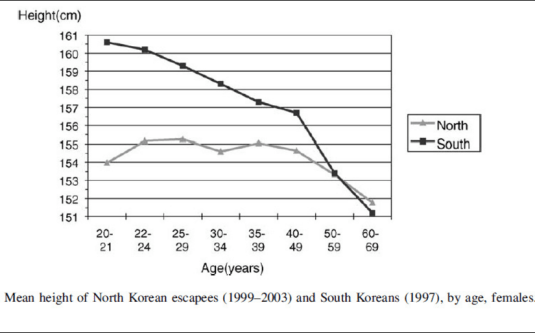
Capitalism delivers growth miracles – Twitter Left still grumbles
20 Oct 2015 Leave a comment
in development economics, economic history, growth disasters, growth miracles
#inequality matters for achieving the end of #poverty. #EvenItUp @OxfamAmerica @dpaulobrien https://t.co/Ld9qhJhfcl—
Nick Galasso (@vngalasso) October 19, 2015
The Left over Left would grumble at the gates of heaven.
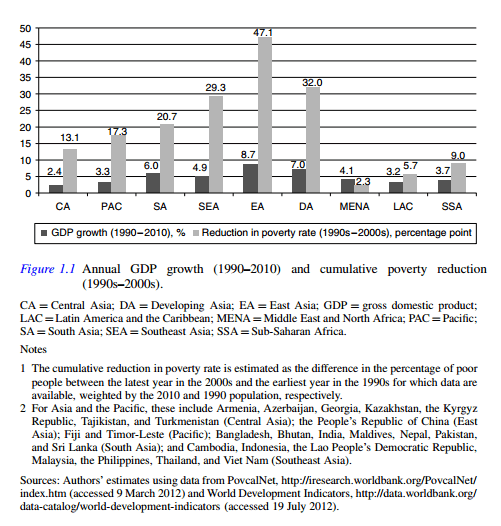
Source: Inequality in Asia and the Pacific | Asian Development Bank.
The fact that most of the Twitter Left would have to go through the eye of a needle would not dawn of them. They would be more interested in whether there was free Wi-Fi.
where do the extreme poor live? this @worldbank graphic wont tell you as it ignores new survey data 4 Nigeria & India http://t.co/APb0M0TuYK—
Laurence Chandy (@laurencechandy) April 14, 2014
The latest grumblings of the Twitter Left is after the World Bank announced that extreme poverty is to drop below 10% of the world’s population for the first time ever.
Rather than celebrate this tremendous achievement of capitalism and freedom, the Twitter Left grumbles about inequality.
A look at hunger reduction → performance + projections by region: brook.gs/1FWLLOS http://t.co/ELNzKn6BCQ—
Brookings Global (@BrookingsGlobal) June 16, 2015
A legitimate reason for the opposition to capitalism in Latin America is crony capitalism. This is opposed to the competitive capitalism that produces economic miracles. Becker defines crony capitalism as
…a system where companies with close connections to the government gain economic power not by competing better, but by using the government to get favoured and protected positions. These favours include monopolies over telecommunications, exclusive licenses to import different goods, and other sizeable economic advantages. Some cronyism is found in all countries, but Mexico and other Latin countries have often taken the influence of political connections to extremes.
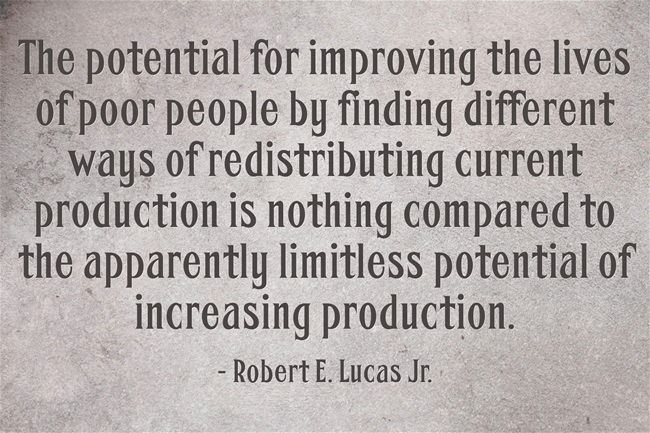
Nearly all of Asia (where much of the world’s population lives) has undergone rapid and sustained economic and social progress because they became market economies, starting with the Asian Tigers and recently in previously socialist India and communist China.
Growth paths of #LatAm & the Caribbean the South East Tigers: wrld.bg/NCtLt #RiseoftheSouth http://t.co/IFuUOWldox—
World Bank Pubs (@WBPubs) May 31, 2015
Latin America adopted the inward economic policies of the mid-20th century that renegade liberals praise so much and they became development disasters.
How can we eradicate #poverty by 2030? @Winnie_Byanyima wef.ch/1QvSVPW #development http://t.co/reBsT24BU3—
World Economic Forum (@wef) September 24, 2015
The trend in past several decades in most countries has been toward more open economies with greater competition within industries. There is more reliance on private enterprise, and with a reduced role for government, government-run enterprises, and cronyism.
Hot off the press: @WorldBank publishes new global poverty estimates and forecasts. 1.01 billion < $1.25/day in 2011 http://t.co/cGfdEAdOMo—
Laurence Chandy (@laurencechandy) October 08, 2014
As the world embraced free market policies in the late 20th century, living standards rose sharply; life expectancy, education and democracy improved and absolute poverty declined.
Xavier Sala-I-Martin and Maxim Pinkovskiy (2010) found that between 1970 and 2006, extreme poverty fell by 86% in South Asia, 73% in Latin America, 39% in the Middle East and 20% in Africa.
The percentage of people living on less than $1 a day (in PPP-adjusted 2000 dollars) fell from 26.8% in 1970 to 5.4% in 2006.
#Africa represents the last hurdle to ending extreme #poverty ($1.25 per day) → brook.gs/1JS4EUH http://t.co/ihDFc6R3ly—
Brookings Global (@BrookingsGlobal) July 29, 2015
Xavier Sala-I-Martin also estimated eight indexes of income inequality. All of them show reductions in global inequality during the 1980s and 1990s.
@BernieSanders @JeremyCorbyn4PM in 1962, people in 51 nations ate <2000 calories a day – how many do today?
19 Oct 2015 Leave a comment
in development economics, economic history, growth disasters, growth miracles Tags: child poverty, extreme poverty, global hunger, global poverty, The Great Escape
In 1962, people in 51 countries consumed <2000 calories per day. In 2011? One. buff.ly/1PmjIRK #WorldFoodDay http://t.co/zdJRWK1Mtj—
HumanProgress.org (@humanprogress) October 16, 2015
The Great Escape into the middle class in the Third World
18 Oct 2015 Leave a comment
#Dailychart: In almost every country, mortality rates fell during the four decades to 2010 econ.st/XUYuSn http://t.co/kTg4oyQPRY—
The Economist (@ECONdailycharts) September 23, 2014
The Great Escape in China
18 Oct 2015 Leave a comment
in development economics, economic history, entrepreneurship, growth disasters, growth miracles Tags: China, The Great Escape
@GreenpeaceNZ @jamespeshaw The Futility and Farce of Global Climate Negotiations @RichardTol
18 Oct 2015 Leave a comment
in constitutional political economy, development economics, economics of bureaucracy, environmental economics, environmentalism, global warming, growth disasters, growth miracles, international economics, politics - Australia, politics - New Zealand, politics - USA, Public Choice, rentseeking Tags: bootleggers and baptists, climate alarmism, expressive voting, free-riders, global warming, green tariffs, international public goods, Leftover Left, New Zealand Greens, Twitter left
It is time for the environmental movement to face up to the fact that there never will be an international treaty to restrain carbon emissions. The practical way to respond to global warming is healthier is wealthier, richer is safer. Faster economic growth creates more resources for resilience and adaptation to a changing environment.
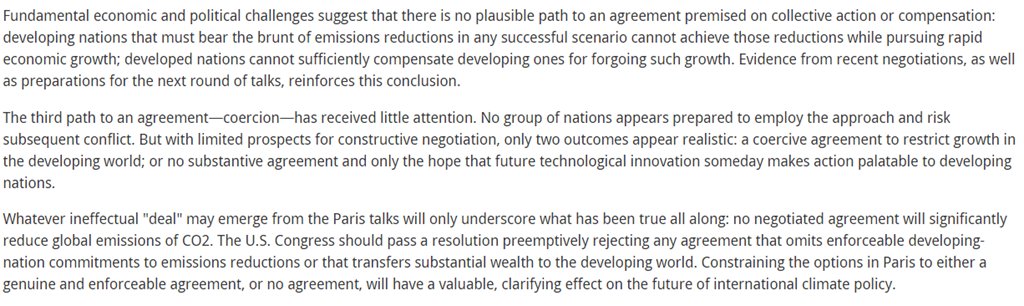
NEW REPORT: The Futility and Farce of Global Climate Negotiations bit.ly/1LvFFv3 http://t.co/TwbFUwaPlm—
Manhattan Institute (@ManhattanInst) October 17, 2015
India's target compared to its recent history http://t.co/pIvwhoSTpL—
Richard Tol (@RichardTol) October 02, 2015
Cell phones are conquering Africa
14 Oct 2015 Leave a comment
in development economics, economics of media and culture, growth disasters, growth miracles Tags: Africa, cell phones, technology diffusion
Africa is more connected than ever, with a record 84 cell phone subscriptions per 100 people. buff.ly/1L4Daw8 http://t.co/GkqcKAUPmW—
HumanProgress.org (@humanprogress) October 06, 2015
Leaked letter shows how @Oxfam @sierraclub lobbied to block cheap energy for poor nations @GreenpeaceNZ @oxfamnz
12 Oct 2015 Leave a comment
in development economics, energy economics, entrepreneurship, environmental economics, environmentalism, growth disasters, growth miracles Tags: energy poverty, expressive voting, global poverty, green rent seeking, Leftover Left, Oxfam, rational ignorance, rational irrationality, stream poverty, The Great Escape
https://twitter.com/MichaelBTI/status/651503672002785281
Outrageous & Orwellian for @Oxfam to lobby to deny cheap energy to poorest people in world. #ElectrifyAfrica http://t.co/b2P09Gn7rP—
Mike Shellenberger (@MichaelBTI) October 06, 2015
Oxfam world HQ looks like such a pleasant place to work. Grid electricity. Effective security. Ample parking. http://t.co/lsxTf2DN6b—
Mike Shellenberger (@MichaelBTI) October 06, 2015
Here's @Oxfam's luxury office building in UK. Were its steel & glass components constructed with solar panels? http://t.co/642mm2zB4B—
Mike Shellenberger (@MichaelBTI) October 06, 2015
https://twitter.com/MichaelBTI/status/651458416569909248
https://twitter.com/VoxMaps/status/608411758022291456/photo/1?ref_src=twsrc%5Etfw
Chile and Venezuela compared
09 Oct 2015 Leave a comment
in development economics, growth disasters, growth miracles, Marxist economics Tags: Chile, Venezuela
Embrace the free market and overtake your socialist competitors. buff.ly/1PZ3yuN http://t.co/xfpF4vtqlv—
HumanProgress.org (@humanprogress) October 05, 2015
What will it take to finish the Last Mile in ending extreme poverty
09 Oct 2015 Leave a comment
in development economics, economic history, growth disasters, growth miracles, politics - Australia, politics - New Zealand, politics - USA, poverty and inequality Tags: capitalism and freedom, The Great Escape, The Great Fact
What will it take to finish the “Last Mile” in ending extreme #poverty? brook.gs/1LiFT8E http://t.co/YxSZ36VCSW—
Brookings (@BrookingsInst) October 07, 2015
#China uses as much coal, steel, and concrete as the rest of the world combined
08 Oct 2015 Leave a comment
in development economics, energy economics, growth miracles, resource economics Tags: China
China uses as much coal, steel, and concrete as the rest of the world combined: bit.ly/1US1Lyc http://t.co/4NqNFNLAYz—
Vox (@voxdotcom) September 15, 2015


Recent Comments