
What was the greatest invention of the industrial revolution?
26 Jun 2014 Leave a comment
This video by Hans Rosling is one of the best about the Great Escape and the Great Fact; and what we just so take from granted, even myself because of the overweening conceit of youth, from our childhoods and the lives of our parents.
The Great Escape: the astonishing fall in child mortality rates
25 Jun 2014 Leave a comment
in development economics, growth miracles Tags: child mortality, The Great Escape, The Great Fact

HT: The Gapminder
On independence, Jamaica was rated a better prospect for economic development than Singapore!
24 Jun 2014 Leave a comment
in development economics, growth disasters, growth miracles Tags: East Asian Tigers, Jamaica, Singapore

Upon Singapore’s independence in 1965—three years after Jamaica’s own establishment as a nation—the two nations were about equal in wealth: the gross domestic product (in 2006 U.S. dollars) was $2,850 per person in Jamaica, slightly higher than Singapore’s $2,650.
Both nations had a centrally located port, a tradition of British colonial rule, and governments with a strong capitalist orientation. (Jamaica, in addition, had plentiful natural resources and a robust tourist industry.)
But four decades later, their standing was dramatically different: Singapore had climbed to a per capita GDP of $31,400 (2006 data, in current dollars), while Jamaica’s figure was only $4,800.
Both countries were ruled by political parties that were members of Socialist International.
Both countries had a Prime Minister who held office for a long time in the period after independence. Both countries had a father and son follow each other in short order as Prime Minister.
Bill Easterly at the Asian Development Bank
20 Jun 2014 Leave a comment
in Bill Easterly, development economics, growth miracles Tags: Bill Easterly, East Asian Tigers

— United Nations Conference on Trade and Development, a body that has long distinguished itself by promoting all the bad ideas that stifle both trade and development.
— But any Asian leader who hasn’t already figured out that trade should be mainstream after Asia’s world-historical trade explosion is past the point of rescue anyway.
— Successful trade booms (and the accompanying infrastructure demand) come about through letting free market entrepreneurs run wild to find things foreigners want rather than consulting ADB bureaucrats on designing a “national development strategy.”
— All of which goes to show that the ADB’s fundamental problem is that it needs advice from successful Asian countries more than they need advice from it.
The World Bank wrote South Korea off in the 1960s
20 Jun 2014 3 Comments
in development economics, growth miracles Tags: East Asian Tigers, South Korea
The World Bank (2002) mentions South Korea and Botswana as long term success stories. The first World Bank mission to Korea in the early 1960s described Korea’s development program as ludicrously optimistic:
There can be no doubt that this development program GDP growth of 7.1 per cent exceeds the potential of the Korean economy. . .
It is inconceivable that exports will rise as much as projected.
Korean economic growth turned out to be 7.3 per cent in the forecasted period. In 1960, South Korea was one of the poorest countries in the world, with an income per head on a par with the poorest parts of Africa.
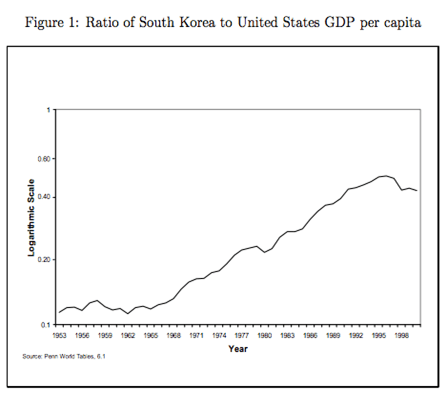
Unfortunately, a study for the World Bank’s Operations Evaluation Department found that Korea’s growth accelerated only after the decline in US aid, and did so by following policies contrary to the advice of US aid officials; hence, the consensus of most studies of Korea is that aid contributed little to Korea’s take-off (Fox 2000).
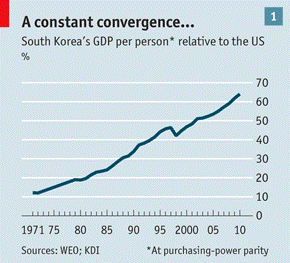
Chenery and Strout forecast in the early 1960s that growth in India and Pakistan over 1962-76 would exceed that of Korea. Rosenstein-Rodan at the same time predicted that Sri Lanka would have a higher per capita income than Taiwan or Korea by 1976. Hong Kong and Singapore, according to the same predictions, were to be left in the dust by Argentina and Colombia.
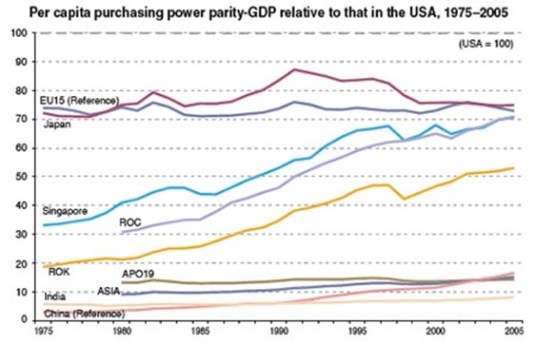
A key feature of this development miracle was an enormous increase in Korea’s international trade. In the early 1960s, Korea eliminated tariffs on imported production inputs and capital goods as long as these imports were used to produce goods for export. Beginning in the 1970s, Korea engaged in a broader, gradual reduction of tariff from about 40 per cent to 13 per cent.
Gordon Tullock is an interesting writer on South Korea saying that:
• Syngman Rhee was a socialist who knew nothing of capitalism.
• To make his country look capitalist to please the Americans, Rhee gave previously Japanese owned industries to his friends as monopolies.
• When General Park overthrew Syngman Rhee, he knew no economics, but he knew the bureaucracy was filled with Rhee’s cronies so he fired them all.
Tullock considers that South Korea became an open economy as a by-product of this political purge.
Double standards watch: was Milton Friedman a double secret communist agent?
20 Jun 2014 Leave a comment
in development economics, growth miracles, Milton Friedman Tags: Chile, China, double standards, Milton Friedman, tinpot dictatorships, totalitarian dictatorships


In March 1975, Friedman had a 45-minute meeting with Pinochet while he was on a private visit to Chile. Friedman later wrote a letter to that tin-pot military dictator proposing some economic remedies. That advice was the same advice he gave to countries all around the world such as to the government of India in 1955 .
Friedman advocated quick and severe cuts in government spending and inflation, deregulation, a floating exchange rate and more open international trade policy and to
provide for the relief of any cases of real hardship and severe distress among the poorest classes.
Milton Friedman first visited China in 1980. According to Ronald Coase’s book on Chinese economic reform, as part of that visit, Friedman gave a week long seminar to Chinese government officials. Friedman met with the leadership of this totalitarian dictatorship. Friedman returned again as a guest of the Chinese government in 1988 and 1993:
Milton Friedman and his wife Rose visited China in 1980 and 1988 to learn about the economic reform that was taking place there and to share their economic knowledge and insights with the Chinese people.
Friedman gave lectures in numerous cities and held discussions with government officials, managers, bankers, students, professors and even with ordinary people in their homes and on the streets.
In their second visit they met with Zhao Ziyang… General Secretary of the Chinese Communist Party, to discuss China’s economic reform.

In his meetings with the Chinese leaders when he first visited China in 1980, Friedman strongly emphasised
the importance of unfettered markets, pointing to China’s neighbour, Hong Kong, as a model to be followed by mainland China.
Steven Cheung wrote about those visits and the extremely sophisticated discussions Friedman had with top Chinese officials and their economic advisers in 1988 with Cheung as his translator. The only two points they disagreed on was the control that the Communist Party had over the society and when to loosen exchange-rate controls. Cheung said that Zhao’s rationale for delay deserved a good grade in any graduate exam. Following Friedman’s meetings with Zhao, he said the general secretary
was the best economist I have ever met from a socialist country
Subsequent to his 1988 meeting with Zhao Ziyang, Milton Friedman wrote him a letter that gave much the same advice that he gave to Pinochet. Friedman also advised the Chinese against following the market socialism model of Yugoslavia because although it would work for a while before further economic growth required privatisation.
Why is it wrong to have one 45 minute meeting with the tin-pot dictator and yet give seminars and detailed policy advice to a totalitarian dictatorship. Friedman would spend the rest of his life being defamed as an accomplice to evil for meeting Pinochet for 45 minutes. Friedman later noted that he gave communist dictatorships the same advice he gave Pinochet:
It’s curious. I gave exactly the same lectures in China that I gave in Chile. I have had many demonstrations against me for what I said in Chile.
Nobody has made any objections to what I said in China. How come?
If the same standard of evidence is applied to all people who visit dictatorships, Friedman must be a Communist agent or at least a collaborator and responsible for all the horrors that took place in China before and after he visited: the Great Leap Forward and the cultural revolution would be examples. Friedman also visited Yugoslavia: market socialism is his fault as well.

The importance of bidding for the Olympics, losing that bid, but putting on a good show
18 Jun 2014 Leave a comment
in development economics, industrial organisation, international economics Tags: game theory, mega sports events, mega-events, Olympics, signalling
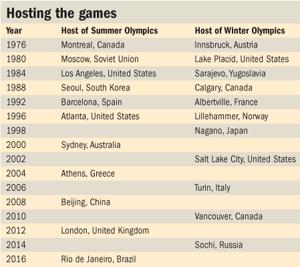
Both successful and unsuccessful bids to host the Olympics have a similar positive impact on exports according to Andrew Rose – no relation.
The Olympic effect on trade is from a signal that a country sends when bidding to host the games, rather than actually hosting the event.

A country that wishes to liberalise its trade may want to signal this by bidding to host a mega-event. It generates extra trade-related investment and creates a political atmosphere where back-sliding on trade liberalisation or the mega-event becomes difficult.
- Rome was awarded the 1960 games in 1955: the same year that Italy started to move towards currency convertibility, joined the UN, and began the negotiations that lead two years later to the Treaty of Rome and the creation of the European Economic Community.
- The Tokyo games of 1964 coincided with Japanese entry into the IMF and the OECD.
- Barcelona was awarded the 1992 games in 1986, the same year Spain joined the European economic community.
- The decision to award Korea the 1988 games coincided with Korea’s political liberalisation.
Many of the countries that are hosted the Olympic Games in recent years such as China have done so as part of showing to the world that they have made it and there’s no going back.
The trick then for the taxpayer is for your country’s bid to host the Olympics to come a close second without anyone knowing you really want to lose.

The trouble with treating the Olympic bid is all show to boost your image as an investment destination and a liberalising economy is your beard might actually win. Throwing a fight is never easy as many a boxer knows.
The great leap backward
17 Jun 2014 Leave a comment
in comparative institutional analysis, development economics, environmental economics, growth disasters, population economics Tags: Deirdre McCloskey
The importation of socialism into the Third World, even in the relatively non-violent form of Congress-Party Fabian-Gandhism, unintentionally stifled growth, enriched large industrialists, and kept the people poor. Malthusian theories hatched in the West were put into practice by India and especially China, resulting in millions of missing girls. The capitalist-sponsored Green Revolution of dwarf hybrids was opposed by green politicians the world around, but has made places like India self-sufficient in grains.
State power in many parts of sub-Saharan Africa has been used to tax the majority of farmers in aid of the president’s cousins and a minority of urban bureaucrats. State power in many parts of Latin America has prevented land reform and sponsored disappearances. State ownership of oil in Nigeria and Mexico and Iraq was used to support the party in power, benefiting the people not at all. Arab men have been kept poor, not bettered, by using state power to deny education and driver’s licenses to Arab women.
The seizure of governments by the clergy has corrupted religions and ruined economies. The seizure of governments by the military has corrupted armies and ruined economies.
P.T. Bauer on the role of government in economic development
16 Jun 2014 Leave a comment
in constitutional political economy, development economics, P.T. Bauer Tags: P.T. Bauer

…the preoccupation with aid, investment, and development planning has served to divert attention from more important factors in development which are influenced by government policy. This same preoccupation has also served somewhat paradoxically to bring about a serious neglect of essential tasks of government.
Governments seem anxious to plan but unable to govern. The neglect extends to such familiar and essential tasks as the maintenance of law and order, the effective management of the monetary and fiscal system, and the provision of basic transport and educational facilities.
What the experiments of the 20th century told me
14 Jun 2014 Leave a comment
in applied price theory, comparative institutional analysis, development economics, economic history Tags: Deirdre McCloskey, The Great Enrichment, The Great Fact

It would have been hard to know the wisdom of Friedrich Hayek or Milton Friedman or Matt Ridley or Deirdre McCloskey in August of 1914, before the experiments in large government were well begun.
But anyone who after the 20th century still thinks that thoroughgoing socialism, nationalism, imperialism, mobilization, central planning, regulation, zoning, price controls, tax policy, labour unions, business cartels, government spending, intrusive policing, adventurism in foreign policy, faith in entangling religion and politics, or most of the other thoroughgoing 19th-century proposals for governmental action are still neat, harmless ideas for improving our lives is not paying attention.
P.T. Bauer on development aid as a precondition to development in the Third World
14 Jun 2014 Leave a comment
in development economics, growth miracles, P.T. Bauer Tags: development aid, P.T. Bauer, The Great Enrichment, The Great Fact
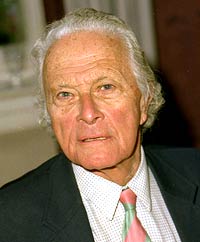
Foreign aid is clearly not a necessary condition of economic development. This fact is obvious from the history of the developed countries, all of which began poor and have invariably progressed without government-to-government aid.
It is clear also from the history of many underdeveloped countries — Hong Kong, Japan, Malaya — which have advanced in recent decades without foreign aid.
No One Cares How Many Predictions Earth Day Founders Got Wrong
13 Jun 2014 Leave a comment
in climate change, development economics, environmentalism Tags: Earth Day, pessimism bias
“Air pollution… is certainly going to take hundreds of thousands of lives in the next few years alone.”
Paul Ehrlich, Stanford University biologist
“The world has been chilling sharply for about twenty years. If present trends continue, the world will be about four degrees colder for the global mean temperature in 1990, but eleven degrees colder in the year 2000. This is about twice what it would take to put us into an ice age.”
Kenneth Watt, Ecologist
“Population will inevitably and completely outstrip whatever small increases in food supplies we make. The death rate will increase until at least 100-200 million people per year will be starving to death during the next ten years.”
Paul Ehrlich
“By… [1975] some experts feel that food shortages will have escalated the present level of world hunger and starvation into famines of unbelievable proportions. Other experts, more optimistic, think the ultimate food-population collision will not occur until the decade of the 1980s.”
Paul Ehrlich
“It is already too late to avoid mass starvation.”
Denis Hayes, chief organizer for Earth Day
“Demographers agree almost unanimously on the following grim timetable: by 1975 widespread famines will begin in India; these will spread by 1990 to include all of India, Pakistan, China and the Near East, Africa.
By the year 2000, or conceivably sooner, South and Central America will exist under famine conditions…
By the year 2000, thirty years from now, the entire world, with the exception of Western Europe, North America, and Australia, will be in famine.”
Peter Gunter, professor, North Texas State University
“Scientists have solid experimental and theoretical evidence to support… the following predictions: In a decade, urban dwellers will have to wear gas masks to survive air pollution…by 1985 air pollution will have reduced the amount of sunlight reaching earth by one half.”
Life magazine, January 1970
via No One Cares How Many Predictions Earth Day Founders Got Wrong.
Should we simply outlaw the scourge of sweatshops and walk away in prim satisfaction?
12 Jun 2014 Leave a comment
in development economics, labour economics Tags: Bill Allen, sweatshops

What is to happen to the erstwhile workers–commonly uneducated, poorly trained, illegally in a land foreign to them, with little experience and marketplace sophistication–who have had their livelihoods abolished? They had been surviving–even if meanly by civilized standards–in market competition by selling their limited services of low value at meager wages.
Taking away those miserable jobs, pricing them out of what had been their best option, does not magically provide them with better alternative employment. Reducing their already poor power to compete, leaving them more handicapped than before, is a strange way to help them.
Bill Allen


Recent Comments