We provide the first direct estimates of the effects of minimum wages on low-wage workers in families at different points of the distribution of income-to-needs, using data from the Survey of Income and Program Participation, which oversamples low-income families. We find adverse – rather than beneficial – effects of minimum wages on the employment, hours,…
Do Minimum Wages Help Worker in Poor and Low-Income Families?
Do Minimum Wages Help Worker in Poor and Low-Income Families?
25 Aug 2026 Leave a comment
in econometerics, economics of regulation, labour economics, minimum wage, poverty and inequality
Whiskey taxes, revenue and voting by members of Congress in history
25 Aug 2026 Leave a comment
in applied price theory, econometerics, history of economic thought, Public Choice, public economics
See Revenue over reason: A case for home distilling by Ben Semark of the Competitive Enterprise Institute. After an excerpt from Semark’s article, I discuss how this relates to voting by congressmen on bills during the Federalist period, the subject of my Ph. D. dissertation.Excerpt from Semark:”Creating home-brewed spirits was not a niche or commercial practice…
Whiskey taxes, revenue and voting by members of Congress in history
College-educated women have maintained stable marriage rates by partnering with high-earning non-college men, shrinking the pool of economically viable partners available to non-college women
24 Aug 2026 Leave a comment
in applied price theory, discrimination, econometerics, economics of love and marriage, gender, human capital, labour economics, labour supply, law and economics, occupational choice, population economics, poverty and inequality
See Gender Disparities in College Enrollment and Marriage Patterns by Clara Chambers, Benjamin Goldman & Joseph Winkelmann.”Over the past half-century, the gender composition of American college campuses has shifted from predominantly male to predominantly female. Today, 1.6 million more women than men attend four-year colleges in the US. Over the same time period, the economic status…
College-educated women have maintained stable marriage rates by partnering with high-earning non-college men, shrinking the pool of economically viable partners available to non-college women
The Confucian fertility paradox
21 Aug 2026 Leave a comment
in development economics, econometerics, economic history, economics of love and marriage, growth miracles, labour economics, labour supply, law and economics, population economics
Total fertility rates in East Asia have fallen to levels without historical precedent, even though the region’s Confucian heritage long placed extraordinary emphasis on family continuity and large families. We argue that this “Confucian Fertility Paradox” dissolves once we separate two strands of the tradition and recognize that modernization affected them very differently. The pro-natal…
The Confucian fertility paradox
The Cost of Going to Space
18 Aug 2026 Leave a comment
in applied price theory, econometerics, economic history, entrepreneurship, industrial organisation Tags: space
Terzi & Nicoli have a fascinating new paper analyzing over 4,400 orbital launches since 1960 to estimate “Wright’s Law.” This law states that a new technology’s unit costs fall in proportion to cumulative experience. Essentially, it is an expression of learning-by-doing. They show:… that the average cost of sending a kilogram to orbit has dropped…
The Cost of Going to Space
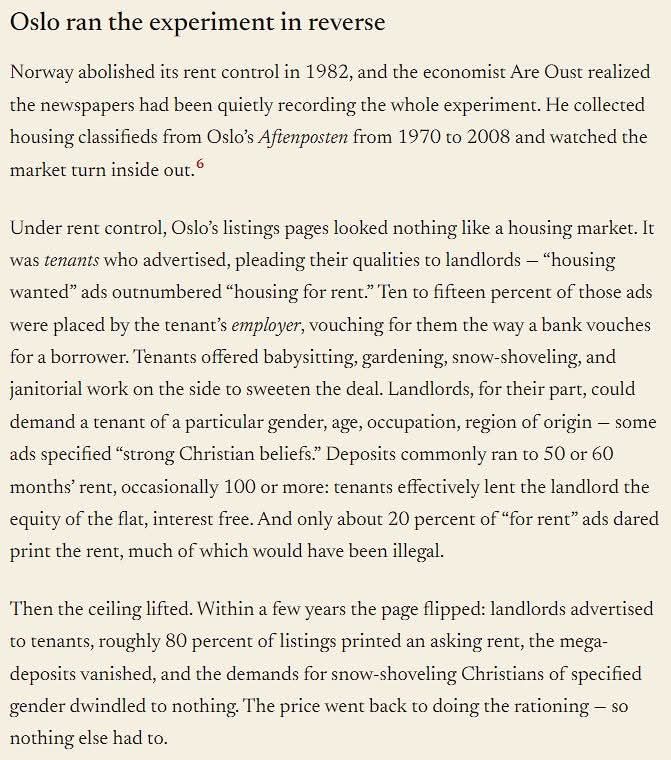
A rent control experiment
13 Aug 2026 1 Comment
in applied price theory, econometerics, economic history, economics of information, economics of regulation, law and economics, property rights Tags: offsetting behavior, rent control, unintended consequences
Immigration and Macroeconomic Outcomes in OECD Countries
10 Aug 2026 Leave a comment
in applied price theory, econometerics, economic history, human capital, labour economics, labour supply Tags: economics of immigration
OECD countries experienced declining native population growth and rising net immigration over 1990-2024. We compile a new dataset of net immigration rates to OECD countries from all origins and show that most of the increase came from non-OECD countries and was predominantly high-skilled. Push factors, network effects, and policy indices explain little of the large…
Immigration and Macroeconomic Outcomes in OECD Countries
The Endangered Species Act Reduces Housing
31 Jul 2026 Leave a comment
in applied price theory, econometerics, economics of regulation, environmental economics, environmentalism, law and economics, politics - USA, property rights, Public Choice, urban economics
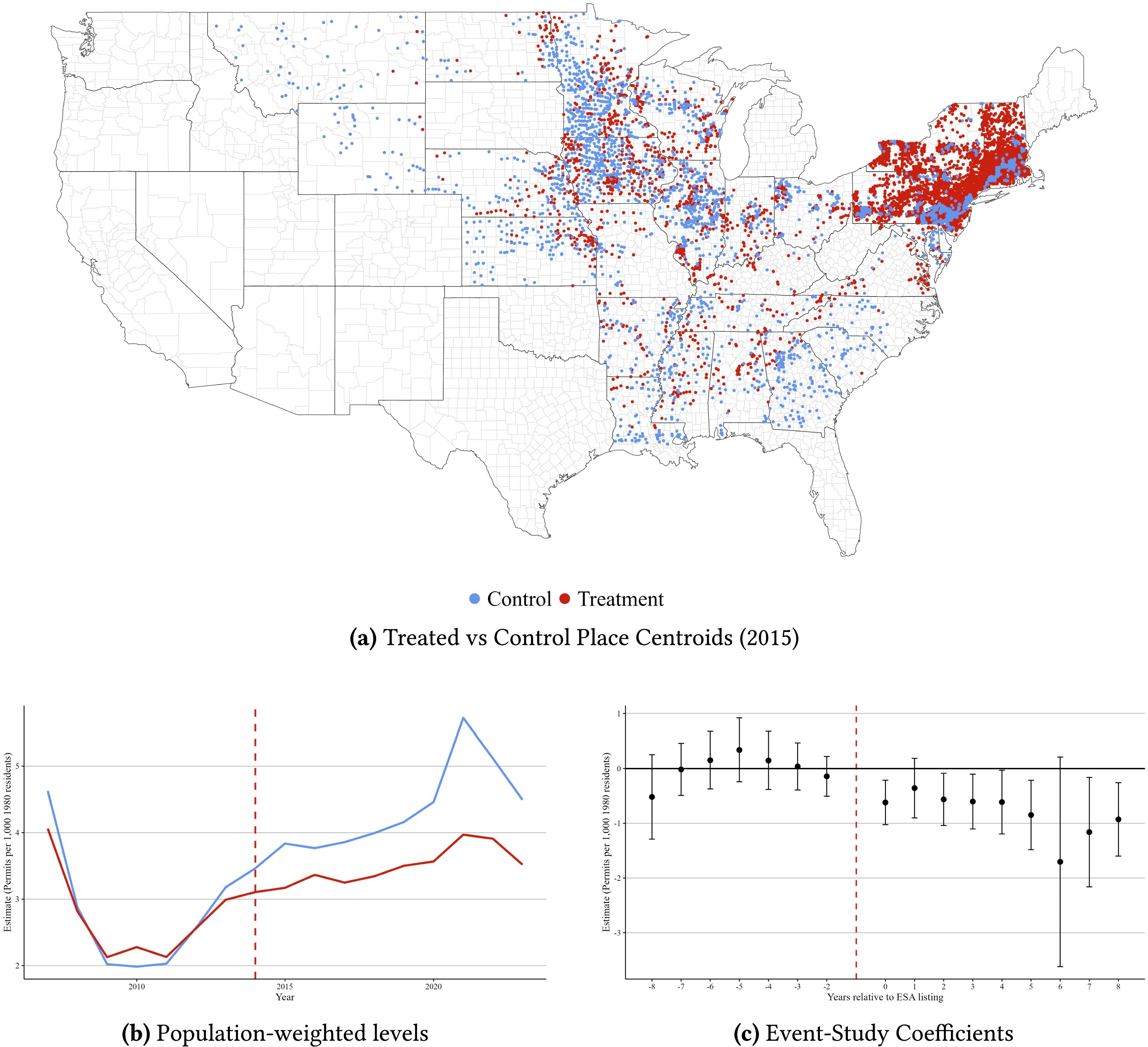
Max Tabarrok’s paper on the Endangered Species Act and housing (WP) has just been published in the Journal of Public Economics! It’s a clever paper: Max observed that the moment an animal is put on the endangered species list, developers face enhanced compliance costs and liability risk. But what’s important for an empirical economist is…
The Endangered Species Act Reduces Housing
Book review: Econometrics for Dummies
19 Jul 2026 1 Comment
in econometerics, economics of education
I just finished reading Roberto Pedace’s 2013 book Econometrics for Dummies. As you might expect from a book written as part of Wiley’s ‘Dummies’ series, the book is written as a basic introduction to its topic, starting from the basics of probability distributions, and ending with a brief primer on how to conduct an econometrics…
Book review: Econometrics for Dummies
Broadband coverage and rural fertility
18 Jul 2026 Leave a comment
in econometerics, labour economics, population economics Tags: economics of fertility
I recently expressed some scepticism at a paper showing that the release of the iPhone explained a third or more of the decline in US fertility. So, I was interested to read this new working paper by Gokhan Kumpas (California State University, Los Angeles), which looks at the effect of broadband coverage on fertility. Specifically, Kumpas…
Broadband coverage and rural fertility
Missing women on Indian streets
09 Jul 2026 Leave a comment
in applied price theory, development economics, discrimination, econometerics, economics of crime, gender, growth miracles, law and economics Tags: sex discrimination
How absent are women from city streets in the developing world? We answer this question using GPS-linked wearable cameras and randomized street audits across ~900 kilometers of roads in greater Mumbai. Across 4000+ street images containing 23,000+ visible person observations, women account for 16.4% of visible people in Mumbai and 14.7% in Navi Mumbai, far…
Missing women on Indian streets
Do falling birth rates boost per capita income?
06 Jul 2026 Leave a comment
in applied price theory, econometerics, economic growth, human capital, labour economics, labour supply, macroeconomics Tags: economics of fertility
The secular decline in birth rates across the globe over the past seven decades has slowed population growth, raised average ages, and reshaped labor markets and the macroeconomy. Contrary to the widespread expectation that these trends hamper economic growth, we find lower birth rates are associated with higher growth in GDP per working-age adult across…
Do falling birth rates boost per capita income?
Piketty’s Eco-Marxist Utopia: Why Degrowth and Global Redistribution Will Trap the Poor in Poverty
13 Jun 2026 Leave a comment
in applied price theory, development economics, econometerics, economic growth, economic history, economics of climate change, economics of regulation, energy economics, environmental economics, environmentalism, fiscal policy, global warming, human capital, income redistribution, industrial organisation, international economics, labour economics, labour supply, macroeconomics, Public Choice, public economics Tags: climate activists, climate alarmism, regressive left
The world’s poor deserve better than another utopia designed for them by the globalist intelligentsia. They deserve cheap energy, open markets, secure property rights, and the freedom to industrialise on terms they choose for themselves. That is what worked in East Asia. It is what will work in South Asia, Africa and Latin America. And…
Piketty’s Eco-Marxist Utopia: Why Degrowth and Global Redistribution Will Trap the Poor in Poverty
A weird way of slicing the stats
12 Jun 2026 Leave a comment
in applied price theory, discrimination, econometerics, economic history, economics of education, human capital, labour economics, labour supply, occupational choice
Ages ago I supervised a superb Honours thesis, which turned into a Masters, looking at the lesbian wage premium. It showed up regularly in the US data: homosexual women earned more than heterosexual women – the opposite of the pattern that obtains for men. I was curious whether the difference could in part be due to…
A weird way of slicing the stats
A Grand Solar Minimum Has Arrived…Global Cooling Of At Least 1°C Is Expected by The 2030s, 2040s
05 Jun 2026 Leave a comment
in econometerics, economic history, economics of climate change, environmental economics, environmentalism, global warming Tags: global cooling
Using pattern analysis, it may be assumed that the onset of the next GSM has arrived, and global cooling will be realized over the next few decades. The post A Grand Solar Minimum Has Arrived…Global Cooling Of At Least 1°C Is Expected by The 2030s, 2040s appeared first on Watts Up With That?.
A Grand Solar Minimum Has Arrived…Global Cooling Of At Least 1°C Is Expected by The 2030s, 2040s


Recent Comments