Three findings emerge. First, improvements in aggregate tax competitiveness are positively and significantly associated with real GDP per capita growth, robust to a wide range of controls. Second, this aggregate effect is driven entirely by the corporate tax pillar; no other component displays a significant growth effect. Third, the corporate tax effect materializes contemporaneously and…
The corporate tax rate really matters
The corporate tax rate really matters
26 May 2026 Leave a comment
in applied price theory, econometerics, economic growth, economic history, entrepreneurship, fiscal policy, macroeconomics Tags: taxation and entrepreneurship, taxation and investment
The economics of unions
22 May 2026 Leave a comment
in applied price theory, comparative institutional analysis, econometerics, economic history, industrial organisation, labour economics, survivor principle, unions
My best read of the evidence is that a union raises wages by around 7% for currently unionized employees. The wage gains from a redistribution of rents evenly across workers. Wage compression exists, but redistribution from worker to worker is only a small part. These are the current effects – unionizing more of the economy […]
The economics of unions
Do Market Reforms Cause Growth?
08 May 2026 Leave a comment
in applied price theory, development economics, econometerics, economic growth, economic history, history of economic thought, labour economics, macroeconomics, unemployment
Do market-oriented reforms cause economic growth? This paper revisits this question using a cross-country panel of reform episodes identified from various changes in well-known economic freedom and structural reform indices. We exploit the timing of reforms using distributed-lag and event-study frameworks that trace the dynamic response of per-capita GDP. We find little evidence of immediate…
Do Market Reforms Cause Growth?
China Shock 2.0 vs. China Shock 1.0
04 May 2026 Leave a comment
in applied price theory, development economics, econometerics, economic history, growth miracles, history of economic thought, industrial organisation, international economics, survivor principle Tags: China, free trade
TweetThis post by Oxford economist J. Zachary Mazlish is very good; I encourage you to read it. (HT David Levey) Nevertheless, there are two points that I think to be worth making in response to Mazlish’s post. I will here make one of these points. I’ll make the other of these points in a follow-up…
China Shock 2.0 vs. China Shock 1.0
How Reform Happens
30 Apr 2026 Leave a comment
in applied price theory, comparative institutional analysis, constitutional political economy, development economics, econometerics, economic history, economics of bureaucracy, growth disasters, growth miracles, history of economic thought, Public Choice
What determines whether and how regulations are reformed? We use a newly constructed data set of 3,590 successful and failed regulatory reforms in 189 countries, between 2005 and 2022, to address this question. We document that regulations have become more business friendly in some regulatory domains but not others. We also show that regulations are…
How Reform Happens
Technological unemployment in Victorian Britain
29 Apr 2026 Leave a comment
in applied price theory, econometerics, economic history, human capital, labour economics, labour supply, occupational choice Tags: creative destruction
We do not know whether technological unemployment swept across England in the wake of the British Industrial Revolution. In this paper, I propose an approach to quantify jobs lost to, and created by, creative destruction in the 19th century. Using over 170 million individual records from the full-count British census (1851–1911), I generate sub-industry “task”…
Technological unemployment in Victorian Britain
Why do Americans No Longer Work So Much More Than Non-Americans?
27 Apr 2026 Leave a comment
in applied price theory, econometerics, economic history, labour economics, labour supply
In the 1990s, Americans used to work much more than non-Americans. Nowadays, about half of the gap in hours worked has reversed. To evaluate the convergence of working hours, we develop a tractable model of labor supply enriched with multiple sources of heterogeneity across individuals, an extensive margin of participation, multi-member households, and an elaborate…
Why do Americans No Longer Work So Much More Than Non-Americans?
Cargo Cult Climate Economics
26 Apr 2026 Leave a comment
in applied price theory, development economics, econometerics, economic history, economics of climate change, energy economics, environmental economics, environmentalism, global warming Tags: climate alarmism

Part 2 of 2 on a damning new paper that takes on the top-down climate-economics literature — “The empirically inscrutable climate-economy relationship”
Cargo Cult Climate Economics
Is each American generation doing better?
23 Apr 2026 Leave a comment
in applied price theory, econometerics, economic history Tags: The Great Enrichment
We construct a posttax, posttransfer income measure from 1963 to 2023 based on the Current Population Survey Annual Social and Economic Supplement that allows us to consistently compare the economic well-being of five generations of Americans at ages 36–40. We find that Millennials had a real median household income that was 20% higher than that…
Is each American generation doing better?
The Paper That Breaks Climate Economics
22 Apr 2026 Leave a comment
in applied price theory, applied welfare economics, development economics, econometerics, economic history, economics of climate change, economics of natural disasters, energy economics, environmental economics, environmentalism, global warming, growth miracles

Part 1 of 2 on a damning new paper that takes on the top-down climate-economics literature — “The empirically inscrutable climate-economy relationship”
The Paper That Breaks Climate Economics
The Chinese Current Account Imbalances
21 Apr 2026 Leave a comment
in applied price theory, development economics, econometerics, economic history, economics of love and marriage, financial economics, growth miracles, labour economics, labour supply, population economics Tags: China
The subtitle of the paper is Puzzles, Patterns, and Possible Causes. Here is the abstract: China’s large current account surplus has been an irritant to its trading partners. While industrial and trade policies often lead to sector-level imbalances, they play a relatively limited role in the economy-wide surplus. Structural factors such as an unbalanced sex…
The Chinese Current Account Imbalances
The Laffer Curve and Limits to Class Warfare Tax Policy, Part II
19 Apr 2026 Leave a comment
in applied price theory, econometerics, entrepreneurship, fiscal policy, human capital, income redistribution, labour economics, labour supply, macroeconomics, poverty and inequality, Public Choice, public economics Tags: taxation and entrepreneurship, taxation and investment, taxation and labour supply
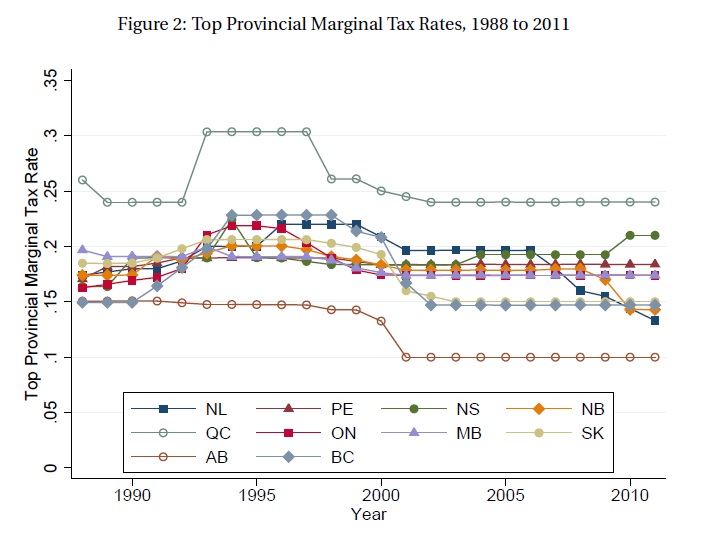
In Part I of this series back in 2014, we looked at some academic research from Canada showing that the revenue-maximizing tax rate on the richest taxpayers was 27.5 percent. A key insight from that research is that high-income taxpayers have considerable control over the timing, level, and composition of their income (just like in […]
The Laffer Curve and Limits to Class Warfare Tax Policy, Part II
The economic value of eliminating cancer
14 Apr 2026 Leave a comment
in applied price theory, applied welfare economics, econometerics, economic history, health economics Tags: life expectancies
This paper estimates the economic value to the United States of eliminating cancer mortality over a 35-year horizon beginning in 2030, which would eliminate 30.7 million cancer deaths with a total mortality burden of 380 million life-years. We quantify the economic value of this substantial reduction in cancer mortality by incorporating the monetized value of…
The economic value of eliminating cancer
The Happiness Crash of 2020
13 Apr 2026 Leave a comment
in applied price theory, econometerics, economic history, technological progress
From the still-active Sam Peltzman: I document a sudden, sharp and historically unprecedented decline in self-reported happiness in the US population. It occurred during 2020, the year of the Covid pandemic, and mainly persists through 2024. This happiness crash spread across nearly all typical demographics and geographies. The happiest groups pre-Covid (e.g., whites, high income,…
The Happiness Crash of 2020
The CA Minimum Wage Increase: Summing Up
06 Apr 2026 1 Comment
in applied price theory, econometerics, economics of regulation, income redistribution, labour economics, labour supply, politics - USA, Public Choice, unemployment
Two recent joint-papers Did California’s Fast Food Minimum Wage Reduce Employment? by Clemens, Edwards and Meer and The Effects of California’s $20 Fast Food Minimum Wage on Prices by Clemens, Edwards, Meer and Nguyen give what I think is a plausible and consistent account of California’s $20 fast food minimum wage. California’s $20 fast food…
The CA Minimum Wage Increase: Summing Up


Recent Comments