“Climate activism has become the new religion of the 21st century – heretics are not welcome and not allowed to ask questions,” says astrophysicist Willie Soon. But data manipulation, or tampering, is rife. Most climate models over-predict warming, while natural variations continue. – – – Temperature records used by climate scientists and governments to build […]
‘Very Bizarre’: Scientists Expose Major Problems With Climate Change Data
‘Very Bizarre’: Scientists Expose Major Problems With Climate Change Data
06 Mar 2024 Leave a comment
in econometerics, energy economics, environmental economics, global warming Tags: climate alarmism
#globalwarming
05 Mar 2024 Leave a comment
in econometerics, economic history, energy economics, environmental economics, global warming Tags: climate activists, climate alarmism
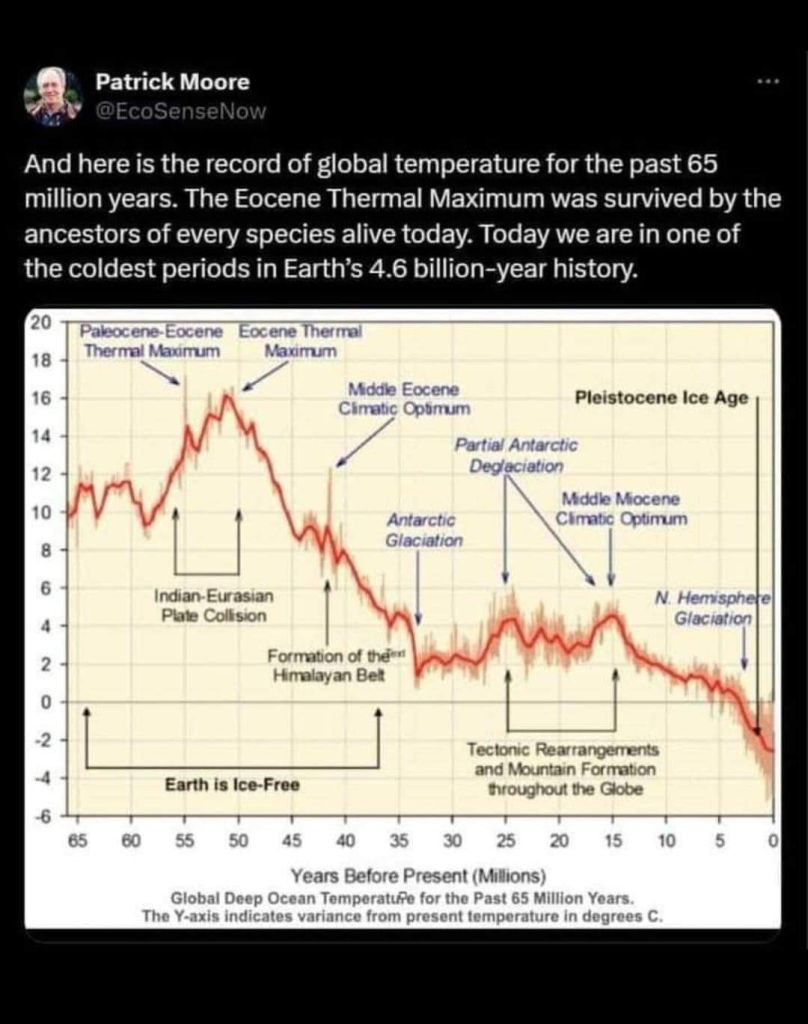
IPCC’s New “Hockey Stick” Temperature Graph
02 Mar 2024 Leave a comment
in econometerics, economic history, energy economics, environmental economics, global warming Tags: climate alarmism

The United Nations’ Intergovernmental Panel on Climate Change (IPCC) published their latest assessment report (AR6) in 2021. In 2023, the Clintel Foundation published a report which criticizes AR6.
IPCC’s New “Hockey Stick” Temperature Graph
ROBERT MacCULLOCH: Former PM Hipkins & Profs Bloomfield & Baker should be held accountable for quoting statistics that have now been shown to be wrongly estimated
27 Feb 2024 1 Comment
in applied welfare economics, econometerics, economic history, economics of regulation, health economics, politics - New Zealand Tags: economics of pandemics
Why are we still talking about Covid when many countries – like the US – have moved on? Well the US economy is currently booming and ours is stuck in the mud. The reason has emerged over time. Although our response to the virus was to be commended in early 2020 when no-one knew what…
ROBERT MacCULLOCH: Former PM Hipkins & Profs Bloomfield & Baker should be held accountable for quoting statistics that have now been shown to be wrongly estimated
When it comes to lifetime earnings, the most important decision appears to be the choice of college major
25 Feb 2024 Leave a comment
in econometerics, economics of education, human capital, labour economics, labour supply, occupational choice, poverty and inequality Tags: College premium
See Choices and consequences in the real “game of life”: From falling in with “bad apples” to choosing a major, economists decipher how early decisions shape long-term outcomes by Jeff Horwich, Senior Economics Writer for the Federal Reserve Bank of Minneapolis. Excerpt:”The research on Minnesota students from Nath, Borovičková, and Leibert (discussed above) finds that while…
When it comes to lifetime earnings, the most important decision appears to be the choice of college major
Bari Weiss interviews Roland Fryer
22 Feb 2024 Leave a comment
in applied price theory, discrimination, econometerics, economic history, economics of crime, economics of education, human capital, labour economics, labour supply, law and economics, occupational choice, politics - USA, poverty and inequality Tags: academic bias, crime and punishment, free speech, law and order, political correctness, racial discrimination, regressive left
A lot of readers and heterodox colleagues have sent me this link to Bari Weiss’s interview with Harvard economics professor Roland G. Fryer, Jr., often accompanied by big encomiums. Despite my unwillingness to watch long videos, I did watch all 77 minutes of it. Unfortunately, I wasn’t mesmerized, or even much interested. There are interesting […]
Bari Weiss interviews Roland Fryer
Pay Transparency: What’s Good to Know?
15 Feb 2024 Leave a comment
in discrimination, econometerics, gender, human capital, labour economics, labour supply, occupational choice, poverty and inequality Tags: gender wage gap

In some countries, like Norway, your income tax forms are public information, so any one can look up what anyone else earns. In a US context, income is mostly considered to be private information, unless you are a public employee or an executive at a public company. Would it be a good thing to have…
Pay Transparency: What’s Good to Know?
T. C. Koopmans Demolishes the Phillips Curve as a Guide to Policy
12 Feb 2024 Leave a comment
in business cycles, econometerics, economic history, history of economic thought, macroeconomics, monetary economics
Nobel Laureate T. C. Koopmans wrote one of the most famous economics articles of the twentieth century, “Measurement Without Theory,” a devastating review of an important, and in many ways useful and meritorious, study of business cycles by two of the fathers of empirical business-cycles research, Arthur F. Burns and Wesley C. Mitchell, Measuring Business […]
T. C. Koopmans Demolishes the Phillips Curve as a Guide to Policy
What’s the Right Interest Rate for the Fed Anyway?
08 Feb 2024 Leave a comment
in business cycles, econometerics, economic growth, inflation targeting, labour economics, macroeconomics, monetary economics, unemployment Tags: monetary policy
Standard models watched by economists at the Federal Reserve and elsewhere suggest that rates should now be lowerBy Justin Lahart of The WSJ. Excerpt:”So where should rates be? There has been a lot of focus recently on the long-term neutral rate—the just-right level of rates for when inflation is at the Fed’s 2% target, and…
What’s the Right Interest Rate for the Fed Anyway?
The Conway speech
08 Feb 2024 Leave a comment
in budget deficits, business cycles, econometerics, economic growth, economic history, economics of bureaucracy, fiscal policy, inflation targeting, labour economics, macroeconomics, monetary economics, politics - New Zealand, Public Choice, unemployment Tags: monetary policy
I’ve been rather tied up with other stuff for the last few weeks (including here) which is why I’ve not previously gotten round to writing about the first piece of monetary policy communications from our Reserve Bank this year. That was the “speech” by the Bank’s chief economist (and MPC) member Paul Conway given to […]
The Conway speech
Two model-observation comparisons confirm: CMIP6 models run too hot
03 Feb 2024 Leave a comment
in econometerics, energy economics, environmental economics, global warming Tags: climate alarmism

By Frank Bosse and Nic Lewis A recent article by Roy Spencer was (strongly) criticized by Gavin Schmidt over at “Real Climate”. In the summary Gavin S. wrote: “Spencer’s shenanigans are designed to mislead readers about the likely sources of any discrepancies and to imply that climate modelers are uninterested in such comparisons – and…
Two model-observation comparisons confirm: CMIP6 models run too hot
*The Case Against Education* Makes the WSJ
01 Feb 2024 Leave a comment
in applied price theory, econometerics, economics of education, economics of information, human capital, labour economics, labour supply, occupational choice, poverty and inequality Tags: screening, signaling

Douglas Belkin, who has an admirably adversarial publication record on higher ed, spotlights my The Case Against Education in his latest piece in The Wall Street Journal:One result of this transactional attitude has been a sharp increase in cheating. College is one of the few products whose consumers try to get as little out of…
*The Case Against Education* Makes the WSJ
Global Warming: Observations vs. Climate Models
27 Jan 2024 1 Comment
in econometerics, economic history, energy economics, environmental economics, global warming Tags: climate alarmism

By Paul Homewood Roy Spencer has written a long, detailed critique of climate models: https://www.heritage.org/environment/report/global-warming-observations-vs-climate-models The full report is worth reading, but his key graph and conclusions are below:
Global Warming: Observations vs. Climate Models
Andrew Montford: Does the Climate Change Committee understand the energy storage problem?
26 Jan 2024 Leave a comment
in econometerics, energy economics, environmental economics, global warming
We need to know.
Andrew Montford: Does the Climate Change Committee understand the energy storage problem?
A congestion theory of unemployment fluctuations
17 Jan 2024 Leave a comment
in business cycles, econometerics, economic history, history of economic thought, job search and matching, labour economics, labour supply, macroeconomics, monetary economics, unemployment
Yusuf Mercan, Benjamin Schoefer, and Petr Sedláček, newly published in American Economic Journal: Macroeconomics. I best liked this excerpt from p.2, noting that “DMP” refers to the Nobel-winning Diamond-Mortensen-Pissarides search model of unemployment: This congestion mechanism improves the business cycle performance of the DMP model considerably. It raises the volatility of labor market tightness tenfold, […]
A congestion theory of unemployment fluctuations
 Utopia, you are standing in it!
Recent Comments