Energy consumption in New Zealand
04 Dec 2015 Leave a comment
in economic history, energy economics, environmental economics, politics - New Zealand
Is Paris the end of fossil fuel era?
04 Dec 2015 Leave a comment
in economic history, energy economics, environmental economics, global warming Tags: climate alarmism, Fossil Fuels, global warming, nuclear power, renewable energy, solar energy, wind power
Creative destruction in cameras
04 Dec 2015 Leave a comment
in economic history, economics of media and culture, entrepreneurship, technological progress Tags: cameras, creative destruction, entrepreneurial alertness, smart phones
@350 @GreenpeaceUSA want to keep poor countries in energy poverty
03 Dec 2015 Leave a comment
in development economics, economic history, energy economics, environmentalism, growth miracles
The supply of facial hair over the centuries
03 Dec 2015 Leave a comment
in economic history, economics of media and culture Tags: fashions
"Frequencies in whisker forms" — a history of men's facial hair: thesocietypages.org/socimages/2015… http://t.co/PfDZSoVBtH—
(@SocImages) April 25, 2015
@cjsbishop @NZGreens Are fossil fuels a good investment? @GreenpeaceNZ @RusselNorman
03 Dec 2015 Leave a comment
in economic history, energy economics, environmental economics, environmentalism, financial economics
Creative destruction in computing
02 Dec 2015 Leave a comment
in economic history, economics, economics of media and culture, entrepreneurship Tags: creative destruction, Moore's law
The modern macroeconomics of the Global Financial Crisis
02 Dec 2015 Leave a comment
in applied price theory, budget deficits, business cycles, economic growth, economic history, economics of regulation, Euro crisis, fiscal policy, global financial crisis (GFC), great depression, great recession, macroeconomics, monetary economics Tags: adverse selection, bank panics, bank runs, banking crises, deposit insurance, economics central banks, financial crises, moral hazard, sovereign defaults
Is promoting R&D New Zealand’s path to prosperity?
02 Dec 2015 Leave a comment
in applied price theory, applied welfare economics, comparative institutional analysis, economic growth, economic history, entrepreneurship, industrial organisation, macroeconomics Tags: creative destruction, endogenous growth theory, entrepreneurial alertness, innovation, international technology diffusion
Michael Reddell was right to run his sceptical eye over the enthusiasm of the New Zealand government for promoting local R&D. Politicians are obsessed with boffins in lab coats who invent thing rather than the entrepreneurs who risk import technologies and adapt them to local markets.
New Zealand is a technology follow-up. 99% of global R&D is undertaken abroad. The key innovation policy question for New Zealand is how to adopt those technologies rather than how to invent them.
https://img.quozio.com/img/a6dd47b6/1025/The-fraction-of-US.jpg
Appropriate institutions and distance for the global technological frontier
As technology followers such as New Zealand approach the global technological frontier, the institutions appropriate for continued productivity growth change.
As a country moves closer to the global technological frontier, the impact of each successive technology import will decline. The latest imported technology is usually a smaller and smaller upgrade on before. A more skilled workforce and greater entrepreneurship is needed to squeeze out all of the available productivity and product quality gains from the latest imported technologies.
The institutions appropriate to further growth are context-dependent
The political, tax and regulatory institutions that favour the more ready-made implementation of more standardised imported technologies do not necessarily favour the growing demand for the domestic innovations in New Zealand as the global technological frontier nears. There is a growing demand for more highly skilled workers to master and adapt the leading-edge technologies to the distinctive circumstances of each New Zealand workplace to stay ahead in rapidly changing competitive environments and meet the changing needs of customers.
Productivity growth is not manna from heaven. Every increase in productivity and in product quality and variety are the sum of many inventions that must be first discovered by prospective innovators building on past ideas and developed, tested, adopted and adapted by profit-minded entrepreneurs and workers. Investments in R&D, in human capital and in on-the job learning and in the entrepreneurial judgments about risking investments in the new technologies that all underpin further growth in productivity are all influenced by public policies.
Moving from implementation-based to innovation-based policy regimes
As a country approaches the global technology frontier, continued technological imitation is no longer enough to keep productivity growing at the trend rate of two per cent per year. There must be an institutional switch from a technology implementation-based policy regime to an innovation-based policy regime.
The end by 1990 of the EU’s productivity convergence on the USA has been partly attributed to not making the policy shift from technology implementation enhancing institutions to innovation enhancing institutions. EU members invested far less than the USA in R&D and tertiary education had more rigid labour and product markets, had less entry and exit of firms, and much higher taxes.
Institutions must adapt to distance from the technological frontier
As a country approaches the global technology frontier, there must be younger firms, fewer incumbents, better educated workers, more R&D, more entry and exit, more flexible product and labour markets and lower taxes. These dynamic entrepreneurial features were not common-place in pre-1984 New Zealand.
New Zealand too had to switch to institutions that enhanced innovation and entrepreneurial entry just to return to growing at the global trend rate of 2 per cent per year. The political, tax and regulatory institutions appropriate prior to 1973 when New Zealand was a colonial farm for the UK are different to the institutions that are growth-enhancing in a less sheltered economic environment. There is no reason to suppose that the rising burden of knowledge and product proliferation has in any way ebbed to lighten the pressure for continued reform.
The institutional foundations of prosperity and stagnation
Questions about greater prosperity of New Zealand must be correctly posed and should focus on the fundamental causes of productivity growth rather than the proximate causes. The proximate causes of productivity and prosperity are the accumulation of more human and physical capital and technological progress.
Institutions are the fundamental cause of prosperity and cross-country differences in per capita incomes. Institutions determine the incentives and constraints on working, learning and investing, and influence, in a profound way, investments in physical and human capital and R&D and the importing of new technologies. It is premature to conclude that the national institutions and policies of OECD member countries are fairly similar and that the institutional differences that they do have are minor in their impact on respective national productivity and income levels.
There have been periods of prosperity, divergence, depression, recovery, catch-up and no catch-up at difference times in OECD member countries and usually for country-specific reasons. These large changes in fortune are not by chance. The differences in policy that gave rise to these divergences in income levels and extended periods of prosperity and stagnation should be open to analysis so that policy improvements can be discovered for possible application in New Zealand.

The Productivity Hub is a partnership of agencies which aims to improve how policy can contribute to the productivity performance of the New Zealand economy and the wellbeing of New Zealanders. The Hub Board is made up of representatives from the Productivity Commission, the Ministry of Business, Innovation and Employment, Statistics New Zealand and the Treasury
The Productivity Hub yesterday hosted a symposium in Wellington with the title “Growing more innovative and productive Kiwi firms”. “Growing” things is usually something gardeners do – people doing stuff to things. So the title perhaps carried somewhat unfortunate connotations of successful firms being the products of government action. That probably wasn’t their intention, at least not wholly, but then again it wasn’t entirely out of line with the list of attendees – 161 names, of whom at least 150 would have been bureaucrats, academics, and the like. There appeared to be only a very…
View original post 2,243 more words
The role of the six-day working week in Japanese sexism and the gender wage gap
02 Dec 2015 Leave a comment
in applied price theory, discrimination, economic history, economics, economics of love and marriage, gender, human capital, labour economics, occupational choice, personnel economics Tags: asymmetric marriage premium, compensating differentials, entrepreneurial alertness, gender wage gap, marital division of labour
When I was studying in Japan, they were at the end of phasing out working on Saturdays. The staff at my university work on Saturday mornings for four hours and then went home.
The Japanese working week was reduced by law from 48 to 44 hours per week in 1988 and to 40 hours per week from 1993 (Prescott 1999; Hayashi and Prescott 2002). The Japanese stopped routinely working on Saturdays over the 1990s. The number of national holidays was increased by three and an extra day of annual leave was also prescribed by law.
While feuding with strangers on an unrelated matter about the gender wage gap, it somehow occurred to me that the six-day working week might have something to do with what is on the face of a large amount of sexism in Japan and a large gender wage gap.
That feud with strangers was about unconscious bias as a driver of the gender wage gap in New Zealand. The gender wage gap Japan is attributed to conscious prejudice.
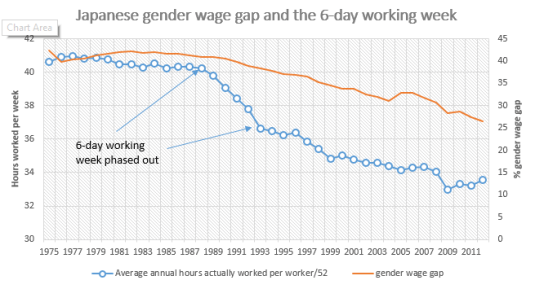
Source: OECD Stat.
In the above chart I have plotted the average weekly hours worked of Japanese workers and the Japanese gender wage gap. Two things can be noticed from the above chart:
- there is a sharp reduction in the number of hours worked per week by Japanese workers when they stopped working on Saturdays; and
- the gender wage gap started declining after the introduction of a five-day working week in Japan.
In a country where it is standard to work six days a week, the price of motherhood would be much higher than in other countries industrialised countries that phased out the 48-hour week decades previous. The asymmetric marriage premium would also be much higher if one partner to the marriage worked a six-day week while the other looked after the children.
Other drivers of the gender wage gap that arise from human capital specialisation and depreciation and from the differences of a few years in the marrying ages of men and women would be intensified if people worked another day per week. The payoff from a marital division of labour and human capital specialisation where one worked long hours and the other focused on investing in human capital that allow them to care for the children and move in and out of the workforce with less human capital depreciation would be much larger.
Much is made of the distinctiveness of Japanese culture and its sexism. In my time in Japan, the thing I notice most distinctively about Japanese culture was its extraordinary pragmatism and willingness to change rapidly. The Japanese economic miracle was founded on rapid industrialisation, innovation and repeated renewal of human capital. That requires an entrepreneurial spirit and open-mindedness.
Cultural and preference based explanations of the gender wage Including that in Japan underrate the rapid social change in the role of women in the 20th century in all countries in all cultures. As Gary Becker explains:
… major economic and technological changes frequently trump culture in the sense that they induce enormous changes not only in behaviour but also in beliefs. A clear illustration of this is the huge effects of technological change and economic development on behaviour and beliefs regarding many aspects of the family.
Attitudes and behaviour regarding family size, marriage and divorce, care of elderly parents, premarital sex, men and women living together and having children without being married, and gays and lesbians have all undergone profound changes during the past 50 years. Invariably, when countries with very different cultures experienced significant economic growth, women’s education increased greatly, and the number of children in a typical family plummeted from three or more to often much less than two.
A good explanation of this rapid social change is in Timur Kuran’s “Sparks and Prairie Fires: A Theory of Unanticipated Political Revolutions” and “Now Out of Never: The Element of Surprise in the East European Revolution of 1989“.
Kuran suggests that political revolutions and large shifts in political opinion will catch us by surprise again and again because of people’s readiness to conceal their true political preferences under perceived social pressure:
People who come to dislike their government are apt to hide their desire for change as long as the opposition seems weak. Because of the preference falsification, a government that appears unshakeable might see its support crumble following a slight surge in the opposition’s apparent size, caused by events insignificant in and of themselves.
Kuran argues that everyone has a different revolutionary threshold where they reveal their true beliefs, but even one individual shift to opposition leads to many others to come forward and defy the existing order. Small concessions embolden the ground-swell of revolution.
Those ready to oppose social intolerance or who are lukewarm in their intolerance keep their views private until a coincidence of factors gives them the courage to bring their views into the open. They find others share their views and there is a revolutionary bandwagon effect.
Plenty of people have had personal experiences of this in the 1980s and the 1990s when there were rapid changes in social and political attitudes about racism, sexism and gay rights. This includes Japan.
In the case of the Japanese gender wage gap, the move from a six-day to a five-day working week radically changed the asymmetric marriage premium and the payoff from investing in both specialised human capital and in human capital that depreciates quickly when away from work.
This large shift in incentives to work and invest in human capital would embolden a change in social attitudes. This is because the previous views were no longer profitable and many would gain from the change. Others who prefer just to go along with crowd would quickly follow them in to stay in tune with whatever is now popular.
Much of Japanese sexism may be the preference falsification that was low-cost when there was a six-day working week. The move to a five-day working week greatly increased the cost of that sexism and the profits from finding new ways of organising the workplace that better matched motherhood and career in Japan.
Undervalued workers are an untapped business opportunity for more alert entrepreneurs to hire these undervalued workers. In the case of Japan, with a five-day working week, hiring women for jobs that involved considerable investment in firm-specific human capital became more profitable. Previously under a six-day working week it was more profitable to invest in men because they undertook few childcare responsibilities. Under a five-day working week, that payoff matrix favours women more than in the past.
Long-term political forecasts should not be based on demographics alone
02 Dec 2015 Leave a comment
in economic history, politics - USA, Public Choice
Australian and New Zealand detrended real GDP growth, PPP, 1956 – 2014
01 Dec 2015 Leave a comment
in economic growth, economic history, macroeconomics, politics - Australia, politics - New Zealand
I have updated my estimates of Australian and New Zealand detrended real GDP growth for the 2014 working age population statistics from the OECD. The charts show:
- the lost decades of New Zealand growth between 1974 and 1992;
- the return of trend growth between 1992 and 2007 but no rebounding to recover lost ground;
- the effects of the global financial crisis in Australia and New Zealand; and
- a return to trend growth in New Zealand since about 2010 but not in Australia.
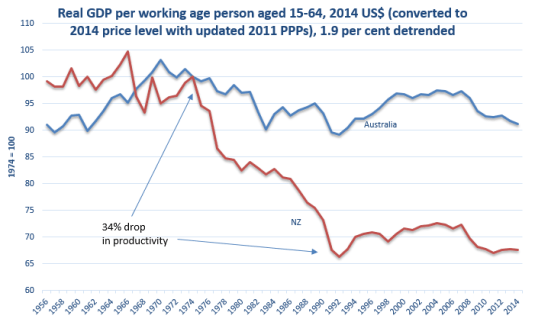
Source: Computed from OECD Stat Extract and The Conference Board. 2015. The Conference Board Total Economy Database™, May 2015, http://www.conference-board.org/data/economydatabase/
The real GDP data in the above chart is detrended by 1.9% per annum. 1.9% growth per year is the trend real GDP growth rate of the USA in the 20th century. The growth rate of the USA is taken as the growth rate of the global technological frontier. A flat line in the above chart is real GDP growth at 1.9% per year. A falling line is real GDP growth in that year of less than 1.9%; a rising line is growth that is greater than 1.9% in that year.
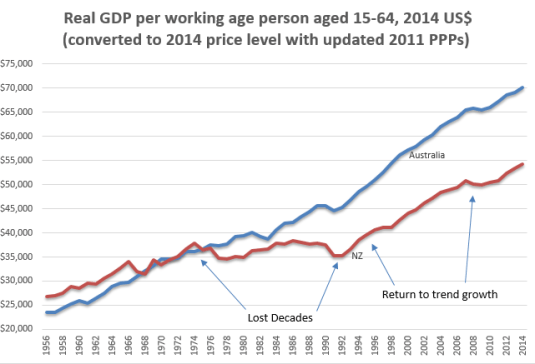
Source: Computed from OECD Stat Extract and The Conference Board. 2015. The Conference Board Total Economy Database™, May 2015, http://www.conference-board.org/data/economydatabase/


About 101 billion people have lived & died
30 Nov 2015 Leave a comment
in economic history, population economics Tags: Population demographics
About 101 billion people have lived & died
fivethirtyeight.com/features/what-… http://t.co/Rk4j6Q8HRl—
Conrad Hackett (@conradhackett) October 17, 2015


Recent Comments