Parliament debates the Sustainable Development Goals today. But how did the MDGs fare? bit.ly/1gbcH6W http://t.co/r12PKVmPzK—
Commons Library (@commonslibrary) September 10, 2015
How did the MDGs fare?
27 Sep 2015 Leave a comment
in comparative institutional analysis, constitutional political economy, development economics, economic history, growth disasters, growth miracles Tags: do gooders, MDG, ODA, overseas aid, United Nations
Aggregate New Zealand European human capital of graduates, 1981-2001
26 Sep 2015 Leave a comment
in economic history, gender, human capital, labour economics, labour supply, politics - New Zealand Tags: female labour force participation, graduate premium, male labour force participation, postgraduate premium, reversing gender gap
There was rapid growth in the human capital of graduates and postgraduates in New Zealand between 1981 and 2001 according to the census data. The growth in female human capital was particularly rapid and especially so at the postgraduate level.
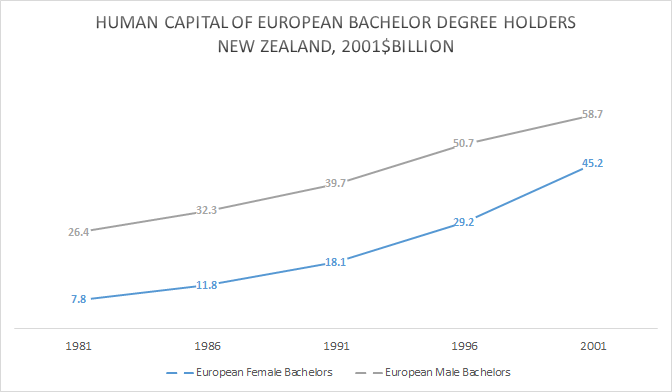
Source: Lˆe Thi. Vˆan Tr`ınh, Estimating the monetary value of the stock of human capital for New Zealand, thesis submitted in partial fulfilment of the requirements for the Degree of Doctor of Philosophy at the University of Canterbury (September 2006).
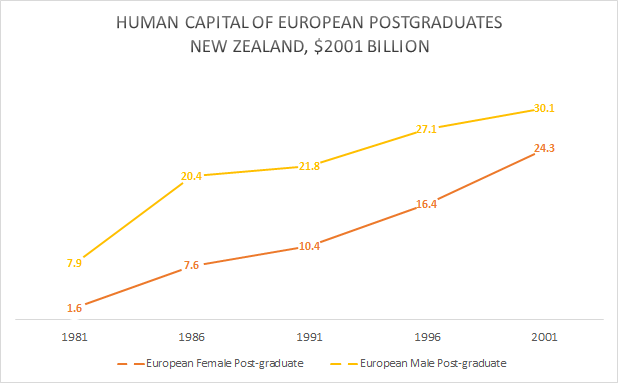
Source: Lˆe Thi. Vˆan Tr`ınh, Estimating the monetary value of the stock of human capital for New Zealand, thesis submitted in partial fulfilment of the requirements for the Degree of Doctor of Philosophy at the University of Canterbury (September 2006).
Cross-sectional versus lifetime inequality in the UK
26 Sep 2015 Leave a comment
in economic history, economics of education, human capital, labour economics, poverty and inequality Tags: British economy
Why inequality is actually much lower in Britain than it at first seems economist.com/blogs/freeexch… http://t.co/uwjqsfan6A—
Charles Read (@EconCharlesRead) September 23, 2015
The decline of the traditional British family
26 Sep 2015 Leave a comment
in economic history, economics of love and marriage Tags: British economy, British history, British politics, economics of fertility, economics of the family, family demographics, marriage and divorce, single families, single mothers
https://twitter.com/ONS/status/624500831023407104/photo/1
Almost half of all babies (47.5%) are now born outside marriage/civil partnership ow.ly/PDqCi http://t.co/aVqG1GAqMA—
(@ONS) July 15, 2015
Roads of the Roman Empire
25 Sep 2015 Leave a comment
in economic history, transport economics Tags: Roman empire
Roads of the Roman Empire
– http://t.co/o0dU4dyF71—
Amazing Maps (@Amazing_Maps) July 14, 2015
The Great Fact in China
25 Sep 2015 Leave a comment
in development economics, economic history, growth disasters, growth miracles Tags: China, The Great Fact
In 1980, the average American was 42x wealthier than the average Chinese. Now it's 4x wapo.st/1j6YcDc http://t.co/7afGdDf6mp—
Ana Swanson (@AnaSwanson) September 22, 2015
Will the standard policy response to a labour market crisis reduce inequality?
24 Sep 2015 2 Comments
in applied price theory, applied welfare economics, economic history, economics of bureaucracy, economics of education, human capital, labour economics, occupational choice, poverty and inequality, Public Choice Tags: assortative mating, asymmetric marriage premium, College premium, economics of higher education, economics of schooling, economics of universities, graduate premium, marriage and divorce, power couples, university premium
Whenever there is a crisis in the labour market, the standard policy response is send them on a course. That makes you look like you care and by the time they graduate the problem will probably fixed itself. Most problems do. I found this bureaucratic response to labour market crises to repeat itself over and over again while working in the bureaucracy.
Inequality – What can be done?
Stefan Thewissen reviews Tony Atkinson’s book
bit.ly/1h0KDDF http://t.co/KiiGgFQJau—
Max Roser (@MaxCRoser) September 27, 2015
The standard policy response to a normal problem in the labour market is send them on a course. Clever geeks as yourself sitting at your desk as a policy analysis or minister did well at university. You assume others will as well including those who have neither the ability or aptitude to succeed in education. Lowering university tuition fees and easing the terms of student loans simply means that those who do well at university will not have to pay back as much to the government. People who succeed at university already have above average IQs so they already had a good head start in life.
Will more education decrease inequality? A simulation provided an answer. nyti.ms/1xw5m9W http://t.co/paQp19BEWc—
The Upshot (@UpshotNYT) March 31, 2015
The standard solution to growing inequality is to send people on a course. Trouble is that just make smart people wealthier without helping the not so smart and increases the chance of smart men and women marrying off together. This increases the inequality between power couples and the rest.
Are the rich getting richer in the USA?
24 Sep 2015 Leave a comment
in economic history, politics - USA, poverty and inequality Tags: Occupy Wall Street, top 1%
https://twitter.com/Mark_J_Perry/status/646427815693434880/photo/1
We hear a lot about rising income inequality but Census data show it's been stable for 20 yrs
aei.org/publication/th… http://t.co/Cb2u0j97fv—
Mark J. Perry (@Mark_J_Perry) September 22, 2015

Is this evidence of the great stagnation?
24 Sep 2015 Leave a comment
in applied price theory, economic history, entrepreneurship, industrial organisation, survivor principle, technological progress Tags: creative destruction, great stagnation, The Great Enrichment
Are today's young Americans the luckiest generation in history? ow.ly/R425e @Mark_J_Perry @AEIdeas http://t.co/8lHZNkq1Ak—
AEI on Campus (@AEIonCampus) August 18, 2015
Real GDP per working age British, Dane and Swede 1950 – 2012, PPP
24 Sep 2015 Leave a comment
in economic history Tags: British disease, British economy, Common market, customs unions, Denmark, European Union, Margaret Thatcher, Sweden, Swedosclerosis
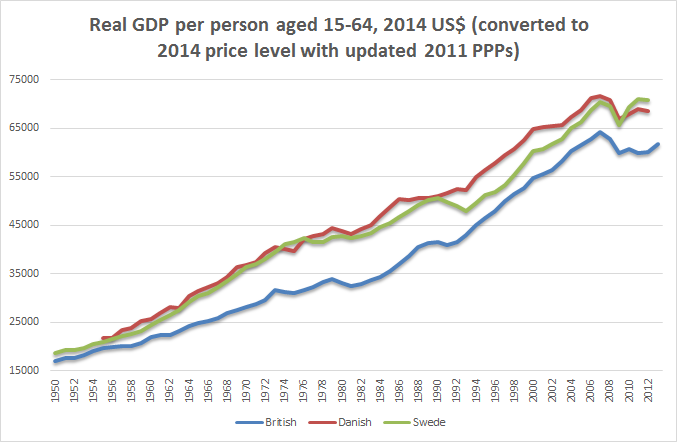
Source: Computed from OECD StatExtract and The Conference Board. 2015. The Conference Board Total Economy Database™, May 2015, http://www.conference-board.org/data/economydatabase/
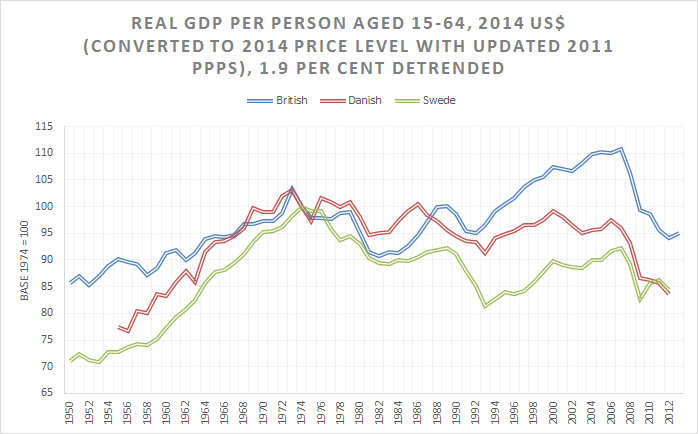
Source: Computed from OECD StatExtract and The Conference Board. 2015. The Conference Board Total Economy Database™, May 2015, http://www.conference-board.org/data/economydatabase/
The data is detrended at 1.9% per year – the trend rate of growth for the USA in the 20th century. A rising line means growth greater than 1.9% for that year, a falling line means growth of less than 1.9% for the year. A flat line is growth of 1.9% for that year.
Britain, Sweden and Denmark all grew quickly up until the 1970s in a period known as post-war catch up.In the 1970s and early 1980s, there was the British disease. The 1970s to the early 1990s was Swedosclerosis. There was a boom in the British economy subsequent to the economics of Mrs Thatcher.
Pope Francis versus The Great Fact
23 Sep 2015 Leave a comment
in applied price theory, development economics, economic history, growth disasters, growth miracles, Marxist economics Tags: capitalism and freedom, Catholic Church, extreme poverty, global poverty, Pope Francis, The Great Fact
Most powerful defense of #capitalism by @DeirdreMcClosk ow.ly/Swgsg
@JimPethokoukis @AEIecon @PrudentiaMag http://t.co/sznhzAl2TS—
AEI on Campus (@AEIonCampus) September 22, 2015
How can we eradicate #poverty by 2030? @Winnie_Byanyima wef.ch/1QvSVPW #development http://t.co/reBsT24BU3—
World Economic Forum (@wef) September 24, 2015


Recent Comments