Improvements in life expectancy since 1900
15 Jun 2015 Leave a comment
in economic history, environmental economics, health economics Tags: anti-vaccination movement, antiscience left, conspiracy theories, conspiracy theorists, life expectancy, Quacks, The Great Escape
The average American woman now weighs as much as the average 1960s man
14 Jun 2015 Leave a comment
in economic history, politics - USA, poverty and inequality Tags: economics of physiology, family poverty, obesity, The Great Escape


Milton Friedman on the essence of the Age of the Worker
13 Jun 2015 Leave a comment
in applied price theory, applied welfare economics, economic growth, economic history, health and safety, income redistribution, industrial organisation, labour economics, labour supply, macroeconomics, Milton Friedman, occupational choice, politics - Australia, politics - New Zealand, politics - USA, Public Choice, rentseeking, unions Tags: competition and monopoly, The Great Enrichment, union power, union wage premium
The Great Escape is increasing life expectancy at all ages
13 Jun 2015 Leave a comment
in economic history, health economics Tags: life expectancy, The Great Escape
It is not only about child mortality.
Life expectancy increased at all ages.bit.ly/1yM33gk http://t.co/MqKJVi3SmL—
Max Roser (@MaxCRoser) June 11, 2015
#Inequality of Life Expectancy fell rapidly over the course of modernity.
(From: bit.ly/1KMkukr) http://t.co/MvU071l0GX—
Max Roser (@MaxCRoser) June 11, 2015
The Nordics use optimal tax theory to fund their welfare states
12 Jun 2015 Leave a comment
in applied price theory, economic history, politics - USA, Public Choice, public economics Tags: Denmark, growth of government, Norway, optimal tax theory, Scandinavia, size of government, Sweden, welfare state
Efficient taxes gather more revenue and therefore are capable of funding a larger public sector with less political resistance from groups who are net taxpayers. The so-called neoliberal reforms of the 1980s and 1990s actually saved the welfare state by putting it on a revenue raising structure that provoked less political resistance.
A switch to more efficient taxes through tax reforms allows governments to raise the same amount or larger amount of revenue for the same level of political resistance from taxpayers. This is because less revenue and output is wasted by discouraging labour supply, investment, savings and investment in capital with high marginal rates of tax on narrower tax basis. Everyone gains from converging on more efficient modes redistribution.
The Nordic countries have been on to this application of optimal tax theory to expanding the size of government and the welfare state for a long time. The Nordics have high but flat taxes on labour income, low taxes on business income and a high, broad-based consumption tax be it called a VAT or GST as illustrated by a just published Tax Foundation report.
To begin with, the USA has a smaller government because it relies more income taxes than on consumption taxes.

Governments in Europe switched towards consumption taxes such as the VAT or GST because this allowed them to raise a large amount of revenue with broad-based taxes at low rates. A VAT or GST exempts exports and business to business transactions from taxes so that reduced taxpayer resistance.
Scandinavian income taxes raise much more revenue than in the USA because they are rather flat. That is, they tax most people at these high rates, not just high-income taxpayers. The top tax rate in the Scandinavian countries cuts in at about one and a half times average income or less rather than eight times average income as in the USA.
Flat high tax "How do Scandinavian countries pay for their govt spending?" bit.ly/1KZ7jOs @JimPethokoukis http://t.co/33oRg8Ozqh—
Old Whig (@aClassicLiberal) June 11, 2015
The marginal income tax rates including this top income tax rate cuts in a low level of income is also rather high in the Nordic countries relative to the USA’s top income tax rate with the exception of Norway.

Nonetheless the Nordic countries are alert to not killing the goose that laid the golden egg. Company taxes are relatively low in Scandinavian countries as compared to the USA so that businesses do not flee to other jurisdictions.

Top marginal tax rates on dividends and capital gains are not above-average in the Nordic states but their taxes on less mobile tax bases such as from labour and consumption are much higher.

A large welfare state such as those in the Nordic countries require a significant amount of revenue, so the tax base in these countries must be broad. This also means higher taxes on consumption through the VAT or GST and higher taxes on middle-income taxpayers.
Business taxes are a less reliable source of revenue because of capital flight and disincentives to invest. Thus, the Nordics do not place above-average tax burdens on capital income and focus taxation on labour and consumption.
via Sources of Government Revenue across the OECD, 2015 | Tax Foundation and How Scandinavian Countries Pay for Their Government Spending | Tax Foundation.
TIL America Online is still in business
12 Jun 2015 Leave a comment
in economic history, entrepreneurship, industrial organisation, survivor principle Tags: creative destruction, entrepreneurial alertness, market selection
After 18 years of acquisitions, sales, and spinoffs, AOL is still holding its own bloom.bg/1IwBaQp http://t.co/Qjwd94THPB—
Bloomberg VisualData (@BBGVisualData) May 17, 2015
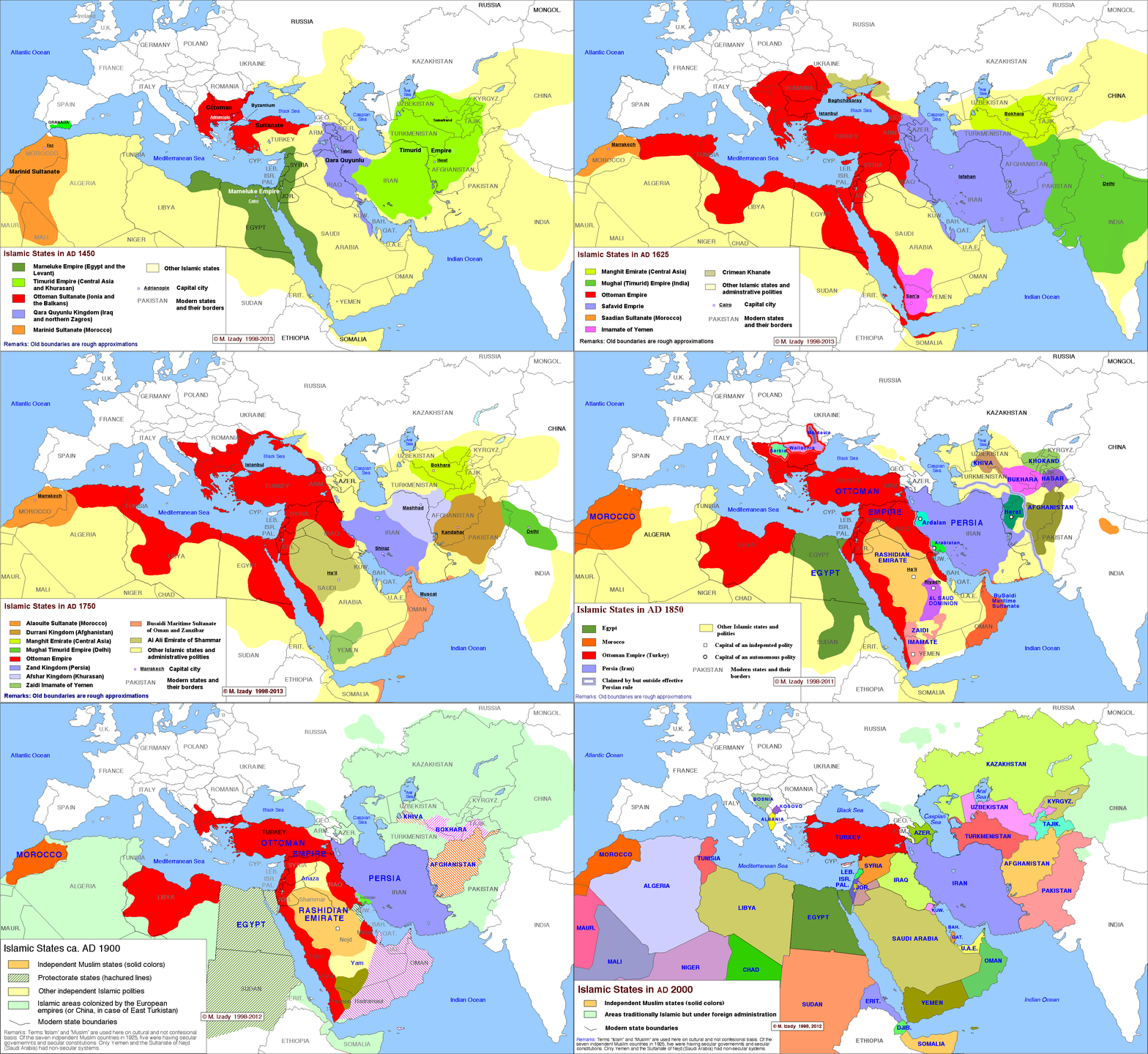
The Islamic states of the world, from 1450 to today
12 Jun 2015 Leave a comment
in economic history, war and peace Tags: colonisation, Eastern Europe, Islam, middle-east, Muslim empires
The Cook Islands became part of New Zealand today, 1901
11 Jun 2015 Leave a comment
in economic history, politics - New Zealand Tags: British empire, colonialism, Cook Islands
On 11 June 1901 the boundaries of the colony of New Zealand were extended by the UK to include the Cook Islands. http://t.co/BDPElzZovz—
History Facts 247 (@historyfacts247) June 11, 2015
Have the mass kidnappings extended to Oxfam and other principled ODA activists?
11 Jun 2015 Leave a comment
in applied welfare economics, development economics, economic history, growth disasters, growth miracles, politics - Australia, politics - New Zealand, politics - USA Tags: extreme poverty, global poverty, Left-wing hypocrisy, The Great Enrichment, The Great Escape, The Great Fact
Oxfam and other ODA activists should be dancing in the streets to celebrate the doubling of global median income in the last 10 years.
This is awesome news!!
Global median income has doubled(!) over the last 10 yearsNew paper: bit.ly/1JRwv90 http://t.co/4cq6x5pXpu—
Max Roser (@MaxCRoser) May 17, 2015
The only reason for them not doing this as they must have been kidnapped en mass.
Staggering #inequality: Top 1% will own 50% of world's wealth by 2016. Help us to #EvenItUp! http://t.co/NcNOqVcTgS—
Oxfam International (@Oxfam) March 20, 2015
We can only hope for their safe release.
Securing a just world means challenging the power of the 1% say civil society groups #WSF2015 oxf.am/ZfkL http://t.co/r2S0lkBoC2—
Oxfam New Zealand (@oxfamnz) March 23, 2015
Lower prices for oil/other commodities have intensified the slowdown in dev'ing countries wrld.bg/O9hq8 #GEP http://t.co/2IsmedNmgW—
World Bank Pubs (@WBPubs) June 11, 2015
Composition of the bottom 40% of the population in #LAC countries: wrld.bg/NkKZP #sharedprosperity http://t.co/MdublHSp59—
World Bank Pubs (@WBPubs) June 09, 2015
The extreme poor live in conflict & rural areas: wrld.bg/Nynge #endpoverty http://t.co/43HDDI11JR—
World Bank (@WorldBank) May 31, 2015
Once were British
11 Jun 2015 Leave a comment
in development economics, economic history, law and economics, property rights, Public Choice Tags: age of empires, British empire, British imperialism, colonialism
Territories that were once part of the British Empire http://t.co/4EyAtGRZyJ—
Amazing Maps (@Amazing_Maps) March 15, 2015
Sir Humphrey was right on why Britain entered the common market in 1973? Real GDP growth per working age British and French, PPP, detrended, 1950 – 2013
11 Jun 2015 Leave a comment
in economic growth, economic history, fiscal policy, global financial crisis (GFC), macroeconomics, monetarism, monetary economics Tags: British disease, British economy, Eurosclerosis, France, Margaret Thatchernomics, sick man of Europe
Figure 1: Real GDP per British and French aged 15-64, converted to 2013 price level with updated 2005 EKS purchasing power parities, 1.9 per cent detrended, 1950-2013
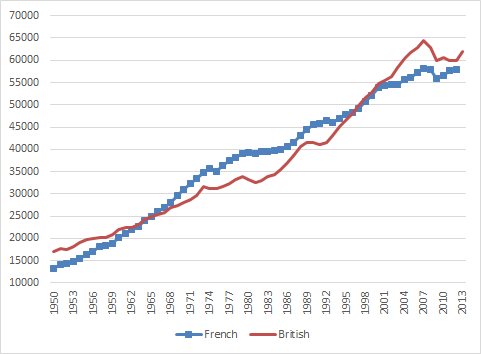
Source: Computed from OECD Stat Extract and The Conference Board, Total Database, January 2014, http://www.conference-board.org/economics
Figure 2: Real GDP per British and French aged 15-64, converted to 2013 price level with updated 2005 EKS purchasing power parities, 1.9 per cent detrended, base 100 = 1974, 1950-2013
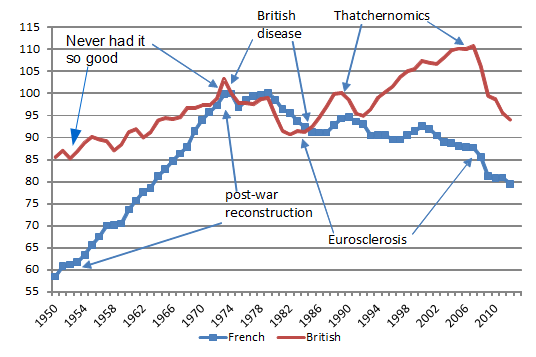
Source: Computed from OECD Stat Extract and The Conference Board, Total Database, January 2014, http://www.conference-board.org/economics
In figure 2, a flat line represents annual real GDP growth at a rate of 1.9%, which is the trend rate of annual growth of the USA in the 20th century. A rising line means annual growth at above that trend rate; a falling line means annual growth at below that trend rate of 1.9% per year.
Divorces and marriages in Britain since 1900
10 Jun 2015 Leave a comment
Divorces and marriages in #Britain since 1900
(From: bit.ly/1v0QB8l ) http://t.co/pJHYtjPfWv—
Max Roser (@MaxCRoser) May 10, 2015
The US share market since 1900
10 Jun 2015 Leave a comment
in business cycles, economic growth, economic history, entrepreneurship, financial economics, macroeconomics Tags: active investing, efficient market hypothesis, entrepreneurial alertness, passive investing
Here’s how Warren Buffett sees the stock market read.bi/1HsUe1p http://t.co/Zm6fDTYpf9—
BI Chart of the Day (@chartoftheday) April 23, 2015
Vintage McDonald’s Advertisement
10 Jun 2015 Leave a comment
in economic history, entrepreneurship Tags: economics of advertising, entrepreneurial alertness, McDonald's
Vintage McDonald’s Advertisements in the 1960s http://t.co/XnKaW8Burn—
History Pics (@HistoryPixs) February 24, 2014


Recent Comments