http://t.co/l7NzR1byNF—
EPI Chart Bot (@epichartbot) April 27, 2015
http://t.co/VZTp2A0H8n—
EPI Chart Bot (@epichartbot) April 05, 2015
Celebrating humanity's flourishing through the spread of capitalism and the rule of law
03 May 2015 1 Comment
in economic growth, economic history, labour economics, labour supply, politics - USA, welfare reform Tags: middle-class wage stagnation, top 1%, US welfare reforms, wage stagnation
http://t.co/l7NzR1byNF—
EPI Chart Bot (@epichartbot) April 27, 2015
http://t.co/VZTp2A0H8n—
EPI Chart Bot (@epichartbot) April 05, 2015
03 May 2015 Leave a comment
in economic history, economics of religion Tags: Christianity
Share of all Christians living in
Europe
1910 66%
2050 16%SS Africa
1910 1%
2050 38%pewresearch.org/fact-tank/2015… http://t.co/yZWG9X25Qz—
Conrad Hackett (@conradhackett) April 26, 2015
03 May 2015 2 Comments
in economic growth, economic history, entrepreneurship, macroeconomics, Public Choice, public economics Tags: British disease, British economy, Margaret Thatcher, poor man of Europe, Sweden, Swedosclerosis, taxation and the labour supply, welfare state
In 1970, Sweden was labelled as the closest thing we could get to Utopia. Both the welfare state and rapid economic growth – twice as fast as the USA for the previous 100 years.
Of course the welfare state was more of a recent invention. Assar Lindbeck has shown time and again in the Journal of Economic Literature and elsewhere that Sweden became a rich country before its highly generous welfare-state arrangements were created
Sweden moved toward a welfare state in the 1960s, when government spending was about equal to that in the United States – less that 30% of GDP.
Sweden could afford to expand its welfare state at the end of the era that Lindbeck labelled ‘the period of decentralization and small government’. Swedes in the 60s had the third-highest OECD per capita income, almost equal to the USA in the late 1960s, but higher levels of income inequality than the USA.
By the late 1980s, Swedish government spending had grown from 30% of gross domestic product to more than 60% of GDP. Swedish marginal income tax rates hit 65-75% for most full-time employees as compared to about 40% in 1960. What happened to the the Swedish economic miracle when the welfare state arrived?
In the 1950s, Britain was also growing quickly, so much so that the Prime Minister of the time campaigned on the slogan you never had it so good.

By the 1970s, and two spells of labour governments, Britain was the sick man of Europe culminating with the Winter of Discontent of 1978–1979. What happened?

Sweden and Britain in the mid-20th century are classic examples of Director’s Law of Public Expenditure. Once a country becomes rich because of capitalism, politicians look for ways to redistribute more of this new found wealth. What actually happened to the Swedish and British growth performance since 1950 relative to the USA as the welfare state grew?
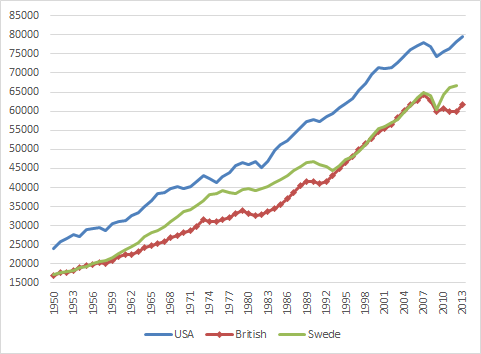
Figure 1: Real GDP per Swede, British and American aged 15-64, converted to 2013 price level with updated 2005 EKS purchasing power parities, 1950-2013, $US
Source: Computed from OECD Stat Extract and The Conference Board, Total Database, January 2014, http://www.conference-board.org/economics
Figure 1 is not all that informative other than to show that there is a period of time in which Sweden was catching up with the USA quite rapidly in the 1960s. That then stopped in the 1970s to the late 1980s. The rise of the Swedish welfare state managed to turn Sweden into the country that was catching up to be as rich as the USA to a country that was becoming as poor as Britain.
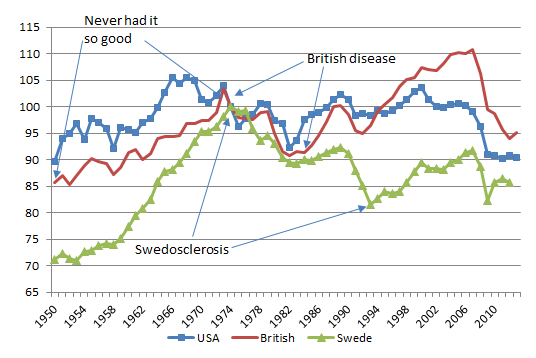
Figure 2: Real GDP per Swede, British and American aged 15-64, converted to 2013 price level with updated 2005 EKS purchasing power parities, detrended, 1.9%, 1950-2013
Source: Computed from OECD Stat Extract and The Conference Board, Total Database, January 2014, http://www.conference-board.org/economics
Figure 2 which detrends British and Swedish growth since 1950 by 1.9% is much more informative. The US is included as the measure of the global technological frontier growing at trend rate of 1.9% in the 20th century. A flat line indicates growth at 1.9% for that year. A rising line in figure 2 means above-trend growth; a falling line means below trend growth for that year. Figure 2 shows the USA growing more or less steadily for the entire post-war period. There were occasional ups and downs with no enduring departures from trend growth 1.9% until the onset of Obamanomics.
Figure 2 illustrates the volatility of Swedish post-war growth. There was rapid growth up until 1970 as the Swedes converged on the living standards of Americans. This growth dividend was then completely dissipated.
Swedosclerosis set in with a cumulative 20% drop against trend growth. The Swedish economy was in something of a depression between 1970 and 1990. Swedish economists named the subsequent economic stagnation Swedosclerosis:
Prescott’s definition of a depression is when the economy is significantly below trend, the economy is in a depression. A great depression is a depression that is deep, rapid and enduring:
There is no significant recovery during the period in the sense that there is no subperiod of a decade or longer in which the growth of output per working age person returns to rates of 2 percent or better.
The Swedish economy was not in a great depression between 1970 and 1990 but it meets some of the criteria for a depression but for the period of trend growth between1980 and 1986.
Between 1970 and 1980, output per working age Swede fell to 10% below trend. This happened again in the late 80s to the mid-90s to take Sweden 20% below trend over a period of 25 years.
Some of this lost ground was recovered after 1990 after tax and other reforms were implemented by a right-wing government. The Swedish economic reforms from after 1990 economic crisis and depression are an example of a political system converging onto more efficient modes of income redistribution as the deadweight losses of taxes on working and investing and subsidies for not working both grew.
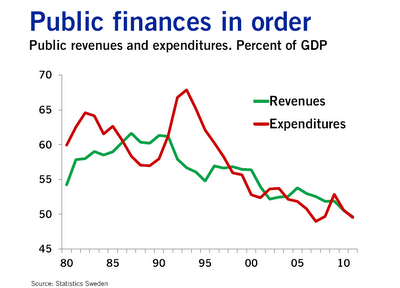
The Swedish economy since 1950 experienced three quite distinct phases with clear structural breaks because of productivity shocks. There was rapid growth up until 1970; 20 years of decline – Swedosclerosis; then a rebound again under more liberal economic policies.
The sick man of Europe actually did better than Sweden over the decades since 1970. The British disease resulted in a 10% drop in output relative to trend in the 1970s, which counts as a depression.

There was then a strong recovery through the early-1980s with above trend growth from the early 1980s until 2006 with one recession in between in 1990. So much for the curse of Thatchernomics?
After falling behind for most of the post-war period, the UK had a better performance compared with other leading countries after the 1970s.
This continues to be true even when we include the Great Recession years post-2008. Part of this improvement was in the jobs market (that is, more people in work as a proportion of the working-age population), but another important aspect was improvements in productivity…
Contrary to what many commentators have been writing, UK performance since 1979 is still impressive even taking the crisis into consideration. Indeed, the increase in unemployment has been far more modest than we would have expected. The supply-side reforms were not an illusion.
John van Reenen goes on to explain what these supply-side reforms were:
These include increases in product-market competition through the withdrawal of industrial subsidies, a movement to effective competition in many privatised sectors with independent regulators, a strengthening of competition policy and our membership of the EU’s internal market.
There were also increases in labour-market flexibility through improving job search for those on benefits, reducing replacement rates, increasing in-work benefits and restricting union power.
And there was a sustained expansion of the higher-education system: the share of working-age adults with a university degree rose from 5% in 1980 to 14% in 1996 and 31% in 2011, a faster increase than in France, Germany or the US. The combination of these policies helped the UK to bridge the GDP-per-capita gap with other leading nations.
03 May 2015 Leave a comment
in applied welfare economics, development economics, economic history, growth disasters, growth miracles Tags: capitalism and freedom, The Great Enrichment, The Great Escape, The Great Fact
Behold: The most important economic chart in Western civilization. ow.ly/Moa2h @JimPethokoukis http://t.co/s1lzl1HLb9—
(@AEI) May 01, 2015
02 May 2015 Leave a comment
in economic history, economics of media and culture, environmental economics, health economics Tags: agricultural economics, Anti-Science left, GMOs, Leftover Left, quackery
01 May 2015 Leave a comment
in economic history, macroeconomics, monetary economics, politics - USA Tags: gold standard, New Deal, regime uncertainty, rule of law
30 Apr 2015 Leave a comment
in economic history Tags: economics of language, English, Shakespeare
30 Apr 2015 Leave a comment
Maldives http://t.co/dPgTJRNDk9—
Nature Discovered (@NatureDiscovere) April 29, 2015
30 Apr 2015 Leave a comment
in economic history, entrepreneurship, technological progress Tags: creative destruction, entrepreneurial alertness, technology diffusion, The Great Enrichment


via The 100-Year March of Technology in 1 Graph – The Atlantic and Guess What’s the Fastest-Adopted Gadget of the Last 50 Years – The Atlantic..
30 Apr 2015 Leave a comment
in applied welfare economics, economic history, energy economics, environmental economics, resource economics Tags: Julian Simon, Paul Ehrlich, Paul Sabin
30 Apr 2015 Leave a comment
in economic history, energy economics, environmentalism, resource economics Tags: commodity prices, Julian Simon, Paul Ehrlich
A 2011 blog post of mine on "the bet" rogerpielkejr.blogspot.com/2011/10/cornuc…
Attached a bigger bin of commodities & bet dates in red http://t.co/SC6HeuRwys—
Roger Pielke Jr. (@RogerPielkeJr) April 29, 2015
30 Apr 2015 Leave a comment
in economic history, entrepreneurship Tags: entrepreneurial alertness, megaprojects
On the plus side, #1WTC is not the only large-scale construction project that ran over budget. forbes.com/sites/niallmcc… http://t.co/JYRwnE0M5T—
Statista (@StatistaCharts) December 10, 2014
30 Apr 2015 Leave a comment
in economic history, economics of media and culture, economics of regulation, economics of religion, political change, politics - USA Tags: expressive voting, preference falsification
This is how fast America changed its mind on the biggest social issues bloom.bg/1DIk6PQ http://t.co/RjAiw0y2dV—
Bloomberg Business (@business) April 27, 2015
29 Apr 2015 Leave a comment
in applied price theory, applied welfare economics, behavioural economics, econometerics, economic history, economics of information Tags: cognitive biases, cognitive psychology, data mining, economics of persuasion, evidence-based policy
Politicians & statistics. My proposal in today's @FT : ft.com/cms/s/0/dcf46a… http://t.co/HYbV4V2ps2—
Jonathan Portes (@jdportes) January 26, 2015
28 Apr 2015 Leave a comment
in economic history, politics - USA, Public Choice, public economics Tags: conspiracy theories, Leftover Left, neoliberalism, taxation in the labour supply, top 1%
How much does each income group pay in taxes? bit.ly/1JHSCik by @aplundeen http://t.co/B66ynsUrkc—
Tax Foundation (@taxfoundation) April 14, 2015
The U.S. Income Tax system is progressive bit.ly/1FG9Usm by @aplundeen http://t.co/HXDWbvv1xy—
Tax Foundation (@taxfoundation) April 15, 2015
Celebrating humanity's flourishing through the spread of capitalism and the rule of law
Celebrating humanity's flourishing through the spread of capitalism and the rule of law
Celebrating humanity's flourishing through the spread of capitalism and the rule of law
Celebrating humanity's flourishing through the spread of capitalism and the rule of law
Celebrating humanity's flourishing through the spread of capitalism and the rule of law
Celebrating humanity's flourishing through the spread of capitalism and the rule of law
A History of the Alt-Right
Econ Prof at George Mason University, Economic Historian, Québécois
Celebrating humanity's flourishing through the spread of capitalism and the rule of law
Scholarly commentary on law, economics, and more
Beatrice Cherrier's blog
Celebrating humanity's flourishing through the spread of capitalism and the rule of law
Celebrating humanity's flourishing through the spread of capitalism and the rule of law
Celebrating humanity's flourishing through the spread of capitalism and the rule of law
Why Evolution is True is a blog written by Jerry Coyne, centered on evolution and biology but also dealing with diverse topics like politics, culture, and cats.
Celebrating humanity's flourishing through the spread of capitalism and the rule of law
A rural perspective with a blue tint by Ele Ludemann
DPF's Kiwiblog - Fomenting Happy Mischief since 2003
Celebrating humanity's flourishing through the spread of capitalism and the rule of law
The world's most viewed site on global warming and climate change
Tim Harding's writings on rationality, informal logic and skepticism
A window into Doc Freiberger's library
Let's examine hard decisions!
Commentary on monetary policy in the spirit of R. G. Hawtrey
Thoughts on public policy and the media
Celebrating humanity's flourishing through the spread of capitalism and the rule of law
Politics and the economy
A blog (primarily) on Canadian and Commonwealth political history and institutions
Reading between the lines, and underneath the hype.
Economics, and such stuff as dreams are made on
"The British constitution has always been puzzling, and always will be." --Queen Elizabeth II
Celebrating humanity's flourishing through the spread of capitalism and the rule of law
Celebrating humanity's flourishing through the spread of capitalism and the rule of law
WORLD WAR II, MUSIC, HISTORY, HOLOCAUST
Undisciplined scholar, recovering academic
Celebrating humanity's flourishing through the spread of capitalism and the rule of law
Res ipsa loquitur - The thing itself speaks
In Hume’s spirit, I will attempt to serve as an ambassador from my world of economics, and help in “finding topics of conversation fit for the entertainment of rational creatures.”
Researching the House of Commons, 1832-1868
Articles and research from the History of Parliament Trust
Reflections on books and art
Posts on the History of Law, Crime, and Justice
Celebrating humanity's flourishing through the spread of capitalism and the rule of law
Exploring the Monarchs of Europe
Cutting edge science you can dice with
Small Steps Toward A Much Better World


Recent Comments