Thomas Sowell on the Vulgar Pride of Intellectuals
27 Mar 2018 Leave a comment
in applied price theory, applied welfare economics, comparative institutional analysis, constitutional political economy, development economics, discrimination, economic history, economics of education, economics of regulation, labour economics Tags: Thomas Sowell
21 year-old LBJ forbad his Mexican students from speaking Spanish at school. He knew that learning English was central to their chances of escaping poverty
25 Mar 2018 Leave a comment
in economic history, economics of education
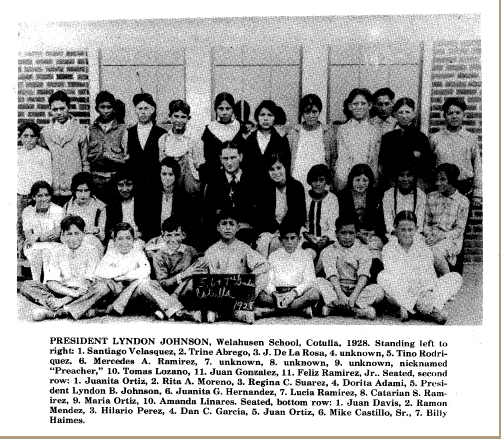
My first job after college was as a teacher in Cotulla, Tex., in a small Mexican-American school. Few of them could speak English, and I couldn’t speak much Spanish. My students were poor and they often came to class without breakfast, hungry. They knew even in their youth the pain of prejudice. They never seemed to know why people disliked them. But they knew it was so, because I saw it in their eyes. I often walked home late in the afternoon, after the classes were finished, wishing there was more that I could do. But all I knew was to teach them the little that I knew, hoping that it might help them against the hardships that lay ahead. Somehow you never forget what poverty and hatred can do when you see its scars on the hopeful face of a young child. I never thought then, in 1928, that I would be standing here in 1965. It never even occurred to me in my fondest dreams that I might have the chance to help the sons and daughters of those students and to help people like them all over this country.
From Special Message to the Congress: The American Promise
March 15, 1965
Is education worth it?
25 Mar 2018 Leave a comment
in economics of education, human capital, labour economics, managerial economics, organisational economics, personnel economics Tags: Bryan Caplan, signalling
Good division of skills and challenges
20 Mar 2018 Leave a comment
in applied price theory, applied welfare economics, economics of bureaucracy, economics of education, economics of marriage, occupational choice, Public Choice
The case against education (Part 1) – interview with Bryan Caplan
17 Mar 2018 Leave a comment
in applied price theory, economics of education, economics of information, human capital, industrial organisation, labour economics, labour supply, managerial economics, organisational economics, personnel economics Tags: Bryan Caplan, signalling
The growing ‘gender college degree gap’ favoring women
12 Mar 2018 Leave a comment
in economics of education, gender, human capital Tags: reverse gender gap
The real reason there aren’t more female scientists | FACTUAL FEMINIST
08 Mar 2018 Leave a comment
in discrimination, economics of education, gender, human capital, labour economics, occupational choice Tags: gender wage gap, reverse gender gap
How To Not Be Poor
08 Mar 2018 Leave a comment
in economics of education, economics of love and marriage, health economics, human capital, labour economics, occupational choice, poverty and inequality, unemployment, welfare reform Tags: child poverty, family poverty
Intersectional Feminism: What is it? | FACTUAL FEMINIST
23 Feb 2018 Leave a comment
in discrimination, economics of education, gender Tags: political correctness
Hillary Clinton on sexual assault issues: Crusader or hypocrite? | FACTUAL FEMINIST
23 Feb 2018 Leave a comment
in discrimination, economics of crime, economics of education, gender, law and economics, politics - USA Tags: 2016 presidential election, political correctness
Are gender specific toys a hazard to children? | FACTUAL FEMINIST
20 Feb 2018 Leave a comment
in discrimination, economics of education, gender, labour economics Tags: gender gap, political correctness
Is education worth it?
20 Feb 2018 Leave a comment
in applied price theory, economics of education, economics of information, human capital, labour economics, managerial economics, occupational choice, organisational economics, personnel economics Tags: signalling
Does @_chloeswarbrick believe @PPTAWeb betrays the working class? Are handmaidens of the bosses?
17 Feb 2018 Leave a comment
in economics of education, politics - New Zealand, unions
Unions fight for better playing conditions for their members. Is not that what the class war is all about? Unions are not there to act as management consultants to the employer, working out ways to make their wage slaves profitable – extract more labour surplus.
Please do not mention that the employer of teachers is the state sector. That is an argument against unions in the state sector, a very slippery slope.
When the interests of the union and it is teacher members and the interests of children conflict, the union will do what its mission is which is to protect its members.
The first jobs to be unionised were craft jobs. The craft unions certainly foster the marketability of their members but were keen to suppress competition nonetheless. To quote Charles Baird
Most unions in the private sector are in crafts and industries that have few companies or that are concentrated in one region of the country. This makes sense. Both factors—few employers and regionally concentrated employers—make organizing easier. Conversely, the large number of employers and the regional dispersion of employers sharply limit unionization in trade, services, and agriculture. A 2002 unionization rate of 37.5 percent in the government sector, more than four times the 8.5 percent rate in the private sector, further demonstrates that unions do best in heavily regulated, monopolistic environments. Even within the private sector, the highest unionization rates (23.8 percent) are in transportation (airlines, railroads, trucking, urban transit, etc.) and public utilities (21.8 percent), two heavily regulated industries.
Craft unions opposed unionisation of less skilled workers because it threatens their own ability to extract higher wages as explained in the Wikipedia entry:
The concept of organizing a strong federation on the basis of craft evolved out of conflict between the Knights of Labor (KOL), which organized mass organizations of unskilled, semiskilled and skilled workers by territory, and the American Federation of Labor (AFL), which organized only skilled workers.[1] The craft workers were capable of demanding more from their employers due to their skills, and therefore organized into stronger organizations pursuing narrower interests.[2] The AFL was formed as a direct result of the perceived need by skilled workers to defend their individual craft organizations from poaching by the Knights of Labor.[3] The Knights of Labor believed that skilled workers should dedicate their greater leverage to benefit all workers.[4] Selig Perlman wrote in 1923 that this resulted in “a clash between the principle of solidarity of labor and that of trade separatism.”[2] The trade unions “declared that their purpose was ‘to protect the skilled trades of America from being reduced to beggary’.”[5]… As long as the craft unions were the dominant power in the AFL, they took every step possible to block the organizing of mass production industries. This led to challenges from both inside and outside the Federation.
The craft unions such as teachers unions have more bargaining power because they are difficult to replace on short notice unlike less skilled workers. In addition, teachers are much more difficult to automate away. I am not too sure what the teachers union might think of giving more responsibility to teachers aides?


Recent Comments