Here are the choices of essay questions for the RES Economics Essay Competition for 2015 beta.tutor2u.net/economics/blog… http://t.co/iurHfRGOd9—
tutor2u Economics (@economicsuk) April 19, 2015
Essay questions for the Royal Economic Society Economics Essay Competition for 2015
19 Apr 2015 Leave a comment
in applied welfare economics, behavioural economics, economics of education, history of economic thought Tags: academic bias, British politics, UK politics
50% more R&D since the 60s, but still no growth dividend?
18 Apr 2015 1 Comment
in applied price theory, economic growth, economics of education, entrepreneurship, history of economic thought, human capital, industrial organisation, macroeconomics, occupational choice, survivor principle Tags: Ben Jones, Chad Jones, creative destruction, endogenous growth theory, innovation, R&D
Spending on intellectual property products has risen in the USA from 1% in 1950 to 5% now. Public R&D spending in the USA has been pretty static for 60 years. Intellectual property products in the chart below includes traditional research and development, spending on computer software, and spending on entertainment such as movies, TV shows, books, and music. Spending on software and entertainment was only recently measured in the US national accounts. This inclusion of intangible capital investments will radically change the story of economic growth and the business cycle in the 20th century.
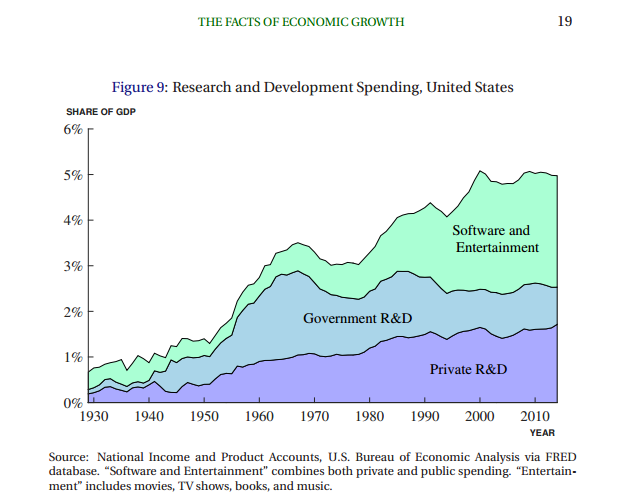
Source: Chad Jones (2015).
The growth rate in the USA hasn’t changed much despite this massive increase in intellectual property property product production. Is innovation getting harder? R&D is supposed to boost the growth rate, if you are to believe politicians bearing subsidies for it wherever they find it.
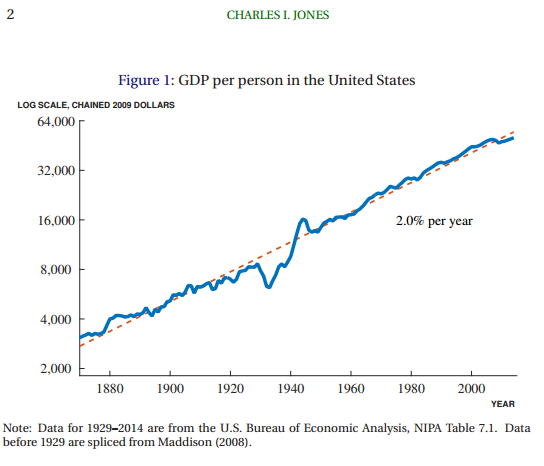
Source: Chad Jones (2015).
Ben Jones in The Burden of Knowledge and the Death of the Renaissance Man: Is Innovation Getting Harder? found that as knowledge accumulates as technology advances, successive generations of innovators may face an increasing educational burden. Innovators can compensate through lengthening their time in education and narrowing expertise, but these responses come at the cost of reducing individual innovative capacities. This has implications for the organization of innovative activity – a greater reliance on teamwork – and has negative implications for economic growth.
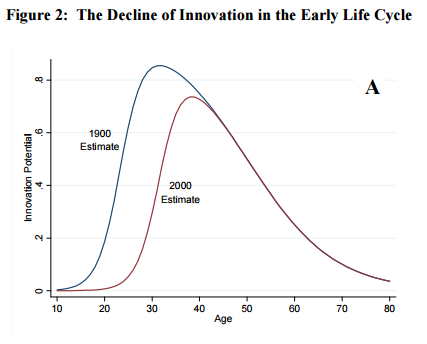
This longer period of education and initial study is not compensated by inventors innovating for longer spans of their lifestyle. This rising burden of knowledge is cutting into their best years of their lives. Jones found a broad and dramatic declines in early life-cycle productivity among great minds and ordinary inventors, and a close relationship of these trends with increased training duration.
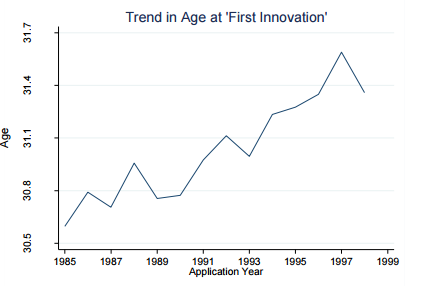
Jones found that the age at first invention, specialisation, and teamwork increased over time in a large micro-data set of inventors. Upward trends in academic collaboration and lengthening doctorates can also be explained in his framework of innovation getting harder because of a rising burden of knowledge. Co-authorship in academic literature has increased, including physics, biology, chemistry, mathematics, psychology, and economics. This measure of teamwork has increased 17% per decade.
Using data on Nobel Prize winners, Jones found that the mean age at which the innovations are produced to win the Prize has increased by 6 years over the 20th Century.
- Before 1901, two-thirds of the Nobel laureates did their prize-winning work before the age of 40 and 20 per cent did it before age of 30.
- By 2000, however, great achievements seldom occurred before the age of 40.
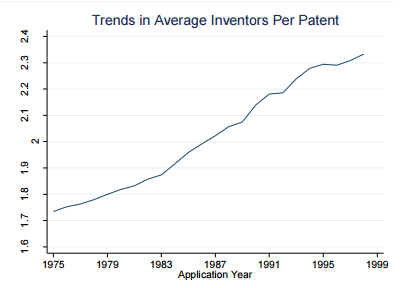
It’s now taking longer for scientists to get their basic training and start their careers. There is simply more to learn because knowledge in all fields has grown by quantum leaps in the past century. Nobels are being handed out for different types of work than a century ago.
- There has been a trend away from awarding prizes for abstract, theoretical ideas.
- Now more honours are being bestowed on people who have made discoveries through painstaking lab work and experimentation – which takes a lot of time to do.
Jones’ theory provides an explanation for why productivity growth rates did not accelerate through the 20th century despite an enormous expansion in collective research effort and levels of education and many more graduates. Innovation is getting harder?
Friedman’s 2nd Law –the government cannot give anything away: free public schools version
17 Apr 2015 Leave a comment
in economics of education, Public Choice, rentseeking

Teachers are pretty well paid in New Zealand
17 Apr 2015 Leave a comment
in economics of education, labour economics, labour supply, occupational choice Tags: teachers pay
How much are #teachers paid across the OECD area? bit.ly/1xuITVF @OECD_Edu http://t.co/YxPhDBuQ4K—
(@OECD) March 17, 2015
Becoming president is part of the college premium
16 Apr 2015 Leave a comment
in economics of education, politics - USA Tags: 2016 presidential election, College premium, graduate premium
These men lacked college degrees but they ran for president & guess what happened next …
pewresearch.org/fact-tank/2015… http://t.co/L05DXnSvtz—
Conrad Hackett (@conradhackett) March 29, 2015
There are big differences in educational attainment across Europe
16 Apr 2015 Leave a comment
in economics of education, human capital, labour economics, occupational choice Tags: educational attainment, Eurosclerosis
Ireland has the highest share of highly qualified 30-34 year olds in the EU http://t.co/LhZMvYcgj5—
Guardian Data (@GuardianData) September 26, 2014
New Zealand spends a lot in education for a pretty average education premium in return
15 Apr 2015 Leave a comment
in economics of education, human capital, labour economics Tags: College premium, education premium, graduate premium
#Education makes up 12.9% of public #spending in OECD area; how does your country compare? bit.ly/1ang3Rj http://t.co/cUgf7fnj8F—
(@OECD) April 13, 2015

@OECD More college grads nationally= a smaller wage premium for young workers bit.ly/1rJ8bz9 #highereducation http://t.co/IWjetA6znw—
Dr. Eugene Kowch (@ekowch) September 17, 2014
Finishing year 10 of high school was a very much a mid-20th century phenomenon
09 Apr 2015 Leave a comment
in economic history, economics of education, human capital, labour economics, occupational choice, politics - USA Tags: educational attainment
Difference in PISA scores of 15-year-old female and male students on reading literacy: 2012
06 Apr 2015 Leave a comment
in discrimination, economics of education, gender, human capital, labour economics, occupational choice Tags: reversing gender gap

via nces.ed.gov
Trends in bachelor degrees conferred on women since 1970
04 Apr 2015 Leave a comment
in discrimination, economics of education, gender, occupational choice Tags: compensating differentials, gender wage gap, reversing gender gap, STEM
A lot of women did information science in the 70s, close to 40% of all information science majors, then women moved away to invest in other majors. It would be laughable to suggest that information science was more welcoming to women in the 1970s but not now. Clearly, a third set of factors is at play unrelated to hostile working environments. Similarly, a large number of women did maths and statistics then that trend petered out in the 1980s.
Hillary Clinton says women earned 2x CS degrees in the '80s as today. Mostly True: politifact.com/truth-o-meter/… #dataviz http://t.co/Zg82d8ZfQh—
Randy Olson (@randal_olson) March 03, 2015
13% of American biology teachers should be fired
04 Apr 2015 2 Comments
in economics of education, labour economics, occupational choice, personnel economics Tags: creationism, Quacks
Bad #dataviz but interesting data -> 13% of US biology teachers advocate teaching Creationism: samuelwbennett.com/the-struggle/1… http://t.co/vmchwAQUsy—
Randy Olson (@randal_olson) March 07, 2015

The rising educational attainment of the poor
01 Apr 2015 Leave a comment
in economics of education, human capital, labour economics, labour supply, poverty and inequality, welfare reform Tags: educational attainment
@mattyglesias poverty trends a good example of why americanprogress.org/issues/poverty… http://t.co/tgn7RzBKzw—
Shawn Fremstad (@inclusionist) March 28, 2015
Has this gone out of style since I was at university, which was much later?
31 Mar 2015 Leave a comment
in economics of education, economics of media and culture Tags: campus days, The 60s
15 young women about to break the world record for passengers in a Mini, 1966. http://t.co/06H0V13wiM—
History In Pictures (@HistoryInPics) March 28, 2015
Check out the hairstyles and fashion.
Whitlam’s curse – How higher education drives inequality among the bottom 99%
30 Mar 2015 Leave a comment
in economics of education, human capital, labour economics, labour supply, occupational choice, politics - Australia, politics - USA Tags: David Autor, education premium, Gough Whitlam, top 1%
Gough Whitlam abolished tuition fees at Australian universities in 1972. The idea was to reduce inequality. He entrenched it instead, and gave a flying start to those of already above-average talents.
David Autor in a recent paper has illustrated how the gap between the highly educated and the less educated is growing at a far faster rate than the gap between the top 1% in the bottom 99% in the USA. David Autor argues that
a single minded focus on the top 1% can be counterproductive given that the changes to the other 99% have been more economically significant.

- since the early 1980s, the earnings gap between workers with a high school degree and those with a college education has become four times greater than the shift in income during the same period to the very top from the 99%.
- Between 1979 and 2012, the gap in median annual earnings between households of high-school educated workers and households with college-educated ones expanded from $30,298 to $58,249, or by roughly $28,000.
- If the incomes of the bottom 99% are grown at the same pace as the top 1% their incomes would have increased by $7000 per household.
Autor argues that the growth of skill differentials among the other 99% is more consequential than the rise of the 1% for the welfare of most citizens.

via How Education Drives Inequality Among the 99% – Real Time Economics – WSJ.
 Utopia, you are standing in it!
Recent Comments