I ask what is the point of passing an exam where there is widespread cheating, and in consequence the exam has little credibility. What is the point of holding an exam when there is widespread cheating?
If you seek to learn skills, cheating would be totally counter-productive. But if the exam simply produces a credential that people accept, students look for ways to get the credential as painlessly as possible.
Cheating works best if the signalling model of education is true. Students should cheat more in those courses that offer the least productivity gains.
Serious cheaters have been found to be more likely to be younger and have a lower grade point average. But as Alex Tabarrok argues
“I sometimes find evidence of cheating on exams but I rarely take action, I don’t have to. Almost invariably the cheaters get abysmally low grades even without penalty.
Some people I know get annoyed when students without evident handicap ask for and receive special treatment such as extra time on exams. I comply without rancor as the extra time never seems to help. Over the years I have had a number of students ask for incompletes. None have ever become completes.
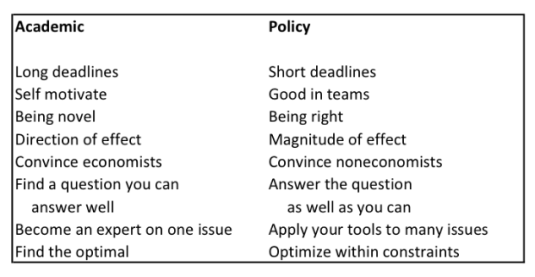
Academia rewards findings that are different and unexpected. In policy it is more important to be right than novel—after all, millions of lives may be impacted by a policy decision. In academia, people argue a lot about the direction of an effect but very little about the magnitude: in policy it’s the reverse…
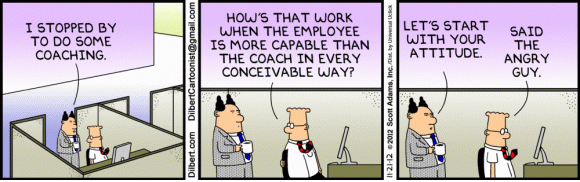
This seems to be a tension between the Dunning-Kruger effect on the principles of coaching as encompassed by its modern manifestation, non-directional coaching.
Under the modern fad of non-directional coaching, the coach asks open-ended questions which will elicit from the coached his or her own breakthroughs. Questions like what happened, what did you do then, is there another way will lead the student of the coach to reveal their knowledge within?
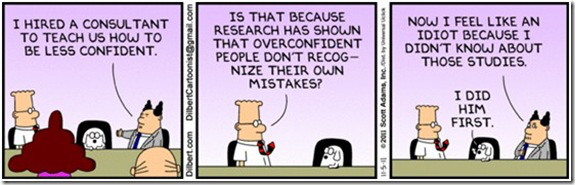
Psychologists David Dunning and Justin Kruger published a paper in which they described cognitive trait that quickly became known as the Dunning-Kruger effect. In a recent article, Dunning summarizes the effect as:
…incompetent people do not recognize—scratch that, cannot recognize—just how incompetent they are
What’s curious is that, in many cases, incompetence does not leave people disoriented, perplexed, or cautious.
Instead, the incompetent are often blessed with an inappropriate confidence, buoyed by something that feels to them like knowledge.
People who lack the skill to do something also lack the skill to recognise that they don’t know how to do it and to develop the skill how to do it. Dunning also points out:
An ignorant mind is precisely not a spotless, empty vessel, but one that’s filled with the clutter of irrelevant or misleading life experiences, theories, facts, intuitions, strategies, algorithms, heuristics, metaphors, and hunches that regrettably have the look and feel of useful and accurate knowledge.
I’m bad at spelling, grammar and proofreading my own work. To know how skilled or unskilled I am at using the rules of grammar, I must have a good working knowledge of those rules to start with the self-assessed myself as not been good at grammar. This is impossible for me to find out for myself because I don’t know the rules of grammar to tell me that I don’t know the rules of grammar and to what extent I don’t know the rules of grammar. I have succumbed to the Dunning-Kruger Effect
“The Dunning–Kruger effect is a cognitive bias in which unskilled people make poor decisions and reach erroneous conclusions, but their incompetence denies them the metacognitive ability to recognize their mistakes.
The unskilled therefore suffer from illusory superiority, rating their ability as above average, much higher than it actually is, while the highly skilled underrate their own abilities, suffering from illusory inferiority.
Actual competence may weaken self-confidence, as competent individuals may falsely assume that others have an equivalent understanding.
As Kruger and Dunning conclude, ‘the miscalibration of the incompetent stems from an error about the self, whereas the miscalibration of the highly competent stems from an error about others’. The effect is about paradoxical defects in cognitive ability, both in oneself and as one compares oneself to others.”
Poor performers fails to see the flaws in their thinking or the answers they lack. As Dunning explains:
A whole battery of studies conducted by myself and others have confirmed that people who don’t know much about a given set of cognitive, technical, or social skills tend to grossly overestimate their prowess and performance, whether it’s grammar, emotional intelligence, logical reasoning, firearm care and safety, debating, or financial knowledge.
College students who hand in exams that will earn them Ds and Fs tend to think their efforts will be worthy of far higher grades; low-performing chess players, bridge players, and medical students, and elderly people applying for a renewed driver’s license, similarly overestimate their competence by a long shot
Dunning and Kruger proposed that, for a given skill, incompetent people will:
fail to recognize their own lack of skill;
fail to recognize genuine skill in others;
fail to recognize the extremity of their inadequacy; and
recognize and acknowledge their own previous lack of skill, if they are exposed to training for that skill
Going back to my point about the modern trend in coaching of asking non-directive questions and open-ended questions and expecting the student to make their own breakthroughs, this contradicts the Dunning Kruger effect and the requirement that it be fixed through training. Coaching is not training; they are separate activities.
I was taught this non-directive coaching and went round the workplace asking questions of colleagues who are not economists using these open-ended questions of a coach. None of them made breakthroughs as a result of questions such as what happened, what happened then and other Socratic questions such as those below:
Conceptual clarification questions
Get them to think more about what exactly they are asking or thinking about. Prove the concepts behind their argument. Use basic ‘tell me more’ questions that get them to go deeper.
· Why are you saying that?
· What exactly does this mean?
· How does this relate to what we have been talking about?
· What is the nature of …?
· What do we already know about this?
· Can you give me an example?
· Are you saying … or … ?
· Can you rephrase that, please?
Probing assumptions
Probing their assumptions makes them think about the presuppositions and unquestioned beliefs on which they are founding their argument. This is shaking the bedrock and should get them really going!
· What else could we assume?
· You seem to be assuming … ?
· How did you choose those assumptions?
· Please explain why/how … ?
· How can you verify or disprove that assumption?
· What would happen if … ?
· Do you agree or disagree with … ?
Probing rationale, reasons and evidence
When they give a rationale for their arguments, dig into that reasoning rather than assuming it is a given. People often use un-thought-through or weakly-understood supports for their arguments.
· Why is that happening?
· How do you know this?
· Show me … ?
· Can you give me an example of that?
· What do you think causes … ?
· What is the nature of this?
· Are these reasons good enough?
· Would it stand up in court?
· How might it be refuted?
· How can I be sure of what you are saying?
· Why is … happening?
· Why? (keep asking it — you’ll never get past a few times)
· What evidence is there to support what you are saying?
· On what authority are you basing your argument?
Questioning viewpoints and perspectives
Most arguments are given from a particular position. So attack the position. Show that there are other, equally valid, viewpoints.
· Another way of looking at this is …, does this seem reasonable?
· What alternative ways of looking at this are there?
· Why it is … necessary?
· Who benefits from this?
· What is the difference between… and…?
· Why is it better than …?
· What are the strengths and weaknesses of…?
· How are … and … similar?
· What would … say about it?
· What if you compared … and … ?
· How could you look another way at this?
Probe implications and consequences
The argument that they give may have logical implications that can be forecast. Do these make sense? Are they desirable?
· Then what would happen?
· What are the consequences of that assumption?
· How could … be used to … ?
· What are the implications of … ?
· How does … affect … ?
· How does … fit with what we learned before?
· Why is … important?
· What is the best … ? Why?
Questions about the question
And you can also get reflexive about the whole thing, turning the question in on itself. Use their attack against themselves. Bounce the ball back into their court, etc.
…if the Americans of 100 years ago took today’s tests, they would have an average IQ of 70 – the recognised cut-off for people with intellectual disabilities. To put it another way, IQ has been rising at roughly three points per decade.
Why Evolution is True is a blog written by Jerry Coyne, centered on evolution and biology but also dealing with diverse topics like politics, culture, and cats.
In Hume’s spirit, I will attempt to serve as an ambassador from my world of economics, and help in “finding topics of conversation fit for the entertainment of rational creatures.”
“We do not believe any group of men adequate enough or wise enough to operate without scrutiny or without criticism. We know that the only way to avoid error is to detect it, that the only way to detect it is to be free to inquire. We know that in secrecy error undetected will flourish and subvert”. - J Robert Oppenheimer.








 Utopia, you are standing in it!
Recent Comments