The impact of neoliberalism on economic freedom in Argentina, Brazil, Chile and Venezuela since 1995
20 Jul 2015 Leave a comment
in applied price theory, applied welfare economics, comparative institutional analysis, development economics, economic history, economics of regulation, growth disasters, growth miracles Tags: Argentina, Brazil, Chile, conspiracy theories, Index of Economic Freedom, Leftover Left, Mont Pelerin Society, neoliberalism, Twitter left, Venezuela
All was quiet on the neoliberalism front in Latin America for the last 20 years. In yet another defeat for the Mont Pelerin Society led transnational conspiracy, economic freedom has been pretty stable in Chile for 20 years and in the serious decline in Venezuela and Argentina – see figure 1. Not much happening in Brazil either on the neoliberalism front – see figure 1. I’ve always had my doubts about the ability of a transnational conspiracy to be led by a society with such a crappy website.
Figure 1: Index of Economic Freedom, Argentina, Brazil, Chile and Venezuela, 95 – 2015
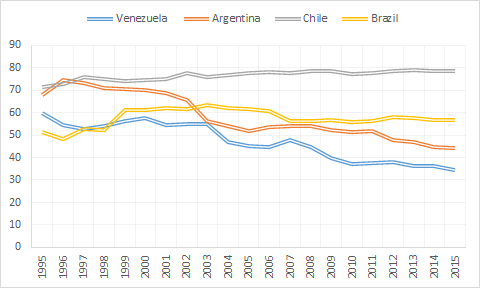
Source: Index of Economic Freedom 2015.

From wisdom to conviction – Paul Krugman on the Card–Kruger study of minimum wages (1998 and now)
18 Jul 2015 1 Comment
in economics of regulation, history of economic thought, labour economics, minimum wage, politics - USA, poverty and inequality Tags: evidence-based policy, living wage, Paul Krugman
This first screenshot is from the New York Times today of Paul Krugman’s current recollection of his interpretation of the Card – Kruger study of minimum wages in restaurants when that study was published all those years ago.
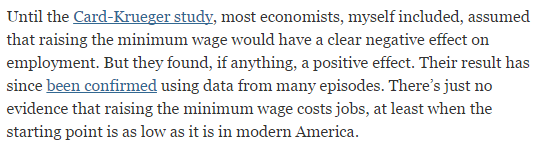
Paul Krugman in his review of Living Wage: What It Is and Why We Need It By Robert Pollin and Stephanie Luce in 1998 was far wiser.
So what are the effects of increasing minimum wages? Any Econ 101 student can tell you the answer: The higher wage reduces the quantity of labour demanded, and hence leads to unemployment. This theoretical prediction has, however, been hard to confirm with actual data.
Indeed, much-cited studies by two well-regarded labour economists, David Card and Alan Krueger, find that where there have been more or less controlled experiments, for example when New Jersey raised minimum wages but Pennsylvania did not, the effects of the increase on employment have been negligible or even positive.
Exactly what to make of this result is a source of great dispute. Card and Krueger offered some complex theoretical rationales, but most of their colleagues are unconvinced; the centrist view is probably that minimum wages “do,” in fact, reduce employment, but that the effects are small and swamped by other forces.
What is remarkable, however, is how this rather iffy result has been seized upon by some liberals as a rationale for making large minimum wage increases a core component of the liberal agenda–for arguing that living wages “can play an important role in reversing the 25-year decline in wages experienced by most working people in America” (as this book’s back cover has it).
Clearly these advocates very much want to believe that the price of labour–unlike that of gasoline, or Manhattan apartments–can be set based on considerations of justice, not supply and demand, without unpleasant side effects.
This will to believe is obvious in this book: The authors not only take the Card-Krueger results as gospel, but advance a number of other arguments that just do not hold up under examination.
The Card– Kruger results have gone from rather iffy in the mind of Paul Krugman to the basis of public policy that, if wrong, costs a lot of low paid workers their jobs. Krugman was well aware in 1998 what a risky path minimum wage increases were:
Now to me, at least, the obvious question is, why take this route? Why increase the cost of labour to employers so sharply, which–Card/Krueger notwithstanding–must pose a significant risk of pricing some workers out of the market, in order to give those workers so little extra income?
Why not give them the money directly, say, via an increase in the tax credit?
Studies of tiny increases in the minimum wage are being used to justify far larger increases in the minimum wage. Krugman was right to be suspect of that in 1998.
Venn Diagram: 1998 Paul Krugman v. 2015 Paul Krugman on the Minimum Wage tinyurl.com/q58ftug @WilliamOccam2 http://t.co/c4DdxqTvwK—
Mark J. Perry (@Mark_J_Perry) July 18, 2015
Krugman’s statements today in the New York Times about the low starting point in modern America for any minimum wage increases is still keeping that slightly cautious tone in his analysis. Few who read his analysis will carry that passing nuance into their own policy advocacy.
Paul Krugman in 1998 was quite astute as to why people want to believe the minimum wage can be increased without any cost to jobs:
One answer is political: What a shift from income supports to living wage legislation does is to move the costs of income redistribution off-budget. And this may be a smart move if you believe that America should do more for its working poor, but that if it comes down to spending money on-budget it won’t.
Indeed, this is a popular view among economists who favour national minimum-wage increases: They will admit to their colleagues that such increases are not the best way to help the poor, but argue that it is the only politically feasible option.
Nor in 1998 was Krugman blind to the expressive politics, the ideological blindness of those who advocate minimum wage increases and living wages:
But I suspect there is another, deeper issue here–namely, that even without political constraints, advocates of a living wage would not be satisfied with any plan that relies on after-market redistribution.
They don’t want people to “have” a decent income, they want them to “earn” it, not be dependent on demeaning hand-outs…
In short, what the living wage is really about is not living standards, or even economics, but morality. Its advocates are basically opposed to the idea that wages are a market price–determined by supply and demand, the same as the price of apples or coal.
It is most unwise to say there is no evidence of minimum wage increases causing unemployment. That sets a low bar of having to find only one or two studies to refute the claim:
1. Taking his claims as true, why do small businesses lobby against raising the minimum wage?
2. Why did Tom Holmes find in his seminal 1999 JPE paper that manufacturing clusters on the Right to Work Side of state borders and avoids the union side of the border?
3. Why did Erin Mansur and I find the same result in our 2013 paper where we build on Holmes’ paper and show that labour intensive manufacturing industries are even more likely to avoid the union side of the border as they are more likely to locate in the adjacent county in the Right to Work State?
4. The Card-Krueger study is certainly important but the variation they used to estimate their effect is tiny relative to the upcoming doubling of the minimum wage up to $15 in cities such as LA and San Fran. How is Dr. Krugman so sure that he can “extrapolate out of sample” to a policy that has never been tried before? Does he have a valid structural model that he can use to conduct such extreme policy counter-factuals?
Karl Popper would be proud of Krugman’s bold and risky prediction that strictly forbids the existence of any studies showing adverse unemployment effects of minimum wage increases.
The thing to remember is, if there is not doubt in the literature, if there are not some mixed results, the econometricians are simply not trying hard enough to win tenure, secure promotion and be published on the top journals.
Rent control and housing quality
18 Jul 2015 Leave a comment
in economics of regulation, politics - USA, urban economics Tags: expressive voting, offsetting behaviour, rational ignorance, rational irrationality, rent control, The fatal conceit, The pretence to knowledge, unintended consequences
Foodborne Illness and Plastic Bag Bans
18 Jul 2015 Leave a comment
in economics of regulation, health economics Tags: antimarket bias, expressive voting, killer green technologies, meddlesome preferences, nanny state, plastic bag bans, plastic bags, rational ignorance, rational irrationality
Where not to invest in Europe
18 Jul 2015 Leave a comment
in applied price theory, applied welfare economics, comparative institutional analysis, economics of bureaucracy, economics of regulation, industrial organisation, law and economics, property rights, Public Choice, rentseeking, survivor principle Tags: doing business, Eurosclerosis, Greece
Where not to invest in Europe: Greece econ.st/1TAd3CZ http://t.co/X9vtnz0uhQ—
The Economist (@EconBizFin) July 15, 2015
NAFTA v. the Common Market: trading across the French, German, Italian, British, Canadian and US borders – World Bank Doing Business rankings compared
17 Jul 2015 Leave a comment
in economics of regulation, industrial organisation, international economics, politics - USA Tags: border costs, British economy, Canada, Common market, Common markets, customs unions, EU, France, free trade areas, Germany, Italy, NAFTA, trade costs
Figure 1: World Bank Doing Business rankings and sub rankings for trading across the French, German, Italian, British, Canadian and US borders, 2014
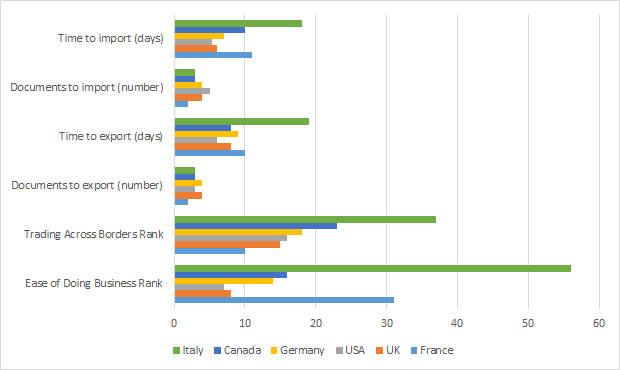
Source: World Bank Doing Business database; note: cost of importing and exporting not included.
Figure 2: World Bank Doing Business rankings – cost of importing and exporting across the French, German, Italian, British, Canadian and US borders, 2014
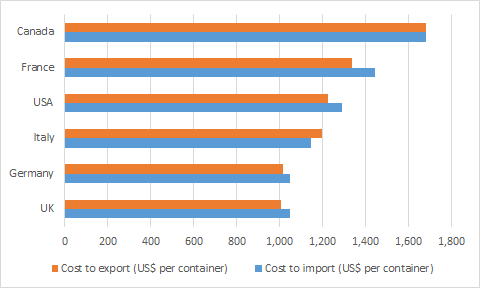
Source: World Bank Doing Business database; note: cost of importing and exporting not included.
Maggie Thatcher on the Greek crisis
17 Jul 2015 Leave a comment
in applied welfare economics, budget deficits, comparative institutional analysis, constitutional political economy, currency unions, economic growth, economic history, economics of regulation, Euro crisis, fiscal policy, income redistribution, macroeconomics, Marxist economics, Public Choice, rentseeking Tags: Greece, growth of government, Margaret Thatcher, size of government
Capitalism and The Great Fact in China
17 Jul 2015 Leave a comment
in applied price theory, applied welfare economics, comparative institutional analysis, development economics, economic history, economics of education, economics of regulation, entrepreneurship, environmental economics, growth disasters, growth miracles, history of economic thought, industrial organisation, Marxist economics, Public Choice Tags: capitalism and freedom, China, fall of communism, Leftover Left, transitional economies
As China grew freer economically, its poverty rate fell. buff.ly/1KohOxS http://t.co/OpaxOzNdNs—
HumanProgress.org (@humanprogress) June 29, 2015
More vital information on the dangers of DHMO
17 Jul 2015 Leave a comment
in applied welfare economics, economics of information, economics of media and culture, economics of regulation, environmental economics, environmentalism, health economics Tags: antiscience left, DHMO, expressive voting, green scare tactics, precautionary principle, rational ignorance, rational irrationality
And the rich got richer, who cares
16 Jul 2015 Leave a comment
in applied price theory, applied welfare economics, Austrian economics, comparative institutional analysis, constitutional political economy, development economics, economic history, economics of bureaucracy, economics of education, economics of regulation, economics of religion, energy economics, entrepreneurship, environmental economics, financial economics, growth disasters, growth miracles, income redistribution, industrial organisation, international economics, labour economics, labour supply, liberalism, poverty and inequality, Public Choice, rentseeking, survivor principle, transport economics, urban economics Tags: Deirdre McCloskey, entrepreneurial alertness, The Great Enrichment, The Great Escape, The Great Fact, top 1%
"The rich got richer, true. But…" —@DeirdreMcClosk buff.ly/1Imdv4o http://t.co/M3ERx3JTIn—
HumanProgress.org (@humanprogress) June 28, 2015
NIMBY: Where, When, And to Which Developers It Happens in the USA
15 Jul 2015 Leave a comment
in economics of regulation, environmental economics, politics - Australia, politics - New Zealand, politics - USA, urban economics Tags: green rent seeking, Inner-city Left, land supply, land use planning, NIMBYs, zoning

Starting a business rankings in the USA, UK, Germany and France compared
11 Jul 2015 Leave a comment
in applied price theory, applied welfare economics, comparative institutional analysis, economics of regulation, industrial organisation, law and economics, politics - USA, property rights Tags: British economy Doing Business, France, Germany, World Bank
Figure 1: Starting a business rankings, USA, UK, Germany and France – World Bank Doing Business rankings, 2014
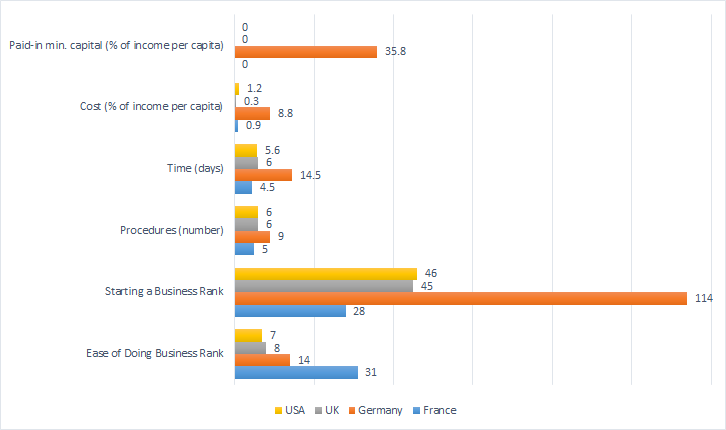
Source: Doing Business – Measuring Business Regulations – World Bank Group.
I have no idea why you have to pledge one third of German per capita income to start a business in Germany. It takes about a week and a half a dozen procedures to start a business in the other countries.
In New Zealand, you can start a business within the hour by registering for GST and registering your company online.
Financial crises surprisingly common, but few countries close their banks
10 Jul 2015 Leave a comment
in business cycles, currency unions, economic history, economics of regulation, Euro crisis, financial economics, global financial crisis (GFC), law and economics, macroeconomics, monetary economics, property rights Tags: bank runs, banking crises, banking panic, financial crises, Greece, sovereign default
Financial crises surprisingly common, but few countries close their banks pewrsr.ch/1NQyz2P #Greece http://t.co/pK0sfB49Ka—
PewResearch FactTank (@FactTank) July 09, 2015


Recent Comments