Basing policy on a scientific consensus is a new development for environmentalists

Previously the precautionary principle was used to introduce doubt when there was no doubt. But when climate science turned in their favour, environmentalists wanted public policy to be based on the latest science.

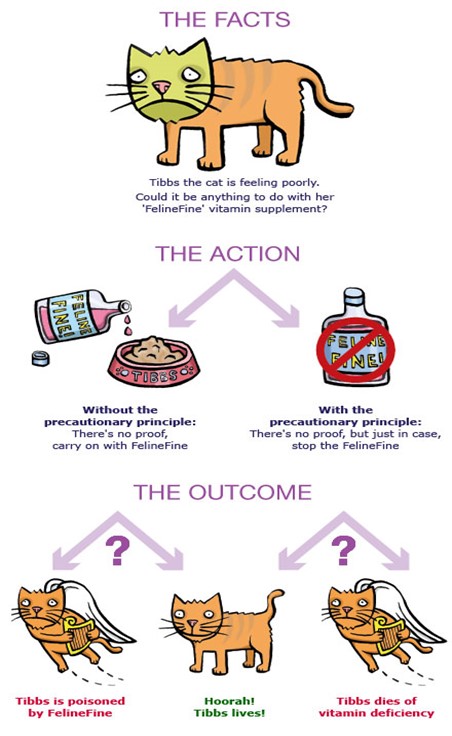
The precautionary principle is deeply incoherent. We should take precautions but there are always risks on both sides of a decision; inaction can bring danger, but so can action. Precautions themselves create risks so the precautionary principle bans what it simultaneously requires.
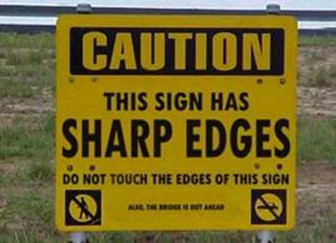
There is never perfect certainty about the nature and causes of health and environmental threats, so environmental and health regulations are almost always adopted despite some residual uncertainty.

We live in a Schumpeterian world where new risks replace old risks.

The obvious question is it safer or more precautionary to focus on the potential harms of new activities or technologies without reference to the activities or technologies they might displace? Jonathan Alder explains

In any policy decision, policy makers can make two potential errors regarding risk.

On the one hand, policy makers may err by failing to adopt measures to address a health or environmental risk that exists.

On the other hand, policy makers may adopt regulatory measures to control a health or environmental risk that does not exist.

Both types of error can increase risks to public health.

Consider the overwhelming consensus among researchers that biotech crops are safe for humans and the environment

This is a conclusion that is rejected by the very environmentalist organisations that loudly insist on the policy relevance of the scientific consensus on global warming.

In his 2012 Dimbleby lecture, Sir Paul Nurse calls for a re-opening the debate about GM crops based on scientific facts and analysis:

We need to consider what the science has to say about risks and benefits, uncoloured by commercial interests and ideological opinion. It is not acceptable if we deny the world’s poorest access to ways that could help their food security, if that denial is based on fashion and ill-informed opinion rather than good science.

Cass Sunstein wrote that in its strongest and most distinctive forms, the precautionary principle imposes a burden of proof on those who create potential risks, and requires regulation of activities even if it cannot be shown that those activities are likely to produce significant harms:

…apparently sensible questions have culminated in an influential doctrine, known as the precautionary principle.

The central idea is simple: Avoid steps that will create a risk of harm.

Until safety is established, be cautious; do not require unambiguous evidence.

Yet the precautionary principle, for all its rhetorical appeal, is deeply incoherent.

It is of course true that we should take precautions against some speculative dangers.

But there are always risks on both sides of a decision; inaction can bring danger, but so can action.

Precautions, in other words, themselves create risks – and hence the principle bans what it simultaneously requires.

Sunstein is a Democrat whose White House appointment to the head the White House Office of Information and Regulatory Affairs under Obama was opposed by the Left of the Democrat Party because of his views on the precautionary principle and his support of cost-benefit analysis as a primary tool for assessing regulations. Sunstein again:

The simplest problem with the precautionary principle is that regulation might well deprive society of significant benefits, and even produce a large number of deaths that would otherwise not occur.

Genetic modification holds out the promise of producing food that is both cheaper and healthier – resulting, for example, in products that might have large benefits in developing countries.

The point is not that genetic modification will definitely have those benefits, or that the benefits of genetic modification outweigh the risks.

The point is that the precautionary principle provides no guidance

The epitome of anti-science is support for the precautionary principle and opposition to cost-benefit analysis in assessing regulations. Which side of politics is guilty of this?

Environmentalists accept the views of scientists when its suits their anti-progress agenda. In other cases, the precautionary principle is used to delay judgment, reject science such as on GMOs and demand ever more evidence.

Environmentalists are all for the precautionary principle except when applied to natural medicines, organic food and marijuana.

Stumbling and Mumbling: 12 alternative principles to Thomas Sargent’s

1. People have different motivations: wealth, power, pride, job satisfaction and so on. Incentive structures which suit one set of motives might not work for another.

2. Many things are true but not very significantly so.

3. Power matters: conventional economics under-states this.

4. Luck matters. The R-squareds in Mincer equations are generally low.

5. There is a great deal of ruin in a nation, and in an organization.

6. Individual rationality sometimes produces outcomes which are socially optimal as in Adam Smith’s invisible hand, and sometimes not.

7. Trade-offs between values are more common than politicians pretend, but are not ubiquitous.

8. Cognitive biases are everywhere.

9. Everything matters at the margin, but the margin might not be very extensive.

10. The social sciences are all about mechanisms. The question is: which ones work when and where? This means there are few if any universal laws in the social sciences; context matters.

11. Accurate economic forecasting is impossible. But time-varying risk premia might give us a little predictability.

12. Risk comes in many types. Reducing one type of it often means increasing exposure to another type.

Chris Dillow at Stumbling and Mumbling: 12 alternative principles.

Famous Fables of Economics: Myths of Market Failures – Daniel Spulber (ed)

Table of Contents

Introduction: Economic Fables and Public Policy: Daniel F. Spulber.

  1. The Lighthouse in Economics: Ronald H. Coase.

  2. The Voluntary Provision of Public Goods? The Turnpike Companies of Early America: Daniel B. Klein.

  3. The Fable of the Bees: An Economic Investigation: Steven N. S. Cheung.

  4. The Fable of the Keys: Stan J. Liebowitz, and Stephen E. Margolis.

  5. Beta, Macintosh, and Other Fabulous Tales: Stan J. Liebowitz and Stephen E. Margolis.

  6. Delivering Coal by Road and Rail in Britain: The Efficiency of the “Silly Little Bobtailed Wagons”: Va Nee L. Van Vleck.

  7. The Acquisition of Fisher Body by General Motors: Ronald H. Coase.

  8. The Fable of Fisher Body: Ramon Casadesus-Masanell and Daniel F. Spulber.

  9. Sharecropping: Steven N. S. Cheung.

  10. Predatory Price Cutting: The Standard Oil (N.J.) Case: John S. McGee.

  11. Another Look at Alcoa: Raising Rivals’ Costs Does Not Improve the View: John E. Lopatka and Paul E. Godek.

  12. How Much Did the Liberty Shipbuilders Learn? New Evidence for an Old Case Study: Peter Thompson.

  13. Financial Legends: The Economist.

via Wiley: Famous Fables of Economics: Myths of Market Failures – Daniel Spulber.

Stephen Franks: Time to call out the earthquake sooks-updated

An over-the-top blog post title spoiled a great round-up by Stephen Franks of the costs and benefits of higher building standards regarding earthquakes:

  • Employees are pressing employers to avoid premises seen as risky even if the earthquake risk is a fraction of the risks faced by employees in their homes, or getting to and from work;
  • Retroactive earthquake strengthening may cost more than the cost of a completely new building (the Canterbury Earthquake Royal Commission mentions up to 120%);
  • Retroactively strengthening buildings outside our highest seismic risk regions is rarely likely to pass any rational cost/benefit test because few if any of them will ever cause an injury.
  • The Martin Jenkins & Associates cost benefit study mentioned by the Canterbury Earthquake Royal Commission showed no  retrospective upgrading policy that could deliver net economic benefit.
  • Rationally, almost all existing weaker buildings should be allowed to end their useful life naturally and be replaced.
  • In high risk Wellington the $60m the Council is looking at spending on the Town Hall would save more lives if spent on dedicated cycle-ways.

via StephenFranks.co.nz » Blog Archive » Time to call out the earthquake sooks.

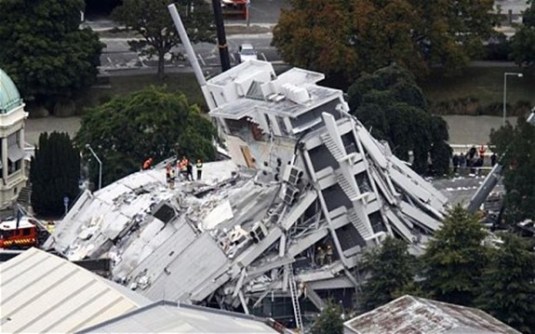
I remember reading a justifiably bitter op-ed by a woman who survived the bus on which a wall fell on and flattened in the second Canterbury Earthquake in February 2011. Eleven died.

That historic wall was known to be in risk is collapse both before and after the first Canterbury Earthquake in 2010.

The wall could not be demolished because of restrictions under the Historic Places Act.

A relative sat on a council committee in a small country town that was among other things trying to demolish a derelict building. The building was protected by heritage legislation.

Permission was refused to demolish the derelict building even after it caught fire and nearly burnt down the pub next door.

Do monopoly concessions increase or decrease gambling?

Do monopoly concessions such as for casinos and the TAB increase or decrease gambling? Is the under-supply of output by a monopoly a good or a bad thing when the good itself is seen as a bad.

James Buchanan started his 1973 paper ‘A defence of organised crime?’ quoting Samuel Butler:

… we should try to make the self-interest of cads a little more coincident with that of decent people

Buchanan’s simple idea is that if a monopoly restricts the output of goods, a standard analytical result, then it must also restrict the output of bads! Buchanan end’s his paper with:

It is not from the public-spiritedness of the leaders of the Cosa Nostra that we should expect to get a reduction in the crime rate but from their regard for their own self-interests

The Cosa Nostra did have a reputation for running honest casinos and keeping crime down nearby.

If an illegal monopoly or cartel becomes competitive and barriers to entry are eliminated, in the long run, more illegal goods will be traded at the new equilibrium.

Should gambling outlets be public monopolies because they would be smaller, badly run and slow to innovate? The monopolisation of bads may shift us in the direction of social optimality. Buchanan, of course, adds that:

The analysis does nothing toward suggesting that enforcement agencies should not take maximum advantage of all technological developments in crime prevention, detection and control.

Regular pardons for speeding offences, accident rates and the Peltzman effect

The French and Korean president every election or so pardons all minor traffic offences. The accident rate goes up on the eve of this pardon.

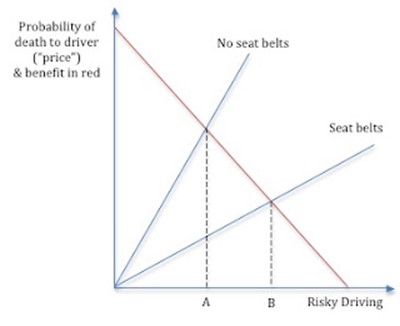
Despite the obvious incentive effect of safer cars on risk taking, I have argued with people until they were black and blue where they were denying that accident rates respond to incentives and risks. My interlocutor even denied that his driving habits would change if seat belts were banned. Oddly enough, he did believe that people acted on better information about risks. I do not know why he thought they had an incentive to act on new information.

I mentioned this French pardon in another conversation. He mentioned that when he lived in Paris, he would save up his traffic and parking tickets in anticipation of the pardon.

Armen Alchian’s famous solution to speeding was to put a jagged spike in car wheels to make sure the driver died if he had an accident. This would ensure that everyone drives very carefully, assuming that anyone every got into a car ever again.

People have considerable control over the risk of accidents. When Sweden changed from driving on the left to driving on the right, motor insurance claims fell 40% for six weeks; fatalities took two years to return fully to previous levels.

The Peltzman effect was named after Sam Peltzman’s findings in “The Effects of Automobile Safety Regulation”, Journal of Political Economy August 1975 about the impact of mandatory safety devices on the accident rates for passengers and pedestrians.

Peltzman found that enough extra pedestrians were mowed down by drivers who were driving faster because they were safer that the increase in these deaths offset the fewer number of drivers and passengers dying in accidents.

Peltzman never said that the behavioural offset to greater safety and reduced risk would always be complete in all cases. Many subsequent studies found at least a partial offsetting effect of greater safety on risk taking, including an increased risk of accidents for others.

Sports economists even found the Peltzman effect in NASCAR racing. A major new safety rule led to more on-track accidents and an increased risk to both spectators and pit crew members. Greg Mankiw pointed to an Australian news report that 4WD drivers were almost four times more likely than other drivers to be using a mobile phone. Maybe they fell safer in accidents. I drive a Toyota Corolla.

The Peltzman effect is a simple point that many still resist. The whole point of safety equipment is to allow us to undertake riskier activities. When more safety equipment becomes available or is mandated, people will undertake more of the risky activity because it is now safer to do so.

HT: http://correctionspageone.blogspot.co.nz/2010/09/seatbelts-are-lifesavers-in-your-car.html for graphics

Managerial Econ: Thwarting Innovation in Sunscreen

One consequence of strict FDA rules on drug approvals is that it is really expensive to improve sunscreen.

The Washington Post has a new story titled “FDA review of new sunscreen ingredients has languished for years, frustrating advocates.”

Since 10,000 Americans die of melanoma every year, this delay has real consequences for consumers. How many people did the FDA kill this year?

via Managerial Econ: Thwarting Innovation in Sunscreen.

The withering away of the union wage premium

The union wage premium is supposed to be 10-15%. There is evidence that it may be close to zero and has been close to zero for some time at least in the USA.


In this paper (QJE 2004), John DiNardo and David Lee compared business establishments from 1984 to 1999 where US unions barely won the union certification election (e. g., by one vote) with workplaces where the unions barely lost.

If 50% plus 1 workers vote in favour of the union proposing to organise them, management has to bargain for a collective agreement in good faith with the certified union, if the union loses, management can ignore that union.

Most winning union certification elections resulted in the signing of a collective agreement not long after. Unions who barely win have as good a chance of securing a collective agreement as those unions that win these elections by wide margins. Few firms subsequently bargained with a union that just lost the certification election. Employers can choose to recognise a union.

Because the vote is so close, a particular workplace becoming unionised was close to a random event.

  • This closeness of the union certification election may disentangle unionisation from just being coincident with well-paid workplaces, more skilled workers and well-paid industries.
  • Unions could be organising at highly profitable firms that are more likely to grow and pay higher wages independent of any collective bargaining. The unions are claiming credit for wage rises that would have happened anyway.

DiNardo and Lee found only small impacts of unionisation on all outcomes that they examined:

  • The estimated changes for wages are close to zero.
  • Impacts on survival rates of the unionised business and their profitability were equally tiny.
  • This evidence suggests that in recent decades, requiring an employer to bargain with a certified union has had little impact because unions have been unsuccessful in winning significant wage gains.

This means that there may not be a union wage premium at all since the early 1980s in the USA.

Private sector union membership is about 7% in the USA. Private sector union membership is barely in the teens in Australia and New Zealand. Fewer people are joining unions because they are not of any value to them.

The transferability of these results to Australia are in doubt, to the extent that there is the option for compulsory arbitration, which there is. The union wage premium may be the product of the ability to lobby for wage regulation.

New Zealand and U.S. unions are more similar in that both are on their own in bargaining with employers for a wage rise. The U.S. result sends a message to New Zealand that unions are a bit of a relic in terms of wage bargaining.

Regulated industries are a little different because it is wise for employers to share the rents from the higher prices with their employees as higher wages. They then unite in a political coalition to support continued regulation and tariffs. There are far fewer industries these days where entry is regulated and prices are higher because of such anti-competitive regulation.

These results about the small size of the union wage premium, of course, would come as no surprise to Milton Friedman. He said in 1950 that most unions could not overcome market forces that would tend to keep wages aligned with competitive rates.

The difference between economics and sociology – natural disasters edition

The chasm between economics and sociologists could not be greater in terms of how each profession views social behaviour. The same in politics: Democrats easily out number Republican economists two or three to one; registered Democrats to Republicans come in at 44:1. Rachel Kling once offered a quick summary of every sociology course: “There’s poverty and America sucks.”

My first serious professional encounter with sociology was when I studied the sociology of natural disasters in the first half of 2011. This was after the February 2011 Christchurch earthquake.

The sociology of natural disasters literature dates back to World War 2 and was large and well established by the 1970s. Disaster sociology is a sub-discipline with university courses, dedicated research centres and special journals.

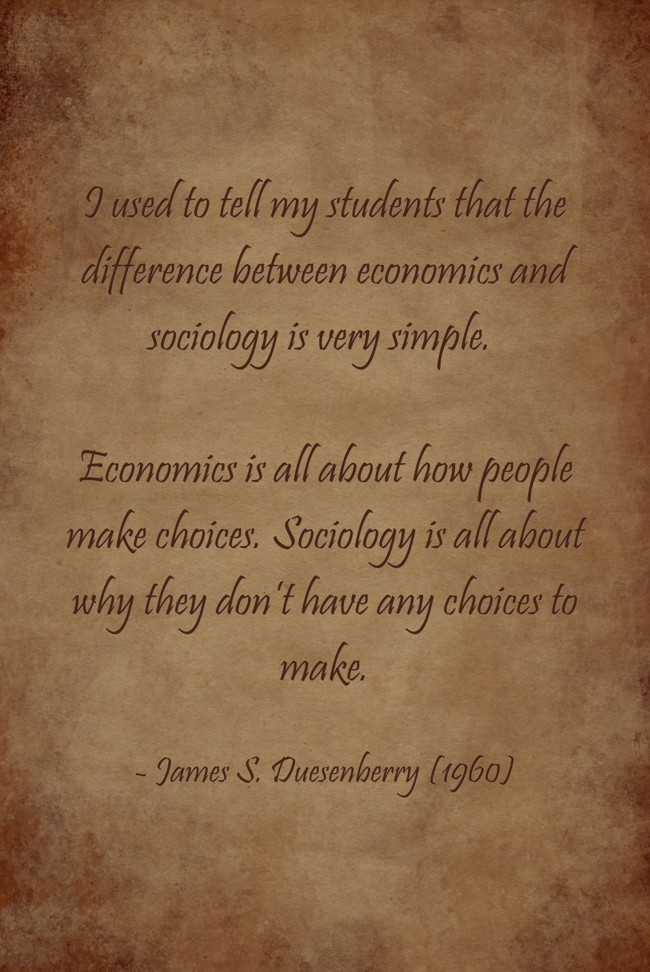
Sociologists study natural disasters to look at how society functions under great stress. If economics is all about how people make choices, and sociology is all about why they don’t have any choices to make, post-disaster recoveries should conform more to the sociological model.

Sociologists found that the common assumptions of post-disaster chaos, disaster shock and social paralysis and helplessness are not well-based on what is known of social behaviour during emergencies.

A central and mistaken assumption of post-disaster responses is emergencies result in drastically different social situations with social chaos. This social chaos is rectified by imposing outside military style command and control systems working from above that supplant the existing social and economic arrangements. Existing social and economic arrangements, including the market process, are seen as fragile in the face of emergencies and incapable of dealing with the disaster.

A better model is continuity, coordination and cooperation. There is post-disaster confusion and new and unexpected problems to confront, but existing social structures are the most effective way to respond.

The existing social structures have the capacity to make rational, informed decisions. An emergency is by its very nature characterised by decentralised and pluralistic decision-making built on local knowledge known only to those on the spot.

Social and economic units, families and businesses are all problem solvers in normal times, and this capacity, their experience and their idiosyncratic knowledge of their particular circumstances of time and place are not lost after a natural disaster.

Disaster forces both governments and citizens to adapt quickly and unexpectedly. Both survivors and those outside the disaster zone act on the basis of a large amount of place- and time-specific knowledge that is generally unavailable to government agencies. Regardless of the extent of the disaster, existing social and economic systems remain surprisingly intact.

Post-disaster coordination is improved if there is a considerable possibility for improvisation of solutions. A great many complex, non-routine tasks evolve after a disaster. These tasks are better dealt with by low levels of centralisation and minimum formality. Without the scope for improvisation, emergency management loses its flexibility in the face of changing conditions and uncertainty.

Post-disaster panic and looting are consistent myths that will not die. Anti-social behaviour after natural disasters is, in fact, rare. A major emergency management issue is the exact opposite of panic, social chaos and flight. The large majority of residents of disaster zones refuse to evacuate and strongly prefer to ride out the storm. Many residents have to be compelled to leave and restrained from returning under threat of arrest.

A central tenet of natural disasters sociology is that most communities can, to a large degree, spontaneously heal themselves.

People affected by a natural disaster obviously often need resources from the outside world such as food, water, and shelter. Most sociological scholars in the field say that this does not mean that the survivors also need outside direction and coordination. Even when the damage is extensive and the loss of life is great, survivors spontaneously marshal their remaining resources and adapt to their new environments.

Disaster sociology suggests it is a profound mistake for outside agencies to enter with the aim of supplanting important parts of the pre-disaster social and economic systems.

  • The pre-disaster social and economic systems, including family and social ties, already have a long history of successfully solving the various social and economic problems that they were presented with day in and day out.
  • After a natural disaster, time and again, these same pre-disaster social and economic systems and family and social networks survived to rapidly adapt to and solve the new set of social and economic problems that emerged using local knowledge to mobilise existing and incoming resources.

The economic literature on natural disasters, war damage and wartime mobilisations and demobilisations reached similar conclusions on post-disaster resilience despite the different assumptions on the ability of people to make choices.

The economics of disasters was pioneered by Jack Hirshleifer. His studies of recoveries from war damage, war communism and the Black Death were for the Rand Corporation in the 1960s in the context of civil defence and recovery after nuclear wars.

  • Most economic studies of natural disaster recoveries show that the use of existing resources and inventories, rationing of what is available, and substitution of labour and other resources away from lower priority uses toward the disaster response and longer working hours are the foundations of the recovery process. Price controls and other regulatory responses lead to shortages and a lack of investment.
  • Effective responses and recoveries from past earthquakes, annual hurricanes, tornadoes, fire and floods, and even catastrophic disasters such as the wartime bombings of German and Japanese cities, have always depended primarily on the resilience of the pre-existing social and economic systems that coordinated people’s daily lives in prior more normal times. If they were well-functioning, disaster recovery is much faster and more complete.
  • The most important task for government after a disaster is to uphold the pre-existing basic rules of society: private property rights, enforcing contracts made prior to the disaster and upholding the rule of law. Uncertainty about the rules of the game inhibits the ability and the willingness to reinvest and anchor expectations around pessimistic outcomes.

Many commonly championed regulatory interventions make the disaster zone worse off.

When studying the economics of natural disasters in the first half of 2011 after the Christchurch earthquake, I happened to read George Stigler and Milton Friedman’s famous 1946 pamphlet Roofs or Ceilings for the first time. It was recently put on the Net.

That famous pamphlet on the dangers of rent controls started with a discussion of the 1906 San Francisco Earthquake and Fire! The purpose of this analysis by Friedman and Stigler was to compare how an earthquake and three-day long fire storm did far less damage to the ability of the housing market to service demand than did the World War 2 rent controls in the same city.

To return to my opening, the resilience and adaptability of society even under the great stress of a natural disaster might call sociology into question as a discipline. People can choose and make choices for themselves despite even the most terrible stresses such as from a natural disaster. People really do bounce-back from even the worst of set-backs.

Sargent, Prescott, Taylor and Kydland on the Global Financial Crisis and the Great Recession

Many of the key issues about what modern macroeconomics has to say on global financial crises are discussed in a 2010 interview with Thomas Sargent where he says that two polar models of bank crises and what government lender-of-last-resort and deposit insurance do to arrest or promote them were used to understand the GFC. They are polar models because:

  • in the Diamond-Dybvig and Bryant model of banking runs, deposit insurance and other bailouts are purely a good thing stopping panic-induced bank runs from ever starting; and

  • In the Kareken and Wallace model, deposit insurance by governments and the lender-of-last-resort function of a central bank are purely a bad thing because moral hazard encourages risk taking unless there is regulation or there is proper surveillance and accurate risk-based pricing of the deposit insurance.

In the Diamond-Dybvig and Bryant model, if there is government-supplied deposit insurance, people do not initiate bank runs because they trust their deposits to be safe. There is no cost to the government for offering the deposit insurance because there are no bank runs! A major free lunch.

Tom Sargent considers that the Bryant-Diamond-Dybvig model has been very influential, in general, and among policy makers in 2008, in particular.

Governments saw Bryant-Diamond-Dybvig bank runs everywhere. The logic of this model persuaded many governments that if they could arrest the actual or potential runs by convincing creditors that their loans were insured, that could be done at little or no eventual cost to taxpayers.

In 2008, the Australian and New Zealand governments announced emergency bank deposit insurance guarantees. In Bryant-Diamond-Dybvig style bank panics, these guarantees ward off the bank run and thus should cost nothing fiscally because the deposit insurance is not called upon. These guarantees and lender of last resort function were seen as key stabilising measures. These guarantees were called upon in NZ to the tune of $2 billion.

  • The Diamond-Dybvig and Bryant model makes you sensitive to runs and optimistic about the ability of deposit insurance to cure them.
  • The Kareken and Wallace model’s prediction is that if a government sets up deposit insurance and doesn’t regulate bank portfolios to prevent them from taking too much risk, the government is setting the stage for a financial crisis.
  • The Kareken-Wallace model makes you very cautious about lender-of-last-resort facilities and very sensitive to the risk-taking activities of banks.

Kareken and Wallace called for much higher capital reserves for banks and more regulation to avoid future crises. This is not a new idea. Sam Peltzman in the mid-1960s found that U.S. banks in the 1930s halved their capital ratios after the introduction of federal deposit insurance. FDR was initially opposed to deposit insurance because it would encourage greater risk taking by banks.

Sargent also said that it is just wrong to say that the GFC caught modern macroeconomists by surprise: Allen and Gale’s 2007 book Understanding Financial Crises compiles many of the dynamic models of the causes of financial crises and government policies that can arrest or ignite them.

Front Cover

Stern and Feldman’s Too Big to Fail uses insights from the formal economic literature to warn in 2004 about the time bomb for a financial crisis set by current banking regulations and government promises.

In Great Depressions of the Twentieth Century (2007) written by a team of 24 economists, Kehoe and Prescott and others concluded that bad government policies are responsible for causing depressions. In particular, while different sorts of shocks can lead to ordinary business cycle downturns, it is overreactions by governments that can prolong and deepen the downturn, turning it into a depression. Depressions and great recessions, such as currently the case in the USA, are caused by crisis management policies that turn garden-variety recessions into something much worse. Crisis management policies distort the incentives to hire and invest and reduce competition and efficiency.

As an example, one in three unemployed in the EU are Spanish mainly because of Spanish employment protection laws.

Cahuc et al. 2012 estimated that Spanish unemployment would be 45% lower if Spain adopted the less strict French laws! About ten years ago, under French employment law, the contestants on the French version of Survivor sued successfully for wrongful dismissal by the Tribal Council! French workers cannot be laid off just to improve business profits. They can be laid off to avoid bankruptcy.

John Taylor argues that we should consider macroeconomic performance since the 1960:

  • There was a move toward more discretionary policies in the 1960s and 1970s;
  • A move to more rules-based policies in the 1980s and 1990s; and
  • Back again toward discretion in recent years.

These policy swings are correlated with economic performance—unemployment, inflation, economic and financial stability, the frequency and depths of recessions, the length and strength of recoveries. Less predictable, more interventionist, and more fine-tuning type macroeconomic policies have caused, deepened and prolonged the current recession.

Finn Kydland considers fiscal policy to be at the heart of current problems. Instead of restructuring and investing more prudently, Western countries faced with budget shortfalls will seek to increase taxes:

  • The U.S. economy isn’t recovering from the Great Recession of 2008-2009 with the anticipated strength.
  • A widespread conjecture is that this weakness can be traced to perceptions of an imminent switch to a regime of higher taxes.
  • The fiscal sentiment hypothesis can account for a significant fraction of the decline in investment and labor supply in the aftermath of the Great Recession, relative to their pre-recession trends.
  • The perceived higher taxes must fall almost exclusively on capital income. People must suspect that the tax structure that will be implemented to address large fiscal imbalances will be far from optimal.

Those who disagree with the policy-based explanation for the depth and length of the Great Recession must explain why the US and EU economies have not recovered after the worst of the global financial crisis passed in November 2008?! The case that there were intervening government policies that prolonged and deepened each national recession is strong.

Next Newer Entries

Coordination Problem

Celebrating humanity's flourishing through the spread of capitalism and the rule of law

Libertarian Land

Celebrating humanity's flourishing through the spread of capitalism and the rule of law

Arin’s Substack

Celebrating humanity's flourishing through the spread of capitalism and the rule of law

David Andolfatto

Celebrating humanity's flourishing through the spread of capitalism and the rule of law

Monetary Non-Neutrality

Celebrating humanity's flourishing through the spread of capitalism and the rule of law

Reason Magazine

Celebrating humanity's flourishing through the spread of capitalism and the rule of law

Coyote Blog

Celebrating humanity's flourishing through the spread of capitalism and the rule of law

Thoughts from the North

Celebrating humanity's flourishing through the spread of capitalism and the rule of law

Fardels Bear

A History of the Alt-Right

Vincent Geloso

Econ Prof at George Mason University, Economic Historian, Québécois

Bassett, Brash & Hide

Celebrating humanity's flourishing through the spread of capitalism and the rule of law

Truth on the Market

Scholarly commentary on law, economics, and more

The Undercover Historian

Beatrice Cherrier's blog

Matua Kahurangi

Celebrating humanity's flourishing through the spread of capitalism and the rule of law

Temple of Sociology

Celebrating humanity's flourishing through the spread of capitalism and the rule of law

Velvet Glove, Iron Fist

Celebrating humanity's flourishing through the spread of capitalism and the rule of law

Why Evolution Is True

Why Evolution is True is a blog written by Jerry Coyne, centered on evolution and biology but also dealing with diverse topics like politics, culture, and cats.

NoTricksZone

Celebrating humanity's flourishing through the spread of capitalism and the rule of law

Homepaddock

A rural perspective with a blue tint by Ele Ludemann

Kiwiblog

DPF's Kiwiblog - Fomenting Happy Mischief since 2003

The Dangerous Economist

Celebrating humanity's flourishing through the spread of capitalism and the rule of law

Watts Up With That?

The world's most viewed site on global warming and climate change

The Logical Place

Tim Harding's writings on rationality, informal logic and skepticism

Doc's Books

A window into Doc Freiberger's library

The Risk-Monger

Let's examine hard decisions!

Uneasy Money

Commentary on monetary policy in the spirit of R. G. Hawtrey

Barrie Saunders

Thoughts on public policy and the media

Liberty Scott

Celebrating humanity's flourishing through the spread of capitalism and the rule of law

Point of Order

Politics and the economy

James Bowden's Blog

A blog (primarily) on Canadian and Commonwealth political history and institutions

Science Matters

Reading between the lines, and underneath the hype.

Peter Winsley

Economics, and such stuff as dreams are made on

A Venerable Puzzle

"The British constitution has always been puzzling, and always will be." --Queen Elizabeth II

The Antiplanner

Celebrating humanity's flourishing through the spread of capitalism and the rule of law

Bet On It

Celebrating humanity's flourishing through the spread of capitalism and the rule of law

History of Sorts

WORLD WAR II, MUSIC, HISTORY, HOLOCAUST

Roger Pielke Jr.

Undisciplined scholar, recovering academic

Offsetting Behaviour

Celebrating humanity's flourishing through the spread of capitalism and the rule of law

JONATHAN TURLEY

Res ipsa loquitur - The thing itself speaks

Conversable Economist

In Hume’s spirit, I will attempt to serve as an ambassador from my world of economics, and help in “finding topics of conversation fit for the entertainment of rational creatures.”

The Victorian Commons

Researching the House of Commons, 1832-1868

Books & Boots

Reflections on books and art

Legal History Miscellany

Posts on the History of Law, Crime, and Justice

Sex, Drugs and Economics

Celebrating humanity's flourishing through the spread of capitalism and the rule of law

European Royal History

Exploring the Monarchs of Europe

Tallbloke's Talkshop

Cutting edge science you can dice with