
Stronger road safety laws kill more pedestrians
24 Jun 2014 Leave a comment
in applied price theory, economics of regulation, Sam Peltzman Tags: offsetting behaviour

Sam Peltzman likes to point out the road fatalities in the USA fell pretty much at a steady rate of 3% for the entire 20th century. There was no break in trend with the drop in fatalities after major road safety legislation was passed by Congress in 1966.
The composition of who died changed: Peltzman found fewer drivers and passengers died but the more pedestrians were killed because drivers drove faster and with less care. Alma Cohen and Linan Einav (2003) found that seat-belt laws, in the absence of any behavioural response, were expected to save three times as many lives as were in fact saved. This shortfall because of greater risk taking is the Peltzman effect:
the hypothesized tendency of people to react to a safety regulation by increasing other risky behaviour, offsetting some or all of the benefit of the regulation.


Learn Liberty | The most dangerous monopoly: When caution kills
22 Jun 2014 Leave a comment
in applied price theory, applied welfare economics, economics, economics of regulation, technological progress Tags: drug lags, health and safety
"Pot Is the New Pizza" in Washington State – Hit & Run
20 Jun 2014 Leave a comment
in applied price theory, economics, economics of regulation, entrepreneurship, industrial organisation Tags: decriminalisation, grey markets, marijuana

Evan Cox left pizza delivery and now employs 50 people in Washington state in his pot delivery company:
Although it is legal to buy marijuana in Washington state, the person who delivers it could be guilty of a felony. That hasn’t stopped Winterlife from attracting competitors.
Mr Cox has registered as a business with the city and state, but he cannot open a bank account, thanks to federal rules.
In April, he paid $167,000 in sales tax to the Washington State Department of Revenue—in cash.
via Door-to-Door Dope Delivery: "Pot Is the New Pizza" in Washington State – Hit & Run : Reason.com.
New Zealand is the second most expensive place to put a roof over your head in the OECD area
16 Jun 2014 Leave a comment
in economics of regulation, urban economics Tags: housing affordability, land supply, land use regulation, urban economics

HT: OECD at slideshare.net via Don Brash
Join the Green Tea Party | Terry Anderson
15 Jun 2014 Leave a comment
in economics of regulation, environmental economics Tags: Terry Anderson

…ask yourself an important question: Are you really an environmentalist, or are you just “greener than thou.” Membership in the Green tea party requires more than just displaying your green bona fides. It requires proven environmental results and pragmatic environmental policies—not just green rhetoric…
With only two planks, the Green tea party’s platform would make it clear that prosperity and incentives, not bureaucracies, drive environmental improvements.
The first plank is that wealthier is healthier. From the United States to the former Soviet Union, data show that economic growth is necessary for environmental improvement, not the enemy of it. The overwhelming evidence says that economic growth results from secure property rights and a strong rule of law.
Given this, we have a recipe for improving the environment that starts with economic progress and a robust private sector. More federal spending and bureaucratic red tape work against these goals. Environmental quality cannot be secured with taxpayer dollars and environmental protection agency regulations.
The second plank is that incentives matter. The Green tea party would use the carrot—property rights and markets—rather than the regulatory stick to improve environmental quality. Kermit agrees with the great conservationist, Aldo Leopold, who said, “Conservation will ultimately boil down to rewarding the private landowner who conserves the public interest.”
Sustainability only comes from profitability and accountability.
To widen the market and to narrow the competition is always the interest of sellers
14 Jun 2014 Leave a comment
in Adam Smith, economics of regulation, Public Choice, rentseeking Tags: competition and monopoly, The wealth of nations
The proposal of any new law or regulation of commerce which comes from this order, ought always to be listened to with great precaution, and ought never to be adopted till after having been long and carefully examined, not only with the most scrupulous, but with the most suspicious attention.
It comes from an order of men, whose interest is never exactly the same with that of the public, who have generally an interest to deceive and even oppress the public, and who accordingly have, upon many occasions, both deceived and oppressed it.
The unintended consequences of dogooder laws
12 Jun 2014 Leave a comment
in economics of regulation, health economics Tags: nanny state, The fatal conceit, unintended consequences

The dead are many – the U.S. Food and Drug Administration (FDA)
11 Jun 2014 1 Comment
in economics of regulation, Sam Peltzman Tags: drug lag, Sam Peltzman

I found that the unregulated market was very quickly weeding out ineffective drugs prior to 1962. Their sales declined rapidly within a few months of introduction, and there was thus little room for the regulation to improve on market forces . . . most of the subsequent academic research reached conclusions similar to mine . . .
The carnage from this regulation, I regret to assure you, will continue for a long time . . . the deaths of which I speak are counterfactual deaths, not deaths that can be directly connected to any regulatory malfeasance . . .
the actual victims of the regulation did not swallow a bad FDA-approved pill. They merely failed to swallow a good one in time and never knew what they had missed.
Housing price booms and the restrictiveness of land-use regulation in the USA
09 Jun 2014 Leave a comment
in economics of regulation, rentseeking, urban economics Tags: housing prices, land use regulation

The picture tells a 1000 words.
Investors think Uber is worth $17 billion. Why that’s not entirely crazy.
08 Jun 2014 Leave a comment
in economics of regulation Tags: offsetting behaviour, Uber

Watch out taxi drivers.
via Investors think Uber is worth $17 billion. Why that’s not entirely crazy..
Sam Peltzman and the great restraint in the growth of government, 1980-2007
01 Jun 2014 Leave a comment
in constitutional political economy, Gary Becker, income redistribution, Public Choice, rentseeking, Sam Peltzman Tags: growth in government, The Great Restraint
From 1950 to 1980 the size of government doubled in the developed world and then stopped dead in 1980. This great restraint on the growth of government happened everywhere. It was not just Thatcher’s Britain or Reagan’s America. It was everywhere, in France and Germany, and even in Scandinavia.
Peltzman’s data below has government spending double between 1950 and 1980, and then nothing much happened in between 1980 and 2007 – the size of government is pretty flat as a share of GDP for 27 years.
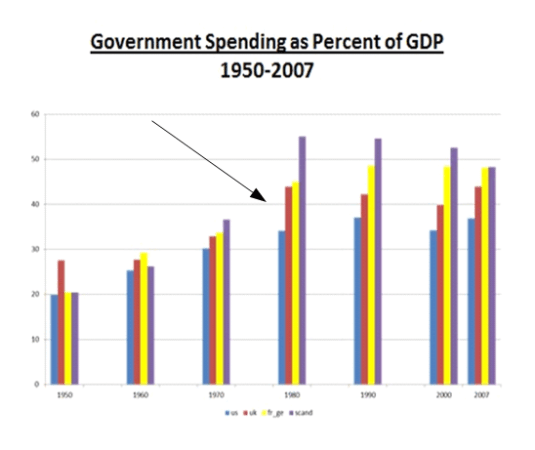
Source: Sam Peltzman, The Socialist Revival? (2012).
There is a noticeable reduction in the size of government spending in Scandinavia. Reagan and Thatcher had nothing on those Social Democrats in Scandinavia when it comes to cutting the size of government.
Governments everywhere hit a brick wall in terms of their ability to raise further tax revenues. Political parties of the Left and Right recognised this new reality.
Government spending grew in many countries in the 20th century because of demographic shifts, more efficient taxes, more efficient spending, a shift in the political power from those taxed to those subsidised, shifts in political power among taxed groups, and shifts in political power among subsidised groups.
The median voter in all countries was alive to the power of incentives and to not killing the goose that laid the golden egg.
After 1980, the taxed, regulated and subsidised groups had an increased incentive to converge on new lower cost modes of redistribution.
More efficient taxes, more efficient spending, more efficient regulation and a more efficient state sector reduced the burden of taxes on the taxed groups.
Most subsidised groups benefited as well because their needs were met in ways that provoked less political opposition.
Gary Becker made this warning about the political repercussions of tax reform and economic reform in general for the size of government:
…the greater efficiency of a VAT and its ease of collection is a two-edged sword.
On the one hand, it would raise a given amount of tax revenue efficiently and cheaply.
Since economists usually evaluate different types of taxes by their efficiency and ease of collecting a given amount of tax revenue, economists typically like value added taxes.
The error in this method of evaluating taxes is that it does not consider the political economy determinants of the level of taxes.
From this political economy perspective, the value added tax does not look so attractive, at least to those of us who worry that governments would spend and tax at higher levels than is economically and socially desirable.
Reforms ensued after 1980 led by parties on the Left and Right, with some members of existing political groupings benefiting from joining new political coalitions.
The deadweight losses of taxes, transfers and regulation limit inefficient policies and the sustainability of redistribution.
Peltzman likes to note that at the start of the 20th century, the United States government was about 8% of GDP. The two largest programs were education and highways. The post office was as big as the military.
Government is about five times that now with defence, health, education and income security accounting for 70% of this total. Peltzman makes the very interesting point that:
There is no new program in the political horizon that seems capable of attaining anything like the size of any of these four.
For the time being the future government rest on the extent of existing mega programs.
Health and income security account for 55% of total government spending in the OECD. It is in these two programs where the future of the growth of government lie.
The pressure for that growth in government will come from the elderly. Governments will have to choose between high taxes on the young to fund these programs for the elderly or find other options.
Those subservient press barons
07 May 2014 Leave a comment
in economics of regulation, entrepreneurship, industrial organisation, politics, Public Choice, survivor principle Tags: media bias, rent extraction
Both political parties used television licensing and the threat of cable TV to manipulate Murdoch, Packer and the other press barons. They were victims of Fred McChesney’s concept of rent extraction:
- Rent extraction is the politician’s pastime of threatening harmful legislation to extract political support and contributions from well-heeled private institutions.
- Payments to politicians are often made not for political favours, but to avoid political disfavour, that is, as part of a system of political extortion or rent extraction.
Rent extraction is money for nothing – money paid in exchange for politicians’ inaction.
The politician is paid, not for rent creation, but for withholding legislative and regulatory action that would destroy existing private rents.
McChesney establishes the conditions under which of rent creation or extraction will occur. The relative attractiveness of the two strategies depends on the elasticities of demand and supply.
- If demand is relatively inelastic, rent creation will occur; and
- If supply is relatively inelastic, rent extraction will occur.
The existence of an organization or a large established firm lowers transaction costs for the politicians negotiating and collecting donations and support, making rent expropriation threats easier.
It is hard to extort rents from those with little in the way of organisation. A cost of being an established lobbying organisation or a large firm with high fixed costs is a greater potential for rent extraction.
The print and electronic media are ripe for rent extraction because of their immobile assets and heavy regulation.
Investors in heavily regulated capital intensive industries such as the mass media, digital and print, do not bite the hand the feeds them.
Little wonder that the media barons were honoured supplicants to whomever is in power in Canberra. They are soon Labor’s business mates whenever Labor was in power.
Threatening to allow cable TV was the big stick in every Australian government’s hand until the 1990s to extract support or at least subservience from the media.
Rupert Murdoch has unashamedly backed political winners, only to dump them when he was convinced that they were washed up or that his newspapers might be left stranded on the losing side of politics.

Murdoch’s see-sawing political stances are entirely pragmatic. He has always been prepared to back winners just before they win, and to shift allegiances on non-ideological grounds.


Recent Comments