
Zealots cannot countenance trade-offs and diminishing returns – Thomas Sowell
13 Aug 2014 Leave a comment


Killer green technologies alert: safety records of the nuclear and wind industries
10 Aug 2014 Leave a comment
in applied welfare economics, climate change, economics of climate change, economics of regulation, environmental economics, global warming, health economics Tags: killer green technologies; wind power
Nuclear fatalities in the last ten years: 7
Wind farm fatalities in the last ten years: 44.


Christchurch Earthquake | Libertarianz TV
04 Aug 2014 Leave a comment
in economics of natural disasters, economics of regulation, liberalism, libertarianism, politics - New Zealand, urban economics Tags: Christchurch earthquake, economics of natural disasters
Devastating effect of government bureaucracy following the earthquakes of 2010 and 2011. As told by two business owners, an economist and an engineer. Concludes with the Libertarianz policy to make Christchurch a free enterprise zone.
How flexible is the New Zealand labour market
31 Jul 2014 1 Comment
in economics of regulation, labour economics, politics - New Zealand, unemployment, welfare reform Tags: 90 day trials, employment law, employment probation periods, employment protection, labour market regulation
The first chart below shows that NZ is the 4th most deregulated labour market for individual dismissals.
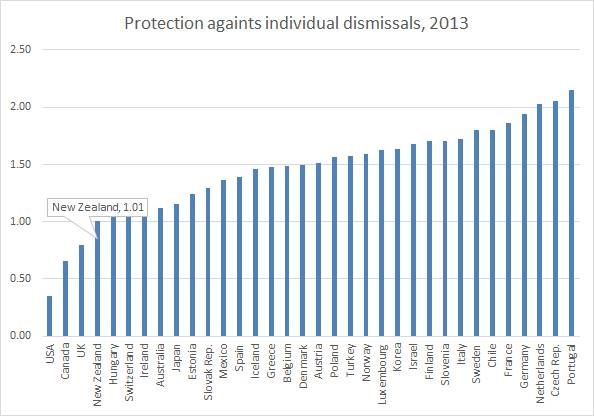
Source: OECD employment protection index
The next figure below shows that NZ is top of the world for deregulation of lay-offs and redundancies.
![clip_image002[7]](https://utopiayouarestandinginit.com/wp-content/uploads/2014/07/clip_image0027.jpg "clip_image002[7]")
Source: OECD employment protection index
The chart below shows that New Zealand is far more flexible than in Western Europe and is pretty near the USA in terms of people moving in and out of the unemployment pool every month with great ease.
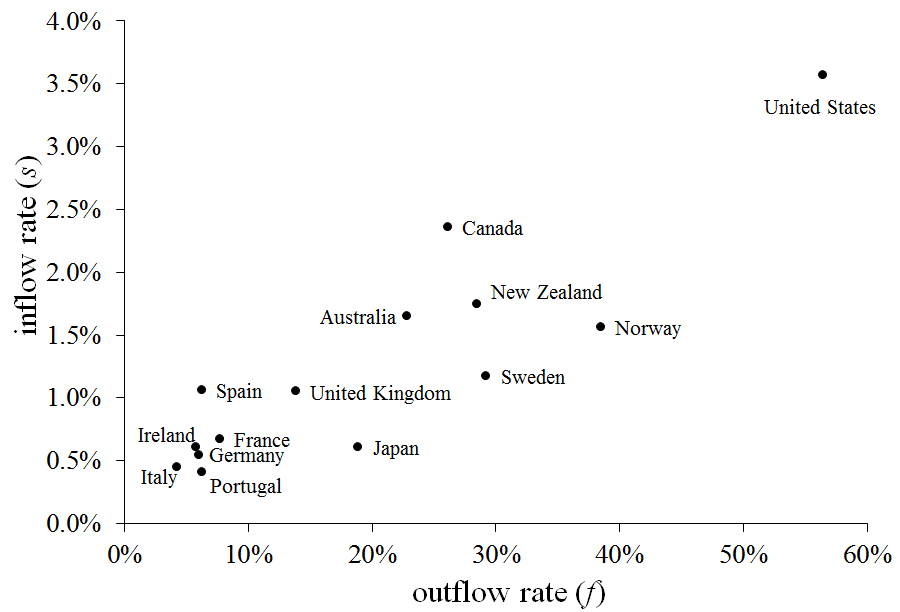
Source: Elsby, Hobijn and Şahin (2013).
There are very high outflow rates from unemployment among the Anglo-Saxon and Nordic economies. The economies of Continental Europe stand in stark contrast. Unemployment outflow rates in these economies lie below 10% at a monthly frequency.
A major labour market reform in recent years in New Zealand was introduction of the option of a 90 day trial for new employees, initially in small businesses and then in all businesses.
The UK recently extended its trial period from one-year to two-years. Trial periods are common in OECD member countries.
There is plenty of evidence to back-up the notion that increased job security leads to less employee effort and more absenteeism. Some examples are:
· Sick leave spiking straight after probation periods ended;
· Teacher absenteeism increasing after getting tenure after 5-years; and
· Academic productivity declining after winning tenure.
The MBIE research into the actual operation of 90-day trials was highly favourable in terms of increased employment, the hiring of riskier applicants and lower costs of ending bad job matches (about 15-20% of trials did not work out). These outcomes are the usual importance of a test drive argument for employment trial periods.
Interestingly, the MBIE research also found that some employers hired new employees on 90-day trials for positions about which these employers were uncertain might be profitable. But for the option of the trial period, these jobs never would have existed.
This suggests that in some firms, 90-day trials are a decisively cheaper alternative to hiring an employee and perhaps making them redundant later if the new position does not pay for itself. No one’s fault: the market just did not sustain the expansion in staff as expected.
The MBIE research shows that winners from 90-day trials are new labour force entrants, the unemployed and beneficiaries, migrants and labour force re-entrants such as mothers.
I kept note of an interesting press report adding to this where Hospitality New Zealand Wellington president Jeremy Smith said he had hired dozens of staff he would not otherwise have considered. Because of the transient nature of the hospitality industry, it was often difficult to check references so a trial period “levelled the playing field”.
Why charging for plastic bags doesn’t work
31 Jul 2014 Leave a comment
in economics of regulation, environmental economics, environmentalism Tags: expressive voting, plastic bags, recycling

My local supermarket tried to charge for plastic bags then backed down because of customer protests.
In the UK, a compulsory 5p charge on plastic bags first resulted in a sharp drop consumption then a rise in in the use of plastic bags last year. It seems the immediate change in behaviour reaped by the new charges is short-lived and it doesn’t take long for old habits to re-emerge.
Attaching a cost to something that was free certainly reduces frivolous consumption, but if that cost that is too low can merely act to pay off one’s conscience.
Beware of putting a price on guilt and letting people down.
A classic paper from 2000, Gneezy and Rustichini studied what happened when day-care centres in Israel tried to reduce late parental pick-ups by introducing fines.
Before long, late pick-ups had not reduced, they had doubled. Why? Because parents felt that the fine was a price worth paying and the guilt which had previously controlled their behaviour was assuaged.

The best discussions on green interest group coalitions
26 Jul 2014 Leave a comment
in economics of regulation, environmental economics, global warming, Public Choice, rentseeking Tags: bootleggers and baptists, Bruce Yandle, environmental interest groups, global warming, green rent seeking, Todd Zywicki
Bootleggers, Baptists, and the Global Warming Battle By Bruce Yandle and Stuart Buck:
The theory’s name is meant to evoke 19th century laws banning alcohol sales.
- Baptists supported Sunday closing laws for moral and religious reasons, while bootleggers were eager to stifle their legal competition.
- Politicians were able to pose as acting in the interests of public morality, even while taking contributions from bootleggers.
Yandle and Buck argue that during the battle over the Kyoto Protocol, he “Baptist” environmental groups provided moral support while “bootlegger” corporations and nations worked in the background to seek economic advantages over their rivals.

BAPTISTS? THE POLITICAL ECONOMY OF POLITICAL ENVIRONMENTAL INTEREST GROUPS By Todd J. Zywicki who specifies three testable implications of a public interest model of the activities of environmental interest groups:
(1) a desire to base policy on the best-available science;
(2) a willingness to engage in deliberation and compromise to balance environmental protection against other compelling social and economic interests; and,
(3) a willingness to consider alternative regulatory strategies that can deliver environmental protection at lower-cost than traditional command-and-control regulation.
Zywicki concludes that It has been argued that environmental regulation can be best understood as the product of an unlikely alliance of “Baptists and Bootleggers” – public-interested environmental activist groups and private-interested firms and industries seeking to use regulation for competitive advantage.

At least 20% of New Zealand workers are subject to occupational regulation
08 Jul 2014 Leave a comment
in applied price theory, applied welfare economics, comparative institutional analysis, David Friedman, economics of information, economics of regulation, entrepreneurship, industrial organisation, labour economics, law and economics, managerial economics, market efficiency, Milton Friedman, personnel economics, politics - New Zealand, Ronald Coase Tags: adverse selection, asymmetric information, blackboard economics, moral hazard, occupational regulation, screening, signalling
There are at least 98 regulated occupations in New Zealand covering about 20% of the workforce. In 2011, this amounts to 440,371 workers. The skills that are regulated range across all skill sets and many occupations:
- 49% of regulation is in the form of a licence;
- 18% of regulated work is in the form of licensing of tasks;
- 31% of regulated workers require a certificate; and
- 4% of regulated workers require registration.
There are 32 different governing Acts that regulated occupations in New Zealand with 55% of the workers subject to occupational regulation are employed in just five occupations:
- 98,000 teachers;
- 48,500 nurses;
- 42,730 bar managers;
- 32,733 chartered accountants; and
- 22,749 electricians.
The Health Practitioners Competency Assurance Act 2003 regulates 22 occupations and a total of 89,807 workers. The next best is the 10 occupations regulated by the Health and Safety in Employment Act 2002 which regulates an unknown number of occupations. The Civil Aviation Act 1990 regulates eight occupations and 19,095 workers, the Building Act 2004 regulates seven occupations and 21,101 workers and the Maritime Transport Act 1994 regulates six occupations and 20,500 workers. 12 of the regulated occupations are regulated under laws passed since 2007.
The purpose of occupational regulation is to protect buyers from quacks and lemons – to overcome asymmetric information about the quality of the provider of the service.
Adverse selection occurs when the seller knows more than the buyer about the true quality of the product or service on offer. This can make it difficult for the two people to do business together. Buyers cannot tell the good from the bad products on offer so many they do not buy to all and withdraw from the market.
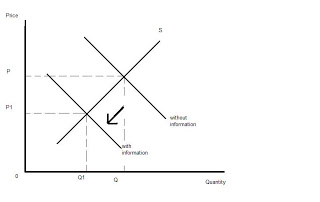
Goods and services divide into inspection, experience and credence goods.
- Inspection goods are goods or services was quality can be determined before purchase price inspecting them;
- Experience goods are goods whose quality is determined after purchase in the course of consuming them; and
- Credence goods are goods whose quality may never be known for sure as to whether the good or service actually worked – was that car repair or medical procedure really necessary?
The problem of adverse selection over experience and credence goods present many potentially profitable but as yet unconsummated wealth-creating transactions because of the uncertainty about quality and reliability.
Buyers are reluctant to buy if they are unsure of quality, but if such assurances can be given in a credible manner, a significant increase in demand is possible.
Any entrepreneur who finds ways of providing credible assurances of the quality of this service or work stands to profit handsomely. Brand names and warranties are examples of market generated institutions that overcome these information gaps through screening and signalling.
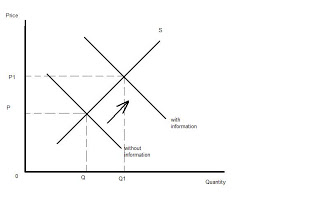
Screening is the less informed party’s effort, usually the buyer, to learn the information that the more informed party has. Successful screens have the characteristic that it is unprofitable for bad types of sellers to mimic the behaviour of good types.
Signalling is an informed party’s effort, usually the seller, to communicate information to the less informed party.
The main issue with quacks in the labour market is whether there are a large cost of less than average quality service, and is there a sub-market who will buy less than average quality products in the presence of competing sellers competing on the basis of quality assurance. This demand for assurance creates opportunities for entrepreneurs to profit by providing assurance.
David Friedman wrote a paper about contract enforcement in cyberspace where the buyer and seller is in different countries so conventional mechanisms such as the courts are futile in cases where the quality of the good is not as promised or there is a failure to deliver at all:
Public enforcement of contracts between parties in different countries is more costly and uncertain than public enforcement within a single jurisdiction.
Furthermore, in a world where geographical lines are invisible, parties to publicly enforced contracts will frequently not know what law those contracts are likely to fall under. Hence public enforcement, while still possible for future online contracts, will be less workable than for the realspace contracts of the past.
A second and perhaps more serious problem may arise in the future as a result of technological developments that already exist and are now going into common use. These technologies, of which the most fundamental is public key encryption, make possible an online world where many people do business anonymously, with reputations attached to their cyberspace, not their realspace, identities
Online auction and sales sites address adverse selection with authentication and escrow services, insurance, and on-line reputations through the rating of sellers by buyers.
E-commerce is flourishing despite been supposedly plagued by adverse selection and weak contract enforcement against overseas venders.
In the labour market, screening and signalling take the form of probationary periods, promotion ladders, promotion tournaments, incentive pay and the back loading of pay in the form of pension investing and other prizes and bonds for good performance over a long period.
In the case of the labour force, there are good arguments that a major reason for investments in education is as a to signal quality, reliability, diligence as well as investment in a credential that is of no value the case of misconduct or incompetence. Lower quality workers will find it very difficult if not impossible to fake quality and reliability in this way – through investing in higher education.
In the case of teacher registration, for example, does a teacher registration system screen out any more low quality candidates for recruitment than do proper reference checks and a police check for a criminal record.
Mostly disciplinary investigations and deregistrations under the auspices of occupational regulation is for gross misconduct and criminal convictions rather than just shading of quality.
Much of personnel and organisational economics is about the screening and sorting of applicants, recruits and workers by quality and the assurance of performance.
Alert entrepreneurs have every incentive to find more profitable ways to manage the quality of their workforce and sort their recruitment pools.
Baron and Kreps (1999) developed the recruitment taxonomy made up of stars, guardians and foot-soldiers.
Stars hold jobs with limited downside risk but high performance is very good for the firm – the costs of hiring errors for stars such as an R&D worker are small: mostly their salary. Foot-soldiers are employees with narrow ranges of good and bad possible outcomes.
Guardians have jobs where bad performance can be a calamity but good job performance is only slightly better than an average performance.
Airline pilots and safety, compliance, finance and controller jobs are all examples of guardian jobs where risk is all downside. Bad performance of these jobs can bring the company down. Dual control is common in guardian jobs.
The employer’s focus when recruiting and supervising guardians is low job performance and not associating rewards and promotions with risky behaviours. Employers will closely screen applicants for guardian jobs, impose long apprenticeships and may limit recruiting to port-of-entry jobs.
The private sector has ample experience in handling risk in recruitment for guardian jobs. Firms and entrepreneurs are subject to a hard budget constraints that apply immediately if they hire quacks and duds.
Blackboard economics says that governments may be able to improve on market performance but as Coase warned that actually implement regulatory changes in real life is another matter:
The policy under consideration is one which is implemented on the blackboard.
All the information needed is assumed to be available and the teacher plays all the parts. He fixes prices, imposes taxes, and distributes subsidies (on the blackboard) to promote the general welfare.
But there is no counterpart to the teacher within the real economic system
Occupational regulation comes with the real risk of the regulation turning into an anti-competitive barrier to entry as Milton Friedman (1962) warned:
The most obvious social cost is that any one of these measures, whether it be registration, certification, or licensure, almost inevitably becomes a tool in the hands of a special producer group to obtain a monopoly position at the expense of the rest of the public.
There is no way to avoid this result. One can devise one or another set of procedural controls designed to avert this outcome, but none is likely to overcome the problem that arises out of the greater concentration of producer than of consumer interest.
The people who are most concerned with any such arrangement, who will press most for its enforcement and be most concerned with its administration, will be the people in the particular occupation or trade involved.
They will inevitably press for the extension of registration to certification and of certification to licensure. Once licensure is attained, the people who might develop an interest in undermining the regulations are kept from exerting their influence. They don’t get a license, must therefore go into other occupations, and will lose interest.
The result is invariably control over entry by members of the occupation itself and hence the establishment of a monopoly position.
Friedman’s PhD was published in 1945 as Income from Independent Professional Practice. With co-author Simon Kuznets, he argued that licensing procedures limited entry into the medical profession allowing doctors to charge higher fees than if competition were more open.
Data Source: Martin Jenkins 2012, Review of Occupational Regulation, released by the Ministry of Business, Innovation and Employment under the Official Information Act.
The value of a statistical life through time in the USA
06 Jul 2014 Leave a comment
in economics of regulation, environmental economics, health economics, technological progress, Thomas Schelling, transport economics Tags: Thomas Schelling, value of life

Thomas Schelling’s crucial contribution in 1968 at RAND was the notion of statistical lives—mortality risks—in contrast to valuing the lives of specific, identified individuals. His insight was that economists could evade the moral thicket of valuing life and instead focus on people’s willingness to trade-off money for small reductions in the risks they face.
Regulation and competition are rhetorical friends and deadly enemies
06 Jul 2014 Leave a comment
in economics of regulation, George Stigler Tags: regulatory capture

George Stigler stubbornly insisted that regulations be judged by their actual results, not their intended results.
How many people has the FDA killed today?
04 Jul 2014 Leave a comment
in economics of regulation, liberalism Tags: drug lags, FDA
Beta blockers regulate hypertension and heart problems. The FDA held up approval of beta blockers for eight years because it believed they caused cancer. Dr. Louis Lasagna of the Tufts University Center for the Study of Drug Development estimated that 119,000 people died who might have been helped by that medication.
Clozaril was first approved and used in 1970 in Europe to treat schizophrenics who did not respond to other medicines. The drug was not approved in the United States until 1990 because companies believed the FDA would reject it on the grounds that 1 per cent of all patients who take the drug contract a blood disease. Clozaril has a beneficial effect on 30 to 50 per cent of patients. FDA delay meant nearly 250,000 people with schizophrenia suffered needlessly.

Mevacor is a cholesterol-lowering drug that became available in Europe in 1989 but did not in the United States until 1992. Taking the drug reduced death due to heart disease by about 55 per cent. During that three-year period as many as a thousand people a year died from heart disease because of this FDA delay.
From 1938 until 1962, the FDA had sixty days to disapprove the application of a new drug. If it did not, the drug could be marketed. The system worked without significant incident.
The dead are many but who did the FDA save from unsafe drugs. There is an infallible test. That test is based on the FDA not being infallible.
The FDA must have made some errors and let some unsafe drugs slip through which caused the hundreds of thousands of deaths needed to make up for the deaths – the premature deaths – that were the result of drug delays. What were those drugs that slipped through the net?
via Unpleasant Economists : The Freeman : Foundation for Economic Education.
The role of equality in subsequently increasing the size of government
30 Jun 2014 Leave a comment
in income redistribution, Public Choice, Sam Peltzman Tags: growth in government

Sam Peltzman argues that:
governments grow where groups which share a common interest in that growth and can perceive and articulate that interest become more numerous.
Growth in the size of governmental is driven by the evolving demands of voters. Peltzman maintains that:
the levelling of income differences across a large part of the population . . . has in fact been a major source of the growth of government in the developed world over the last fifty years [because this levelling created] a broadening of the political base that stood to gain from redistribution generally and thus provided a fertile source of political support for expansion of specific programs. At the same time, these groups became more able to perceive and articulate that interest . . this simultaneous growth of “ability” served to catalyse politically the spreading economic interest in redistribution
Growing income equality, which was a result of the Industrial Revolution and modern economic growth, caused the size of government to then grow. The reduction in inequality preceded the rise of the welfare state in the mid-20th century.


Recent Comments