Excellent news out of the UK. Abrysvo, a vaccine for RSV administered to pregnant women, reduces infant hospitalisation by 80%. From the BBC:A vaccine during pregnancy which protects newborns against nasty chest infections is cutting hospital admissions of babies by more than 80%, UK health officials say.A virus, called RSV, affects many babies in the first…
Medsafe Delenda Est
Medsafe Delenda Est
01 May 2026 Leave a comment
in economics of regulation, health economics, politics - New Zealand Tags: drug lags
This may come as no surprise
30 Apr 2026 Leave a comment
in applied price theory, economics of regulation, health economics, politics - New Zealand Tags: black markets
RNZ reports:An RNZ investigation into the tobacco blackmarket found packs of cigarettes and loose tobacco being sold brazenly over the counter at heavily discounted prices.By law, cigarettes have to include pictures and health warnings covering at least 75-percent of the front of the packs. But the cigarettes being sold on the blackmarket are a throw…
This may come as no surprise
Breaking: Major Under-the-Radar SCOTUS Decision on Climate Lawfare
22 Apr 2026 1 Comment
in economics of climate change, economics of regulation, energy economics, environmental economics, environmentalism, global warming, law and economics, politics - USA, property rights Tags: nuisance suits
There are Supreme Court decisions that arrive with fanfare, and then there are those that quietly rearrange the legal landscape in ways that only become obvious after the dust settles. Today’s decision in Chevron USA Inc. v. Plaquemines Parish belongs firmly in the latter category. It is not packaged as a climate case. It does…
Breaking: Major Under-the-Radar SCOTUS Decision on Climate Lawfare
Matt Ridley thinks the Climate Parrot is almost dead
18 Apr 2026 Leave a comment
in economics of climate change, economics of regulation, energy economics, environmental economics, environmentalism, global warming Tags: solar power, wind power
A central theme in Ridley’s argument is the failure of renewable energy—particularly wind and solar—to deliver reliable and scalable solutions. He described these sources as inherently intermittent and argued that “the transition to them is simply failing to materialize.” While not dismissing renewable energy outright, he questioned why concern about climate change is often equated…
Matt Ridley thinks the Climate Parrot is almost dead
‘Market Power in Antitrust: Economic Analysis after Kodak,’ by Benjamin Klein
17 Apr 2026 Leave a comment
in applied price theory, economics of regulation, history of economic thought, industrial organisation, law and economics, politics - USA Tags: competition law
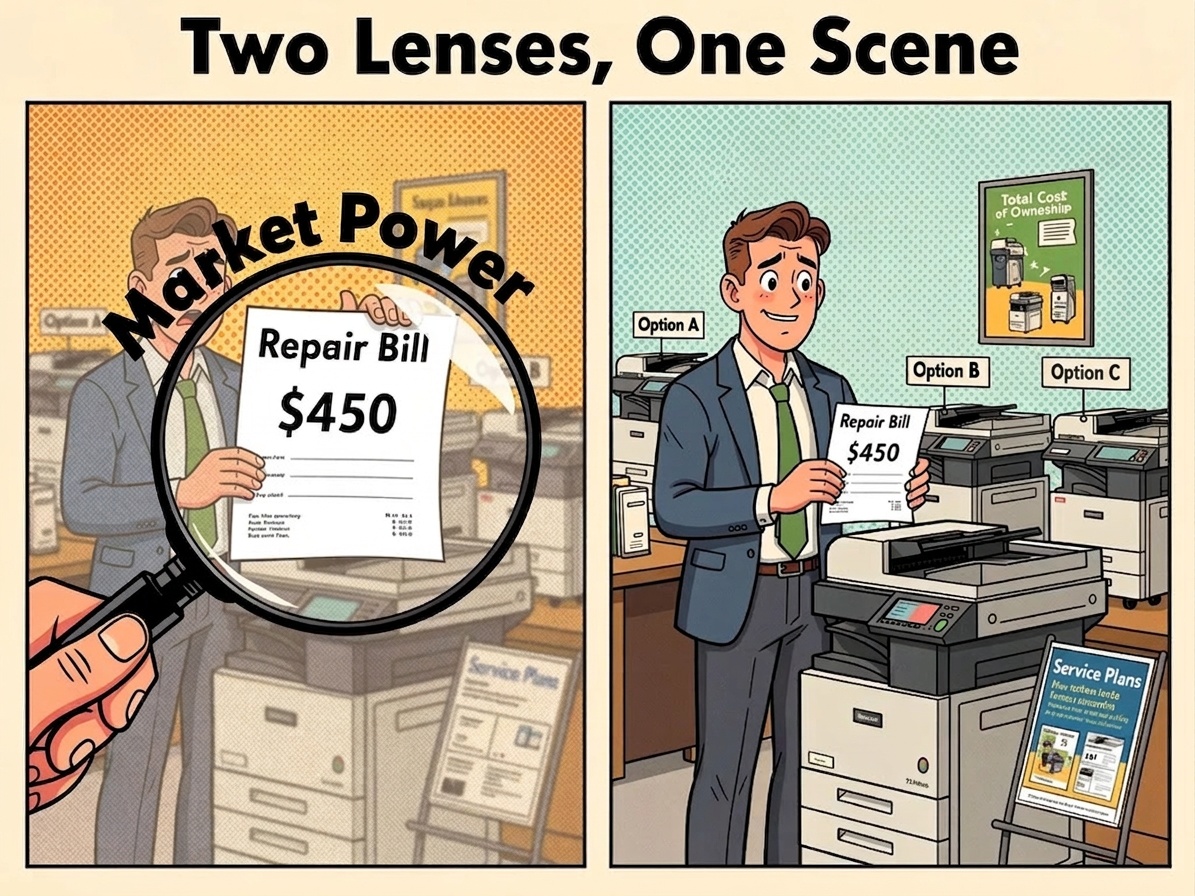
In 1992, the U.S. Supreme Court held in Eastman Kodak Co. v. Image Technical Services that a firm without market power in photocopiers might still possess market power in photocopier parts and service. The Court’s logic turned on opportunistic hold-up: Kodak could profit by trading short-run exploitation of locked-in customers for long-run losses in equipment…
‘Market Power in Antitrust: Economic Analysis after Kodak,’ by Benjamin Klein
The Paramount Question Isn’t Paramount
17 Apr 2026 Leave a comment
in applied price theory, economics of media and culture, economics of regulation, entrepreneurship, industrial organisation, law and economics, managerial economics, market efficiency, movies, organisational economics, politics - USA, television Tags: competition law, creative destruction, merger law enforcement

Big mergers make headlines. They don’t always make antitrust problems. In a previous commentary, I explored the antitrust implications of a potential acquisition of Warner Bros. Discovery (WBD). That uncertainty is now resolved. On Feb. 27, Paramount Skydance Corp. agreed to acquire WBD for roughly $110 billion in enterprise value—$31 per share, all cash. The…
The Paramount Question Isn’t Paramount
Incentives matter, Mexican cartel edition
16 Apr 2026 Leave a comment
in applied price theory, development economics, economics of crime, economics of regulation, law and economics, transport economics, urban economics Tags: Mexico
But the cartel’s interests may prove just as important to security as government efforts, according to a dozen local and state officials and security experts. The CJNG has much to gain from the regional economic boost of a successful tournament in Guadalajara — akin to its administrative headquarters — and much to lose from drawing…
Incentives matter, Mexican cartel edition
A discussion about Anti-Capitalism and “Public Health”
15 Apr 2026 Leave a comment
in applied price theory, comparative institutional analysis, economics of regulation, health economics, liberalism, Marxist economics Tags: nanny state, regressive left
I spoke to my friends at the Sloavkian think tank INESS (the Institute of Economic and Social Studies) recently. We talked about my 2025 paper Anti-Capitalism and Public Health and you can watch the video below.
A discussion about Anti-Capitalism and “Public Health”
La Marxista: Mamdani Pledges to Open First City-Run Store with Projected $30 Million Initial Cost
15 Apr 2026 Leave a comment
in economics of bureaucracy, economics of regulation, history of economic thought, industrial organisation, law and economics, Marxist economics, politics - USA, property rights, Public Choice, survivor principle, urban economics Tags: New York City, state ownership

Mayor Zohran Mamdani used his “First 100 Days” speech this week to announce that he has kept his promise to…
La Marxista: Mamdani Pledges to Open First City-Run Store with Projected $30 Million Initial Cost
The superpower that could unlock billions for KiwiRail – or another railway company
15 Apr 2026 Leave a comment
in economics of regulation, law and economics, politics - New Zealand, property rights, transport economics, urban economics Tags: land supply, zoning
Imagine waking up and discovering that, overnight, you had been granted superpowers. With a touch of your finger, you could cause new housing to emerge in places with housing shortages. It would cost you next to nothing. You could just do it.
The superpower that could unlock billions for KiwiRail – or another railway company
“Evictions are an Act of Policy Violence”: Pressley and Democrats Introduce Eviction Reform Legislation
15 Apr 2026 Leave a comment
in economics of regulation, income redistribution, politics - USA, Public Choice, rentseeking, urban economics Tags: regressive left, rent control

Rep. Ayanna Pressley (D., Mass.) joined fellow Democrats last week in calling for the passage of the Housing Emergencies Lifeline Program…
“Evictions are an Act of Policy Violence”: Pressley and Democrats Introduce Eviction Reform Legislation
That time we gave Cocaine to our kids for a sore throat and toothaches.
12 Apr 2026 Leave a comment
in economic history, economics of regulation, health economics

How things have changed. Nowadays we wouldn’t dream of giving our children cocaine to treat sore throats or toothaches, Firstly because we know how devastating cocaine is and secondly we would be arrested, But in days of yore it was perfectly acceptable to give you offspring and indeed yourself a ‘healthy’ dose of cocaine.
That time we gave Cocaine to our kids for a sore throat and toothaches.
The Fatal Conceit of Cheap Drugs
07 Apr 2026 1 Comment
in applied price theory, Austrian economics, economics of information, economics of regulation, health economics, law and economics, politics - USA, property rights Tags: copyrights and patents, intellectual property

The U.S. Supreme Court agreed to hear Hikma v. Amarin to answer a narrow question. It may end up saying far more about how policymakers misunderstand pharmaceutical markets. On its face, the case is narrow. It asks whether a generic drug manufacturer can face liability for inducing patent infringement based on how it markets a…
The Fatal Conceit of Cheap Drugs
The CA Minimum Wage Increase: Summing Up
06 Apr 2026 1 Comment
in applied price theory, econometerics, economics of regulation, income redistribution, labour economics, labour supply, politics - USA, Public Choice, unemployment
Two recent joint-papers Did California’s Fast Food Minimum Wage Reduce Employment? by Clemens, Edwards and Meer and The Effects of California’s $20 Fast Food Minimum Wage on Prices by Clemens, Edwards, Meer and Nguyen give what I think is a plausible and consistent account of California’s $20 fast food minimum wage. California’s $20 fast food…
The CA Minimum Wage Increase: Summing Up
Quotation of the Day…
05 Apr 2026 Leave a comment
in applied price theory, economics of regulation, labour economics, labour supply, law and economics, Richard Epstein

Tweet… is from page 162 of Richard Epstein’s magnificent 1995 volume, Simple Rules for a Complex World: The entire regulatory process [of wrongful dismissal of workers] shows the constant preoccupation with the direct effects of decisions on named persons, without regard to the vastly greater indirect effects on other persons similarly situated. The effort to…
Quotation of the Day…


Recent Comments