CHART: Since 1995 the CPI for new vehicles has been flat, while the CPI (and wages) increased 60%. What a bargain! http://t.co/DOdlQn8pcK—
Mark J. Perry (@Mark_J_Perry) July 01, 2015
Creative destruction in car prices
07 Oct 2015 Leave a comment
in applied welfare economics, economic history, entrepreneurship, politics - USA, technological progress, transport economics Tags: creative destruction
This Is The Very First Cat Video Posted To YouTube
04 Oct 2015 Leave a comment
in cats, economic history, economics of media and culture, entrepreneurship Tags: cats, YouTube
@GreenpeaceNZ The 25th anniversary of the famous bet between Julian Simon and Paul Ehrlich
03 Oct 2015 Leave a comment
in economics, energy economics, entrepreneurship, environmental economics, resource economics
A 2011 blog post of mine on "the bet" rogerpielkejr.blogspot.com/2011/10/cornuc…
Attached a bigger bin of commodities & bet dates in red http://t.co/SC6HeuRwys—
Roger Pielke Jr. (@RogerPielkeJr) April 29, 2015
Milton Friedman on the ultimate consumer protection
03 Oct 2015 Leave a comment
in applied price theory, applied welfare economics, entrepreneurship, industrial organisation, Milton Friedman, survivor principle Tags: competition and monopoly, consumer protection, consumer sovereignty, The meaning of competition
Creative destruction in music sales
02 Oct 2015 Leave a comment
in economic history, economics of media and culture, entrepreneurship, industrial organisation, Music, survivor principle Tags: creative destruction, entrepreneurial alertness, market selection, The meaning of competition
Money spent on music by average American, 1973-2009
businessinsider.com/these-charts-e… http://t.co/zhJN4j5l1n—
Conrad Hackett (@conradhackett) May 30, 2015
US top incomes – average incomes
02 Oct 2015 Leave a comment
in applied welfare economics, economic history, entrepreneurship
The top 1% in the USA became rather more exclusive since about 1980 and the Reagan revolution. Up until then, far too many middle-class professionals were knocking at the door of the top 1% by having being just a little bit more successful than their peers.

Source: The World Top Incomes Database.
If our Marxist friends are to be believed, ruling class membership should be more exclusive than that. The Rothschilds and Rockefellers and the rest of the gang could not possibly be brushing shoulders with tradesmen made good at meetings of the executive committee of the ruling class.
Hayek’s use of knowledge in society
02 Oct 2015 Leave a comment
in applied price theory, economics of information, entrepreneurship, F.A. Hayek, industrial organisation, survivor principle Tags: competition as a discovery procedure, entrepreneurial alertness, market process, The meaning of competition
The IMF’s Causes and Consequences of Income Inequality: A Global Perspective
02 Oct 2015 2 Comments
in entrepreneurship, human capital, industrial organisation, labour supply, occupational choice, politics - USA, poverty and inequality Tags: entrepreneurial alertness, superstar wages, superstars, top 0.01%, top 0.1%, top 1%, working rich
The IMF has joined the OECD in arguing there is an important connection between inequality and who gains from economic growth.
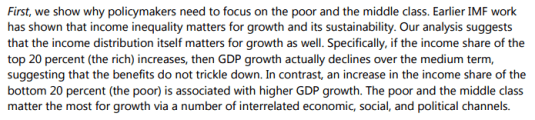
To reach the conclusion that the income distribution matters, the IMF had to tie its master the exact same weak moorings that the OECD did. Specifically the ability of the lower middle class to finance investments in school and higher education.
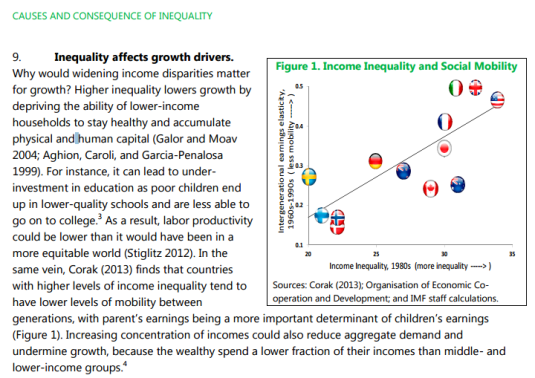
The IMF has articulated a specific hypothesis that can be confronted with facts and logic.
Many critics of inequality are extremely vague about what exactly is the process that grinds the proletariat down. The withering away of the proletariat in the 20th century has been discussed elsewhere on this blog.
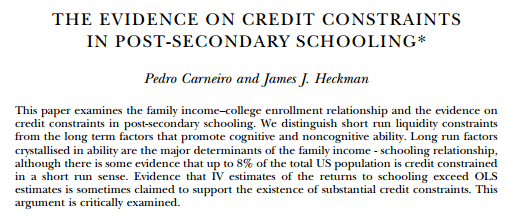
The impact of low income on the ability to accumulate physical and human capital sounds like an interesting question. Not surprisingly, the top labour economists have looked into it.
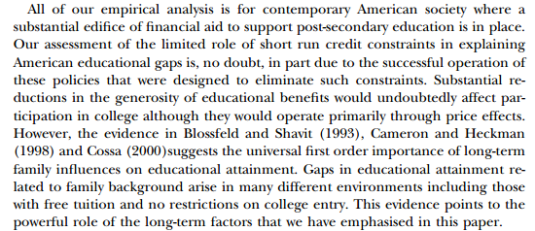
Short-term factors such as the ability to borrow to fund higher education has been found to be seriously wanting. Only a small percentage of people are in any way constrained from going on to higher education because of the lack of money. This is not surprising in any society with student loans freely available at low or zero rates without any need to post collateral.
Wow. I mean, WOW. College completion figures over time by income quartile. bit.ly/16Bb1jh http://t.co/y0MVyiDCEZ—
Richard V. Reeves (@RichardvReeves) February 04, 2015
The notion that the rich are just replicating the good fortunes of their parents has also fallen on hard times despite the persistence of the OECD and the IMF in championing this old Marxist fantasy.
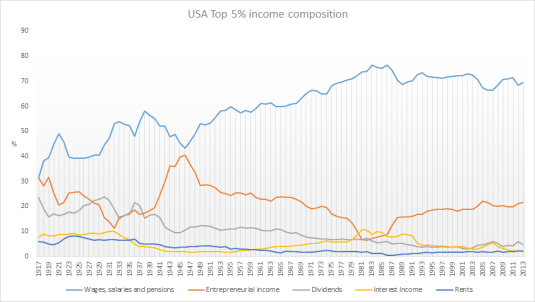
Source: The World Top Incomes Database.
If you look at the income composition of the top 5% of the USA, for example, it is a disappointing story for the IMF and the OECD. Today’s rich are working rich with the majority of their income from wages and salaries and much of the rest from entrepreneurial income. There is no passive rich earning incomes from their inherited investments and grinding the proletariat down.
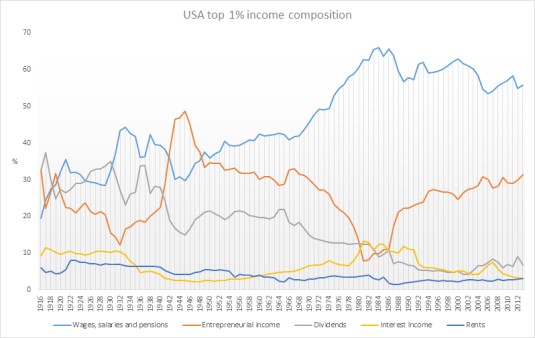
Source: The World Top Incomes Database.
It is the same story with the top 1%. They are working rich with the majority of their incomes paid in wages and salaries and running a business. They are top executives, managers and leading professionals that go to work every day.
Who are today’s supermanagers and why are they so wealthy? equitablegrowth.org/research/today… http://t.co/Ts2OkOUk5g—
Equitable Growth (@equitablegrowth) December 03, 2014
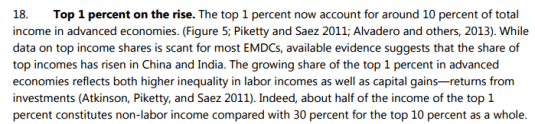
The IMF was simply wrong to claim that at least half the income of the top 1% in the USA was not labour income.
Before 1940, most of the income of the top 0.1% of income earners in the USA was income from investments. By the end of the 20th century, the top 0.1% were earning their incomes as wages and salaries, business incomes and capital gains. Very little of that income of the top 0.1% was in the form of passive income from capital. The top 0.1% of the USA are now working rich – entrepreneurs.
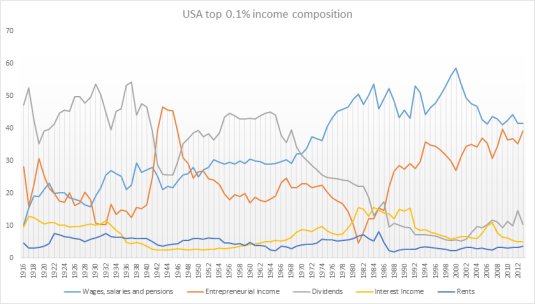
Source: The World Top Incomes Database.
In the good old days of high taxes, the top 0.01% did earn the great majority of their income from passive investment.
Only under the scourge of neoliberalism starting in the 1970s and then massive tax cuts in the Reagan Revolution did the top 0.01% join the working rich. Even the super super-rich have to work for their money these days.
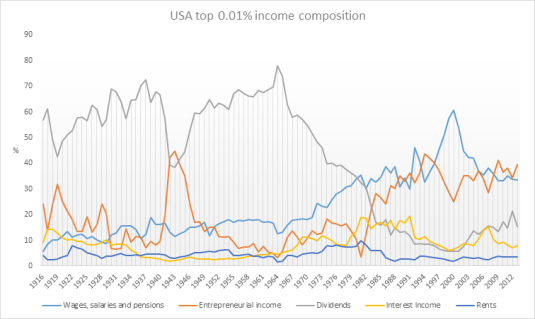
Source: The World Top Incomes Database.
The IMF and before it the OECD were batting from a weak position when they argued that human capital investments of ordinary families is held up by inequality. Student loans to pay for subsidised tuition fees and living expenses solve that problem long ago.
How many of the richest Americans inherited their fortune? Find out. buff.ly/1DNM3g2 http://t.co/QlarE5yAdT—
HumanProgress.org (@humanprogress) August 14, 2015
It was simply wrong of the IMF to claim that the top 5%, 1% and 0.1% of for example the USA are living off the rest of society. In the USA, is usually put forward as the worst-case, the rich and super-rich are working rich making their fortunes by building and running businesses. In The Evolution of Top Incomes: A Historical and International Perspective (NBER Working Paper No. 11955), Thomas Piketty and Emmanuel Saez concluded that:
While top income shares have remained fairly stable in Continental European countries or Japan over the past three decades, they have increased enormously in the United States and other English speaking countries. This rise in top income shares is not due to the revival of top capital incomes, but rather to the very large increases in top wages (especially top executive compensation). As a consequence, top executives (the “working rich”) have replaced top capital owners at the top of the income hierarchy over the course of the twentieth century…
Steven Kaplan and Joshua Rauh make a number of basic points backed up by detailed evidence about top CEO pay:
- While top CEO pay has increased, so has the pay of private company executives and hedge fund and private equity investors;
- ICT advances increase the pay of many – of professional athletes (technology increases their marginal product by allowing them to reach more consumers), Wall Street investors (technology allows them to acquire information and trade large amounts more easily), CEOs and technology entrepreneurs in the Forbes 400; and
- Technology allows top executives and financiers to manage larger organizations and asset pools – a loosening of social norms and a lack of independent control of CEO pacesetting does not explain similar increases in pay for private companies– technology explains it.
The report SuperEntrepreneurs shows that:
- SuperEntrepreneurs founded half the largest new firms created since the end of the Second World War
- There is a strong correlation between high rates of SuperEntrepreneurship in a country and low tax rates
- a low regulatory burden and high rates of philanthropy both correlate strongly with high rates of SuperEntrepreneurship
- Active government and supranational programmes to encourage entrepreneurship – such as the EU’s Lisbon Strategy – have largely failed.
- Yet governments can encourage entrepreneurialism by lowering taxes (particularly capital gains taxes which have a particularly high impact on entrepreneurialism while raising relatively insignificant revenues); by reducing regulations; and by vigorously enforcing property rights.
- High rates of self-employment and innovative entrepreneurship are both important for the economy.
- Yet policy makers should recognise that they are not synonymous and should not assume policies which encourage self-employment necessarily promote entrepreneurship.
John Rawls is often put forward by political progressives as the starting point for political philosophy. Rawls pointed out that behind the veil of ignorance, people will agree to inequality as long as it is to everyone’s advantage. Rawls was attuned to the importance of incentives in a just and prosperous society. If unequal incomes are allowed, this might turn out to be to the advantage of everyone.
Steven Kaplan and Joshua Rauh’s “It’s the Market: The Broad-Based Rise in the Return to Top Talent”, Journal of Economic Perspectives (2013) found that:
- Rising inequality is due to technical changes that allow highly talented individuals or “superstars” to manage or perform on a much larger scale.
- These superstars can now apply their talents to greater pools of resources and reach larger numbers of people and markets at home and abroad. They thus became more productive, and higher paid.
- Those in the Forbes 400 richest are less likely to have inherited their wealth or have grown up wealthy.
- Today’s rich are working rich who accessed education in their youth and then applied their natural talents and acquired skills to the most scalable industries such as ICT, finance, entertainment, sport and mass retailing.
- The U.S. evidence on income and wealth shares for the top 1% is most consistent with a “superstar” explanation. This evidence is less consistent with the gains in earnings of the top 1% coming from greater managerial power over the determination of their own pay in the corporate world, or changes in social norms about what managers could earn.
Today’s super-rich are highly productive because they produce new and better products and services that people want and are willing to pay for. These rewards for entrepreneurship and hard work guide people of different talents and skills into the occupations and industries where their talents are valued the most. The efficient allocation of talent and income maximising occupational choices were important to Rawls’ framework.
The IMF and World Bank should look for policies that remove barriers to riches. Instead, the IMF and OECD are giving support to those who want to tax and regulate the super-rich that drive much of the innovation, entrepreneurship and creative destruction in modern economies.
Creative destruction in cable TV
01 Oct 2015 Leave a comment
in economics of media and culture, entrepreneurship, industrial organisation, survivor principle Tags: cable TV, creative destruction, economics of television, Hollywood economics
Google wants to break the grip cable and satellite-TV companies have over the set-top box bloom.bg/1GbGDqz http://t.co/zGj4OBTzq3—
Bloomberg Business (@business) September 29, 2015
How much does it cost to produce an Apple iPhone S6?
30 Sep 2015 1 Comment
in applied price theory, economics of media and culture, entrepreneurship Tags: creative destruction, Iphone, smart phones
How much do all the components in an iPhone 6S cost Apple? And how does that compare to the price you pay? http://t.co/gbqJIXBov4—
paulkirby (@paul1kirby) September 28, 2015

Drug Price Controls End Up Costing Patients Their Lives
24 Sep 2015 Leave a comment
in applied price theory, applied welfare economics, comparative institutional analysis, economics of regulation, entrepreneurship, health economics, industrial organisation, law and economics, politics - USA, property rights, survivor principle Tags: creative destruction, endogenous growth theory, innovation, intellectual property rights, patents and copyrights, pharmaceutical innovation, price controls
Our research shows that when prices fall, innovation falls even more. Patients would see their lives cut short by delayed or absent drugs.
Source: Drug Price Controls End Up Costing Patients Their Health – NYTimes.com
…cutting prices by 40 to 50 percent in the United States will lead to between 30 and 60 percent fewer R and D projects being undertaken in the early stage of developing a new drug. Relatively modest price changes, such as 5 or 10 percent, are estimated to have relatively little impact on the incentives for product development – perhaps a negative 5 percent.
Source: The Effect of Price Controls on Pharmaceutical Research


Is this evidence of the great stagnation?
24 Sep 2015 Leave a comment
in applied price theory, economic history, entrepreneurship, industrial organisation, survivor principle, technological progress Tags: creative destruction, great stagnation, The Great Enrichment
Are today's young Americans the luckiest generation in history? ow.ly/R425e @Mark_J_Perry @AEIdeas http://t.co/8lHZNkq1Ak—
AEI on Campus (@AEIonCampus) August 18, 2015
Entrepreneurial alertness in vehicle emissions testing
23 Sep 2015 1 Comment
in economics of crime, entrepreneurship, environmental economics, industrial organisation, law and economics, survivor principle, transport economics Tags: air pollution, entrepreneurial alertness, vehicle emissions testing, Volkswagen
Here's how Volkswagen's system for fooling the emission tests worked: nyti.ms/1Fdlcus http://t.co/U7hlLejNK0—
NYT Business (@nytimesbusiness) September 22, 2015
Many conservationists are against effective rhino conservation
23 Sep 2015 Leave a comment
in applied price theory, development economics, entrepreneurship, environmental economics, growth disasters, growth miracles, law and economics, property rights Tags: Africa, agricultural economics, do gooders, economics of conservation, economics of endangered species, endangered species, expressive voting, Leftover Left, Twitter left, unintended consequences
https://twitter.com/ConversationUK/status/646227223716872197/photo/1
https://twitter.com/dlAfrican/status/646215227076292608
Capturing the economic value of wildlife for the benefit of wildlife. New in PERC Reports: bit.ly/1JHerwj http://t.co/yijFIChPDo—
PERC (@PERCtweets) September 13, 2015
How private ownership and trophy hunting saved the southern white rhino: bit.ly/1HhZy55 #WorldRhinoDay http://t.co/s4PudPwrrI—
PERC (@PERCtweets) September 22, 2015
 Utopia, you are standing in it!
Recent Comments