The just resigned Chair of the NZ Green Investment Fund (NZGIF) and Chancellor of Auckland University, Cecilia Tarrant, previously worked at Morgan Stanley Bank in New York, starting in 1997 and finishing in 2009. She’s a very nice person, a lawyer by training, and Structured Products expert, in particular on Mortgage Backed Securities. The collapse of…
Call in the Bailiffs: How the NZ Government’s Green Investment Fund Turned Itself Into an Unpleasant Predatory Lender and Debt Collection Agency.
Call in the Bailiffs: How the NZ Government’s Green Investment Fund Turned Itself Into an Unpleasant Predatory Lender and Debt Collection Agency.
16 Dec 2024 1 Comment
in applied price theory, comparative institutional analysis, energy economics, entrepreneurship, environmental economics, law and economics, politics - New Zealand, property rights Tags: solar power
#OTD a monopoly was born!?
15 Dec 2024 Leave a comment
in economic history, entrepreneurship, industrial organisation, survivor principle Tags: competition law, creative destruction, merger law enforcement

The NZ Green Investment Fund should be Liquidated for Losing Money that could’ve gone into alleviating Poverty.
13 Dec 2024 Leave a comment
in economics of bureaucracy, economics of climate change, energy economics, entrepreneurship, environmental economics, environmentalism, financial economics, global warming, politics - New Zealand, Public Choice, rentseeking

Only a few months ago, the Chair of the NZ Green Investment Fund (NZGIF) and Chancellor of the University of Auckland, Cecilia Tarrant, visited my “Law and Economics” class. Why? She’s a lawyer who worked in “structured products” and “real estate finance” at Morgan Stanley in New York – and knows a Kiwi friend of…
The NZ Green Investment Fund should be Liquidated for Losing Money that could’ve gone into alleviating Poverty.
“This is Not the Time for Balance”: LA Times Columnist Resigns in Protest . . . Over Balanced Commentary
13 Dec 2024 Leave a comment
in entrepreneurship, financial economics, industrial organisation, law and economics, politics - USA, property rights, survivor principle Tags: media bias

When now President-Elect Donald Trump was convicted, the thrill-kill atmosphere around the courthouse and the country was explosive, but no one was more ecstatic than liberal columnist and former prosecutor Harry Litman. The then L.A. Times columnist told MSNBC’s Nicolle Wallace that it was a “majestic day” and “a day to celebrate.” A lawfare advocate, […]
“This is Not the Time for Balance”: LA Times Columnist Resigns in Protest . . . Over Balanced Commentary
More on Business Dynamism
11 Dec 2024 Leave a comment
in applied price theory, economic history, economics of bureaucracy, economics of regulation, entrepreneurship, financial economics, income redistribution, industrial organisation, labour economics, labour supply, managerial economics, organisational economics, personnel economics, Public Choice, rentseeking, survivor principle, theory of the firm Tags: creative destruction, employment law
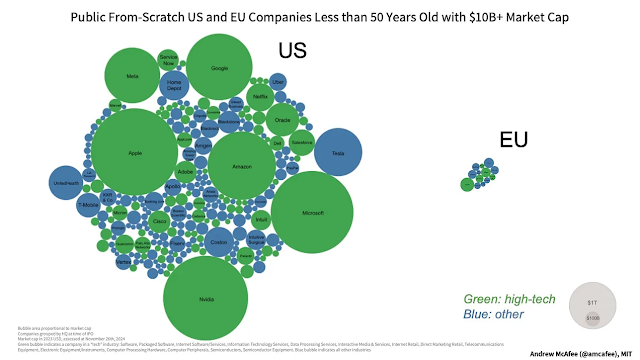
Over at the Geek Way, Andrew McAfee has created a startling visualization related to entrepreneurship in the US and EU. The Draghi Report on EU competitiveness is generating a small buzz among economists. One startling claim is thatthere is no EU company with a market capitalisation over EUR 100 billion that has been set up…
More on Business Dynamism
Nobody Wants To Build Wind Farms In The North Sea
10 Dec 2024 1 Comment
in economics of climate change, energy economics, entrepreneurship, environmental economics, environmentalism, global warming, industrial organisation, resource economics, survivor principle Tags: wind power

By Paul Homewood h/t Hugh Sharman If wind power was so cheap, you would think they would be queuing up to build them: The Danish Energy Agency has not received a single bid for any of the three offshore wind farms in the North Sea, the agency said in a […]
Nobody Wants To Build Wind Farms In The North Sea
Reality Forces Reason into Power Choices
09 Dec 2024 2 Comments
in energy economics, entrepreneurship, industrial organisation, politics - USA Tags: nuclear energy, solar power, wind power
Amazon executives realized their very profitable data centers would fail if they kept posturing with renewable energy.
Reality Forces Reason into Power Choices
How is the Russian war economy doing?
08 Dec 2024 1 Comment
in applied price theory, defence economics, development economics, economic growth, economics of regulation, entrepreneurship, fiscal policy, growth disasters, income redistribution, industrial organisation, international economics, law and economics, macroeconomics, monetary economics, property rights, Public Choice, war and peace Tags: Russia, Ukraine
Here is a gloomy account from Vladimir Mirov: Ruble depreciation will contribute to inflation even further, as Russia is continued to be heavily reliant on imports – this is a kind of self-sustaining spiral. I also strongly disagree with those who say that cheaper ruble is “good” for exporters and the budget. Exporters have yet […]
How is the Russian war economy doing?
Why are no trillion dollar companies being created in Europe?
07 Dec 2024 1 Comment
in applied price theory, comparative institutional analysis, economics of regulation, entrepreneurship, human capital, industrial organisation, labour economics, labour supply, law and economics, occupational choice, poverty and inequality Tags: employment law
That is the theme of a new Substack by Pieter Garicano, here is one excerpt: These answers, according to a recent paper by Olivier Coste and Yann Coatanlem, two French investors, miss the point: the reason more capital doesn’t flow towards high-leverage ideas in Europe is because the price of failure is too high. Coste estimates that, […]
Why are no trillion dollar companies being created in Europe?
Why are no trillion dollar companies being created in Europe?
07 Dec 2024 Leave a comment
in applied price theory, economics of regulation, entrepreneurship, industrial organisation, labour economics, law and economics, property rights
That is the theme of a new Substack by Pieter Garicano, here is one excerpt: These answers, according to a recent paper by Olivier Coste and Yann Coatanlem, two French investors, miss the point: the reason more capital doesn’t flow towards high-leverage ideas in Europe is because the price of failure is too high. Coste estimates that, […]
Why are no trillion dollar companies being created in Europe?
What is the price of production at nighttime?
05 Dec 2024 Leave a comment
in economics of climate change, energy economics, entrepreneurship, environmental economics, environmentalism, global warming, Public Choice, rentseeking Tags: solar power
The Missing Myths
04 Dec 2024 Leave a comment
in applied price theory, comparative institutional analysis, constitutional political economy, discrimination, economic history, economics of climate change, economics of information, economics of media and culture, economics of regulation, energy economics, entrepreneurship, environmental economics, environmentalism, financial economics, gender, global warming, health economics, human capital, income redistribution, labour economics, labour supply, law and economics, liberalism, libertarianism, Marxist economics, occupational choice, politics - USA, poverty and inequality, property rights, Public Choice, rentseeking Tags: Age of Enlightenment, crime and punishment, criminal deterrence, free speech, gender wage gap, law and order, political correctness, racial discrimination, regressive left, sex discrimination
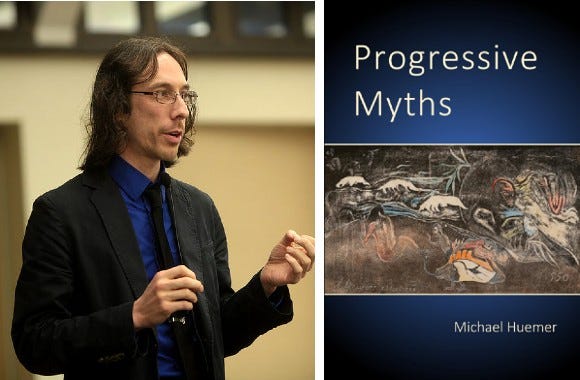
Michael Huemer’s Progressive Myths is the best book on wokeness. One of its many strengths is its focus on basic facts. As the author explains:I have selected beliefs that can be debunked fairly quickly and forcefully. Many other progressive beliefs require long argumentation and subjective judgment calls to assess. About these more difficult issues, I…
The Missing Myths
Paul Krugman Is Right…albeit Selectively and Hypocritically
04 Dec 2024 Leave a comment
in applied price theory, comparative institutional analysis, economic history, economics of bureaucracy, economics of regulation, entrepreneurship, income redistribution, industrial organisation, international economics, law and economics, politics - USA, property rights, Public Choice, public economics, rentseeking Tags: tarrifs
I like profits. But let me qualify that statement. I like profits that are the result of businesses providing goods and services that consumers value. Those profits are earned. By contrast, I don’t like it when businesses get in bed with government and get money via cronyism, bailouts, subsidies, protectionism, or industrial policy. Those profits […]
Paul Krugman Is Right…albeit Selectively and Hypocritically
The Consequences of Limiting the Tax Deductibility of R&D
03 Dec 2024 Leave a comment
in applied price theory, econometerics, entrepreneurship, fiscal policy, macroeconomics, Public Choice, public economics Tags: taxation and entrepreneurship, taxation and investment
We study the tax payment and innovation consequences of limiting the tax deductibility of research and development (“R&D”) expenditures. Beginning in 2022, U.S. companies are required to capitalize and amortize R&D rather than immediately deduct these expenditures. We utilize variation in U.S. firms’ fiscal year ends to test the effects of the R&D tax change […]
The Consequences of Limiting the Tax Deductibility of R&D
Another corporate welfare failure
02 Dec 2024 Leave a comment
in applied price theory, comparative institutional analysis, energy economics, entrepreneurship, environmental economics, financial economics, global warming, income redistribution, industrial organisation, politics - New Zealand, Public Choice, rentseeking, survivor principle Tags: climate alarmism
The Herald reported: The Government has $115 million at risk from the collapse of SolarZero. Finance Minister Nicola Willis said she was seeking urgent advice on the SolarZero situation. She had no further comment. NZ Green Investment Finance – a “green investment bank” created by the previous Government to fund environmentally-friendly businesses – made a $145m…
Another corporate welfare failure
 Utopia, you are standing in it!
Recent Comments