Conventional antitrust enforcement tries to prevent harmful mergers by blocking them but empirical evidence shows that rival stock prices often rise when a merger is blocked—suggesting that many blocked mergers would have increased competition. In other words, we may be stopping the wrong mergers. In a clever proposal, Ayres, Hemphill, and Wickelgren (2024) argue that […]
Shorting Your Rivals: A Radical Antitrust Remedy
Shorting Your Rivals: A Radical Antitrust Remedy
24 Jul 2025 Leave a comment
in applied price theory, economics of regulation, entrepreneurship, financial economics, industrial organisation Tags: competition law, competition law enforcement, mergers
Markets in everything, bet on tariff repeal edition
23 Jul 2025 Leave a comment
in applied price theory, entrepreneurship, financial economics, international economics, politics - USA Tags: tarrifs
Cantor Fitzgerald, a financial services company led by the sons of US Commerce Secretary Howard Lutnick, has offered to buy the right to hundreds of millions of dollars in potential refunds from companies that have paid Trump’s tariffs. The offer means that the sons of the pro-tariff commerce secretary, Kyle and Brandon, have made a way for […]
Markets in everything, bet on tariff repeal edition
Creative destruction
23 Jul 2025 Leave a comment
in economic history, entrepreneurship, industrial organisation Tags: creative destruction

Failing to Learn the Lessons of History
01 Jul 2025 1 Comment
in applied price theory, economics of bureaucracy, entrepreneurship, income redistribution, industrial organisation, labour economics, politics - USA, Public Choice, public economics, unions, urban economics
Plenty of people have commented on New York City mayoral candidate Zohran Mamdani’s proposal to lower food prices by creating city-owned grocery stores, but there is still more to be said about this plan. Mamdani either thinks or believes that voters think that store owners are making huge profit through … Continue reading →
Failing to Learn the Lessons of History
Supersonics Takeoff!
27 Jun 2025 1 Comment
in economics of regulation, entrepreneurship, transport economics
In Lift the Ban on Supersonics I wrote: Civilian supersonic aircraft have been banned in the United States for over 50 years! In case that wasn’t clear, we didn’t ban noisy aircraft we banned supersonic aircraft. Thus, even quiet supersonic aircraft are banned today. This was a serious mistake. Aside from the fact that the noise was exaggerated, technological development […]
Supersonics Takeoff!
How America Built the World’s Most Successful Market for Generic Drugs
06 Jun 2025 1 Comment
in applied price theory, economics of regulation, entrepreneurship, health economics, industrial organisation Tags: drug lags
The United States has some of the lowest prices in the world for most drugs. The U.S. generic drug market is competitive and robust—but its success is not accidental. It is the result of a series of deliberate, well-designed policy interventions. The 1984 Hatch-Waxman Act allowed generic drug manufacturers to bypass costly safety and efficacy […]
How America Built the World’s Most Successful Market for Generic Drugs
Why the U.S. Produces More Unicorns Than China and the EU
01 Jun 2025 1 Comment
in applied price theory, comparative institutional analysis, development economics, economic history, economics of regulation, entrepreneurship, human capital, industrial organisation, labour economics, occupational choice, poverty and inequality, survivor principle Tags: creative destruction
The United States has produced about twice as many unicorns (private startups valued at $1B+) as China and more than four times as many as the European Union. These numbers reflect deep institutional and cultural advantages in the U.S. startup ecosystem. Table: Number of Unicorns Created Since ~1990 Region Cumulative Unicorns United States ~1,950 China…
Why the U.S. Produces More Unicorns Than China and the EU
The (deeply underwhelming) Budget
23 May 2025 Leave a comment
in applied price theory, budget deficits, economic growth, economics of regulation, entrepreneurship, fiscal policy, macroeconomics, politics - New Zealand, Public Choice, public economics

Michael Reddell writes – There were good things in the Budget. There may be few/no votes in better macroeconomic statistics and, specifically, a monthly CPI but – years late (for which the current government can’t really be blamed) – it is finally going to happen.
The (deeply underwhelming) Budget
Pro-Market & Pro-Business: Firms Strive to Satisfy the Customer
22 May 2025 Leave a comment
in applied price theory, comparative institutional analysis, economics of information, economics of regulation, entrepreneurship, history of economic thought, industrial organisation, labour economics, law and economics, property rights
Econ 101 is Underrated: Pharma Price Controls
22 May 2025 Leave a comment
in applied price theory, development economics, economics of regulation, entrepreneurship, health economics, law and economics, politics - USA, property rights Tags: 2024 presidential election, patents and copyrights, price controls, price discrimination
Econ 101 is often dismissed as too simplistic. Yet recent events suggest that Econ 101 is underrated. Take the tariff debate: understanding that a tariff is a tax, that prices represent opportunity costs, that a bilateral trade deficit is largely meaningless, that a so-called trade “deficit” is equally a goods surplus or an investment surplus—these […]
Econ 101 is Underrated: Pharma Price Controls
Kevin Gentry Talks With Me About Trade and Phil Gramm’s and My New Book
20 May 2025 Leave a comment
in applied price theory, applied welfare economics, Austrian economics, comparative institutional analysis, development economics, economic history, economics of regulation, entrepreneurship, history of economic thought
TweetThanks for the honor, Kevin! The post Kevin Gentry Talks With Me About Trade and Phil Gramm’s and My New Book appeared first on Cafe Hayek.
Kevin Gentry Talks With Me About Trade and Phil Gramm’s and My New Book
Propping up the film sector or stimulating growth?
19 May 2025 Leave a comment
in economics of media and culture, entrepreneurship, industrial organisation, movies, politics - New Zealand, Public Choice, rentseeking, survivor principle, television Tags: corporate welfare
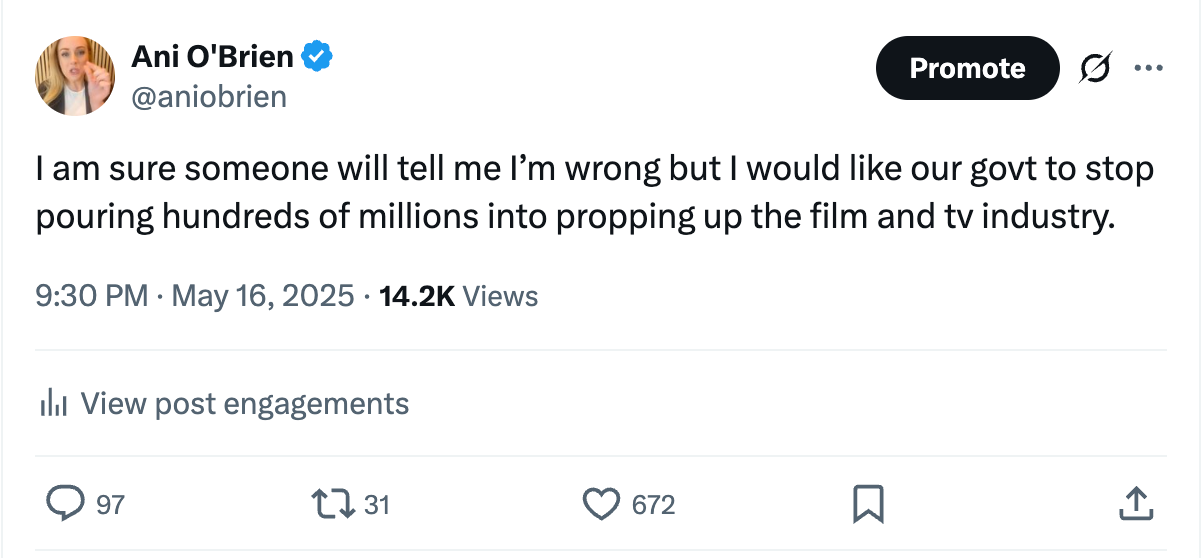
Ani O’Brien writes – On Friday night, having imbibed a few wines I strayed onto X to unwisely engage in some (slightly drunk) opinion sharing. I tweeted:
Propping up the film sector or stimulating growth?
Supply is elastic, installment #6437
14 May 2025 Leave a comment
in applied price theory, entrepreneurship, health economics, industrial organisation, politics - USA, Public Choice, rentseeking Tags: price controls
Numerous empirical studies show a relationship between a drug’s expected market size and the magnitude of research and development investments. Early studies focused on changes to market size resulting from the demographics of disease burden (Acemoglu and Linn 2004) and policy changes influencing market demand (Finkelstein 2004). These findings have largely been confirmed by more […]
Supply is elastic, installment #6437
The Economic Consequences of Ever-Growing Government in Finland
10 May 2025 1 Comment
in applied price theory, economic growth, entrepreneurship, human capital, labour economics, labour supply, macroeconomics, Public Choice Tags: Finland, taxation and entrepreneurship, taxation and investment, taxation and labour supply

I’m currently in Finland for meetings with various people and I learned that the country’s bloated public sector and expensive welfare state are imposing a very heavy cost on the economy. How heavy of a cost? According to IMF data, there’s been no growth in per-capita GDP over the past 18 years. Why is Finland […]
The Economic Consequences of Ever-Growing Government in Finland
Buffett’s Alpha
05 May 2025 Leave a comment
in entrepreneurship, financial economics Tags: active investing
Berkshire Hathaway has realized a Sharpe ratio of 0.76, higher than any other stock or mutual fund with a history of more than 30 years, and Berkshire has a significant alpha to traditional risk factors. However, we find that the alpha becomes insignificant when controlling for exposures to Betting-Against-Beta and Quality-Minus-Junk factors. Further, we estimate […]
Buffett’s Alpha


Recent Comments