1993 vs 2013: http://t.co/tdnNqmRmcS—
History Pics (@HistoryPixs) January 08, 2014
Creative destruction in digital devices
01 Jun 2015 Leave a comment
in economics of media and culture, entrepreneurship, industrial organisation, survivor principle, technological progress Tags: cell phones, creative destruction, entrepreneurial alertness, PCs, smart phones, The Great Enrichment
How much of the top 0.1% are now working rich in the USA, 1916–2013, and Canada, 1946–2007
01 Jun 2015 Leave a comment
in economic history, entrepreneurship, human capital, industrial organisation, labour economics, labour supply, occupational choice, survivor principle Tags: Canada, CEO pay, creative destruction, entrepreneurial alertness, super-entrepreneurs, superstar wages, superstars, top 0.1%, top 1%, working rich
Piketty and Saez (2003) concluded that a substantial fraction of the rise in top incomes was due to surging top wage incomes. They concluded that top executives (the ‘working rich’) replaced top capital owners (the ‘rentiers’) at the top of the income hierarchy.
That conclusion still holds for both the USA and Canada. The largest portion of the top 0.1% in both countries have become those earning wages. The top 0.1% are top wage earners who work for their livings founding, building or directing businesses.
Figure 1: percentage of top 0.1% with wages, salaries, pensions or entrepreneurial incomes, USA, 1916 – 2013
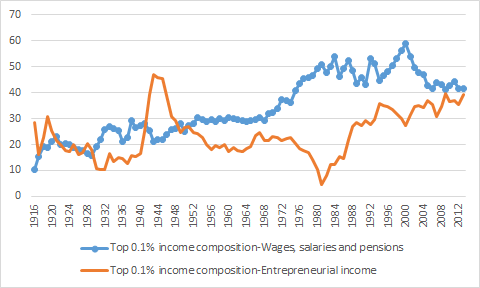
Source: Alvaredo, Facundo, Anthony B. Atkinson, Thomas Piketty and Emmanuel Saez, The World Top Incomes Database.
Figure 2: percentage of top 0.1% with incomes from interest, dividends and rents, USA, 1916 – 2013
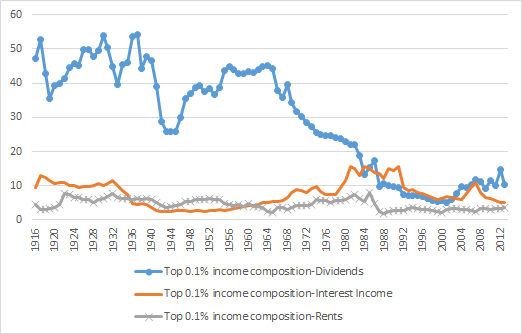
Source: Alvaredo, Facundo, Anthony B. Atkinson, Thomas Piketty and Emmanuel Saez, The World Top Incomes Database.
Figure 3: percentage of top 0.1% with wage salary and pension incomes, business incomes and professional incomes, Canada, 1946 – 2007
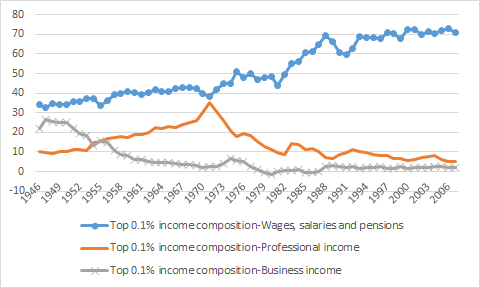
source : Alvaredo, Facundo, Anthony B. Atkinson, Thomas Piketty and Emmanuel Saez, The World Top Incomes Database.
Figure 4: percentage of top 0.1% with dividend, interest or investment incomes, Canada, 1946 – 2007

Source: Alvaredo, Facundo, Anthony B. Atkinson, Thomas Piketty and Emmanuel Saez, The World Top Incomes Database.
Creative destruction in television prices in New Zealand
01 Jun 2015 1 Comment
in economics of media and culture, entrepreneurship, politics - New Zealand, technological progress Tags: creative destruction, good old days


Creative destruction in content control
01 Jun 2015 Leave a comment
in economic history, economics of media and culture, entrepreneurship, industrial organisation, survivor principle Tags: consumer sovereignty, creative destruction, entrepreneurial alertness, media bias

I might do most of these. Do you?
31 May 2015 2 Comments
in economics of media and culture, entrepreneurship, industrial organisation Tags: cell phones, creative destruction, entrepreneurial alertness, PCs, smart phones

Does Inequality Reduce Economic Growth: A Sceptical View
30 May 2015 Leave a comment
in applied price theory, applied welfare economics, comparative institutional analysis, development economics, economic history, entrepreneurship, growth disasters, growth miracles, income redistribution, politics - Australia, politics - New Zealand, politics - USA, Public Choice, public economics, rentseeking Tags: entrepreneurial alertness, Leftover Left, taxes and the labour supply, The inequality and growth, Thomas Piketty, top 1%, Twitter left
Tim Taylor, the editor of the Journal of Economic Perspectives, has written a superb blog post on why we should be sceptical about a strong relationship between inequality and economic growth. Taylor was writing in response to the OECD’s recent report "In It Together: Why Less Inequality Benefits All,".
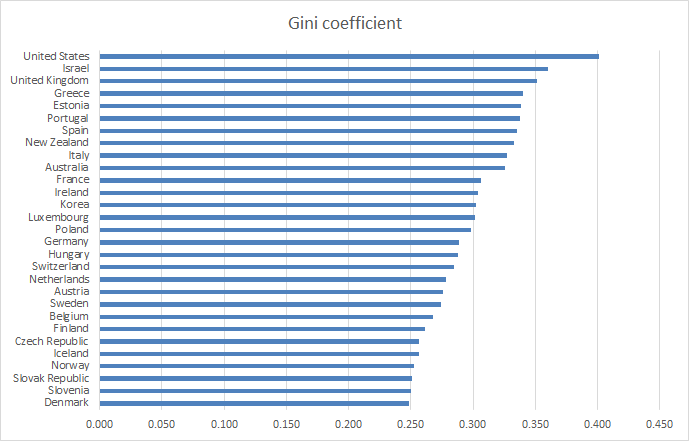
Taylor’s basic point is economists have enough trouble working out what causes economic growth so trawling within that subset of causes to quantify the effects of rising or falling inequality inequality seems to be torturing the data to confess. The empirical literature is simply inconclusive as Taylor says:
A variety of studies have undertaken to prove a connection from inequality to slower growth, but a full reading of the available evidence is that the evidence on this connection is inconclusive.
Most discussions of the link between inequality and growth are notoriously poor of theories connecting two. There are three credible theories in all listed in the OECD’s report:
The report first points out (pp. 60-61 that as a matter of theory, one can think up arguments why greater inequality might be associated with less growth, or might be associated with more growth. For example, inequality could result less growth if:
1) People become upset about rising inequality and react by demanding regulations and redistributions that slow down the ability of an economy to produce growth;
2) A high degree of persistent inequality will limit the ability and incentives of those in the lower part of the income distribution to obtain more education and job experience; or
3) It may be that development and widespread adoption of new technologies requires demand from a broad middle class, and greater inequality could limit the extent of the middle class.
About the best theoretical link between inequality and economic growth is what Taylor calls the "frustrated people killing the goose that lays the golden eggs." Excessive inequality within a society results in predatory government reactions at the behest of left-wing or right-wing populists.

Taylor refers to killing the goose that laid the golden egg as dysfunctional societal and government responses to inequality. He is right but that is not how responses to inequality based on higher taxes and more regulation are sold. Thomas Piketty is quite open about he wants a top tax rate of 83% and a global wealth tax to put an end to high incomes:
When a government taxes a certain level of income or inheritance at a rate of 70 or 80 percent, the primary goal is obviously not to raise additional revenue (because these very high brackets never yield much).
It is rather to put an end to such incomes and large estates, which lawmakers have for one reason or another come to regard as socially unacceptable and economically unproductive…
The left-wing parties don’t say let’s put up taxes and redistribute so that is not something worse and more destructive down the road. Their argument is redistribution will increase growth or at least not harm it. That assumes the Left is addressing this issue of not killing the goose that lays the golden egg at all.

Once you discuss the relationship between inequality and growth in any sensible way you must remember your John Rawls. Incentives encourage people to work, save and invest and channels them into the occupations where they make the most of their talents. Taylor explains:
In the other side, inequality could in theory be associated with faster economic growth if: 1) Higher inequality provides greater incentives for people to get educated, work harder, and take risks, which could lead to innovations that boost growth; 2) Those with high incomes tend to save more, and so an unequal distribution of income will tend to have more high savers, which in turn spurs capital accumulation in the economy.
Taylor also points out that the OECD’s report is seriously incomplete by any standards because it fails to mention that inequality initially increases in any poor country undergoing economic development:
The report doesn’t mention a third hypothesis that seems relevant in a number of developing economies, which is that fast growth may first emerge in certain regions or industries, leading to greater inequality for a time, before the gains from that growth diffuse more widely across the economy.
At a point in its report, the OECD owns up to the inconclusive connection between economic growth and rising inequality as Taylor notes:
The large empirical literature attempting to summarize the direction in which inequality affects growth is summarised in the literature review in Cingano (2014, Annex II).
That survey highlights that there is no consensus on the sign and strength of the relationship; furthermore, few works seek to identify which of the possible theoretical effects is at work. This is partly tradeable to the multiple empirical challenges facing this literature.
The OECD’s report responds to this inclusiveness by setting out an inventory of tools with which you can torture the data to confess to what you want as Taylor notes:
There’s an old saying that "absence of evidence is not evidence of absence," in other words, the fact that the existing evidence doesn’t firmly show a connection from greater inequality to slower growth is not proof that such a connection doesn’t exist.
But anyone who has looked at economic studies on the determinants of economic growth knows that the problem of finding out what influences growth is very difficult, and the solutions aren’t always obvious.
The chosen theory of the OECD about the connection between inequality and economic growth is inequality leads to less investment in human capital at the bottom part of the income distribution.
[Inequality] tends to drag down GDP growth, due to the rising distance of the lower 40% from the rest of society. Lower income people have been prevented from realising their human capital potential, which is bad for the economy as a whole
I found this choice of explanation curious. So did Taylor as the problem already seems to have been solved:
There are a few common patterns in economic growth. All high-income countries have near-universal K-12 public education to build up human capital, along with encouragement of higher education. All high-income countries have economies where most jobs are interrelated with private and public capital investment, thus leading to higher productivity and wages.
All high-income economies are relatively open to foreign trade. In addition, high-growth economies are societies that are willing to allow and even encourage a reasonable amount of disruption to existing patterns of jobs, consumption, and ownership. After all, economic growth means change.
In New Zealand, interest free student loans are available to invest in higher education as well as living allowances for those with parents on a low income. There are countries in Europe with low levels of investment in higher education but that’s because of high income taxes not because of inequality.
The OECD’s report is fundamentally flawed which is disappointing because most research from the OECD is to a good standard.
via CONVERSABLE ECONOMIST: Does Inequality Reduce Economic Growth: A Skeptical View.
Did changes in capital gains and dividend tax rates caused the dot.com bubble to begin and end?
30 May 2015 Leave a comment
in applied price theory, economic history, entrepreneurship, financial economics, public economics Tags: capital gains tax, dot.com bubble, entrepreneurial alertness, tax arbitrage
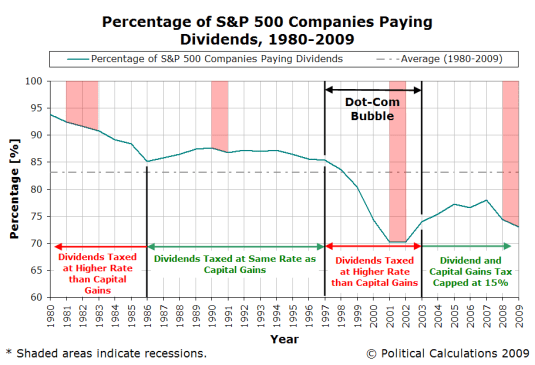
…the Taxpayer Relief Act of 1997 left dividend tax rates unchanged – they continued to be taxed at the same rates as regular income in the United States, which provided a powerful incentive for investors to treat the two kinds of stocks very differently, favouring the low-to-no dividend paying stocks over those that paid out more significant dividends.
At least, until May 2003, when the compromises that led to, and ultimately the signing of the Jobs and Growth Tax Relief Reconciliation Act of 2003 would set both the tax rates for capital gains and for dividends to once again be equal to one another, as they had been in the years from 1986 through 1997…
the founding and rapid growth of new computer and Internet technology-oriented companies in the early 1990s, which grew rapidly to become large companies and which as growth companies, did not pay significant dividends to shareholders, provided the critical mass needed for the 1997 capital gains tax cut to launch the Dot Com Bubble.
via Political Calculations: What Caused the Dot Com Bubble to Begin and What Caused It to End?.
Facebook started 10 years ago today
29 May 2015 Leave a comment
10 years ago today Facebook was founded by Mark Zuckerberg and his college friends http://t.co/IVFDFvu2VM—
History Pics (@HistoryPixs) February 04, 2014
The rise and rise of working billionaires
23 May 2015 Leave a comment

Big business is getting bigger
22 May 2015 Leave a comment
If it seems like big business is getting bigger, it is: 53eig.ht/1L127cr http://t.co/OX9eSj01yc—
(@FiveThirtyEight) May 18, 2015
Entrepreneurial alertness alert: Las Vegas advertised itself as a place to watch the nearby nuke tests
19 May 2015 Leave a comment
in economic history, entrepreneurship, politics - USA Tags: atomic bomb tests, entrepreneurial alertness, Las Vegas
Back in the 1950s, Las Vegas advertised itself as a place to watch the nearby nuke tests. Bring the whole family! http://t.co/zMrCdskYLk—
Weird History (@weird_hist) December 06, 2014
Maybe this is why Twitter is struggling a bit
17 May 2015 Leave a comment
in economics of media and culture, entrepreneurship Tags: creative destruction, entrepreneurial alertness, Facebook, market selection, The meaning of competition, Twitter
According to @Shareaholic, Facebook drives 20x as much traffic to websites as Twitter does statista.com/chart/2480/twi… http://t.co/c2TRVndt4K—
Statista (@StatistaCharts) July 22, 2014
More evidence of the rise and rise of the working rich, who build businesses
17 May 2015 1 Comment
in economic history, entrepreneurship Tags: CEOs, creative destruction, entrepreneurial alertness, superstar wages, superstars, top 1%
Er: more taxes on capital and wealth, anyone? (CBO latest). http://t.co/PT95Py3USu—
Richard V. Reeves (@RichardvReeves) November 17, 2014
The International diffusion of the Internet
17 May 2015 Leave a comment
in development economics, economic history, entrepreneurship, growth disasters, growth miracles, industrial organisation, survivor principle Tags: China, creative destruction, international technology diffusion, technology diffusion
The robots are coming, the robots are coming to property values
16 May 2015 Leave a comment
in applied price theory, economics of media and culture, entrepreneurship, industrial organisation, survivor principle, technological progress, transport economics, urban economics Tags: agglomeration, compensating differentials, creative destruction, driverless cars, drones, entrepreneurial alertness, land prices, land supply
A few years ago, Casey Mulligan wrote a fascinating little op-ed about the impact of drones on land prices and urban living.

As drones and driverless cars make it cheaper to move people around cities, the value of inner-city land will fall simply because their proximity to the action has diminished.
With drones and driverless cars, it will be easier to bring something in on the just-in-time basis rather than have it on hand as inventory or within walking distance because traffic congestion makes it too slow to call it up from the suburbs through the conventional commercial transport.
But we live in a world of trade-offs. More people may want to move into the city because it’s so much easier to move around and call things up by drone, driverless car and the share economy, so this may intensify agglomeration effects and increased land prices. Another big day out for the two handed economist.
 Utopia, you are standing in it!
Recent Comments