Facebook is now worth more than Walmart
buff.ly/1fuvV7V h/t @DKThomp
$FB $WMT buff.ly/1fuvSZB http://t.co/FtIIJP3EGN—
Ninja Economics (@NinjaEconomics) June 22, 2015
Facebook is now worth more than Wal-Mart
25 Jun 2015 Leave a comment
in economic history, economics of media and culture, entrepreneurship, financial economics, industrial organisation, survivor principle Tags: creative destruction, entrepreneurial alertness, Facebook, Walmart
@MaxRashbrooke The top 1% in New Zealand are lazy and incompetent as a ruling class
24 Jun 2015 1 Comment
in applied price theory, applied welfare economics, economic history, entrepreneurship, health and safety, human capital, industrial organisation, liberalism, Marxist economics, poverty and inequality, Rawls and Nozick, unions Tags: capitalism and freedom, Class war, Joan Robinson, Joseph Schumpeter, social insurance, The Great Enrichment, top 1%, welfare state, withering away in the proletariat
New work by Chris Ball and John Creedy shows substantial *declines* in NZ inequality.
initiativeblog.com/2015/06/24/ine… http://t.co/f94fw4Bhae—
Eric Crampton (@EricCrampton) June 24, 2015
The top 1% in New Zealand really have been dropping the class war ball for at least a generation.
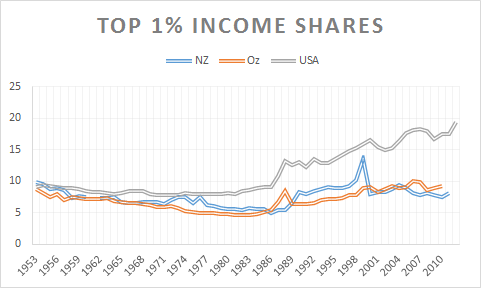
Source: The World Top Incomes Database.
Not only have the New Zealand top 1% been pretty miserable at increasing their share of incomes, hardly any change since 1990 and not much before that, the top 1% allowed inequality in both consumption and disposable income to actually fall since 1990 as shown by Treasury analysis published today.
Joan Robinson was on to this in the 1940s when she said the battle cry of Marxists would have to change from the 1848 version “rise up ye workers, rise up for you have nothing to lose but your chains” to “rise up ye workers, rise up for you have nothing to lose but the prospect of a suburban home and a motorcar”.

Today that battle cry of the Marxist revolution would have to be “rise up ye workers rise up for you have nothing to lose but your iPhone and your air points”. As Joan Robinson observed in the 1940s, that’s not much of a basis for a revolutionary movement.
Creative destruction in electronic devices
23 Jun 2015 Leave a comment
in economic history, economics of media and culture, entrepreneurship, technological progress Tags: creative destruction, smartphone, The Great Enrichment
Innovation is letting us accomplish more with less. Learn more: buff.ly/1LmtAZD #tech #progress http://t.co/e2kQlGu3NA—
HumanProgress.org (@humanprogress) June 22, 2015
GM’s 1956 vision of a self drive car by 1976
22 Jun 2015 Leave a comment
in economic history, economics of media and culture, entrepreneurship, industrial organisation, survivor principle, transport economics Tags: creative destruction, self drive cars
The entrepreneurial alertness of the Apollo 11 astronauts
22 Jun 2015 Leave a comment
in economic history, economics of media and culture, entrepreneurship, health and safety, labour economics, labour supply, occupational choice Tags: adverse selection, Apollo 11, economics of insurance, entrepreneurial alertness, moon landings, space
Biggest box office successes by profit ratio
21 Jun 2015 Leave a comment
in economics of media and culture, entrepreneurship, industrial organisation, movies, survivor principle Tags: entrepreneurial alertness, markets selection, The meaning of competition
Paranormal Activity earned 3,592x its budget in domestic ticket sales alone. #dataviz
Source: randalolson.com/2014/12/29/the… http://t.co/i6RALzOChI—
Randy Olson (@randal_olson) December 30, 2014
How much are the top speakers paid?
21 Jun 2015 Leave a comment
in economics of media and culture, entrepreneurship, human capital, labour economics, labour supply Tags: entrepreneurial alertness, superstar wages, superstars, top 1%
Speaking engagements very lucrative secondary career for public figures
statista.com/chart/3525/was… http://t.co/YNuQb51Ekk—
Statista (@StatistaCharts) June 04, 2015
Eugene Fama on what is a bubble
19 Jun 2015 Leave a comment
in economic history, economics of media and culture, entrepreneurship, financial economics Tags: asset price bubbles, dot.com bubble, entrepreneurial alertness, Eugene Fama

Peter Garber on what is an asset price bubble
18 Jun 2015 Leave a comment
in entrepreneurship, financial economics, macroeconomics Tags: asset price bubbles, entrepreneurial alertness, The fatal conceit

Every 20 years we worry about losing jobs to technology
17 Jun 2015 Leave a comment
in economics of education, entrepreneurship, human capital, industrial organisation, labour economics, labour supply, occupational choice, Public Choice, rentseeking, survivor principle Tags: antimarket bias, creative distraction, expressive voting, make-work bias, rational ignorance, rational irrationality, technological unemployment
Every 20 years we worry about losing jobs to tech. books.google.com/ngrams/graph?c… http://t.co/KW47Iwzsp9—
James Bessen (@JamesBessen) August 10, 2014
Creative destruction in legacy media revenues
16 Jun 2015 Leave a comment
in economics of media and culture, entrepreneurship, industrial organisation, survivor principle Tags: creative destruction, economics of advertising, entrepreneurial alertness, legacy media, market selection
The media needs a new formula for paying for news gathering, says @bradwarthen: brook.gs/1JlfWUT http://t.co/QDGti24x1f—
Brookings (@BrookingsInst) May 15, 2015
The Value of Steve Jobs
15 Jun 2015 Leave a comment
in entrepreneurship, industrial organisation, managerial economics Tags: CEO pay, superstar wages, superstars, top 1%

| Peter Klein |
As you have likely heard, Steve Jobs is taking an indeterminate leave of absence from Apple to deal with his continuing health problems. How will this affect Apple? How important is one person — albeit the founder and CEO — to a diversified multinational company with tens of thousands of employees? Apple’s stock slipped slightly on the news of Jobs’ leave (down 2.3 percent today, the first trading day after the announcement), but Jobs’s health problems are well known and Apple’s stock price presumably already included a discount reflecting the possibility he’d step down. To estimate the value of a particular employee to the firm in this way, we need an unanticipated departure, one that isn’t a response to poor performance and isn’t expected in advance.
Sure, enough, there’s an app for that — I mean, there’s a literature on that. An influential 1985 paper by Bruce Johnson, Robert Magee, Nandu…
View original post 429 more words
Is Uber taking British customers for a ride?
14 Jun 2015 Leave a comment
in economics of regulation, entrepreneurship, industrial organisation, survivor principle Tags: creative destruction, taxi regulation, Uber
Is Uber taking British customers for a ride? i100.io/40kqOqH http://t.co/ok7UJmmgNQ—
i100 (@thei100) June 11, 2015

 Utopia, you are standing in it!
Recent Comments