https://twitter.com/BjornLomborg/status/593445076321312769/photo/1
@oxfamgb @GreenpeaceUSA Cooking is now one of the biggest causes for outdoor air pollution
28 Oct 2015 Leave a comment
in applied welfare economics, development economics, energy economics, environmental economics, growth disasters, growth miracles Tags: air pollution, energy poverty, indoor air pollution
The Great Escape and #vegetarianism
25 Oct 2015 Leave a comment
in development economics, economic history, environmental economics, growth miracles, health economics, Public Choice, rentseeking Tags: expressive politics, The Great Enrichment, The Great Escape, The Great Fact, vegetarianism
The Economics of Red State vs. Blue State Carbon Politics
25 Oct 2015 Leave a comment
in applied price theory, climate change, constitutional political economy, economics of climate change, economics of media and culture, economics of regulation, energy economics, environmental economics, environmentalism, politics - Australia, politics - New Zealand, politics - USA, Public Choice, transport economics, urban economics
1. My JPAM 2000 paper documents that suburbanites drive more and consume more electricity than urban residents.
2. My 2011 JUE paper documents that center city liberal resident NIMBY zoning regulation has deflected more development to the suburbs where people live a high carbon life (see paper #1 above) and then oppose carbon pricing.
3. My co-authored 2013 JPUBE paper documents that energy intensive manufacturing industries seek out cheap electricity price areas. Whether U.S carbon pricing and the resulting higher electricity prices would nudge them to move oversees remains an open question.
4. My co-authored 2012 EER paper documents that more educated people are more likely to have installed solar panels and to go off the grid and thus not pay higher electricity prices.
5. My 2013 EI paper documents that Congress Representatives oppose carbon mitigation regulation when they are conservative, their district is poorer and their district is high carbon. Nancy Pelosi and Tom Steyer are in liberal, rich, low carbon San Francisco. There, it is easy to comply with carbon regulation. They will pay few new costs for such low carbon regulation.
6. My co-authored 2015 JAERE paper documents that even in California and within counties that suburbanites vote against low carbon regulation relative to center city residents. Since we control for the fact that liberals live in center cities, this 3rd variable does not explain the urban form/voting correlation.
7. In my co-authored 2015 JUE paper we document that U.S protectionism through the Buy America Act has hindered the improvement of our bus fleet as a green technology.
Source: Environmental and Urban Economics: The Economics of Red State vs. Blue State Carbon Politics
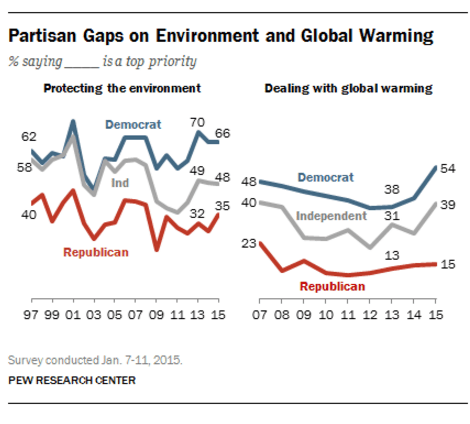
@CarlyFiorina says it all on action to fight global warming @jamespeshaw @AndrewLittleMP @garethmorgannz
24 Oct 2015 Leave a comment
in applied price theory, comparative institutional analysis, energy economics, environmental economics, global warming, Public Choice, rentseeking Tags: 2016 presidential election, climate alarmists, expressive voting, free riding, game theory, global warming, international public goods, rational ignorance, rational irrationality
The irony of environmental protests
24 Oct 2015 Leave a comment
in environmental economics, environmentalism Tags: activists, do gooders, green hypocrisy, Left-wing hypocrisy
@oxfamnz @GreenpeaceNZ Further evidence of mass kidnappings of principled environmentalists – indoor pollution version
23 Oct 2015 Leave a comment
in applied price theory, applied welfare economics, development economics, economics of regulation, environmental economics, health economics Tags: expressive voting, indoor air pollution
4.3 million die every year. Indoor air pollution is the least reported problem of the world. bit.ly/1BfMiZg https://t.co/yZRcl9vWoa—
Max Roser (@MaxCRoser) October 22, 2015

The deadliest environmental problem today is indoor air pollution — killing 4 million a year. vox.com/2014/9/15/6150…http://t.co/xtwLRfkVF2—
Vox Maps (@VoxMaps) June 11, 2015
@RusselNorman tried to outthink, outsmart @JohnKey unlike @nzlabour who just tried to smear him
22 Oct 2015 Leave a comment
in environmental economics, Marxist economics, politics - New Zealand, Public Choice, rentseeking Tags: Leftover Left, New Zealand Greens, New Zealand Labour Party, rational ignorance, rational rationality, Russel Norman, Twitter left
Five characteristics of science denial
21 Oct 2015 Leave a comment
in economics of regulation, environmental economics, health economics Tags: Anti-Science left, climate alarmists, conjecture and reputation, cranks, philosophy of science, Quacks
@GreenpeaceNZ @jamespeshaw The Futility and Farce of Global Climate Negotiations @RichardTol
18 Oct 2015 Leave a comment
in constitutional political economy, development economics, economics of bureaucracy, environmental economics, environmentalism, global warming, growth disasters, growth miracles, international economics, politics - Australia, politics - New Zealand, politics - USA, Public Choice, rentseeking Tags: bootleggers and baptists, climate alarmism, expressive voting, free-riders, global warming, green tariffs, international public goods, Leftover Left, New Zealand Greens, Twitter left
It is time for the environmental movement to face up to the fact that there never will be an international treaty to restrain carbon emissions. The practical way to respond to global warming is healthier is wealthier, richer is safer. Faster economic growth creates more resources for resilience and adaptation to a changing environment.
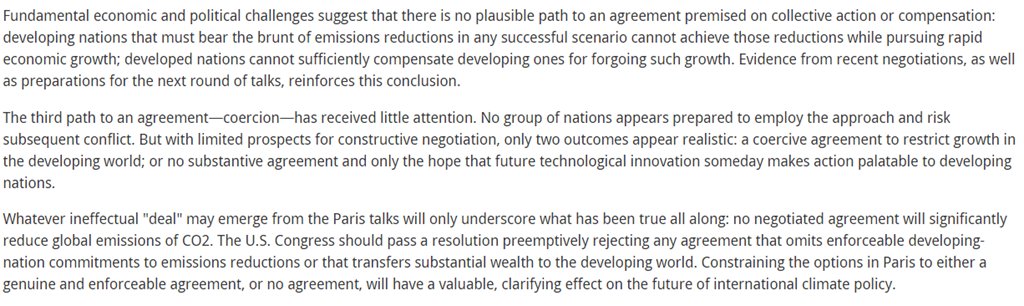
NEW REPORT: The Futility and Farce of Global Climate Negotiations bit.ly/1LvFFv3 http://t.co/TwbFUwaPlm—
Manhattan Institute (@ManhattanInst) October 17, 2015
India's target compared to its recent history http://t.co/pIvwhoSTpL—
Richard Tol (@RichardTol) October 02, 2015
What is the current rate of species extinction?
14 Oct 2015 Leave a comment
in environmental economics, environmentalism Tags: dangers species, doomsday profits, species extinction
Is the North Pole ice free as @algore predicted to happen by now
14 Oct 2015 Leave a comment
in environmental economics, environmentalism, global warming Tags: Al Gore, climate alarmism
Leaked letter shows how @Oxfam @sierraclub lobbied to block cheap energy for poor nations @GreenpeaceNZ @oxfamnz
12 Oct 2015 Leave a comment
in development economics, energy economics, entrepreneurship, environmental economics, environmentalism, growth disasters, growth miracles Tags: energy poverty, expressive voting, global poverty, green rent seeking, Leftover Left, Oxfam, rational ignorance, rational irrationality, stream poverty, The Great Escape
https://twitter.com/MichaelBTI/status/651503672002785281
Outrageous & Orwellian for @Oxfam to lobby to deny cheap energy to poorest people in world. #ElectrifyAfrica http://t.co/b2P09Gn7rP—
Mike Shellenberger (@MichaelBTI) October 06, 2015
Oxfam world HQ looks like such a pleasant place to work. Grid electricity. Effective security. Ample parking. http://t.co/lsxTf2DN6b—
Mike Shellenberger (@MichaelBTI) October 06, 2015
Here's @Oxfam's luxury office building in UK. Were its steel & glass components constructed with solar panels? http://t.co/642mm2zB4B—
Mike Shellenberger (@MichaelBTI) October 06, 2015
https://twitter.com/MichaelBTI/status/651458416569909248
https://twitter.com/VoxMaps/status/608411758022291456/photo/1?ref_src=twsrc%5Etfw
Radiation in Perspective
11 Oct 2015 Leave a comment
in environmental economics, health economics Tags: environmental scares, Green alarmism, risk risk trade-offs
Radiation in Perspective. http://t.co/iuUQboD3un—
Max Roser (@MaxCRoser) June 24, 2015
Will Auckland become like San Francisco?
10 Oct 2015 1 Comment
in economic history, economics of regulation, environmental economics, politics - New Zealand, politics - USA, urban economics Tags: Auckland, housing affordability, land supply, land use planning, RMA, San Francisco, zoning
https://twitter.com/JoshZumbrun/status/652517712070082561/photo/1
"Your neighborhood could be next." San Francisco-wide mailer in support of Prop I, the Mission housing moratorium. http://t.co/PtN38JTaUM—
Jed Kolko (@JedKolko) October 10, 2015
@sival84 @MarketUrbanism @SFyimby More for thought: Permits vs prices for top ten tech hubs trulia.com/blog/trends/pr… http://t.co/yRvjVWDova—
Ralph B. McLaughlin (@housingnomix) October 01, 2015
 Utopia, you are standing in it!
Recent Comments