Climate alarmism and the low cost of the green economy
06 Dec 2014 Leave a comment
in environmental economics, global warming, Marxist economics Tags: climate alarmism, green rent seeking, low carbon economy, Robert Murphy
On the beneficial effects of climate change
05 Dec 2014 Leave a comment
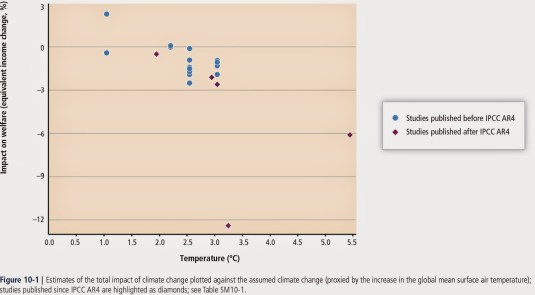
The above figure is as it appears in the final, published version of Chapter 10 of the Contribution of Working Group II to the Fifth Assessment Report of the Intergovernmental Panel on Climate Change.
via Richard Tol.
Environmental Law 101 | Richard Epstein
05 Dec 2014 Leave a comment
in environmental economics, law and economics, liberalism, property rights, Richard Epstein Tags: environmental law, law of nuisance, Richard Epstein, tort law

Back in 1999, Richard Epstein wrote a great summary of what should be environmental law from an old common law perspective, from a classical liberal perspective, and a pragmatic economic libertarian perspective:
Stated bluntly, nothing in the theory of property rights says that my property is sacred while everybody else’s property is profane. That single constraint of parity among owners should lead every owner to think hard…
This recognition of the noxious uses of private property is the source of the common law of nuisance.
That law dates from medieval times, certainly by 1215, at the time of the Magna Carta. It is no new socialist or environmentalist creation for the twentieth century.
When the common law of nuisance restricts the noxious use of property, it benefits not only immediate neighbours but the larger community. If I enjoin pollution created by my neighbour, others will share in the reduction of pollution.
Simply by using private actions, we have built a system for environmental protection that goes a long way toward stopping the worst forms of pollution.
Epstein does not stop there. He recognises as he should that the common law of nuisance is not enough to stop all problems of pollution:
Yet before we leap for joy, we must recognize that private actions are not universally effective in curbing nuisances.
Sometimes pollution is widely diffused—waste can come from many tailpipes, not just one—so that no one can tell exactly whose pollution is causing what damage to which individuals.
Under those circumstances, private enforcement of nuisance law can no longer control pollution…
We do not change the substantive standards of right and wrong, but we do use state regulation to fill in the gaps in private enforcement.
 Epstein then makes a plea for private covenants to deal with a great deal of the social frictions that arise in the suburbs:
But often when individuals worry about their local environments, they’re not particularly happy to treat the nuisance law, however enforced, as the upper bound of their personal protection.
They want (especially as their wealth increases) more by way of aesthetics and open spaces. Fortunately, our legal system has a way to accommodate these newer demands.
One of our most important land-use control devices is the system of covenants by which all the holders of neighbouring lands agree among themselves and for their successors in title
Covenants might work in Greenfields developments in modern cities. But they really doesn’t work in managing land use conflicts in the inner city where regulation is been used to substitute the covenants for many decades.
Epstein’s ideal for modern environmental law is:
In sum, the system of public and private enforcement of nuisances and public and private purchases of environmentally sensitive sites is the way that sound environmental policy should proceed.
We’ve got 5 years (now 1 hour left) to save world says Australia’s chief scientist Professor Penny Sackett, 4th December 2009 | Herald Sun
04 Dec 2014 Leave a comment

The U.S. has built its first new oil refinery in 40 years
04 Dec 2014 Leave a comment
in economics of regulation, energy economics, environmental economics, resource economics Tags: green rent seeking, NIMBYs
M.A. Adelman on natural resource exhaustion
04 Dec 2014 1 Comment
in energy economics, entrepreneurship, environmental economics, resource economics Tags: entrepreneurship, M. A. Adelman, resource economics

On the unsustainability of wind power – noise pollution edition
03 Dec 2014 Leave a comment
in energy economics, environmental economics, global warming, law and economics Tags: noise pollution, wind power

Three days to save the world from climate change, if Australia’s chief scientist is to believed?!
01 Dec 2014 Leave a comment
in environmental economics, global warming, politics - Australia Tags: climate alarmism, global warming, green rent seeking
A Revealing Cartoon |Ideas
30 Nov 2014 Leave a comment
in economics of information, economics of media and culture, environmental economics, global warming Tags: climate alarmism, economics of advertising, global warming

But it apparently does not occur to them that, for someone not persuaded of their policies, the same argument applies to them, that, from the standpoint of the people they want to convince, the cartoon is a reason to be more skeptical of their views, not less.
via Ideas.

Too Many Battery Factories, Too Few Electric Cars | MIT Technology Review
29 Nov 2014 Leave a comment
in energy economics, environmental economics Tags: electric cars, expressive voting


Treat scientific advice on global warming like advice from your doctor
28 Nov 2014 Leave a comment
in applied price theory, applied welfare economics, environmental economics, global warming Tags: climate alarmism, cost benefit analysis, evidence-based policy, global warming

1. Physicians may not agree on the medical condition causing the symptoms the patient presents.
2. Even if physicians agree on their diagnoses, they often do not agree on the efficacy of alternative responses — for example, surgery or medical management for lower-back pain.
3. The reason patients seek advice and treatment is that they expect physicians to have vastly superior knowledge about the proper diagnosis and efficacy of treatment.
4. Medicine proceeds on the basis of double blind trials and other small field experiments. Control and treatment groups are used before any treatment is applied widely.
5. Medicine is not perfect as was the case with the misdiagnosis of the causes of stomach ulcers.
6. The lag between cause and effect are short as would be the case if you rejected emergency treatment after a car accident or cancer treatment.
7. Medicine tests the efficacy of invasive treatments, weighs side-effects and encourages adaptation and prevention.
8. The staying power of self-interest in medicine is well-known: much higher rates of surgery when there is fee for service and much lower rates of surgery if the patient is a doctor or his partner. The efforts of the medical profession to suppress competition is well-known.

A Mini adventure: London to Edinburgh in an electric car
28 Nov 2014 2 Comments
in energy economics, environmental economics, global warming Tags: climate alarmism, electric cars, expressive voting, global warming

The intrepid adventurer from the BBC drove the 778 kilometers from London to Edinburgh in an electric Mini, and had to stop eight times to recharge – often waiting six hours or more.
In total, he spent 80 hours waiting or driving, averaging just ten kilometers per hour – an unenviable pace even before the advent of the steam engine.
via BBC News – Mini adventure: how far can an electric car go?.


Recent Comments